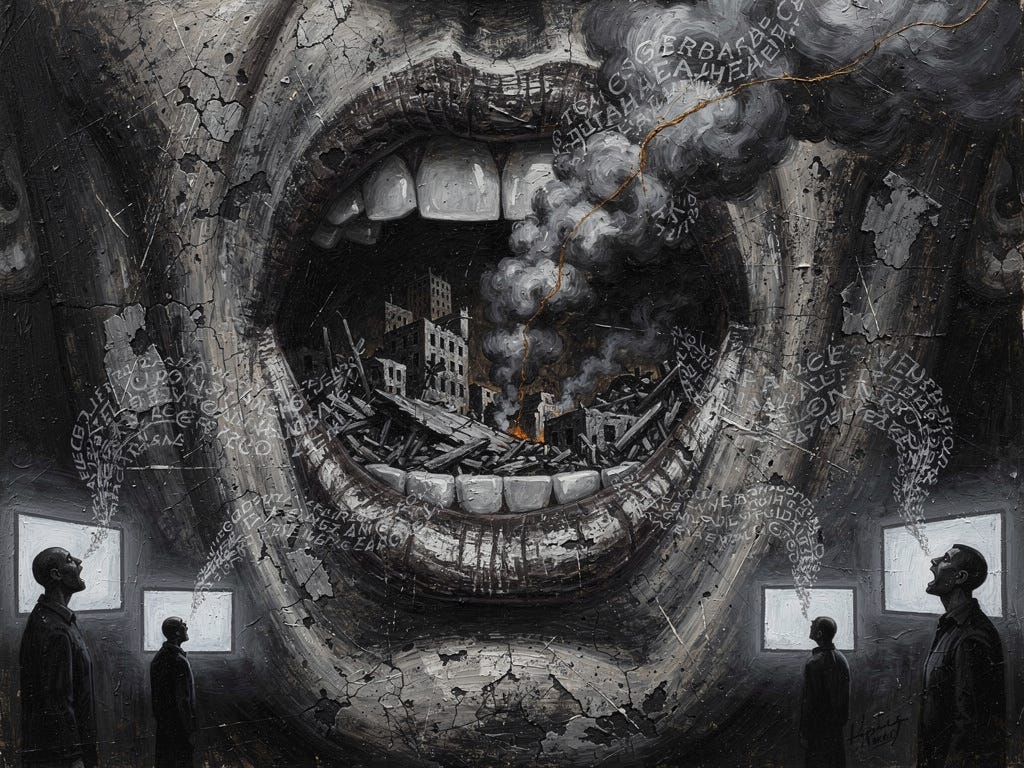
I am an author. I am writing into a moment when people are watching – often on the same small screen they use for gossip and distraction – the systematic devastation of an entire population. Buildings imploding in clouds of dust. Children emaciated by siege. Politicians standing in front of flags, explaining why this is unfortunate but necessary. Others, just as theatrical, declaring this proves the enemy is evil in its essence.
In these moments speech doesn’t sit at the edge of events as commentary. It becomes part of the event. Every description is already a decision: which reality to highlight, which suffering to render vivid, which actors to flatten into caricature so that we don’t have to sit with the discomfort of their complexity.
This morning I read a piece on social media about the “sheer evil” of a nation. The gentle rebuttal from a comment that followed was clearly meant as a small act of resistance:
“Israeli officials and the military have a documented pattern of making false or misleading claims, and significant parts of Israeli public opinion have supported extremely harsh and dehumanising policies toward Palestinians. But it is not accurate to collapse that into saying “the vast majority” of Israelis are a “death cult” or that the entire society is irredeemable.”
I suspect the author of that comment was not attempting to soften what’s happening in Gaza but endeavouring to keep the language from joining the killing. Because when a state decides to starve a population, it does so after a long apprenticeship in linguistic brutality. Long before the food is cut off, words have been quietly modified. A child becomes “a demographic threat”. A city block is “a target-rich environment”. A mother wailing beside a body is “Hamas propaganda”. Once those terms are in common use, the rest is logistics.
Outrage at this process is sane. Necessary, even. But outrage by itself is a poor guide to speech. Under its influence, we answer one simplification with another. They call Palestinians “human animals”; we call Israelis a “murderous death cult” – matching the dehumanising logic even as we believe ourselves to be resisting it. They insist their violence is self-defence; we insist theirs is uniquely evil in a world where every empire has left its mark on the ground. They erase their internal dissenters; we erase them too, so that our story stays clean.
The context, then, is not just “the Israel–Palestine conflict”. It’s the much larger civilisational habit of speaking as if peoples come in moral blocs: righteous victims here, irredeemable barbarians there. That habit has justified atrocities on every continent and throughout history. It is how colonisers described the colonised and how majorities describe despised minorities when something inside them has already decided that those people are in the way.
We are now surrounded by a media ecology that rewards exactly this kind of speech. Algorithms amplify the most extreme formulations because they travel further and stick more easily. Any kind of nuance – the discipline of keeping multiple truths in play at once – is drowned beneath competing absolutes. It becomes increasingly difficult to say, for example, “Yes, this is a war crime” and, in the same breath, “No, that does not make every citizen of the perpetrating state a monster in perpetuity.” Any statement that doesn’t choose a side with maximal ferocity is condemned by both.
This is why accuracy matters in the middle of atrocity. Not as a pedantic fussing over footnotes, but as a survival practice for our own humanity. To say “this brigade did that; this minister authorised it; this policy had these foreseeable consequences” is harder work than declaring an entire nation diseased. It’s also the only kind of speech that can form the basis for genuine accountability rather than revenge.
There’s a further layer of context that rarely gets mentioned. Most of us, most of the time, are bystanders. We are not dropping the bombs or digging the graves. We are watching, reposting, commenting in threads, and arguing with relatives over dinner. It is comforting to tell ourselves that if we shout loudly enough, and with sufficient moral fury, we have absolved ourselves of complicity. But if what we shout is sloppy, if we abandon truth for the adrenaline of denunciation, we’re not standing outside the system. In truth we’re feeding it.
The people ordering the next airstrike need the world to polarise into camps. They need criticism to become indiscriminate, because indiscriminate criticism is easy to dismiss. They need Jews and Israelis who are uneasy about what is being done in their name to feel hated regardless – to conclude that nothing they say or do will make any difference to how they are seen. Blanket language is a gift to them.
So when, as a writer, I insist on precision, I am not asking anyone to look away. I am asking them to look more closely.
Look closely enough, and you see an Israeli teenager who will soon be conscripted, half indoctrinated and half terrified, posting patriotic memes because the alternative would mean confronting the possibility that his uniform will make him complicit in something his grandchildren will whisper about. You see a Palestinian mother quietly telling her son not to join the armed wing, knowing that refusal itself may be fatal. You see officials in foreign capitals speaking the language of “stability” while calculating arms contracts and election cycles. None of these people fit cleanly into the categories our slogans offer. Yet without them, there is no story – and no path, however faint, to anything better.
This doesn’t cancel responsibility. On the contrary. Once we admit that ordinary people, with recognisable fears and loves, can lend their weight to monstrous systems, responsibility becomes harder to dodge. The “death cult” narrative lets too many of us off the hook. If the problem lives in that cursed population over there, then we, over here, are pure. We can keep our hands reasonably clean by choosing the right hashtags.
The more disturbing possibility is this: what we’re watching in one corner of the world is an acute symptom of a much wider disorder – a planetary civilisation whose dominant arrangements have normalised extraction, hierarchy, and disposable lives. Under that diagnosis, what’s happening is not a unique aberration produced by uniquely aberrant people. The same underlying machinery produces different local tragedies, with the roles of perpetrator and victim distributed by history and geography rather than by innate character. Which means that the work of resistance is not simply to stop this particular killing — it is to understand the conditions that keep generating killings and to refuse to reproduce those conditions in the very language we use to protest them. That doesn’t dissolve individual or collective accountability. It makes it harder to localise, and therefore harder to evade.
That is the context. A world in which our language either helps to unmask that machinery or becomes another layer of camouflage over it.
We can’t permit ourselves the luxury of silence in the face of atrocity. But neither can we indulge in language that dehumanises whole populations because it feels cathartic. The discipline is to name crimes as crimes, lies as lies, patterns as patterns – and to stop just short of the point where the people inside those patterns are stripped of their humanity and written off as irredeemable. Once we cross that line, we are no longer witnesses. We’re just apprentices in the same craft we thought we were condemning.
What we choose to say in these moments will outlast the immediate crisis. Language accumulates. The habits we form under the pressure of atrocity don’t dissolve when the cameras move on — they migrate, looking for the next application. “Never again” has always been a promise about speech as much as about arms. We should probably take it more seriously as one.