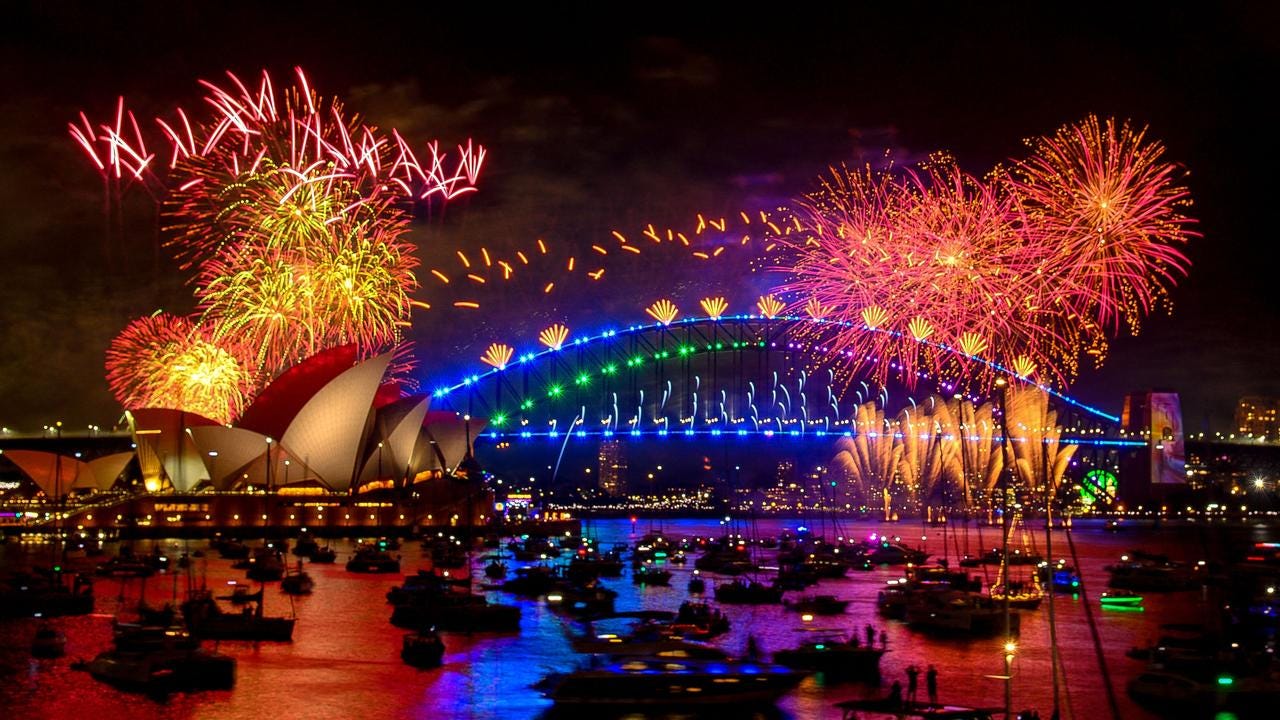
Nothing says “Happy New Year” in late‑industrial Australia quite like a jittery constable in body armour, cradling a military‑grade weapon, scanning families for “threat profiles” as they wait for the fireworks to explode over Sydney Harbour.
We are told this is for our safety. We’re assured there is “no specific threat.” We are invited to feel gratitude for the optics of war on a night supposedly dedicated to peace and renewal. And we are instructed, by an increasingly paternalistic political class, not to expect an apology.
What fascinates me is not the predictable theatre of “security”, but the deeper story such theatre reveals about who we’re becoming, what we’re normalising, and which futures we’re quietly discarding without anything resembling genuine debate.
The spectacle of fear
Highly armed police on city streets are not a neutral precaution in any city. In Sydney they are a performance. Criminologists and sociologists across several countries have spent decades documenting how late‑modern states try to manage anxiety by staging rituals of control – from high‑visibility patrols to “rings of steel” around public gatherings. Legal scholars examining counter‑terrorism policy in liberal democracies have suggested that “security” now functions almost like a secular promise of salvation: an ever‑receding horizon that demands perpetual sacrifice, never quite attainable, yet forever invoked.
Whether one accepts the more elaborate versions of these critiques or not, one stubborn question remains: what work is being done, symbolically and psychologically, when a democracy floods its public squares with weaponry more suited to Fallujah than to Circular Quay? Several intersecting patterns are worth tracing.
First, there is the conversion of amorphous unease into something visible, fundable, and televisual. Terrorism, random violence, “social disorder” – these are slippery categories. But line up officers with assault‑style rifles in front of the Opera House and the state’s response becomes photogenic. The message is clear enough: you are afraid; we are armed; therefore, you are safe. The circular logic hardly matters. It looks decisive on the evening news.
Second, there’s the gradual recasting of public space as a conditional privilege. Once the streets belong, psychically, to the gun – once presence in a crowd carries the tacit warning that lethal force can be deployed in seconds – something fundamental shifts. We are no longer simply citizens gathering. We become potential nuisances being managed.
Third, there is habituation. Emergency measures, repeated often enough, lose their exceptional quality. If militarised policing on New Year’s Eve is framed as “common sense”, why not at major sporting events? Why not at protests? Why not at any gathering that might embarrass a government, unsettle investors, or interrupt the smooth circulation of capital?
Fourth, the burdens are wildly uneven. For many white, middle‑class Australians, a phalanx of police is a mild inconvenience, perhaps even a source of reassurance. For others – particularly First Nations people, African and Middle Eastern diaspora communities, Pacific Islanders, anyone already intimate with over‑policing – such displays are anything but comforting. They are directly threatening. They are a reminder that they exist in this country on terms they did not set, under a gaze they did not invite.
These patterns are not uniquely Australian. They are part of a global choreography refined in cities as diverse as London, Rio, Lagos and New York. The choreography serves an economic worldview that treats anxiety as a resource to be harvested: fear in, compliance out.
Safety as a pretext for power
A recurring feature of industrial economism – the global, extraction‑driven dogma masquerading as common sense – is its gift for conflating care with control. We see it in “public health” campaigns that can slide into opportunities for surveillance. We see it in “border protection” policies that harden into indefinite detention for those with the wrong documents or skin tone. And we see it when “community safety” is used to justify armoured vehicles, stun grenades, predictive policing algorithms, and now machine guns on city streets.
Is there an empirically robust basis for believing that the visible deployment of such weapons in peaceful cities prevents attacks? Studies from the United States examining the militarisation of police forces – particularly the transfer of surplus military equipment to local departments – have found links with increased civilian casualties and more violent encounters. The evidence that such militarisation reduces crime or terrorism is, at best, disputed among criminologists and human rights organisations. If this research is incomplete or contested, would it not be prudent to exercise caution rather than enthusiasm?
If the preventative value is uncertain, the symbolic value is glaring. Machine guns are not instruments of conversation. They do not de‑escalate. They do not soothe. They send one message: should anything “unexpected” occur, the default answer will be overwhelming violence.
In any democracy worthy of the label, lethal force is supposed to be a reluctant last resort, wielded by citizens in uniform, under clear legal constraints, on behalf of other citizens. When that relationship is inverted – when the state reveals itself primarily as an armed presence patrolling “its” population – the social contract begins to resemble something far closer to a contract of intimidation.
The immediate danger is that mistakes will happen. The deeper danger is that we forget what a different arrangement ever felt like.
Imported fears, imported scripts
There is another layer to this story that Australia, like much of the West, is studiously sidestepping: the way domestic security theatre is now narrated through the prism of Israel–Palestine. In the wake of Hamas’s 7th October 2023 attack and Israel’s devastating response in Gaza, any attempt across Western societies to question Israeli policy, or even to recite casualty figures from reputable international agencies, has routinely been met with a fierce chorus of outrage from prominent Zionist organisations and their political allies. Some of these groups appear to frame almost any criticism of Israeli conduct as an existential threat to Jewish life.
We have seen peaceful pro‑Palestinian marches described by certain commentators as proto‑pogroms. Student encampments in Europe, North America and Australia have been painted as breeding grounds of terrorism. A slogan on a placard carried by a pensioner in London is treated as more dangerous than an artillery shell landing in a densely populated neighbourhood. Is that an accurate reading of reality, or a deliberate amplification of fear?
What tends to follow, almost automatically, is the insistence that Jewish life in the diaspora – including Australia – is so precarious that only a sharply more aggressive security posture can guarantee safety. Heavier policing of demonstrations. Expanded surveillance of “extremism”. Ever‑broader definitions of “incitement” or “hate”. And, woven into that atmosphere, heavily armed officers at public events, implicitly cast as guardians against the supposedly ever‑present mob.
Antisemitism is real. Its historical record is horrifying, and contemporary incidents in many countries – from attacks on synagogues to vile online campaigns – are thoroughly documented. The question is not whether Jewish communities have grounds for vigilance. They absolutely do. The question is whether that reality automatically validates a permanent state of emergency, or the moral outsourcing of Australian policing priorities to those Zionist lobbyists who are most inclined to see any dissent on Israel–Palestine as a prelude to 1930s Europe.
In both the US and the UK, for example, civil liberties lawyers and legal scholars have raised the alarm about the way some institutional definitions of antisemitism have been stretched, under intense lobbying, to include standard criticisms of Israeli state policy and references to Palestinian experiences. Are we seeing a similar drift in Australia when political leaders describe mass demonstrations – overwhelmingly peaceful and diverse – as tantamount to hate marches?
Australia’s political class, like its counterparts elsewhere, appears increasingly willing to echo talking points that treat anger at mass civilian casualties in Gaza as, in itself, a species of extremism. Once that framing is in place, the logic is simple: more guns, more surveillance, more bans on protest, all framed as essential to “Jewish safety”.
There’s another, quietly inconvenient, possibility. What if genuine Jewish safety, Muslim safety, Palestinian safety, and the safety of every other minority in this country are not competing commodities to be rationed by a skittish state, but manifestations of a deeper principle: nobody is secure in a society that normalises treating entire groups as enemies‑in‑waiting? Zionist outrage, when permitted to dictate the weather of public conversation, places Jewish communities themselves in an impossible position. They are used as moral human shields for an expanding security state whose tools, in practice, fall most heavily on the usual suspects: young men of colour, refugees, First Nations activists, those whose mere presence triggers the algorithm of suspicion. The young African‑Australian pulled over for “driving while brown” on the Hume Highway does not experience New Year’s Eve machine guns as guardians of minority rights. He experiences them as an extension of the same apparatus that already marks his body as a problem.
From citizen to suspect
Australia is an instructive case because of its peculiar founding stories. On one side, Australians delight in picturing themselves as irreverent larrikins, informal, allergic to pomposity. On the other lies a history born of a penal colony, extended through violent dispossession, administered through centralised bureaucracy, and hardened over the past two decades by an increasingly baroque security apparatus.
When police ram a car, drag unarmed young people from the vehicle, and then charge them with barely disguised non‑offences such as “driving to Sydney for a holiday” or the unofficial crime known in many communities as “driving while brown”, we glimpse a collision between mythology and practice. The easygoing, “no worries” self‑image coexists with tactics recognisable from far less self‑congratulatory regimes.
Studies in multiple jurisdictions – from Canada and the UK to South Africa and Brazil – highlight the same pattern: once certain bodies are coded as risky (Black, brown, Indigenous, migrant, visibly Muslim, visibly poor), the threshold for suspicion drops and the justifications for force expand. Is there any credible reason to believe Australia has escaped this dynamic, given the testimonies from Aboriginal communities, African‑Australian youth, and Muslim Australians over many years?
In that context, machine guns don’t just float in abstraction. They sit in a dense cultural script that already decides who looks “out of place”, who fits the narrative of threat, who can be stopped, questioned, or worse, in the name of everyone else’s peace of mind. Children who grow up seeing armed police as a normal fixture of city life are being inducted into a worldview in which conflict is handled primarily through domination, surveillance, and coercion. That does not stay confined to policing. It leaches into workplaces, schools, domestic life, and eventually geopolitics.
The economics of securitised life
It’s tempting to dismiss all of this as the latest round of “law and order” posturing. In fact, it’s woven into the economic operating system of our era. Neoliberal capitalism treats almost everything as a market – including fear. Fear is monetised. It sells security contracts, consultancies, cameras, biometrics, insurance, gated communities. It justifies budgets that might otherwise be politically impossible. It feeds a hyperactive media cycle that depends on the constant drama of threat.
In such a climate the aim is not to resolve anxiety, but to calibrate it. Too little fear, and the market for control mechanisms stagnates. Too much, and social order begins to crack. Somewhere in the middle lies a profitable equilibrium where citizens remain worried enough to accept more guns, more laws, more surveillance, but not so alarmed that they start asking awkward structural questions. Armed patrols in festive crowds fit neatly into that balancing act. They communicate that risk is ever‑present, that danger lurks beneath even the most ordinary pleasures. Yet they also reassure that the state is “on the job”, investing in hardware, training and readiness.
There is no need to invoke a smoky backroom conspiracy. This is a structural alignment of interests. An ecosystem of political, corporate, bureaucratic and media actors benefits, materially and symbolically, from the normalisation of securitised life. That ecosystem has scant incentive to ask whether such normalisation is spiritually sane, democratically defensible, or psychologically sustainable.
Meanwhile, other forms of safety – secure housing, functioning healthcare, ecological stability, meaningful work, and cultural belonging – receive a fraction of the imaginative energy. It is far easier, budgetarily and rhetorically, to buy more guns than to ask why so many people feel precarious, alienated or enraged in the first place.
The psychology of a besieged civilisation
Why are societies that have never been materially richer, more technologically capable or more interconnected also among the most frightened? One hypothesis is that the industrial worldview we inherited is running out of road. We have built systems designed primarily for extraction – of resources, labour, attention, data – and then feigned surprise when the resulting brittleness shows up as anxiety, polarisation and despair. In such a setting, militarised policing is not an aberration. It’s an expression of deeper confusion.
A civilisation dedicated to endless growth on a finite planet must suppress an enormous amount of unease. Rather than face its contradictions – ecological overshoot, expanding inequalities, the hollowness of its promises – it searches for scapegoats and palliatives. “Security” provides one of those palliatives: a way to externalise inner turmoil onto a rotating cast of enemies.
Terrorist, thug, hooligan, “gang member”, “youth of interest”, “radicalised individual”: the labels alter, the function remains. The theatre of control over these figures briefly disguises the more disquieting truth: our institutions have lost control over the very conditions they helped create. In that sense, a police officer with a machine gun on a Sydney street on New Year’s Eve is not simply a person doing a job. He or she is an avatar for a culture that has forgotten how to feel safe without a weapon in sight.
Democracies on a hair trigger
There’s also the small matter of physics and flesh. Weapons designed for urban warfare are not subtle instruments in crowded civilian environments. They are crude promises. Under pressure, with adrenaline surging and information fragmentary, human beings make mistakes. This is established knowledge, not an insult. Even elite soldiers in combat zones misidentify threats, fire on the wrong target, misunderstand what they are seeing. If such errors occur in settings where danger is expected, what happens in a civilian crowd where the overwhelming majority are simply trying to watch fireworks or share a picnic? In the glare of bias and split‑second judgement, who is most likely to be misread as a threat?
Police organisations insist, understandably, that training and strict protocols make tragedy unlikely. Perhaps they reduce the odds. Yet “unlikely” is not the same as impossible. And even if bullets are never fired, the constant background thrum of potential force reshapes the relationship between state and society. Fear of the state is not the bedrock on which robust democracies rest.
Imagining other kinds of safety
Critique without imagination risks becoming one more performance. What, then, might a different approach to safety look like?
In numerous cities – from parts of Scandinavia to Latin America and some African municipalities – experiments have been underway for years: unarmed mediators at public events; community‑led safety councils; youth workers and elders on the streets at night; urban design that reduces flashpoints; restorative responses to harm that foreground repair over punishment. Evaluations are mixed and context‑dependent, as one would expect. But there is enough evidence to pose a serious question: are societies that invest in relationship‑based safety less reliant on spectacle‑based control?
China complicates that picture in ways Western commentators are often reluctant to examine. Many large Chinese cities feel extraordinarily safe, clean and convivial at street level. Walk through Chengdu, Xi’an, Shanghai, Dalian, or any number of so‑called “second‑tier” cities at midnight and you will encounter children playing, elderly people dancing, food stalls doing a brisk trade, young couples glued to their phones – often with far less visible drunkenness, harassment, or random aggression than in London, Sydney, or Los Angeles.
Foreign residents and visitors, across a wide spectrum of political beliefs, routinely report precisely that: a strong sense of personal safety in public space. International crime data are imperfect and subject to under‑reporting, but recorded violent crime rates in China are generally lower than in many Western states. Global surveys of trust in local order and satisfaction with city life, including some by commercial research firms and multilateral organisations, tend to show relatively high reported contentment in Chinese cities. Even allowing for methodological caveats – fear of criticising authorities, cultural norms around complaint – is it plausible that these patterns are entirely manufactured?
How did that configuration emerge?
One strand is material and prosaic. Over the past few decades China has ploughed vast resources into the physical texture of everyday life: parks, plazas, pedestrian streets, mass transit, lighting, public exercise equipment, night markets. The ecological and human costs of such development – from demolition to displacement – are real. Yet from the narrow vantage point of someone walking home after dark, the result is an environment designed to be used, not avoided. Busy, well‑lit, walkable spaces generate their own species of safety through ceaseless, ordinary presence.
A second strand is cultural. Older generations carry living memories of communal courtyards, work units, and tight‑knit neighbourhoods. Those forms have been reshaped – often distorted – by market reforms and high‑rise living, but traces persist. Public squares fill with dancers. Mahjong tables appear on pavements. Teenagers congregate in plazas rather than retreat entirely into private cars and fortified suburbs. Social psychologists have long argued that “eyes on the street” are one of the most powerful deterrents to petty crime and random violence. Chinese cities, for all their gigantism, frequently retain that dense, casual social visibility. Safety emerges as a side effect of people actually using the commons rather than hiding from it.
A third strand is impossible to ignore: a formidable apparatus of state control. Cameras, real‑name registration, extensive patrols, a well‑resourced security bureaucracy – especially in regions such as Xinjiang and Tibet – all contribute to the sense that misbehaviour will be noticed and sanctioned. Human rights organisations and independent journalists have documented the darker sides of that apparatus: mass surveillance, arbitrary detention, harassment of dissidents, collective punishment of minorities. Any honest account of “Chinese safety” must acknowledge that some of the tranquillity enjoyed by many urban Han citizens rests on tools that are profoundly illiberal and, in some cases, brutal.
A fourth strand is psychological. For several decades many Chinese have experienced tangible improvements in income, health, housing and mobility. Polling by a number of transnational research organisations consistently finds high levels of stated trust in central government compared with many other countries. Even if those surveys are not perfectly free, is it credible to suggest that they are entirely fabricated? Or is there genuine belief, among hundreds of millions, that the bargain – constrained formal politics in exchange for stability, rising living standards, and civic order – has, thus far, been worth it?
China’s streets therefore present a paradox for Western debates. They demonstrate that one can achieve very low levels of visible street crime with far fewer guns on public display than in the Anglosphere, but with a much denser weave of digital monitoring and administrative power. They suggest that trust in the everyday environment can grow even where trust in Western‑style procedural liberalism is not the organising principle.
They also complicate any lazy claim that militarised policing is the only route to security in crowded cities. Chinese police carry weapons, of course, but you rarely see the kind of New Year’s Eve spectacle now being staged in Sydney, where officers with long guns become the centrepiece of the event. In much of urban China, control is embedded less in theatrical shows of force than in infrastructure, bureaucracy, data, and widely understood boundaries that most people instinctively avoid crossing. You may feel watched, but you don’t necessarily feel menaced by a rifle barrel at eye level.
For those of us arguing against machine guns on Australian streets, the Chinese experience is both useful and unsettling. It supports the core contention that safety in public space can be engineered through design, routine, and shared custom rather than through sporadic displays of militarised power. At the same time, it warns that if we neglect the patient work of nurturing social trust and building common infrastructure, political elites will eventually reach for the tools Beijing has refined: total visibility, predictive control, soft coercion.
Is that really a trade we are willing to make?
There’s another, still tentative, path. It would borrow China’s seriousness about the commons – the recognition that streets, parks, and trains are worth investing in because they are where life happens – without importing the machinery of total surveillance. It would borrow Scandinavia’s welfare sensibility – that material insecurity corrodes safety – without indulging the complacency that assumes gun‑toting police are a passing anomaly. It would borrow from Indigenous and other non‑Western traditions the understanding that order grows from webs of relationship and mutual obligation, not merely from edicts and cameras.
The contrast with our current mindset is clear. Gun‑centred policing is a pharmacological response to a social malaise. It may be warranted in rare acute crises. As a standing arrangement, it’s analogous to keeping an entire population on permanent high‑dose sedatives “just in case”. A more mature society would surely start elsewhere. How do we design cities that welcome rather than corral? How might schools cultivate emotional literacy in place of boredom and humiliation? What economic arrangements reduce the need for predatory opportunism? How might we protect minorities without turning whole communities into suspects?
These are not easy questions. They do, however, share one virtue. They refuse to outsource the work of safety to the barrel of a gun.
Australia as warning – and possibility
As an Australian living abroad, I watch my country with a peculiar mix of affection and disbelief. From offshore detention to automated cruelty in welfare systems, from “no‑fail” anti‑terror laws to the normalisation of ministerial discretion over rights, Australia has quietly become a laboratory for policies others then adopt.
New Year’s Eve machine guns may seem, against that backdrop, like a minor flourish. Yet they emerge from the same reflex: an administrative caste that prefers blunt instruments to complex conversation, and a populace that has been subtly coached to mistake comfort for freedom and control for care. The irony is unsettling. Australia could be inventing something else entirely: I have spoken on numerous occasions about a vision for Australia as the first genuinely “global” nation. The remaining traces of neighbourly informality, the Indigenous wisdom still alive beneath the asphalt, the country’s relative insulation from some of the planet’s worst flashpoints: all could be ingredients for a different story of safety, one not driven by industrial economism’s addiction to fear as a management tool.
Such a reinvention will not be led by premiers in search of a tough soundbite, or by lobby groups whose currency is perpetual outrage. It will not emerge from police associations eager for bigger arsenals. If it emerges at all, it will be because enough people quietly decide to stop internalising the scripts offered to them. It will grow from young people who decline to accept that they must be scanned by rifles to attend a concert. From parents unwilling to have their children’s first memory of civic space include the geometry of a gun barrel. From First Nations leaders, migrants, and long‑over‑policed communities who already understand what happens when the state’s “protection” consistently bypasses them.
And, perhaps, from inside the machine itself: officers tired of being cast as extras in a political drama; public servants who still recall that the word public points to the whole of society, not just the most anxious shareholders.
What kind of New Year?
Around the world, New Year rituals draw on an ancient archetype: a brief pause at the edge of time, an opportunity to let go of old patterns and lean, however hesitantly, into a more generous story. What story are we choosing when we mark that threshold under the gaze of semi‑automatic weapons?
One story insists that the world is irredeemably dangerous, that our fellow humans are latent threats, and that our only refuge lies in an armed state authorised to intimidate, injure, or kill on our behalf. Another whispers that while the world is unsettled, much of the danger is of our own making; that our safety is braided together; that genuine security cannot be delivered at gunpoint because it germinates in dignity, reciprocity, and the patient tending of conditions that leave violence with nowhere to root.
Only one of these stories is compatible with cities in which our grandchildren might wander through public squares and find the idea of police with machine guns at family celebrations as archaic and repulsive as public executions in the town square. Which story prevails is not fate. It is crafted, year by year, through what we accept as normal, and what, even in our exhaustion, we still find the resolve to refuse.
For my part, I would prefer a New Year in which the loudest bangs are from fireworks, not from weapons designed for battlefields. A year in which “security” is reclaimed from those who wield it as a spell, and re‑imagined as the humble, difficult, beautiful craft of caring for each other so well that war on our own citizens becomes unthinkable – on any night of the year.