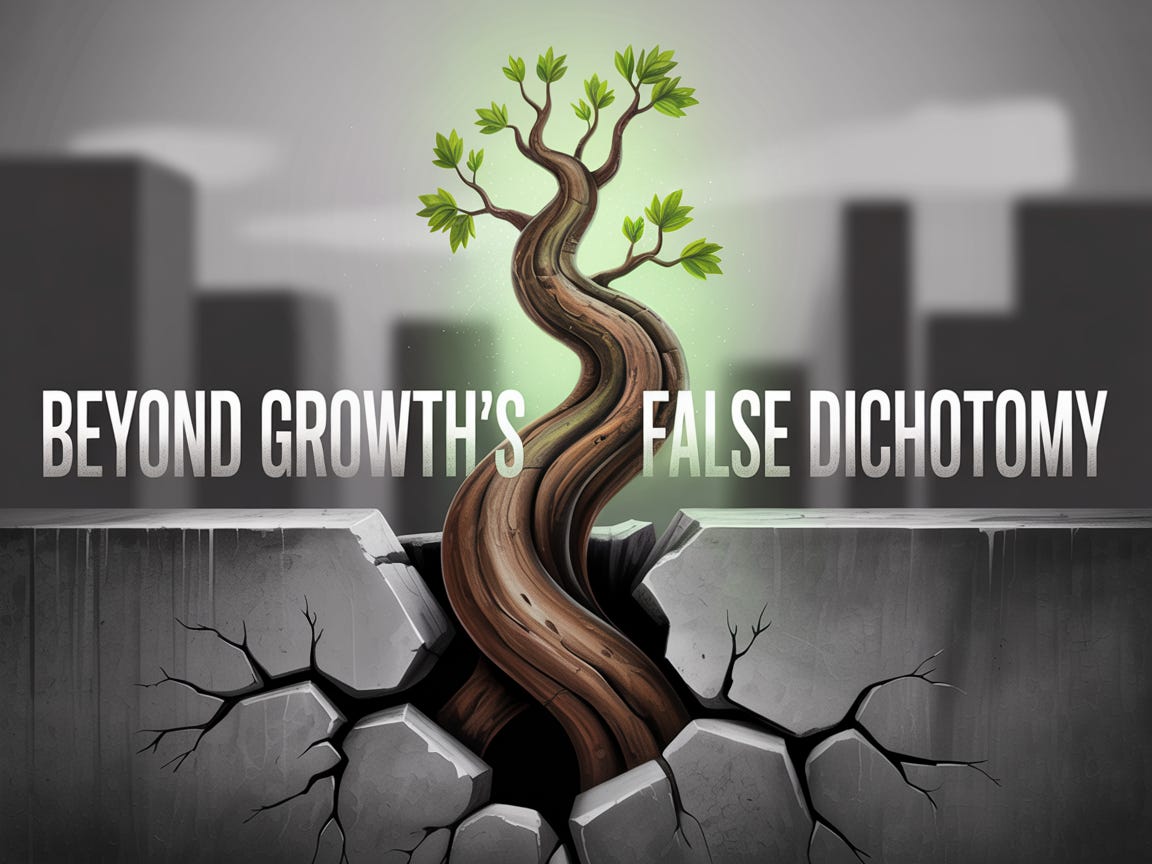
We're facing a situation where the foundations of our economic thinking demand radical reconstruction. The ritualistic incantation of "growth" as the universal solvent for all fiscal ailments—from ageing populations to crumbling infrastructure—is just a hollow neoliberal mantra, echoing down through the corridors of power even as the evidence mounts that this singular obsession (with its ever-present accomplice, competition) is driving us toward collapse. Yet the wholesale rejection of growth represents an equally dangerous fundamentalism, one that ignores the arithmetic of existing institutional arrangements while offering little more than moral posturing.
The contemporary predicament requires us to move beyond the sterile binary of growth versus degrowth and embrace what I refer to as "scaffolding economics". This is the recognition that growth, at least in our current institutional matrix, must function not as scripture to be worshipped or to be burnt but as temporary structural support to be strategically deployed while we reconfigure the foundations of prosperity.
Our options are constrained. The demographic architecture of the twentieth century – those pay-as-you-go pension systems and health care compacts – assumes an ever-expanding source of workers supporting retirees. When fertility rates plummet and longevity soars, the mathematics become brutally unforgiving. This is our reality. Only sustained productive growth can prevent these intergenerational contracts from dissolving into benefit cuts that would devastate the elderly or tax burdens that would crush the young. The mathematics of public finance require tomorrow's economy to be able to outrun today's promises. Without growth, the choice narrows to austerity or default – both politically toxic and economically destructive.
The politics of redistribution depend on expansion; when growth stalls, generosity calcifies into competition. Every budget allocation becomes a war between essential services – nurses versus soldiers, students versus pensioners – with no coalition yet demonstrating the political courage to navigate such treacherous waters. These constraints are not immutable laws of nature, but unfortunately they do represent the institutional legacy we've inherited, and ignoring them while pursuing ideological purity would not be a good idea.
On the other hand, the limits that constrain endless expansion are becoming increasingly visible and increasingly violent in their feedback effects. We live on a planet in overshoot. Humanity's material footprint has tripled since 1970, while population just doubled. Carbon dioxide, nitrogen cycles, phosphorus flows, biodiversity loss, and freshwater depletion are all breaching the safe operating boundaries that define a stable Earth system. The much-heralded "absolute decoupling" of economic output from material throughput remains a theoretical possibility rather than an empirical reality at a global scale.
Demographically, the dividend that fuelled post-war prosperity is transforming into an invoice coming due. By mid-century, one in four Europeans and East Asians will be over sixty-five, with worker-to-retiree ratios falling below two-to-one across most developed economies. Migration might cushion these trends to an extent, but the political ceiling on immigration is painfully evident in the rise of nativist movements across the democratic world.
Perhaps most corrosive is the political dimension of growth's failure. Rising GDP has coincided with stagnant median wages across many democracies since the 1980s, creating a profound legitimacy crisis. Growth without shared prosperity erodes the social contract that underpins egalitarian governance, opening space for authoritarian alternatives that promise simple solutions to complex problems. The electorate have grown weary of being told that rising tides will eventually lift their particular rowboat when decades of experience suggest otherwise.
Given all of this, I am in favour of a conscious transition design – deliberate strategies for making the growth we temporarily need as benign as possible while building the institutional infrastructure that will eventually make our dependency on growth obsolete. This involves multiple simultaneous interventions across different temporal horizons.
In the immediate term, we must redirect the trajectory of necessary growth toward ecological restoration rather than destruction. Carbon pricing at the true social cost of emissions, coupled with border adjustments to prevent carbon leakage, can internalise environmental costs that markets currently ignore. The staggering $1.6 trillion in annual fossil fuel subsidies globally represents low-hanging fruit for redirection toward clean technology research and just transition programmes for affected communities. Tax systems must shift their burden from productive activities like employment and innovation toward extractive activities like resource depletion and pollution generation, making "real zero" emissions economically inevitable rather than politically optional.
We must also ensure that whatever growth occurs is distributed far more equitably than current patterns suggest. This requires rebuilding the countervailing institutions that were systematically dismantled over recent decades – sectoral bargaining arrangements, antitrust enforcement with genuine teeth, worker representation on corporate boards and the like. Automatic stabilisers must be radically strengthened through mechanisms like comprehensive wage insurance, universal basic assets, and progressive wealth-building accounts that begin at birth.
More fundamentally, we must begin "degrowth-proofing" our welfare systems through calculated redesign. Pension systems must migrate toward prefunded models using sovereign wealth funds invested in globally diversified portfolios, breaking the direct link between current payrolls and current benefits. Fiscal frameworks must evolve to recognise that public investment in climate resilience and social infrastructure represents asset creation rather than expenditure, allowing such investments to receive different treatment under deficit rules.
Perhaps most importantly, we must expand our measurement frameworks beyond the crude calculus of GDP toward metrics that capture genuine human wellbeing and ecological health. Distributional national accounts, wellbeing dashboards, and carbon intensity measures should receive equal prominence with growth statistics in public discourse and policy evaluation. Social cohesion indices, time-use surveys that track leisure and care work, mental health prevalence rates, and community resilience indicators must become standard features of national accounting.
Ecological metrics should encompass not just carbon but biodiversity indices, soil health assessments, water quality measures, and circular economy ratios that track waste-to-resource conversion. Democratic health indicators – voter turnout, institutional trust levels, civic engagement rates, and media diversity scores – deserve equal billing with economic aggregates. This transition in measurement will gradually reshape political incentives and public understanding toward outcomes that actually determine whether life is getting better or worse for both people and planet.
The narrative dimension of this transformation should not be overlooked. The stories we tell ourselves about progress and prosperity shape the realm of political possibility as much as any economic models. We need a new cultural grammar that distinguishes between regenerative and degenerative forms of economic activity – much as medical science learnt to differentiate between beneficial and harmful forms of cholesterol. This requires public rituals and institutions that embed such distinctions: national budgets that explicitly account for natural and social capital alongside financial capital, citizen assemblies that deliberate on long-term fiscal choices, and educational curricula that teach ecological literacy as a basic requirement for economic understanding.
The scaffolding metaphor captures the essential tension. Growth, in our current circumstances, is neither destination nor demon but a temporary structural support that prevents collapse while we undertake the more important work of rebuilding our economic foundations. Like any scaffold, it carries moral obligations: we must minimise its weight on the living systems below, and we must dismantle it systematically as new load-bearing structures – pre-funded social insurance, ecological budgeting frameworks, and institutions for shared prosperity – prove their capacity to support human prosperity without endless expansion.
The scaffolding metaphor captures the essential tension, though it also carries risks – institutional inertia could transform temporary supports into permanent dependencies. This is why explicit sunset clauses, measurement frameworks that track progress toward post-growth institutions, and democratic oversight mechanisms are essential components of any transition strategy.
This perspective transcends the tired old debate between growth advocates and degrowth purists by focusing on the quality, distribution, and ultimate purpose of economic activity. The relevant question is no longer whether we should pursue growth, but what kinds of growth serve human and ecological wellbeing, for how long such growth remains necessary, and what institutional transformations will eventually make our dependency on growth obsolete.
This isn't about betting everything on perpetual growth or slamming on the brakes. It's about rebuilding the engine while the car is still moving—upgrading our economic systems without crashing them. As Keynes observed, we may all be dead in the long run, but in the medium run we can construct pathways that are both economically solvent and ecologically sustainable.