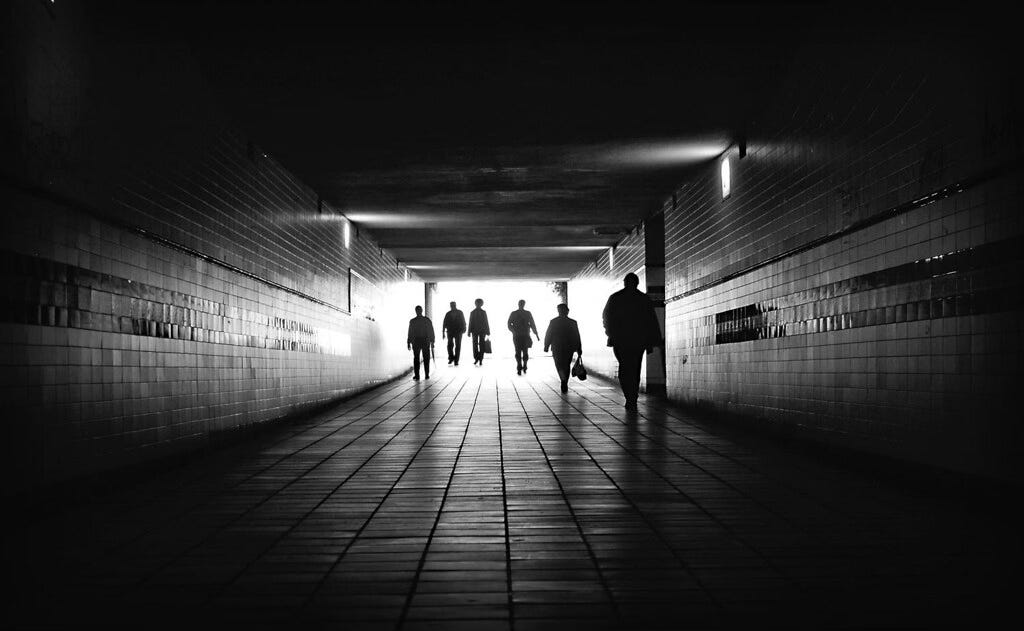
For growing numbers of people in the West there’s the sense of a growing epidemic of meaninglessness in everyday life – a tension between disenchantment and emptiness. Ennui of dystopian futures populated by cyborgs and AI is only one narrative. But it’s a dominant narrative that acquires its power through a culture of scientific rationalism, along with constant justifications for why the world is the way it is, repeated over and over in our manufactured zeitgeist.
If we want to counter the disenchantment narrative and its technological positivism, we must understand how and why it works, and what’s at stake when one rejects any sense of hope and falls for the rationalist extreme of separation and futility. When we, as sentient beings, started to contemplate our insignificance, it became almost inevitable that the material world would begin to lack integrity and meaning. But when purely rational ways of interfacing with the world, and with a cosmos far greater than we can ever know, is accepted and enforced as the ultimate truth, the resulting burden of existential insecurity is so very hard to endure.
Today our lives have become an expression of the chaos and confusion caused by a complete breakdown of traditional values and purpose. Clever people remain quiet for fear of offending foolish people. Faith in dogma is declining, deprivingus of every thread of public morality. The production and consumption of material goods has become an all-encompassing obsession. Escapism among the owners of capital seems to indicate the forfeiture of their previously assured influence via traditional systems of power. The quest for geopolitical hegemony takes precedence over multipolar cooperation, as if it’s the conclusive way of relating to the world. Unchained from certainty, nobody can see what might come next.
To the nihilists, only the natural sciences and mathematics deal with truths unspoiled by human prejudice; only in science, narrow and precise, can the answers to our existence, and life’s true meaning, be found.
I find that disheartening. Surely we don’t need to be reminded that our scientific theories do not govern the universe; our scientific theories govern us and our elementary ways of interpreting the universe. Our theories and laws are of our own making, with a distinctly European signature.
Science and the scientific method is one epistemology and its value should not be underestimated. But the Kantian notion that reason, or moral law, is embedded in the very structure of human cognition and that is the only truth we should accept, is still only one way of knowing about our world - transmitting by way of scientifically induced nihilism where data is mistaken for cosmology.
Rationalism disqualifies multiple truths. The crux of nihilism is that in accepting scientism, it’s difficult if not impossible to achieve transcendent or intrinsic knowledge - the why of existence. This is why the Buddhist notion of being conscious of, and appreciating, the present moment (what I refer to as the expanded now) becomes critical for (re)discovering purpose and meaning in life. And this very fact of valuing the meaning of life in the present, of finding our own kind of Dionysian enchantment as an antidote to meaninglessness, and valuing the sacred of the every day, demonstrates how socially unsustainable nihilism actually is.
The Dionysian mode is the art of madness, emotion, ecstasy, and above all, unity – a music of the spheres that unites humans, as well as humans and nature, in the present moment. Within a Dionysian state of joy, there are no lines; no limits. Everything becomes one under the experience of primordial unity. Music is a resistant force to meaninglessness. Like Nietzsche, I believe the rise of nihilism is not an end as much as a portal to new ideas, new meanings, and transcendent values; just as social collapse is the inevitable blaze through which we need to leap in order to give birth to a new and more conscious civilisation.
Finding one’s own meaning in life, through whatever mode of enchantment seems most appropriate, is the final bastion against nihilism, political cynicism, and detachment. But then there’s the context to consider.
Industrial economism is a toxic virus, its stillborn progeny - predatory capitalism - a bloodsoaked zombie stealing stillness and causing untold hurt. It provides us with toys and other vicarious thrills, distracting us by saying “look at how great all of this progress is.” And it only works because we’re so detached, from each other and the Earth, as to not consider the cost of the comforts we enjoy as others half a world away go hungry and thirsty.
Does our comfort and supposed progress necessarily need to cost so much? Or do we naively choose this cost because it’s the path of least resistance? As consumers are we completely comfortable with this cost? Modernity has absolutely given us things to be thankful for, and to cherish, but at the cost of death and detachment on an unprecedented scale.
During the latter part of the 20th century, and before, people still saw themselves as part of a much larger scheme… a web of fecund life in which humans figured in their proper place alongside other creatures. And although traditions and circumstances restricted us, these social orders brought stability and meaning to the world, and purpose to our activities. The discrediting and downgrading of these social orders has been called the disenchantment of the world. With it, life lost some of its magic.
Every thinking individual needs to ponder a critical question: is what we possess worth all the anxiety and pain? Nihilism, detachment, apathy, and boredom, all different shades of the same color, are at their core antithetical to the fundamentals of ecology and the ethos needed to care for each other and the Earth that feeds us. But that seems not to be widely understood.
If nihilism functions as a damper on anti-rationalism, and seamlessly leads to detachment and unprincipled behaviours, what’s needed is a counter-narrative. We need to regain the magic. For, through enchantment, we keep can nihilism at bay. If we subscribe to the understanding that nihilism’s affective detachment from the world and self is wrong, then music and the arts are our most elemental way of keeping the moral self and collective strong, healthy and intact. They are the sacred flame that protects us against the darkness.