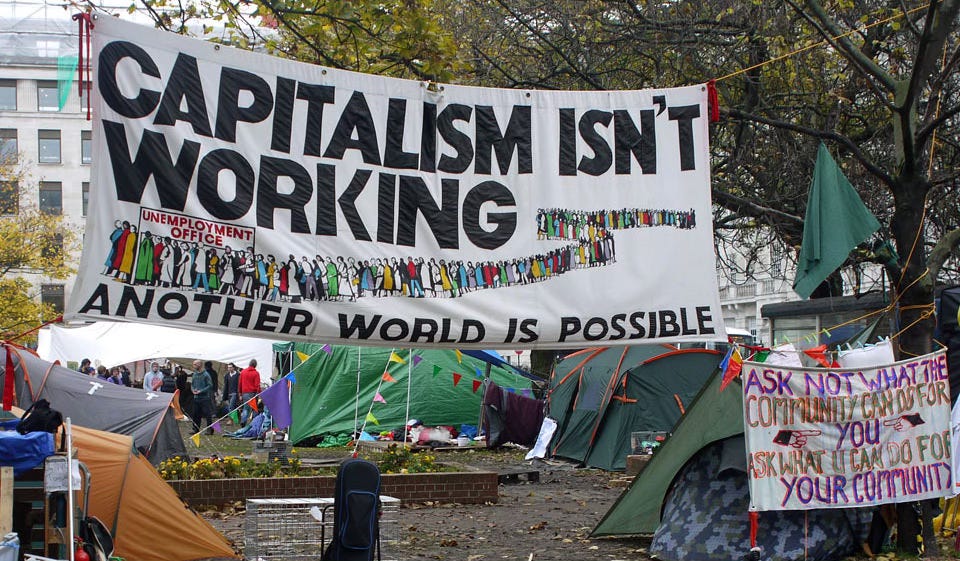
Depending upon one’s point of view, capitalism is either a practical socio-economic system where the means of production happen to be held in private hands but market-driven competition determines almost everything else, or an ideological behemoth that thrives on relentless growth, often at a devastating cost.
Those who hold the former view will argue that it's the fairest economic system yet devised and therefore unnecessary to completely abandon it, even if some reforms are needed to address income inequality, improve workers' rights, and regulate businesses to prevent abuses. If the latter you will point to the negative impacts on the environment alongside a widening chasm of inequality, where the affluent soar on the wings of wealth while the less fortunate are left to the whims of an unforgiving market.
In terms of reform, the social democracies to be found in many European countries, are models of hybrid attempts to combine capitalism with a strong social safety net. Some advocate for a comprehensive shift to economic systemswhere the means of production are owned and controlled by the community or the state. However, historical attempts to establish such systems have faced challenges, not the least being how to incorporate innovation in such structures, and the success of such transitions remains a topic of ongoing debate.
Another approach involves promoting local sustainable microeconomies, emphasizing community-based production and consumption. Some advocate for decentralized and cooperatively owned businesses as an alternative to large, profit-driven corporations.
Various alternative theories propose moving beyond capitalism altogether. Some argue for a post-capitalist society characterized by different economic structures, perhaps based on collaborative and decentralized models facilitated by advancements in technology. Changing the way we think about wealth, success, and progress is another avenue. Encouraging a shift in societal values toward long-term sustainability, social responsibility, stewardship, reciprocity and well-being over pure economic growth could certainly influence the purpose and trajectory of economic management.
My major objection to capitalism as it currently works is a philosophical one. Our planet, the cradle of life itself, is treated as a cheap commodity, its resources extracted with reckless abandon, and its most fragile ecosystems exploited purely for profit. In its unbridled and most predatory form, capitalism has ushered in an era where consumption is king, and possessions are the yardstick of success. In the relentless pursuit of more and more stuff, we have lost sight of what truly matters — our kinship with each other, our niche in nature, and any sense of a more exalted purpose beyond material gain.
We are trapped in a cycle of desire and consumption that venerates wealth and power, ignoring the human costs thatentails — costs paid in the currency of social injustice, environmental degradation, ennui of banal futures, and a deep sense of existential void.
I entertain no illusions about the complexity of the problem. I understand that capitalism is neither the sole, simple source of our world’s challenges, nor a construction that can be dismantled overnight. To paint capitalism as the root of all evil is to oversimplify a vastly intricate issue comprising economic, social, and political dynamics.
Capitalism has been a driver of innovation and growth, lifting people from poverty and hastening important advancements across numerous sectors. But the recognition of these achievements does not blind me to its more fundamental flaws and excesses. My concerns are founded on an understanding that while capitalism has been a part of our progress, it has also created significant disparities and environmental crises.
Capitalism shapes far more than just economics. Its tentacles touch every aspect of modern life. From its feudal beginnings, early signs of capitalism can be seen in the rise of the merchant class in Europe, the exploration and colonization that contributed to the growth of trade networks, and the establishment of joint-stock companies which allowed for shared investment and risk.
Beginning in the late 18th century in Britain, the industrial revolution ushered in factory-based mass production, enabled by technological advances and the growth of wage labour. This was followed in the 19th century by the consolidation and expansion of capitalist practices. Capitalism became entrenched in Western societies, characterized by free-market principles, private property rights, and industrial practises.
This cavalcade of developments moulded a materialist worldview that dominates almost everything we do today. After centuries of capitalist ideology spreading globally, most of us struggle to imagine alternatives that look nothing like acapitalist status quo. But ever-worsening wealth gaps, the climate crisis and other existential threats rooted in capitalism increasingly demand a radical shift of mind.
This is the underlying philosophical question: can we truly free ourselves from it? Can we quit capitalism? Not just in the practicalities of detaching our society from a capitalist infrastructure, but in inquiring more deeply into the quest of redefining values and reinventing our collective consciousness. This is the central challenge for civilisational renewal and it begins with a simple, profound realisation. To quit capitalism, we also have to free ourselves from an ingrained dogma and world-system beyond mere economic reform. It demands a fundamental shift in the importance we attach tocommunity, how we comprehend success, and how we see our role in the future of life on this planet.
How do we quit capitalism? There are some obvious layers we must peel back - primarily in how we conceive of ourselves and our relationships.
In that regard the first layer is the need to rescind any notion that envy, greed, and selfishness are innate human qualitiesthat any of our most life-critical systems must accommodate. In reality, humans intuitively demonstrate cooperation, empathy, compassion, and social responsibility, alongside healthy competition. Capitalist competitiveness, on the other hand, is contrived within the context of scarcity in order to bring out our most individualistic instincts. Our real altruistic nature will only surface if we design systems that appeal to our heart and soul, rather than attract our more base transactional margin.
The second layer is the belief that having a job is needed to generate, sustain and shape life’s true meaning and purpose. Disparities become inevitable when work governs identity and dictates the allocation of time across society. People sacrifice relationships and downtime that nurture overall wellbeing. Post-capitalism must diversify sources of purpose across family, friends, pastimes, environment and community — a richness impossible when working persistently simply to afford basic needs.
The third layer cuts to the core of what we are repeatedly told is success. We assume capitalist hierarchy reflects meritocracy and differences in human potential. Some CEOs today attract salaries more than 300 times that of their workers. That is a farcical situation. In truth, no one works hundreds of times harder than another to earn their extra millions. And many worthwhile pursuits, including caregiving and the arts, languish, unable to find acceptable formulae for monetising their true value under capitalism. Hierarchy stems more from privilege and luck than worth or effort. A post-capitalist system must better reward diligence across all socially constructive roles.
Finally, the deepest layer may be the conflation of commodification with progress. We struggle to identify any human need that cannot be financialised for a profit. But by commercialising knowledge, relationships, identity, and more, capitalism crowds out intrinsic developmental rewards with extrinsic financial ones — leaving us spiritually and emotionally deprived. Beyond reform, quitting capitalism requires wholly reimagining concepts like innovation and technology outside capitalist logic, even if that vision is hard to see.
Even allowing for the major variants in contemporary economic systems, there are many ways we can evolve a post-capitalist society aligned to the elemental conditions needed to sustain life on Earth. The most obvious of these is scaling down consumption while encouraging localised production.
Challenging the uncompromising pillars of consumerism - planned obsolescence, pervasive advertising, and the pursuit of novelty and luxury status symbols - is vital. By reducing wasteful use of resources, economic activity aligns with ecological sustainability, nurturing a culture of mindful consumption. Then migrating to distributed, independent, small-scale production models, helps to grow and strengthen community ties while stimulating shared prosperity. This dual approach enhances local economies, substantially reducing the environmental impact of long-distance supply chains, while building resilience and sustainability.
We can also make changes to the ethos and nature of work, much of which is already happening through automation, and much still to arrive in the the use of artificial intelligence to accelerate and amplify routine tasks.
Embracing shared ownership and self-management practises in businesses creates a culture of workplace democracy.Long appreciated as an effective means of empowerment, this strategy gives workers a voice in decisions and a stake in outcomes, thereby actualising the cooperative values at the heart of all economic activity.
Recognising essential services like healthcare, education, and childcare as universal rights can pave the way for a more equitable society too. Such services, provided universally, would ensure that every individual has the foundation to thrive, making equitability an ideal and scalable reality. In similar vein, the introduction of an unconditional basic wage would recognise the essential dignity of all individuals. Providing a safety net allows people to engage in voluntary labour and pursue meaningful work without the constraints and risks of financial insecurity.
There are also a range of less major, nevertheless effective actions, that would reinforce any new narrative. Hours in the working week could be curtailed. We know that this significantly improves individual wellbeing and boosts productivity. Beyond personal benefits, this helps conserve resources, minimises environmental strain, and can lead to a more equitable distribution of income and employment opportunities. Amending the tax regime is to reflect new priorities would be vital. Implementing luxury and wealth taxes would be a step towards rectifying economic disparities. As technological advances concentrate wealth, such taxation ensures a fairer redistribution of resources, helping to bridge the widening inequality gap.
Scenarios reflecting differing lifestyle choices available to us in a post-capitalist society all seem to reinforce the changing mores in our society. From making better informed purchasing decisions, to supporting businesses that are ethical, environmentally friendly, and socially responsible, and avoiding products that contribute to wasteful practices or are produced unethically, the general consensus is positive.
Embracing a more modest lifestyle, by reducing unnecessary possessions, cutting out waste and excess, walking and cycling, gardening and other forms of self-sufficiency, engaging in local initiatives, donating time to worthy causes, focusing on quality over quantity, community activism, valuing experiences over material goods, and ensuring family wellbeing, is also high on many people’s agenda.
Post-capitalism can also be supported in the virtual world. Opting for open-source alternatives to mainstream software, for example, which are often collaboratively developed and freely available, embodies communal sharing and innovativeprinciples. Engaging with decentralised social networks, content platforms, payment providers and processes distribute power away from centralised authorities, thereby developing a digital ecosystem based on equality and direct user control.
Again there are so many little things we can do differently to effect a paradigmatic shift in economic habits, from participating in the cooperative sharing economy online, adopting digital minimalism, becoming a digital nomad, and promoting crowdfunding for social, environmental, and community-based projects, to supporting fair trade and ethical e-commerce, all have a cumulative impact.
The initial mindset shift seems tiny relative to systemic oppression. The Do-It-Yourself movements, self-sufficiententerprises, and activists already show how new narratives can quickly catalyse major change once a critical consciousness awakens. Latent seeds of alternative living sprout everywhere, from anarchist communes to agroecology farming to open-source technologies. Capitalism’s myths have already begun to decompose as younger generations face the failures of capitalism’s appetite for endless growth.
Now the hard work starts: composting capitalism’s decay into fertile soil where shared prosperity has at least a chance.Once we start to chip away at capitalist assumptions constraining the imagination, radically different socio-economic forms emerge where equity and sustainability reign. Relationship anarchy usurps hierarchy. Identity is rooted in purpose, not occupation. Technology aligns with ecology. Innovation seeks social gain, not market share. Production localises. Possession communalises. Value redistributes. Labour diminishes. Resources do not infinitely grow, but capabilities and connections do.
Quitting capitalism requires political change and economic restructuring. But the most crucial transition is the psychological one — quitting the competitive, individualist, consumption-driven mindset at capitalism’s core. No economic reform can create enduring change until we start perceiving each other as cooperative partners working toward shared prosperity. We will need to undergo a profound ideological transition before we can build an equitable post-capitalistfuture.
It’s tough to rethink, reimagine, and redesign a world where the current ideology is so rigidly entrenched. But cracks in the capitalist facade are showing, and through these cracks, we see glimmers of hope, of new possibilities, of a future where the economy serves humanity, rather than the other way around.
This is our moment to question, contest, and move towards a new economic paradigm. The stakes are high, but we’re slowly acquiring the determination to visualize and create the world we’ve talked about endlessly in the past. A world that does indeed prioritise people and the planet over mere profit.
The most viable way forward is not revolutionary on all levels. It demands a nuanced and staged approach; one that seeks to reform and reshape rather than to uncritically demolish. Waiting in the wings we can see an economic system that retains the strength of past achievements and the benefits of present activities. We see a system that can correct its more blatant failures. A system ensuring progress and prosperity are not mutually exclusive and do not come at the cost of our planet’s health or our moral compass.