I write The Hames Report from a conviction that the prevailing narrative is usually the one most in need of a plot twist. Allow me to explain.
Some years ago a group of American Army officers were handed a problem that their intelligence could not solve. Not their intelligence in the colloquial sense — these were people with soaring IQs, elite educations, and years of training in analysis. Their intelligence in the technical sense: the apparatus of reasoning they had been taught to trust. Faced with volatility, uncertainty, complexity and ambiguity, the very conditions their profession exists to confront, they cracked. Not because they lacked information. Because they had been taught to think like the machines they carried in their pockets, and the machines had no answer either.
The professor who was eventually brought in to help them was not a strategist or a psychologist. He was a Shakespeare scholar with a degree in neurophysiology. Angus Fletcher, of Ohio State’s Project Narrative, had spent years arguing something that almost every institution he approached found faintly absurd: that the human brain is not, at its core, a logic engine. It’s a story engine. It thinks in characters, causes, actions and consequences. And the faculties that allow a human being to act wisely with almost no information — intuition, imagination, emotion, common sense — are not decorative extras bolted onto rational cognition. They are narrative cognition. Our brains are not computers designed to calculate truth, but biological storytellers designed to generate meaning. These faculties evolved specifically to help us navigate the messy, uncertain, and social world we inhabit—a task that rigid rule-based systems cannot replicate.
We often speak of the left brain as logical and the right brain as creative. But this neat division is more myth than science. Modern neuroscience shows that both hemispheres work together constantly, connected by billions of neural pathways. The real distinction isn’t anatomical — it’s cognitive. What we call ‘logic’ is paradigmatic thinking: rules, categories, proof. What we call ‘creativity’ is narrative thinking: meaning, sequence, intention, consequence. Both modes require both sides of the brain. Yet our education systems still privilege one over the other, teaching children to compute when they need to comprehend, to categorize when they need to connect. We’re not training a hemisphere; we’re training a human mind that evolved for stories, not spreadsheets.”
Fletcher was rejected by everyone except US Army Special Operations. When his training was applied to senior officers, their creative problem-solving improved by close to a full standard deviation. The Army gave him a Commendation Medal. The rest of us gave the brain-as-computer metaphor another decade of unearned authority.
I want to take his thesis seriously here — more seriously, perhaps, than Fletcher himself does, because I think it bears on something larger than just leadership training. It bears on what kind of civilisation we’re becoming, and on the quiet catastrophe of a species that has begun to distrust the only intelligence it actually possesses.
The metaphor we mistook for a fact
For about seventy years we have described the mind using the vocabulary of the machine. We process information. We store memories and retrieve them. We suffer from bandwidth problems. We reboot. This started as an analogy — a really useful one, in the early days of cognitive science, when Herbert Simon and Allen Newell were building the first symbol-manipulating programs. At that stage it seemed plausible that human thought was just very sophisticated symbol manipulation.
But analogies have a way of hardening into ontology. Within a generation the metaphor had become the model. Intelligence was defined as the capacity to reason logically from premises to conclusions, to detect patterns in data, and to optimise. Whatever didn’t fit that definition — hunches, feelings, the ability to size up a stranger in two seconds, the knack for knowing when a plan is about to go wrong — was reclassified as noise, bias, or at best a heuristic shortcut for people who either couldn’t afford to do the proper calculation or were unable to.
Our schools followed suit. We built an education system that rewards the retrieval of correct answers, the application of known rules, and the imitation of established procedures. Fletcher’s phrase for the product is brutal: we are turning children into second-class algorithms. Or as I have stated on so many occasions recently: We’re breeding cognitive livestock for slaughter by silicon. We drill them to do badly what a machine does well, and in the process we let atrophy the faculties that no machine possesses at all.
But then the machines got good — really good — at the thing we had defined as intelligence. And we panicked. Because if intelligence is pattern-detection and logical inference, and silicon does that faster and more cheaply than carbon, then what exactly are we for?
The panic is real but the premise is false. The premise is false because the metaphor was always wrong.
What primal intelligence actually is
Jerome Bruner, the great developmental psychologist, argued in the 1980s that human beings possess two irreducible modes of thought. The paradigmatic mode seeks truth through logic, category and formal proof. The narrative mode seeks meaning through sequence, intention and consequence — through plot. Bruner insisted the two couldn’t be collapsed into one another. Neither was a degenerate form of the other. But he also noticed that Western intellectual culture had spent three centuries elevating the first and patronising the second.
Fletcher’s contribution is to show, with the tools of neuroscience, what the narrative mode is actually doing. His four “primal powers” are not a motivational-speaker’s checklist. Each is a specific cognitive operation, and each is narrative in structure.
Intuition has nothing to do with being vague. It’s the brain’s capacity to notice an exception — that which doesn’t fit the pattern — and to infer a hidden rule from it. A logic machine treats an outlier as an error to be smoothed away. A story-brain treats it as the moment when the plot turns. The Special Operations spy-hunters Fletcher studied surface hidden truths almost entirely with who, what, when, where and how questions, and almost never with why. Why triggers judgement and closes the inquiry; the other five keep the story open until the exception reveals itself.
Imagination is most commonly thought to be fantasy. It’ not. It’s the construction of branching futures — the ability to run a sequence of actions and their probable consequences forward in the mind, and then run a different one, and another, and compare them. This is what a plan is. It is also, precisely, what a plot is: a causal chain of actions taken by agents with intentions. The imagination that writes a novel and the imagination that plans a rescue operation are the same faculty pointed at different targets.
Emotion is not the enemy of reason. Antonio Damasio demonstrated decades ago that patients with damage to their emotional circuitry don’t become cool, Spock-like rationalists. They become incapable of deciding anything at all, because they can no longer tell which option matters. Fletcher goes further: emotions are the brain’s instruments for monitoring whether the story you are living is going well. Fear says the plan is failing. Grief says a character has been lost from the plot. Hope says the future still has open branches. Emotion is the narrative’s diagnostic system.
Common sense, the most maligned of the four, is the capacity to detect the limits of your own knowledge — to know that you do not know — and to act wisely in that condition. It’s the faculty that seeks falsification rather than confirmation. It matches the boldness of a plan to the volatility of a situation: stable conditions favour proven methods, chaotic ones demand improvisation. Common sense is what tells you which story you are in.
Put these together and you have an intelligence that evolved not to compute the world but to act in it — under time pressure, with inadequate data, with lives at stake. It’s not a lesser form of reasoning. It’s the older, deeper, and in most real circumstances more useful one.
Why it isn’t coming to a data centre
Here I must be careful, because the claim that “machines can’t do X” has a poor historical record, and I have no interest in adding to it.
Large language models can produce text that has the surface form of story. They can generate a plot, describe a character, even mimic the cadence of grief or elation. This is not surprising: they have been trained on the whole archive of human storytelling, and story is the dominant form of human communication. If you ask a pattern-detector to predict the next word in a corpus that is mostly narrative, you get a very good narrative-imitation engine.
But look at what the machine is actually doing. It’s finding the statistically probable continuation of a word sequence, based on what has already been written. Its entire relationship to the future is that the future should look like the past. This is the paradigmatic mode in its terminal form: a system that has read everything and therefore knows what is typical.
Narrative cognition does the opposite. It begins from the exception — an event that’s never happened before — and asks what it might cause. It’s not interested in what is typical. On the contrary, it’s attracted to what’s possible, and in what a particular agent, with specific intentions, might do next. It’s a technology for acting when the data has lapsed.
A machine has no stake in the plot. It doesn’t fear the plan’s failure for it has no plan, just outputs. It doesn’t grieve a character; it has no characters, only tokens. It doesn’t know that it does not know, because knowing that requires a self that persists through time and has something to lose. Fletcher’s four primal powers are not features that can be added to an architecture optimised for prediction, because each of them depends on being an agent inside a story, with a body, a history, and a future that matters. The data centre has none of these. It can describe them endlessly. It cannot possess them.
None of this means machine intelligence is trivial or well-meaning. The potential threat is not that machines will out-think us at that which we do best. The threat is that we will forget what we do best — that we will keep redefining intelligence to match what silicon does, and keep discarding what it doesn’t. That’s not a technological risk. It is a civilisational choice, and we are making it right now, mostly by default.
Some overly cautious experts like Geoffrey Hinton warn that machines will destroy us; others suggest we might simply disappear into them. Both fears miss the point. The danger isn’t that AI will become too smart for us to control — it’s that we will become too stupid to notice what we’re losing. When we redefine intelligence to match what silicon does well, we aren’t just optimising for efficiency. We’re outsourcing meaning itself. The ‘existential risk’ isn’t necessarily a robot uprising. It’s a quiet surrender: the gradual erosion of imagination, intuition, emotion, and common sense — the very faculties that made us human in the first place.
Story rewires the brain
If narrative cognition is the substrate, then stories are not just entertainment. They are interventions. In his earlier book Wonderworks, Fletcher made the case that the great literary forms — tragedy, the epic, the sonnet, the detective novel, the stream-of-consciousness narrative — are inventions, in the strict sense. In other words orchestrated devices that produce specific, measurable impacts in the human nervous system. Tragedy was a technology for grief. The Homeric epic was a technology for courage. These things were discovered, refined and transmitted because they worked.
But here’s where the story shifts: those technologies were once cultivated slowly, over generations, by communities that understood their effects. Today, they have been industrialised. Hollywood movies and streaming platforms like Netflix don’t just distribute stories — they optimise them. Algorithms measure engagement, retention, completion rates. Stories are no longer transmitted; they are engineered at scale. What happens when the technology for grief becomes content designed to keep you scrolling? When the technology for courage becomes spectacle that numbs rather than mobilises? We haven’t lost the power of story. We’ve outsourced its design to machines that have no regard for whether it heals or harms.
None of this is abstract to me. My most recent books, and a daily Hames Report, have been written from inside a body that no longer holds a pen easily. Arthritis persuaded me to use voice-to-text software some months ago, and every sentence I publish now starts as speech before it becomes text. Where the algorithm optimises story for retention, dictation returns composition to the oldest channel of transmission, the one narrative cognition evolved to use before writing existed at all. A voice thinking aloud is not a stream of retrievable data points. It’s a person testing a sequence of causes against an audience that hasn’t yet arrived.
The clinical literature has caught up with intuition. James Pennebaker’s decades of research on expressive writing show that people who write narratively about difficult experiences — not merely venting, but constructing a sequence with causes and consequences — show improvements in immune function, fewer doctor’s visits, and better psychological outcomes than controls. Narrative exposure therapy, developed for survivors of war and torture, works by helping patients place fragmented traumatic memories into a coherent life-story with a before, a during, and an after. The trauma doesn’t disappear. It acquires a position in the plot.
While neuroplasticity is the mechanism, story is the method. The brain changes itself in response to every experience, and story is the most concentrated form of experience we can dispense to ourselves. Every time you inhabit a character’s choices you are running a simulation, and simulations leave traces. This is why children who are read to develop differently from children who are not, and why cultures that lose their stories lose more than heritage. They lose the training regime for their own minds.
Context beats content
We live in an age of unprecedented content yet starving context. There has never been more information available to more people, and there has rarely been less collective understanding of what any of it means.
Content is the fact. Context is the plot to which the fact belongs. A number — 1.5 Celsius, four percent unemployment, a casualty figure — is content. What it means depends entirely on the story in which it is framed: who did what, to whom, with what intention, leading where. The same fact in two different plots is two different facts. This is not relativism. It’s how meaning works, and every propagandist knows it, which is why the most effective disinformation does not falsify content. It supplies a false context and lets true facts do the damage.
I have written before about the institutional blindness of strategic planning — the way large organisations construct elaborate monitoring systems that are trained, by their own design, to treat any anomaly as noise. That blindness is a context failure. Most planners have content in abundance. What they lack is a narrative capacious enough to accommodate the exception — the weak signal, the outlier, the factor that doesn’t fit the model. Their systems are optimised to confirm the story they already believe. Intuition, which notices exceptions, and common sense, which seeks falsification, have been engineered out of the process because they don’t produce dashboards.
There are older knowledge systems that got this the right way round. The songlines of Aboriginal Australia are not maps with stories attached; they are stories that function as maps, and as law, and as ecology, and as ethics, all at once. The knowledge is inseparable from the narrative that carries it, and it has been carried, with remarkable fidelity, for tens of thousands of years across a continent that would kill anyone who forgot it. That is context-first intelligence. Content — the location of a waterhole, the season of a food source — is embedded in plot, because plot is what the human brain retains, transmits and acts on. We would do well to stop treating such systems as charming survivals and start treating them as evidence.
The plot twist
Which brings me to the claim that will strike some readers as the most fanciful, and that I believe is the most important: a well-placed plot twist can turn trauma into growth.
Consider what trauma is from the perspective of narrative. It’s a story that has stopped in its tracks. The event or events happened, but the mind cannot integrate it into the ongoing plot of a life. So it loops. It replays. It intrudes. The traumatised person is, in a precise sense, stuck in a scene that will not end and can’t be followed by another scene. The past has colonised the future.
Now consider what a plot twist is. It’s hardly ever the erasure of what came before. In a well-constructed twist, every earlier event remains exactly as it was — but its meaning changes, because we suddenly see it in a different causal light. The betrayal turns out to have been a protection. The defeat turns out to have been the necessary condition for that which follows. Nothing in the content has altered. Everything in the context has.
This is what post-traumatic growth looks like from the inside. The researchers who coined the term, Tedeschi and Calhoun, were careful to insist that this is not the same as recovery, and it is emphatically not “positive thinking”. People who grow through trauma do not decide that a terrible experience was secretly good. They construct a story in which the terror leads somewhere — in which it becomes the hinge of a plot rather than its terminus. Viktor Frankl in the camps didn’t deny the horror; he found, instead, a plot of which he could still be the author.
Fletcher’s work with Army medics and veterans is, at source, about this. He observed that certain stories — Tim O’Brien’s The Things They Carried is one soldiers return to again and again — function as therapeutic devices because of their narrative structure, not their content. They narrate a death multiple times, from shifting angles, the way Greek tragedy lets you know the prophecy before the fall. They give the reader the experience of a perspective larger than the narrator’s own. And that experience — the sense that there is a bigger story, that the scene in which you’re trapped is not the whole plot — is precisely what a mind stuck in trauma cannot generate for itself. The story lends it a vantage point. The twist is borrowed until it can be owned.
No rule can do this. No algorithm can be applied to a stuck story to unstick it, because the problem is not a missing fact or a faulty inference. The problem is that the plot has no next scene, and only a mind that thinks in plots can write one.
What is at stake
We are in the process of building a civilisation whose central institutions run on the paradigmatic mode, and we are outsourcing that mode, with escalating enthusiasm, to machines. Our markets, our bureaucracies, our media feeds, our planning systems and increasingly our decisions about who gets what and who is believed are being handed to systems that find patterns in what has already happened and project them forward. By almost any measure, these systems are extraordinary. They are also, by construction, incapable of noticing that the story has changed.
And the story has changed. The climate is doing things it has not done in the whole span of human records. The geopolitical order is shifting in ways the models did not predict because the models were trained on the order that’s ending. Every one of the challenges that will define this century is an exception — the kind of thing that appears in no training set, that arrives without precedent, and that can only be met by minds able to ask: given that this has never happened previously, what might it cause, and what might we do about it?
That is narrative cognition. It’s the intelligence we were born with and have spent seventy years teaching ourselves to distrust. It can’t be bought from a vendor or run in a data centre. It can only be cultivated — in children who are read to, in students who are asked what a character would do rather than what the answer is, in leaders who are trained to hunt exceptions rather than confirm forecasts, in the wounded who are helped to find the next scene, in the same soldiers who improved by nearly a full standard deviation once someone thought to teach them plots instead of procedures.
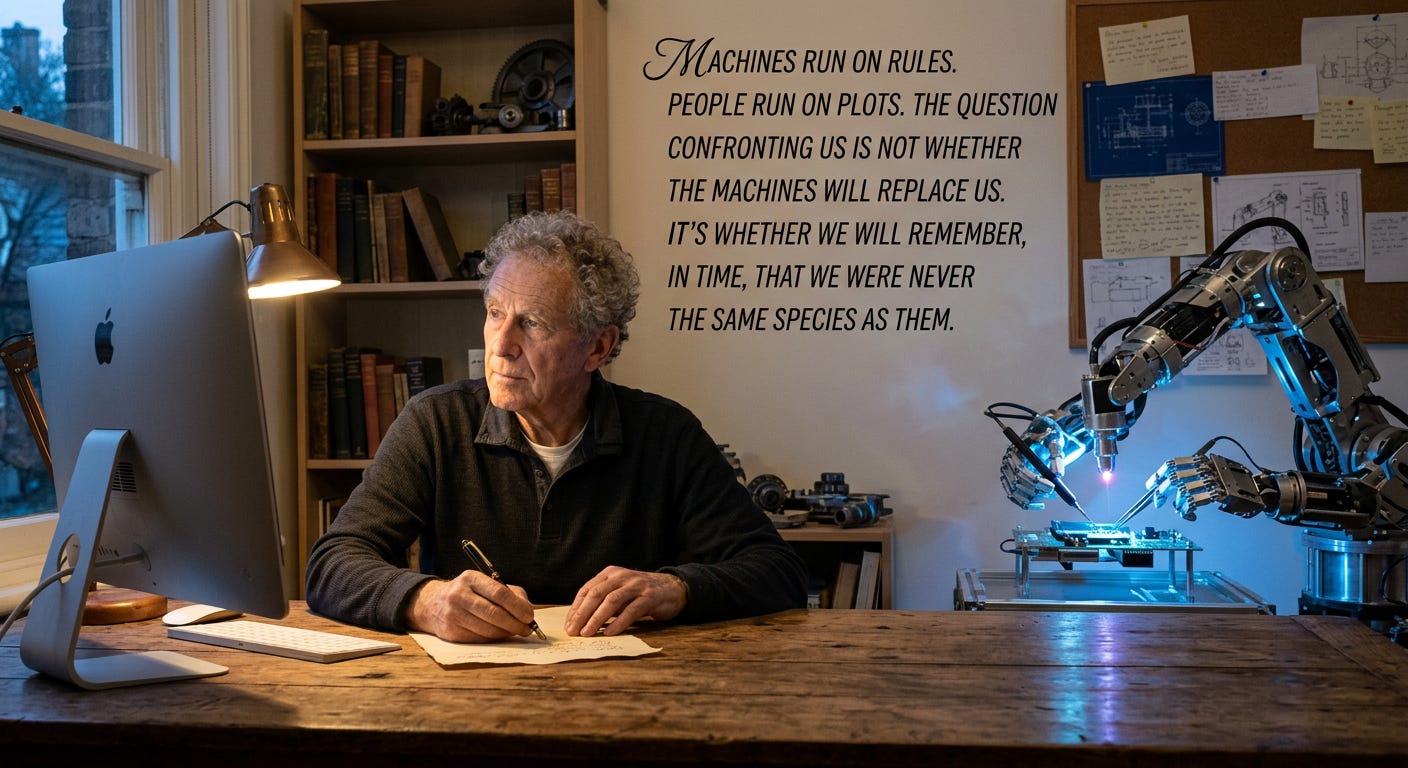
Machines run on rules. People run on plots. The question confronting us is not whether the machines will replace us. It’s whether we will remember, in time, that we were never the same species as them.