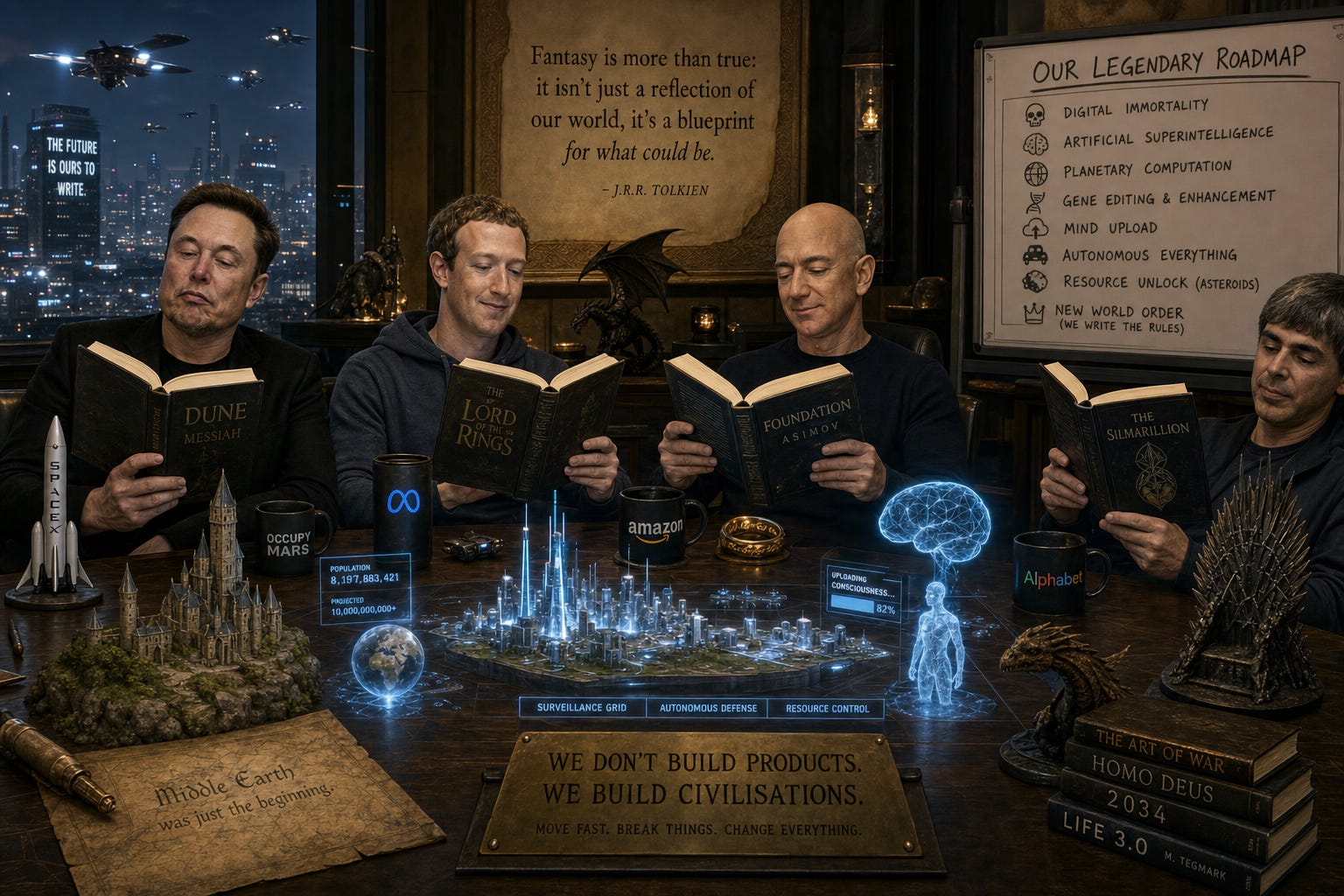
There’s something uniquely revealing and authentically childlike about the way some entrepreneurs in Silicon Valley have consumed science fiction. For generations, the genre served as a kind of rehearsal room for contemporary civilisation. Writers from Mary Shelley to William Gibson imagined machines that might outshine us, cities transformed by technology, and societies in which humans became prisoners of their own invention. These stories were rarely intended as predictions. They were warnings.
Science fiction gave us the rare capacity to experience the consequences of our choices before making them, testing what technologies might be enabling against what harm they might do to our species. Yet somewhere along the way, that relationship appears to have inverted.
Some of the people now building the technologies that will shape this century seem to have read the warning as a blueprint. The killer robot becomes a product line. Artificial superintelligence becomes an engineering milestone. The virtual companion becomes a business model. Escape from Earth becomes a funding round, and dystopia becomes a prototype.
This is no amusing cultural quirk. It signals a real failure of imagination, though not through any shortage of it. The failure is one of range. These minds can conceive of machines with extraordinary capability, of computational systems that outstrip human intelligence, of autonomous vehicles, synthetic biology, immersive virtual worlds, and even colonies on distant planets.
Understanding what these technologies might do to human beings, however, is an altogether different undertaking. It draws on history, philosophy, anthropology, psychology, ethics, and an appreciation of power. Above all it demands a question that engineering culture rarely trains anyone to ask: because we can build something, does it follow that we should?
That question grows more urgent as technological power concentrates into remarkably fewer hands. A small number of entrepreneurs, engineers and investors now hold decisions that will shape the conditions under which billions live. Their assumptions about what a human being is, and needs, therefore matter enormously. This is where Silicon Valley’s own cultural formation becomes instructive.
A generation grew up surrounded by stories about machines becoming conscious, computers surpassing humans, corporations controlling societies, technology transforming civilisation. These stories were intended to provoke unease. They asked readers to contemplate unintended consequences. But what happens when the child who reads the story grows up to become the person capable of building the machine? The distinction between imagination and instruction can disappear.
Four public figures illustrate the pattern with unusual precision.
· One entrepreneur has built an entire public identity on the rebuttal of an internal censor, treating any unfiltered utterance as proof of authenticity. He has come to own not only a communications platform but orbital infrastructure on which governments increasingly depend for basic connectivity. So a private impulse, once only embarrassing, can now move markets and trigger diplomatic incidents.
· A second built his fortune by discovering that people will disclose nearly everything about themselves provided they believe they’re only speaking to friends. He turned that discovery into an advertising machine now entangled with child safety, political speech and content moderation all at once.
· A third has converted a well-known appetite for influence into the cooler vocabulary of structural critique. He has consistently argued that democratic institutions are just defective systems awaiting replacement by more competent individuals, an argument that happens to arrive at the conclusion its author would have reached anyway.
· A fourth speaks calmly, almost modestly, about machines that may exceed human cognition and transform civilisation. He describes the danger the way a scientist might describe a virus multiplying in his own laboratory: with careful, unhurried precision, cataloguing every way it could escape containment, continuing to feed it, and quietly reserving the only known antidote for himself.
I have to assume that none of these men are unusually evil, although that would be a simpler and more satisfying explanation from an author’s point of view. Each grew up, by his own account or by inference, absorbing decades of stories about thinking machines, colonised planets, defeated mortality, and a parade of heroic individuals who saw the future before institutions caught up. Most people who read such stories as adolescents eventually return the books to the shelf. A few decided instead to fund them.
Nobody needs to lie to himself for this to work. Each success confirms the very ability that produced it, and the confirmation rarely arrives labelled with its own limits. So genuine self-belief and grandiosity end up feeding on the same evidence. A man who was right about rockets has no reason, from where he’s standing, to doubt himself about civilisation.
Here a familiar psychological pattern asserts itself. Competence in one domain, however extraordinary, slides quietly into a felt licence to redesign every other domain, so that solving one engineering problem breeds the suspicion that most problems are engineering problems, and a society built from centuries of negotiated compromise starts to resemble a legacy system awaiting an upgrade. Institutions become chapter six of somebody else’s adventure: the regulator, the journalist, the ethics committee, all recast as the tedious officials who can’t see that the protagonist is trying to save civilisation.
Founders are received, and increasingly accept themselves, less as business people than as parental figures: the saviours who will rescue us from ageing, from failing institutions, from Earth’s own limits, from death itself. Growing up, in the ordinary human sense, means discovering that parents are not omnipotent, only capable, fallible and mortal like everyone else. The tragedy specific to this moment is that the market keeps rewarding the postponement of that discovery. Every successful launch, every defeated regulator, every survived scandal, reinforces the fantasy rather than puncturing it.
We may therefore have entered an extraordinary historical moment in which some of our most powerful technological actors are attempting to turn yesterday’s dystopian fiction into tomorrow’s infrastructure. The irony is almost unbearable. The writers were saying: look what could happen if we are careless. The builders sometimes seem to have heard: look what we could build. How exciting.
That difference matters. Because civilisation has always depended on a balance between capability and restraint. Human beings have developed weapons more destructive than anything our ancestors could have imagined. We have developed technologies capable of altering the atmosphere, manipulating genomes and surveilling entire populations. We have created machines that can calculate, communicate and now increasingly reason at scales and at speeds no individual human being can match.
Our problem has never been a shortage of power. It has been our inability to develop wisdom at the same speed. Technology accelerates competence. Culture evolves slowly. And wisdom, if we’re honest, often arrives after the damage is well and truly done. This is particularly dangerous with a technology like artificial intelligence.
The central question is frequently presented as whether machines will become more intelligent than humans. That may be the wrong question. As I explored in my book, Teaching Silicon How to Feel, the more important question is whether humans will become less capable of deciding what intelligence is for and how to use it appropriately.
Intelligence without wisdom is not civilisation. It is capability without direction. A machine may optimise a system extraordinarily well while having no understanding whatsoever of whether the system ought to exist. It may maximise engagement while destroying attention. It may maximise productivity while making human beings economically redundant. It may generate persuasive information while making the distinction between truth and fiction increasingly difficult. It may eventually design systems more sophisticated than its creators understand.
None of these are necessarily technological failures. They are failures of governance, judgement and imagination. And that’s why the cultural mindset behind technological development matters.
There’s also a banal, more structural reason the fantasy persists. Moderation costs money. Safeguards cost money. Independent review, child protection, cybersecurity, compliance. All of it costs money, and some of these safeguards cost something companies value even more than money. Growth. When commercial interests and libertarian convictions happen to point in the same direction, it becomes difficult, including for the person holding both, to tell where the belief ends and the balance sheet begins.
There’s a tendency within parts of the technology industry to regard humanity itself as a problem to be solved. Human bodies are inefficient. Human cognition is deficient. Human institutions are slow. Human emotions are irrational. Human mortality is inconvenient. Human labour is expensive. Human decision-making is messy. The list goes on...
From an engineering perspective, these observations may be entirely reasonable. But civilisation is not an engineering problem. Human beings are not defective machines waiting for an upgrade. Our irrationality is sometimes destructive. But it’s also where compassion, art, humour, love and moral courage emerge.
Our inefficiency can be wasteful, but it also creates the space for reflection. Our mortality is inconvenient, but it gives life meaning. Our limitations do more than constrain. They are part of what makes us human. This is why the most important question about artificial intelligence may ultimately have very little to do with artificial intelligence. It may instead be: what kind of human civilisation do we want to preserve while helping it to evolve?
That question is conspicuously absent from much technological discourse. We talk endlessly about what AI will do to jobs, education, warfare, markets and productivity. We talk much less about what it might do to attention, agency, dignity, meaning and our sense of responsibility for the choices we make each day. We celebrate the possibility of machines that can do almost anything we can imagine. But we rarely ask whether a civilisation in which machines do almost everything might leave human beings with too little to do that actually matters.
The most unsettling actor in this arrangement may not be any of the four men in Silicon Valley at all. It may be the recommendation engine sitting beneath all of them, which doesn’t ask what’s true, or good for a person, or wise for a society. Its only question is what keeps someone from looking away, and the human nervous system supplies reliable answers: anger, envy, humiliation, tribal loyalty, moral outrage. Centuries of science and extraordinary feats of engineering have converged, in the end, on machinery whose principal achievement is making human beings more efficient at provoking one another.
This same tension over restraint and freedom recurs wherever power concentrates, whether inside a state ministry, a family conglomerate, or a platform company answerable to no jurisdiction in particular. Some cultures instinctively ask what freedom permits; others instinctively ask what freedom costs the people standing nearest to it. Neither instinct, taken to its extreme, is safe. The first congeals into the conviction that nobody will tell me anything, the second into an infinite proliferation of committees, each reviewing the last one’s terms of reference, until the difference between governance and paperwork vanishes.
This is where the old science-fiction stories regain their relevance. Their power lay less in predicting the future than in unsettling it, in giving us futures where convenience curdled into control, intelligence into domination, abundance into emptiness, progress into civilisational regression. They asked us to look into a mirror. A small number of extraordinarily wealthy men appear to have mistaken the mirror for a set of instructions.
The most profound weakness of our technological age has little to do with any shortage of imagination. It has everything to do with confusing one kind of imagination for another: mistaking the technological for the human.
Technological imagination asks: what can we make possible? Human imagination asks: what would it mean if we did? A wise civilisation requires both. But when the first overwhelms the second, progress becomes dangerous. We’re increasingly capable of creating futures that nobody has adequately thought through. And perhaps that’s the real lesson hidden inside all those dystopian novels and films that so influenced Silicon Valley.
This same conviction has worn many names across history before it wore this one. Monarchs held it. Popes held it. Dictators held it. The belief that extraordinary standing in one domain licenses exceptional certainty in every other, and that whoever holds the greatest power is the one who needs restraint least. The vocabulary changes with each generation. This generation calls it innovation. The underlying delusion doesn’t change one iota.
The machines were never really the monsters. The monster was always the assumption that because something could be built, it deserved to be built. Instead, some of us are still under the covers, reading the story. Only now, the people holding the book also have the money, the laboratories and the computing power to make the nightmare real.