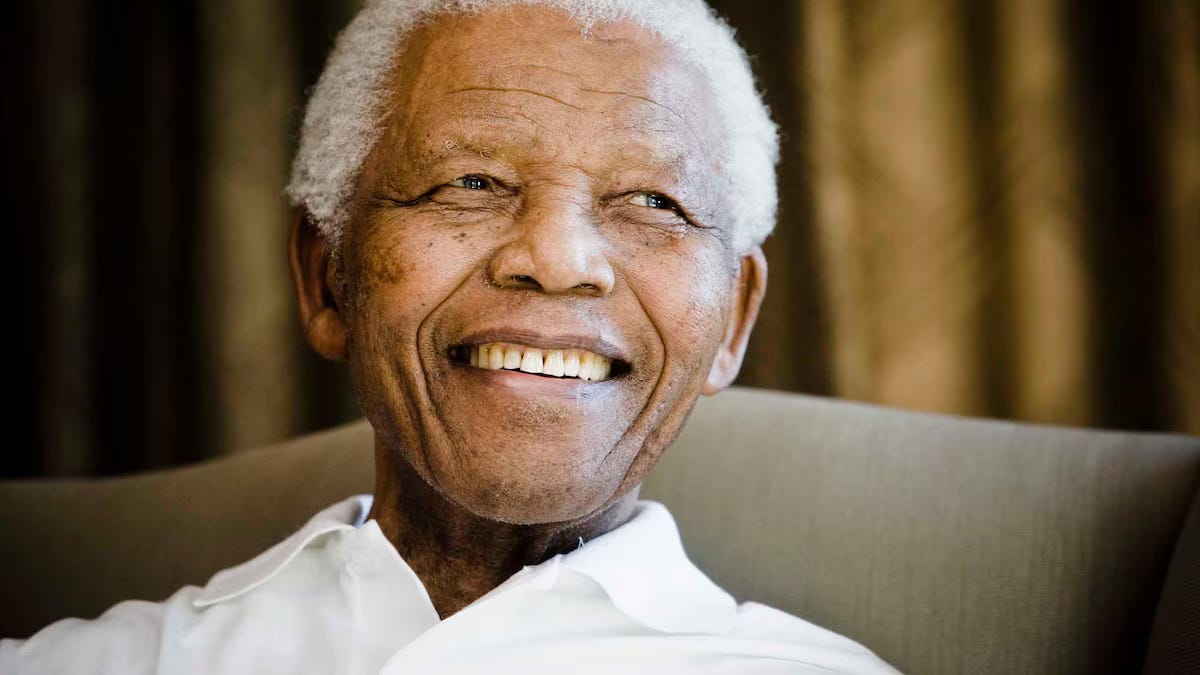
In 1990, Nelson Mandela was asked about his close ties with leaders such as Fidel Castro, Yasser Arafat, and Muammar Gaddafi. I’ll never forget his response. He thought for a moment and then said: “One of the mistakes which some political analysts make, is to think that their enemies should be our enemies.” This powerful statement resonated with the crowd, highlighting Mandela’s belief in the importance of understanding and dialogue, even with those who may be seen as controversial figures.
Mandela’s remark should have detonated far more than a ripple of applause in 1990. It was a direct challenge to one of the most stubborn habits of industrial civilisation: outsourcing our moral map to someone else’s conflicts.
We like to pretend that foreign policy is a chessboard. In reality, it’s closer to a feudal blood feud but with better stationery. Mandela refused to inherit other people’s vendettas. That refusal was not a polite diplomatic gesture; it was a philosophical strike at the operating system of an age defined by industrial economism – a global doctrine that needs enemies in order to keep extracting, consuming and justifying its power.
The Politics of Borrowed Hatreds
From Washington to Beijing, Riyadh to Brussels, public life is increasingly governed by what I would call borrowed hatreds. We’re encouraged to dislike on credit – to inherit animosities we did not examine, toward people we have never met, in theatres of conflict we barely comprehend and, in many cases, oblivious to where they happen to be on a map of the world.
Once you accept borrowed hatreds as normal, you no longer need to think. Enemy-labelling substitutes for inquiry. Whole populations are told that some leader is a monster, some movement is “terrorist”, some nation is “rogue”. The labels may occasionally match a semblance of reality. But industrial economism does not really care whether they are accurate; it cares only that they’re serviceable. Demonisation oils the gears of sanctions, war, occupation and plunder. Once an enemy has been defined, almost any cruelty becomes administratively reasonable.
Mandela understood that trap from the inside. The apartheid state cast him as a terrorist. Western governments, for decades, went along with that script. If he had mirrored the same binary – if he had automatically aligned his friends and enemies with those favoured by Western powers – he would simply have reproduced the apartheid mentality wearing different colours. Instead he chose to talk to those his critics despised: Castro, Gaddafi, Arafat. He did not need to sanctify them to speak with them. He simply refused to swallow other people’s prejudices as if they were moral truth.
The Industrial Machine Needs Villains
Industrial economism – the prevailing civilisational pattern particularly in the old Western empires – feeds on opposition. Its underlying story is astonishingly simple: permanent expansion, permanent scarcity, permanent rivalry. For that story to hold, there must always be an “other” to fear, to compete with, to punish, to colonise, to “save”, or to “civilise”.
During the Cold War that “other” was communism. After that, it became “terrorism”. If those labels weaken, new ones will be found. The category is what matters, not the details. It creates the psychological scaffolding that allows billions of people to accept as normal: mass surveillance, military budgets beyond comprehension, ecological devastation, and a global economic order that treats much of humanity as expendable.
When Mandela refused to sign up to these enemy lists, he was not just practising smart diplomacy. He was walking away from a civilisation-wide superstition: the superstition that safety depends on aligning our hatreds with those of the most powerful players in the room.
The Courage Not to Choose Sides
We’re told, in increasingly shrill tones, that neutrality is immoral, that we must “choose a side”. But what if the entire architecture of “sides” is itself corrupted? What if, in many cases, the demand to choose is designed to close down reflection? Mandela did not confuse dialogue with endorsement. He visited Havana and Tripoli not because he thought their leaders were saints, but because he understood the difference between gratitude and obedience, between solidarity and subservience. The ANC had received support when almost every polite capital turned its back. He was not going to erase that history just because the global script had changed.
Many of the complaints aimed at him were not really about ethics at all. They were about disobedience. He had broken an unwritten rule: once the West defines its villains, everyone else is expected to fall in line or be labelled suspect. This same demand plays out today in various guises – around wars, sanctions, technology bans, humanitarian crises. Those who refuse to echo the authorised narrative are portrayed as traitors, apologists, extremists, propagandists. Yet the louder the pressure to conform, the more we should ask: whose interests does this narrative serve? Who actually profits when whole populations are instructed to hate or fear on command?
The Pathology of Moral Outsourcing
Morality, in any living culture, should be a continuous conversation: messy, self-critical, awkward. Under industrial economism it becomes a product line. Media outlets, think tanks, security services and political parties manufacture ready-made moral positions, which citizens are encouraged to consume and repeat, and increasingly sanctioned if they do not.
This outsourcing has at least three consequences. It infantilises the public, who are treated as spectators in conflicts that demand unquestioning loyalty rather than informed judgment. It rewards shallow certainty over patient doubt. And it allows governing elites to hide their strategic ambitions behind moral slogans, turning wars of choice into “defence of democracy” and financial predation into “development”.
Mandela’s apparently simple statement cuts through this fog. If your enemy says someone else is dangerous, why should you automatically agree? If a superpower tells you who to condemn and who to praise, why trust their hierarchy of virtue? Why should any state, bloc or ideology be given the power to allocate our loyalties?
These are not academic issues. Every time we absorb someone else’s hostility without interrogation, we help lock in a world built on permanent division. That division does not just play out between nations. It seeps into communities, families and inner life. People replicate the same reflex in their own relationships: “If you are not against who I am against, you are against me.” It’s the psychology of the playground, projected onto planetary politics.
From Enemies to Difficult Relationships
None of this means that everyone is secretly good, that atrocities do not occur, or that all views are equally worthy. Some people, movements and systems commit crimes so grave they must be confronted, restrained, tried. The point is not to abolish judgment, but to reclaim it.
What might change if we replaced the notion of “enemy” with something less theatrical and more honest? Perhaps with the phrase “difficult relationship”, which might better capture the reality that, on a finite planet, no group can truly escape its entanglement with others.
A difficult relationship does not demand unconditional love, nor does it forbid resistance. It does, however, keep open the possibility of understanding. It reminds us that today’s enemy may be tomorrow’s partner – and that every war leaves behind a residue of trauma that eventually finds new targets.
Mandela’s relationships with so-called “controversial” leaders, at least through Western eyes, can be read as an experiment in living with difficult relationships at scale. Rather than treating geopolitical alliances as moral commandments, he treated them as consequences of history, circumstance and power. He did not allow ideological purity tests – written elsewhere, by others – to dictate his gratitude, his memory or indeed his curiosity.
What This Means For Each Of Us
It is tempting to treat all of this as “high politics”, far removed from daily life. That would be a comforting mistake. The same mental software that drives wars drives domestic politics, workplace feuds, religious quarrels and online mobs. Whenever a friend demands that we shun someone else; whenever a party, sect, or tribe instructs us whom to despise; whenever a media chorus swells against the latest villain – we are back in the space Mandela spoke to. Do we simply adopt the animosities on offer, or do we pause long enough to ask our own questions?
In a world saturated with propaganda – state, corporate and algorithmic – the refusal to adopt second-hand enemies may be the first step toward sanity. This doesn’t guarantee agreement. It doesn’t magically bring peace. But it does something much more subtle and perhaps more durable: it restores the capacity for independent moral discernment.
The Emotional Economy of Industrialism
If global society is to move past the extractive industrial script that currently sets the rules, it will not be enough to invent greener technologies or more polite slogans. The underlying emotional economy must shift. A civilisation that constantly needs adversaries in order to cohere will always be at war – with other nations, with its own poor, with non-human life, with the future itself.
Mandela’s stance hints at another possibility: a world in which relationships are not pre-programmed by empires, and in which loyalty is not measured by the intensity of shared hatred. That world would still contain conflict, tension, struggle. But it might be organised around shared problems rather than shared enemies.
Such a transformation, if it’s possible, will not be led only by governments. It will emerge from countless acts of refusal: refusal to hate on demand, refusal to echo slogans we have not examined, refusal to confuse obedience with ethics. It will also require a new calibre of education – not more data, but a stronger capacity to see through the emotional manipulations that accompany every call to arms.
Mandela, released from prison after 27 years, had every reason to be consumed by resentment, every incentive to adopt the enemy lists of his new allies. Instead he chose a more uncomfortable, more dangerous path: he kept talking to those he was told to condemn. Whether he was always “right” in specific alliances is a question historians will continue to debate. What seems far more important today is the pattern of thought he modelled.
He was telling us, in effect: “Do not let anyone else tell you who to hate.” In an age of weaponised information and industrial-scale propaganda, that may be one of the most revolutionary instructions available to us.