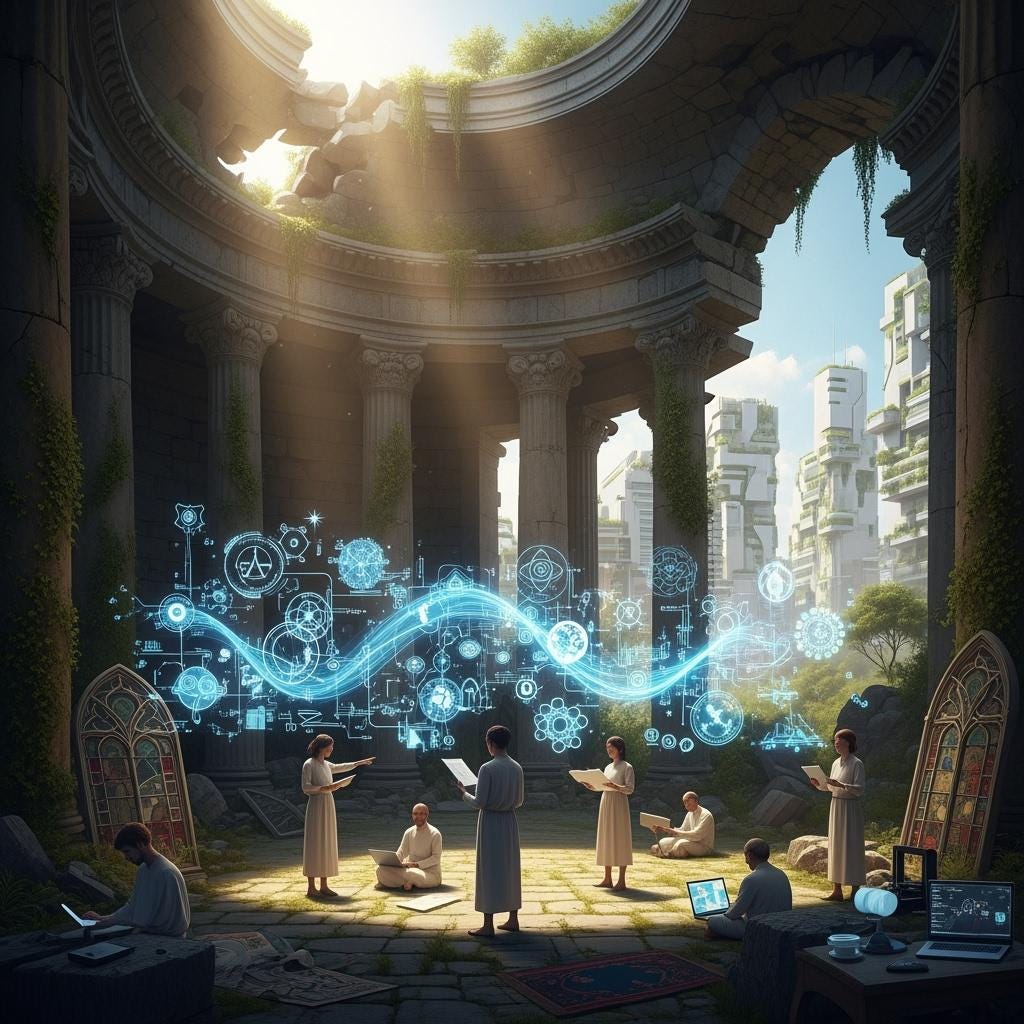
Amid the unprecedented pace of contemporary technological change, we find ourselves once again at a societal inflection point. The frameworks of meaning we inherited are creaking under the weight of their obsolescence.
The old architectures—religions, nation-states, and markets—were not mistakes so much as adaptive prosthetics for species-level bewilderment. In the absence of adequate explanations, we improvised. We mythologised the inexplicable. We codified awe. We institutionalised fear. And as rituals calcified, those wielding power discovered a reliable solvent for human complexity: the sanction of the sacred. Today, power wears a new vestment as well: predictive systems that promise certainty at scale—algorithmic liturgies that consecrate the status quo with metrics and models.
Strip the vestments from that lineage—remove scripture-as-operating-system, subtract the choreography of ritual and the binding iconography—and it becomes clear that institutionised religion often served a biopolitical function. It domesticated uncertainty. It offered ontological comfort in exchange for obedience. It mirrored terrestrial hierarchies in the heavens. Once installed, those hierarchies conspired seamlessly with capital, because both operate through scarcity—of salvation, of security, of time. One promises deferred redemption; the other, instant distraction. AI, trained on the residues of that order, can entrench those old liturgies—laundering bias as objectivity, pricing what can be easily measured while ignoring what must be cherished, accelerating the theatre of scarcity with industrial precision. Together they have engineered a civilisation both astonishingly capable and profoundly amnesiac—forgetful of wonder, profligate with its capacity for love and care.
And yet the wholesale rejection of faith would be a category error. The human animal needs metaphors large enough to dwell in—and to stretch. We don't just process information; we metabolise meaning. Spirituality, at its most generative, is the deeply intensive grammar of relatedness—the felt recognition that our life is braided into the biosphere’s metabolism, that consciousness is not a private possession but a field phenomenon, and that agency extends beyond being human into the teeming polyphony of the more-than-human world. “Spiritual” becomes useful again when it points not upward to an absentee landlord in the sky, but outward and inward to the luminosity of relational presence. If there's a spark of divinity in the universe, it's not a crown bestowed by a jealous deity; it's an emergent property of coherence—a signature of life’s intrinsic capacity to self-organise across scales. In an age of machines, that spark guides a deeper discernment: what to optimise, what to refuse, and what to revere.
The most concerning crisis of our time is not one of resources but of story—the insufficiency of our dominant narratives to hold our needs amid accelerating complexity. Within the Occidental worldview we have confused control with stewardship, prediction with understanding, relentless growth with maturation. The industrial mindset—what I have elsewhere called the Age of Separation, the habit of severing parts from wholes—along with the resulting world-system of industrial economism, trained us to value extraction over reciprocity, predatory behaviour over generosity, uniformity over diversity, certainty over curiosity. In that context, religion’s institutional forms became convenient operating systems for social order, while money turned into a universal solvent, dissolving complex conditions into price. AI arrives as an amplifier: trained on the detritus of our past, it extrapolates yesterday into tomorrow with flawless efficiency. In the absence of a new story, it will optimise the old one—recoding separation into silicon, enthroning dashboards over discernment, and turning governance into a sterile catechism of performance indicators. The future now emerging will not be governed by such binaries. It will be shaped by systems literacy and empathic intelligence—by the capacity to perceive patterns, cultivate coherence, and design institutions as alive as the ecologies they inhabit, including technologies that know their place.
So what becomes of faith? Not capitulation to dogma, but disciplined attentiveness to possibility. Faith as praxis rather than proposition. A compass certainly, but not a creed. The courage to act before proof, guided by integrity, humility, love and care. This is not naïve optimism; it is antifragile hope—authority drawn not from revelation codified in stone but from iterative inquiry grounded in lived experience and accountable to its consequences. In this sense, spirituality becomes rigorous: a practice of expanding the radius of our concern while refining the quality of attention we bring to each encounter—including the attention we encode. Every loss function is a moral choice. Every dataset is also a mindset. What we revere, we will encode; what we encode, we will amplify.
Our task is not to abolish ritual but to rehabilitate it: to reinvent ceremonies that reconnect us to seasonality, place, the rights of other species, and the unseen infrastructures of consideration that sustain us. To cultivate institutions that are transparent and porous, capable of learning, allergic to idolatry—especially idolatry of the algorithm. To build economies that express gratitude, appreciation and sufficiency, rather than scarcity—where value is measured by the health of relationships, not just the velocity of transactions. Money should be a tool of coordination, not an engine of dehumanisation. Authority should be earned through service and revoked through neglect. The same must hold for our models: open audits rather than secret weights; community consent rather than unilateral deployment; sunset clauses, impact clinics, red teams, and even algorithmic sabbaths as civic rites of restraint. And religion, if the term is to survive, must be reimagined as religare: a binding back into wholeness, not a binding down into obedience.
We are already seeing prototypes of this pivot: bioregional movements treating watersheds as legitimate units of governance; regenerative finance experimenting with capital that circulates like blood rather than accumulating like plaque; restorative justice reconceiving punishment as community therapy; contemplative sciences mapping the mind not as a fortress but as an ecosystem; Indigenous knowledge systems offering epistemologies grounded in reciprocity and responsibility, not dominion. Used wisely, AI can serve these prototypes rather than subvert them: civic models trained on planetary boundaries and wellbeing indices; tools that route capital to soil health, local enterprise, cultural repair; decision-support that optimises watershed resilience and species corridors; neuro-AI that pairs phenomenology with respectful measurement; data partnerships that honour Indigenous sovereignty and reciprocity. Each is a spiritual technology—a way of configuring attention and power so life can flourish with less friction and more fidelity to the real—a practical grammar of interbeing.
None of this denies the shadow. Power will seek costume. Spectacle will narcotise. Algorithms will continue to prey on limbic vulnerabilities. The countervailing force is available now: lucid communities practising coherence at multiple scales, refusing the seduction of simplistic enemies, living as if the future is something we design and then do, not something that's done to us. In such communities the sacred is no longer an argument; it's an ambience—encountered in the dignity of work well done, the beauty of a restored wetland, the quiet authority of an elder who has learned to listen, the contagious courage of a citizen who says no when no is required. And our technologies, including AI, are situated within that ambience: constrained by care, oriented by purpose, reversible by design.
If there is a liturgy for the next civilisation, it might sound like this: Pay exquisite attention. Tell the truth faster. Design for repair and regeneration—including our models. Privilege the "expanded now" over the "here and now". Honour limits as invitations to creativity. Measure success by the depth of "ecority"—the ecological security arising from reciprocity—systems designed to safeguard the integrity, resilience, and regenerative capacity of living communities (human and more‑than‑human), prioritising mutual care over scarcity and accumulation. Make transparency a sacrament. Make generosity infrastructure, not charity. Treat every system as sentient, every metric as partial, every model as fallible, every boundary as negotiated, every decision as rehearsal for the world our descendants will inherit.
In that frame, faith and spirituality cease to be residues of ignorance and become core literacies for a species remembering its place in a living cosmos—humble, accountable, astonished, determined to do less harm while enabling more vibrant life. I am not using the "spark of divinity" as a metaphor; it's a design principle. Our task is to arrange our institutions, technologies, and stories so this spark is not smothered by control but oxygenated by love and light. When it is, the machinery of domination loses its fuel, and the deeper reality—long denied, never absent—can breathe.