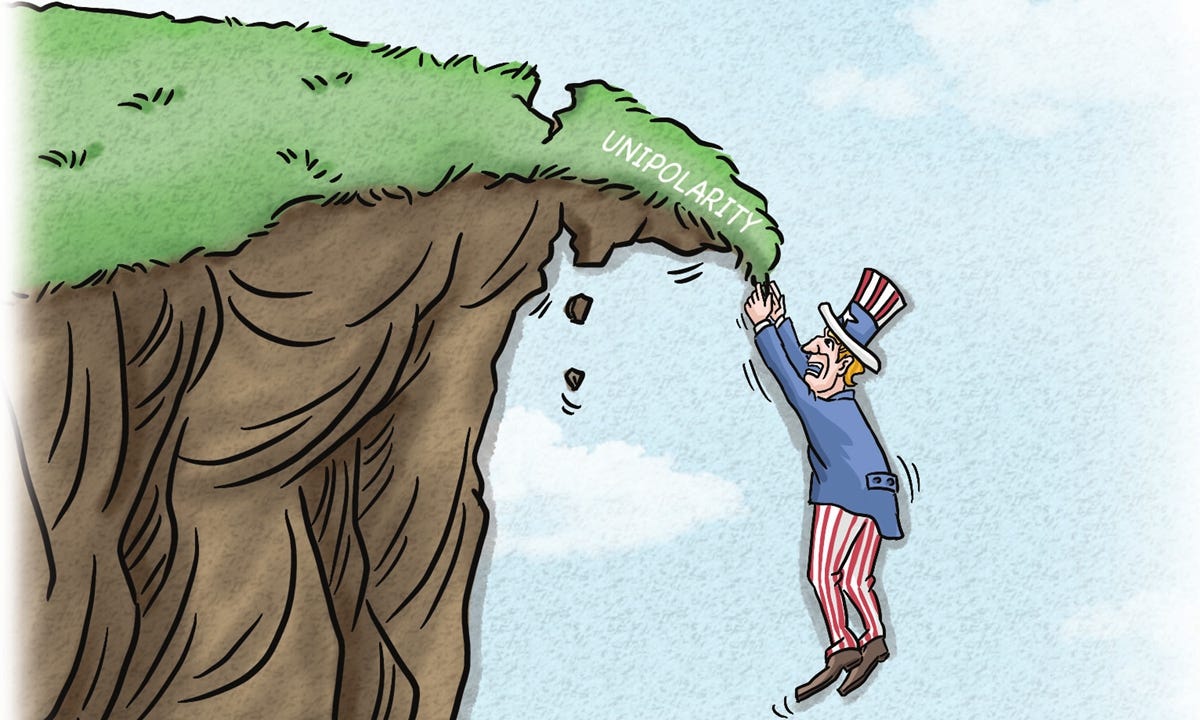
Without the shadow of a doubt, the USA today is the most powerful empire the world has ever seen. Its power is often portrayed as “hegemony,” as if that word were synonymous with stability, order, benign dominion and strategic wisdom. But when you look closely at how that power is actually exercised – from coups and invasions to the kidnapping of foreign leaders – you see something much more brittle and self-destructive. What’s being sold as leadership is increasingly just brute bullying, and bullying, in the 21st century, is a stupid way to run an empire.
The recent US raid to seize Venezuela’s president and drag him into an American courtroom is not an aberration. It’s the latest episode in a long-running series: Iran 1953, Vietnam, Afghanistan, Iraq, Libya – maybe the most extensive catalogue in modern history of how to break a country and then walk away from the wreckage. The common thread is not democracy or human rights. It’s the assertion of a unilateral right to rearrange other people’s politics by force, combined with a near-total disinterest in what happens after the door is kicked in.
In this essay I am making three core claims. First, US hegemony has developed a pathological dependence on regime change and extra-legal coercion that reliably produces chaos, blowback, and civilian misery. Second, actions like the Venezuelan raid and the open talk of “taking” Greenland reflect an explicit doctrine of entitlement – “strength, force, and power” over law, alliances, and norms – that is strategically irrational in a networked world. Third, if this trajectory continues, the United States will not just erode its legitimacy; it will also destroy the alliance and institutional networks that are the real foundations of its global dominance, turning itself from a system manager into a system-level pariah and saboteur.
Regime Change as Hegemonic Habit
The seizure of Maduro is best understood as a continuation of a long-established American habit: deciding that a foreign leader is intolerable, removing or attempting to remove them, and then improvising “next”amid the ruins.
Iran in 1953 is the archetype. Mohammad Mossadegh was overthrown in a coup orchestrated by the US and UK because he tried to nationalise Iran’s oil industry. The Shah was reinstalled and backed for decades as a loyal autocrat. Even the CIA now admits the coup was anti-democratic. The long-term consequences – nationalist resentment, anti-Western sentiment, and ultimately the 1979 Revolution – were not accidents. They were the political sediment of a society that watched foreign powers treat its sovereignty as an inconvenience.
Vietnam extended the same pattern on a larger scale. The United States intervened massively, on the pretext of containing communism and defending freedom, and engineered a war that killed millions, destabilised an entire region, and tore American society open at home. The US eventually left; Vietnam unified under the very regime Washington had tried to prevent, and later became a capitalist trading partner. In strategic terms, the whole operation was an extravagant detour: immense human suffering and financial cost for an outcome that could likely have been reached without a war, had Washington accepted limits on its power.
Afghanistan was supposed to be the place where the US learned from history. Instead, it demonstrated how deeply the lesson has not sunk in. Twenty years of occupation, trillions of dollars spent, countless Afghan and American lives lost, and the final act is the Taliban back in charge. If “nation-building” means anything, it’s the creation of a stable, legitimate, minimally inclusive political order. By that definition, the project failed. The US toppled a regime, tried to assemble a new one in its own image, and when the political scaffolding couldn’t sustain itself without permanent outside force, Washington walked away, leaving behind a brutal movement empowered and legitimised by the very war meant to destroy it.
Iraq is the high watermark of this entire approach, the “crown jewel” of chaotic overreach. The US toppled Saddam Hussein, dismantled the Iraqi state, and created an enormous power vacuum. What followed was predictable to anyone who understood how fragile multi-ethnic, authoritarian-ruled states can be once the centre is smashed: sectarian militias, insurgency, and the eventual rise of ISIS. The decision to invade was wrapped in soaringly adolescent rhetoric about freedom and weapons of mass destruction; the result was a shattered country that became a breeding ground for the very forms of violence the intervention was supposed to prevent.
Libya replicated Iraq in miniature. NATO backed the removal of Gaddafi under the banner of averting an imminent massacre, as if he were nothing but a cartoon villain. What that story edited out was the other side of his rule: one of the highest living standards in Africa, broad access to education and healthcare, and ambitious regional projects aimed at African self‑reliance. Gaddafi was pushing for monetary and political independence from the US‑centred system – including ideas for an African gold‑backed currency – which did not exactly delight Western financial and strategic planners. None of that made him a saint, but it does make the “purely humanitarian” narrative look flimsy. Once the bombs fell and he was gone, there was no serious postwar plan. The state fragmented, militias and regional warlords took over, and rival governments carved up what was left. Once again, the easy part – removing a leader the West had decided to hate – was treated as if it were the whole job. The hard part – building durable institutions, mediating between competing power centres, preventing armed entrepreneurs from seizing control – was treated as an afterthought, if it was thought about at all.
This repertoire – topple, destabilise, exit – is not incidental to US hegemony. It has become one of its principal tools. It rests on a repeated miscalculation: that you can remove a single person at the top and produce a better, more pliable system without blowing up the underlying power structures. History says otherwise.
Venezuela as the Next Iteration
Seen against this backdrop, the US operation to “snatch” Maduro and appear to legitimise it via a US court is the same script, with a new cast and a slightly different setting.
The surface story is familiar: a corrupt, authoritarian regime presiding over economic collapse, humanitarian crisis, and political repression. The deeper story, already visible in the commentary and political rhetoric, has the same old smell: oil. Venezuela has enormous reserves. Almost immediately, talk emerges about US oil companies participating in “rebuilding” the country while shares in Chevron and ExxonMobil go through the roof. The incentives line up in a now-routine way: replace an unfriendly government sitting on valuable resources with one more aligned with US commercial and strategic interests.
If the animating concern were Venezuelan welfare, the priorities would look different. The opening move would not be a paramilitary snatch operation but a massive humanitarian and institutional package: emergency food and medical supplies coordinated through neutral channels; investment in power, water, and healthcare infrastructure; the creation of anti-corruption mechanisms with genuine independence; binding rules to prevent a rush of foreign firms from slicing up national assets on predatory terms. In other words, if you cared first about Venezuelans and only second about leverage, you would build institutions before you rearranged elites.
Instead, the pattern repeats. Remove the leader; treat the future political order as an administrative detail. The assumption is that once the “bad guy” is gone, the invisible hand of markets and some loosely defined “democratic transition” will sort everything out. But regime change is not a polite reshuffle. It detonates power structures.
When you decapitate a regime – particularly in a state whose entire political economy has been organised around a strongman, oil, and patronage – you don’t get an instant level playing field. You get a free-for-all. Armed groups scramble to control territory and revenue. Old elites attempt comebacks. New factions backed by different foreign sponsors emerge. Criminal networks, seeing enforcement and intelligence falter, expand. What had been a repressive but coherent order becomes an arena in which “stability” is redefined as whoever has the most guns and the deepest pockets at any given moment.
The result is not liberation but a different form of captivity: societies trapped in cycles of revenge, fragile coalitions, and the constant threat of renewed conflict. Civilians invariably pay the price. The pre-intervention regime may have been brutal, corrupt, and economically disastrous. The post-intervention environment can be all of those things plus anarchic and chronically violent.
There is also the precedent. If the US can unilaterally declare a sitting foreign leader a criminal, send in special forces, and haul him into a domestic court, then the norm that heads of state are not to be kidnapped by other states collapses. Once that behaviour is normalised, nothing stops other major powers from doing exactly the same thing. They will have their own lists of “criminal” leaders, their own ideological justifications, their own spectacular raids to showcase to domestic audiences. The world becomes less a rules-based system and more a marketplace of competing vigilante sovereignties.
That is the Venezuelan operation’s deeper significance: not just what it does to Venezuela, but what it does to the fabric of international order.
From “International Niceties” to “Strength, Force, and Power”
The Trump-era rhetoric around these moves is unusually frank. When a senior White House advisor like Stephen Miller goes on television and says that international law is just “international niceties,” and that the world is governed by “strength, force, and power,” he is not improvising. He is articulating a doctrine: that constraints – legal, moral, institutional – are signs of weakness, and that a great power should not be bound by them.
The discussion of “taking” Greenland is a grotesque but revealing example. The logic is almost comically crude: Denmark is small and militarily weak; the US is large and strong; therefore, if Washington wants Greenland, it should simply take it, because “nobody’s going to fight the United States militarily.” The old colonial equation resurfaces in pure form: weak equals available.
This way of thinking has two key features.
First, it defines power in purely material and coercive terms: who has the bigger military, who can impose their will. International law becomes window dressing – something that matters only insofar as it constrains you from doing what you want. Alliances are reinterpreted less as mutually beneficial security architectures and more as free-riding arrangements that shackle American freedom of action.
Second, it cannot process complexity. It sees discrete, short-term transactions – take island, get minerals – but is blind to network effects and systemic value. It does not calculate what is lost when you behave like a thief in a neighbourhood where your wealth actually depends on everyone trusting you with their money, their data, and their security.
The Greenland Thought Experiment: Strategic Stupidity in Practice
Run the numbers on the Greenland fantasy, and the irrationality of this dominance doctrine becomes obvious. If the United States chose to acquire Greenland through coercion or the threat of force in a way that shattered the core of the Western alliance system, here is roughly what it would be putting at risk:
- A tightly linked economic bloc worth about $35 trillion, where US companies are deeply embedded as major traders, investors, and standard‑setters.
- A worldwide network of 750+ US military bases that only exists at this scale because other countries host them, politically tolerate them, and cooperate with them.
- The dominance of the US dollar, which depends on global confidence in US political, legal, and financial institutions and is reinforced by the wider Western banking and payments system.
- Any serious effort to contain or balance China, which is impossible without willing partners in Europe and Asia; American ships and planes alone are not enough.
- The entire edifice of intelligence-sharing arrangements like the Five Eyes, which give the US extraordinary reach for relatively little marginal cost.
- Hundreds of billions of dollars in long-term defence, technology, and energy contracts premised on interoperability and shared security commitments.
And what would it gain?
- Some rare earth minerals whose extraction and processing would take a decade or more to scale.
- Arctic strategic positioning that it already substantially enjoys via Alaska.
- A small new population and a territory whose development would require massive investment.
- Severe reputational damage and the status of an international pariah.
In net terms, it would be trading trillions in real, present, and structural value – alliance-provided reach, financial centrality, technological leadership – for a hypothetical, long-term gain measured in the low hundreds of billions, at best, and that only if everything went smoothly. It is like burning down your mansion and alienating your wealthy neighbours in order to steal their plastic garden ornament. This is not “hard-nosed realism.” It’s a failure to recognise what power actually is in a complex, interdependent system.
Network Power vs. Territorial Control
The real strategic lesson here is that in the 21st century, power is less about owning territory and more about controlling networks: of money, information, security, and legitimacy.
US global dominance after 1945 did not come from annexing large amounts of land. It actually came from designing and sitting at the centre of a new architecture: NATO and other alliances; the Bretton Woods financial institutions; the dollar-based global payments system; global trade regimes; technology and standards bodies. This networked hegemony created a world in which the path of least resistance for most states was to integrate with systems the US controlled or heavily influenced.
When you are the hub of those systems, everyone has to work with you. That is power! They need your markets, your security guarantees, your financial channels, your recognition. You do not have to invade their territory to shape their choices. You can set rules, offer access, withdraw privileges, and coordinate collective responses through institutions that, however imperfect, have a veneer of shared legitimacy.
This is precisely what China has understood in building the Belt and Road Initiative. It is not colonising huge blocs of land. It’s constructing infrastructure, finance, and trade links that make other countries’ economic futures dependent on Beijing’s continued goodwill and capacity. That is network power: you make yourself the indispensable node in other actors’ development plans.
By contrast, when a hegemon starts behaving like a cartoonish imperial bully – a “Dennis the Menace” threatening to “take” pieces of other countries, abducting heads of state, publicly mocking international norms – it sends a very clear message to everyone else: you cannot safely rely on this country. You need alternatives. You need to route around the hub. That impulse may be slow in coming, but once it gathers pace, it’s hard to reverse. New financial arrangements are built to reduce dollar exposure. New security partnerships are explored. New standards, payment systems, and diplomatic forums emerge.
In other words: dominance thinking erodes the very network structures that make dominance possible.
Internal Contradictions: Elites Who Need the Network
Inside the US, there are powerful actors who understand this, not out of moral clarity, but out of self-interest. The business and technology communities depend on a stable, cooperative international environment. Elon Musk doesn’t need Greenland; he needs European, Asian, and other markets where contracts are enforceable and trade rules are predictable. American tech firms rely on a world where US data standards, intellectual property rules, and platform norms are widely accepted – an acceptance underpinned by America’s reputation as at least somewhat rule-bound.
The financial sector lives on dollar hegemony: the fact that global trade, reserves, and capital flows are denominated in US currency. That status is not guaranteed by brute force alone. It rests on confidence that the US will not arbitrarily weaponise access to its currency and banking system against everyone, all the time.
The Pentagon, despite its appetite for resources and latitude, also knows that alliances are irreplaceable force multipliers. NATO, Asian alliances, and partnership networks save the US enormous sums and extend its reach. A US military that has to operate in a world where host nations are suspicious, intelligence flows are curtailed, and allied cooperation is contingent on daily transactional bargaining is a weaker military.
So there is a structural tension. On one side, you have a political and ideological tendency that glorifies unilateral action, territorial swagger, and contempt for law. On the other, you have economic and strategic interests that require a stable, rule-laced network in which the US is trusted enough to be the central node. As Washington leans further into the fantasy of cost-free dominance, it endangers the precise conditions that make its wealth and security possible.
Madness at Home: Trade Wars, ICE Raids, and Crypto Carnivals
If this was just about foreign adventures, you could at least pretend there’s a wall between “over there” and “over here.” There isn’t. The same dominance‑addled mindset that kicks down doors abroad is now busy sawing through the floorboards at home.
Take the tariff wars. Trump didn’t just tinker with trade policy; he took a sledgehammer to decades of economic integration because he wanted to look tough. Tariffs on China, tariffs on allies, threats to blow up NAFTA, abuse of “national security” exemptions to hit European steel – all sold as defending American workers, all executed with the subtlety of a drunken brawl.
On paper, this is about leverage. In reality, it’s the Greenland logic applied to global supply chains: destroy trillions in network value just to prove that you can. You raise costs for your own consumers and manufacturers, you push allies to quietly diversify away from you, you encourage China and others to build alternative trading and payment networks. You turn the US from the predictable hub of the system into the guy who might flip the table if he doesn’t like the hand.
That’s not hardball realism; it’s economic self‑harm dressed up as patriotism. It tells every trading partner: you cannot trust our word, our signatures, or our institutions. Today it’s tariffs; tomorrow it’s sanctions; next week it’s some made‑up emergency to rip up another agreement. And then Washington acts surprised when countries start experimenting with non‑dollar trade, new blocs, and backup plans that don’t require begging the US Treasury for mercy.
The same war‑on‑everything mentality shows up in how the US polices its own borders. ICE operations have turned immigration enforcement into a quasi‑counterinsurgency campaign. Raids at workplaces, dawn arrests, vast detention centres, kids in cages, “zero tolerance” policies that proudly separate families – all under the banner of “law and order,” all administered with a casual cruelty that might as well have been focus‑grouped for maximum terror.
The message to the world is simple: this is a country that will lecture you about human rights while running its own mini–gulag archipelago along the southern border. It exports the idea of “law enforcement by force” to other states and then re‑imports the same playbook at home. Once you normalise black‑bag operations and legal exceptionalism abroad, you don’t just stop at the water’s edge. You teach your own security agencies that restraint is optional and that the line between “foreigner” and “enemy” is thin and negotiable.
So yes, you might reasonably decide it’s not the safest time to stroll into that system as a visitor and hope you don’t get caught in whatever theatre they’re staging this month.
And then there’s the economic circus: the Musk–DOGE–crypto carnival that shows how deeply unserious parts of the American elite have become, even as they sit on top of crucial infrastructure.
In any sane hegemon, the people controlling your launch capacity, your satellite networks, your de facto public square, and your military contracts are boring, predictable, and heavily regulated. In the contemporary US, a single billionaire can tweet a meme about a joke coin (DOGE), send markets lurching, and then sit down with generals to decide under what terms his private satellite network will be used in an actual war zone.
Starlink in Ukraine, X (Twitter) as a global information artery, Tesla as a flagship of US industry – and hovering over all of it, a man who treats financial markets like a video game and public communication like an endless trolling contest. That isn’t just a personality problem. It reveals a state that has outsourced major chunks of its strategic capacity to private actors it neither truly controls nor fully understands.
Crypto more broadly – the wild speculation, the pump‑and‑dump schemes, the cults around coins that started as jokes – is the perfect metaphor for this phase of US hegemony: a casino built on real infrastructure, moving real money, with almost no guardrails, whose operators insist that if you get wrecked, it’s your fault for not reading the terms and conditions. The same culture that shrugs at that kind of chaos in finance also shrugs at endless wars and botched interventions. Risk is someone else’s problem. Consequences are for the poor and the foreign.
Put tariffs, ICE, and the Musk–DOGE circus together, and a pattern comes into focus. This is not just a country that destabilises others while remaining a calm, rational hegemon at home. It is exporting and importing the same pathology: contempt for rules, a love of spectacle over substance, and a profound inability to understand that, in a networked world, you cannot keep smashing things without eventually bringing the roof down on your own head.
Captured Policy: AIPAC, Israel, and Distorted Hegemony
If you want to understand how totally off‑the‑rails a hegemon has gone, look at who can tell it what to do. In the US case, you don’t have to look far. The influence of pro‑Israel lobbying – with AIPAC as the most visible tip of a much larger iceberg – is a textbook case of how a supposedly sovereign superpower lets a client state’s priorities bend its own foreign policy into grotesque shapes.
This is not subtle. Congress people show up at AIPAC conferences and read scripts about “unbreakable bonds” like they’re auditioning for a role. Bipartisan majorities pass resolutions that might as well have been faxed straight from a foreign embassy. Any politician who questions unconditional support for Israel – even in the face of repeated settlement expansion, annexation talk, or televised brutality in Gaza – is instantly swarmed with accusations of disloyalty, antisemitism, or “endangering our closest ally.” Careers have ended that way. That’s not a normal marketplace of ideas; that’s enforcement.
The result is that the US, which markets itself as the leader of a “rules‑based international order,” repeatedly gives Israel a pass on the very rules it claims to uphold. Collective punishment, disproportionate force, permanent occupation, two‑tier legal systems in the West Bank – all of this is waved away or wrapped in euphemisms. At the UN, Washington burns through its veto power to shield Israel from even mild censure, then wonders why everyone treats its human‑rights sermons as a sick joke.
Strategically, this is insane. Every time the US writes another blank cheque for Israeli policy, it pays in three currencies: regional hatred, jihadist recruitment fodder, and the erosion of its claim to moral authority. The Middle East is littered with the debris of US attempts to manage the fallout: Iraq invasions, counterterrorism campaigns, “peace processes” that go nowhere, and armed groups that point to US‑Israel actions as their raison d’être. Support for Israel at any cost isn’t just expensive; it keeps generating the very crises that then justify more US militarisation in the region.
From the perspective of my argument, AIPAC and the broader Israel lobby are not an isolated scandal. They’re simply another expression of the same pattern: US hegemony increasingly hijacked by narrow, unaccountable interests that treat American power as a tool for their own projects. It’s the mirror image of Musk treating US launch capacity as his personal brand booster, or ICE treating the border as a stage set. Here, a foreign state and its advocates in Washington help steer the world’s most powerful military and diplomatic machine in directions that regularly contradict US long‑term interests.
And Congress, allegedly the guardian of the national interest, plays along. Not because every member is bought and owned in some cartoonish sense, but because the political cost of crossing the lobby is so high that most simply don’t bother. The effect, from the outside, looks exactly like ownership: a legislature that will pass sanctions on countries thousands of miles away for boycotting Israel faster than it will pass infrastructure bills for its own constituents.
In a rational hegemon, support for allies is conditional and instrumental: are they advancing or undermining the stability of the system you sit atop? In the current US, support for Israel has become quasi‑theological. That is not strategy; that is capture. And it’s one more way in which American power stops being a system‑managing force and becomes a blunt instrument, swung on behalf of whoever can most effectively game its domestic politics.
From Hegemon to Destabiliser
Bring these strands together, and a picture emerges of where this trajectory leads.
First, the routine use of regime change, extraterritorial abduction, and norm-breaking interventions erodes the legitimacy of US leadership. Even allies may privately agree that Maduro is a thug or that Gaddafi was a menace. But they also see that the US claims an extraordinary, unilateral right to decide who governs where, and to enforce that decision with force. Over time, that does not inspire trust. It inspires hedging.
Second, by normalising the idea that power trumps law – that “international niceties” can be discarded when they are inconvenient – the US invites imitation. Other great powers, and some regional ones, will follow the example where they can: Russia in its near abroad, China in its periphery, others wherever opportunity arises. This doesn’t create a world where the US can act freely while everyone else stays deferential. It creates a world where more states feel emboldened to settle scores by force.
Third, this behaviour hollows out the alliance and institutional structures that keep the US at the centre of global politics. If allies come to believe that Washington is willing to sacrifice NATO, trade regimes, or legal norms for short-term, spectacle-driven gains – kidnapping a leader here, threatening a territorial grab there – they will slowly shift their bets. They may not align outright with rivals, but they will diversify: more trade in non-dollar currencies, more regional security arrangements, more investment in autonomous capabilities.
Fourth, as US behaviour shifts from system-manager to system-wrecker, the relative appeal of alternative hubs – China’s economic networks, regional groupings, even ad hoc coalitions – increases. The world does not become more orderly or just. It becomes more fragmented. But in that fragmentation, US capacity to dictate terms shrinks.
The paradox is that America’s “leaders”, in asserting that they will no longer be bound by “niceties,” may end up giving away the most valuable asset the country has ever possessed: not just its raw strength, but the willingness of others to see that strength as at least partially legitimate, and to accept US leadership of the systems that organise global life.
The raid on Venezuela’s president, the casual talk of seizing Greenland, the long history of shattered states from Iran to Libya - these are symptoms of a deeper confusion about what power is and how it works now. A hegemony that rests on networks, trust, and rules can be enduring, even if it’s unjust. A hegemony that insists only on the right to kick down doors and grab what it wants will, in the end, find more and more doors barred, more networks bypassing it, and more of its own strength wasted in performative displays that terrify but in no way persuade.
If the US continues down this path, the question of Venezuela or some hypothetical Greenland crisis, pale into irrelevance. It’s what it will do to itself: how quickly it will burn through the intangible capital of alliance, legitimacy, and centrality that no amount of aircraft carriers can buy back once it’s gone.