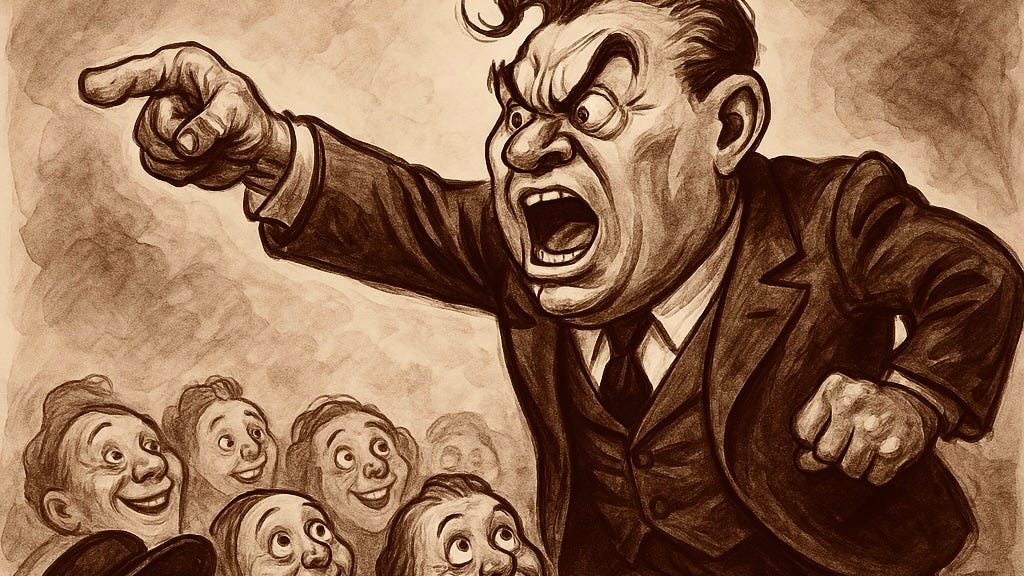
For as long as we have told ourselves stories about power, we have called the protagonists “leaders” and left the rest of the cast in the anonymous chorus of “followers”. That vocabulary is now redundant. It obscures more than it illuminates. In a world where a single algorithm can tilt an election, a legal clause can sterilise a river, and an unseen supply-chain decision can hollow out an entire town, the old idea of leadership resembles a tattered costume kept in the ancestral wardrobe for sentimental reasons. It no longer fits the body politic we have grown into, and it certainly doesn’t equip us for the storm we have conjured.
I have spent much of my life in rooms where people intone the word leadership as if invoking a secular god. Cabinets, boardrooms, community meetings—different décor, same incantation. We revere it, teach it, brand it, blame it. Yet the more we invest in this idea as the organising principle of human affairs, the more we seem to edge towards a cliff whose edge we still refuse to name.
If we’re to avoid walking over that edge altogether, we will first need to be far more precise about what we mean when we talk about leadership, what needs to be composted, and what entirely new shoots might yet emerge from that decay.
Leadership as a Spent Idea
The word itself is exhausted. It carries so much historical sediment that it now drags conversations into the precise ruts we must leave. For several centuries at least, “leadership” has been the label we affix to structures designed to centralise decision-making, legitimise inequality, and furnish moral cover for the organised application of force. The uniforms and rituals change. The core choreography does not, at least not in my lifetime.
Strip away the romantic varnish and an unnerving pattern appears across monarchy, empire, corporate governance, party politics and parts of organised religion. A narrow stratum claims the right to decide on behalf of the many. That claim is dressed up in whatever mythology is marketable or happens to be in vogue—bloodline, divine favour, revolutionary virtue, technical expertise, shareholder value. The story adapts; the same architecture persists.
Within the industrial‑growth paradigm—what I have elsewhere consistently referred to as industrial economism—this architecture has been refined to a dazzling degree, although it’s by no means exclusive to that framework. The monarch is reincarnated as the chief executive. The vassal becomes the employee. The parish is reassembled as the customer base. Progress is measured in throughput. Leadership, in this schema, becomes the art of extracting more, faster, from human and non-human systems whose dignity is treated as a side issue.
When that pattern is scaled globally, the result is a civilisation that behaves as if the living world were a warehouse and the rest of us inventory. It should not surprise us that the same mentality now presides over climate destabilisation, species loss, obscene inequality, and the corrosion of trust in even our most venerable institutions, such as the law and academe. Nor should we be surprised that calls for “better leadership”—more ethical, more diverse, more emotionally literate—have failed to gain traction. They have largely been attempts to humanise an operating system that was never designed to care about the continuity of life.
If leadership continues to mean the right of a few to steer many within the logic of extraction, then leadership, in that sense, has reached the limits of its usefulness. It no longer simply fails to solve our most urgent problems. It actively amplifies them. It’s now a critical risk factor in its own right.
Four Shadows We Refuse to Name
When people complain that “leaders have failed us”, they usually point to character flaws—corruption, arrogance, narcissism, timidity. There are plenty of those, of course. But beneath the personalities lies a deeper pattern of cultural coding; trappings that cling to most leadership cultures irrespective of rhetoric.
The first pattern is domination clothed as responsibility. “I carry the burden for you” quickly morphs into “I know better than you.” Once this logic is accepted, imposing decisions on others becomes an act of supposed care or protection. History is awash with cruelties rationalised as necessary for the greater good. We still witness its milder forms every day: decisions made about people without them present, explained as tough but indispensable calls.
The second pattern is the cult of the hero. We insist on telling stories through sole protagonists: the visionary founder, the reforming president, the genius entrepreneur. Reality, in contrast, is woven from densely entangled contributions—seen and unseen, human and more‑than‑human. Yet we cling to the drama of the singular saviour because it’s emotionally convenient and ideologically tidy. It allows us to outsource agency and blame an individal, rather than interrogate the systems we inhabit and so casually reproduce.
The third pattern is a permanent state of competitive scarcity. Industrial economism instructs us that value arises through rivalry—firms battling for markets, states racing for GDP, universities jostling for rank, individuals clambering over each other on career ladders. In that mental climate, leadership collapses into the craft of winning. Collaboration is tolerated only insofar as it furthers advantage. The guardianship of the commons—shared conditions such as air, soil, cultural fabrics, mental health—becomes decorative at best.
The fourth pattern is temporal myopia. Reward structures are keyed to cramped horizons: quarterly results, election cycles, trending hashtags. Leaders are applauded for defending sunk costs, not for refusing a profitable project that would harm people they will never meet in places they will never visit. Long arcs—future generations, global ecosystems, civilisational viability—receive eloquent speeches but scant operational attention.
These four habits—domination, hero worship, competitive scarcity, and short‑termism—are not incidental flaws. They are built into upbringing, schooling, work, worship, governance and media. Children learn to obey authority well before they are invited to exercise discernment. Students are sorted into pyramids of “talent”. Congregations are accustomed to following. By the time those same individuals enrol in leadership programmes, most of the wiring is already in place.
Viewed from that angle, the contemporary crisis of trust may not be a crisis of leadership at all. It may be the first hesitant recognition that the story we’ve consistently told ourselves about leadership is no longer credible.
Civilisation as Managed Irresponsibility
Nowhere is this more apparent than in geopolitics. The modern state system was assembled around an idea of sovereignty that made sense in an era of slower feedback loops and less technological reach. The Westphalian settlement imagined a patchwork of rival “we’s” defending their turf and negotiating rules of engagement. It simply didn’t foresee a civilisation whose tools would eventually be capable of triggering planetary tipping points.
Today, the same doctrines—national interest, deterrence, comparative advantage—govern decisions about weapons systems, energy policy, financial flows, and data architectures. Each government insists its first obligation is to “its own people.” Yet the cumulative impact of their choices is felt in the chemistry of the atmosphere and the stability of oceans. No single leader experiences direct accountability for that aggregate. Each can point to the provocations and defaults of others. The effect is a highly rational system, on its own terms, that behaves almost suicidally when viewed from the vantage point of the biosphere.
When the horizon of responsibility stops at the border, or worse at the next election, leadership degenerates into an elaborate apparatus for distributing irresponsibility. Climate breakdown, mass displacement, pandemics, financial shocks, and automated warfare are presented as external shocks to be managed. In reality they are symptoms of an operating logic that renders truly shared responsibility almost unthinkable.
Can such a system simply be reformed by urging political leaders to be nicer or wiser? Or must the idea of leadership that underpins it be retired in favour of an entirely different way of organising collective agency and obligation? If the second is even remotely plausible, then clinging to the old vocabulary may be one of the ways we avoid the depth of change now required.
From Leaders and Followers to Co‑Creators of Conditions
When I speak of leadership, I’m no longer referring to the familiar image of a lone figure at the front of a room, a country, or a logo. I am referring to a phenomenon that arises when human beings come together to improve one or more aspects of the human condition. Without that intention—to reduce suffering, enhance meaning, protect the vulnerable, repair damage—we are dealing with technique, manipulation or tyranny, not leadership in any sense I would care to defend.
Seen from this angle, authority is less a personal trait and more a property of relationships. There are moments when someone speaks or acts in a way that crystallises what a group values, making latent possibilities more tangible. That is leadership‑as‑function. It doesn’t require a title, a corner office, or a portrait in the foyer. It requires attunement to a shared identity and a willingness to bear risk on its behalf.
The corollary is awkward for many of our institutions: there’s no such thing as a permanent leader. There are only recurring invitations to perform leadership functions in different contexts. The moment someone declares “I am a leader” as if it were an enduring identity, we should be alert to the temptations of ego and branding.
At the other end of the old binary, the notion of followers becomes increasingly untenable. In tightly-coupled societies, everyday actions carry systemic consequences. The food a parent chooses to buy, the projects an engineer chooses to tackle, the platform a programmer chooses to build for, the narrative an educator chooses to reinforce: all nudge complex systems. We already participate in shaping shared conditions whether we acknowledge that or not. The real question is whether we learn to do so consciously and with discernment.
In that sense, the future once labelled “leadership” will not be built by better heroes with larger stages. It will emerge as more of us accept that we are implicated in the fates of strangers and species we will never know, and insist that any structure claiming authority must demonstrate that same awareness in practice.
From Commanding People to Tending Conditions
If the classic image of leadership is a person directing others, the image that needs to supersede it is a pattern of shared care for the conditions on which life depends.
This is not a sentimental distinction. It has concrete implications. The focal point shifts from controlling people to nurturing relationships and monitoring feedback loops. The unit of moral attention widens beyond in‑groups to encompass the fields we share: watersheds, information ecologies, labour markets, urban fabrics, digital architectures, and the subtle climates of trust and fear.
Power itself looks different through that lens. Industrial economism imagines power as ownership, manipulation and control—possessing land, capital, data, intellectual property, reputations, armed force. Stewardship, or guardianship if you prefer, starts instead from the recognition that most of what we treat as assets are in fact flows. Nobody truly owns a river, a language, an algorithm, a child. We occupy temporary positions within currents that pre‑date us and will outlast us. The sane question is not “What can I extract?” but “What quality of conditions will remain because I touched this flow at this time?”
Once power is reframed as temporary custodianship, three habits of mind start to look untenable. The first is extractivism: the belief that it’s acceptable to maximise financial returns from practices that degrade the living systems upon which those returns rely. The second is the convenient fiction of “externalities”—harms offloaded onto communities, other species, or future generations simply because they don’t immediately appear on a balance sheet or opinion poll. The third is the idea that accountability stops at the human and the present.
None of these are easily relinquished. They are embedded in law, theology, economics and common sense. Yet if we maintain them, no amount of cleverness elsewhere will prevent our civilisation from shredding the self-same conditions that sustain it.
A future worthy of the name will require that any person or institution claiming the right to shape decisions at scale be held to a simple, ruthless standard: do your actions enhance or diminish the long‑term capacity of diverse life to thrive? Not just in your jurisdiction, not just for your shareholders or supporters, but across the webs of consequence you touch. If the answer is routinely the latter, then whatever you are practising, it’s not leadership, however glossy your brochures or stirring your speeches.
Deep Design: Changing the Code, Not the Wallpaper
Faced with accelerating breakdowns, the common response has been to adjust attitudes while leaving architectures intact. We exhort those we annoint as “leaders” to be more authentic, more transparent, more authentic, more empathetic. We build training industries around emotional literacy and mindfulness. Organisations hire Chief Sustainability Officers while continuing to reward the very behaviours that corrode social and ecological resilience.
These gestures can soften edges and slow damage. They do not reconfigure the underlying logic. If the destination remains an ever‑expanding volume of extraction, then leadership development becomes a polite way of reconciling cosmetic virtue with systemic vice.
What’s needed instead is work at the level of the code—the often‑invisible beliefs and rules that generate repeating patterns of harm. That work is less like painting a house and more like attending to the soil from which it sprang. It demands that we ask unfashionable questions. Like, why do we equate well‑being with perpetual growth in commodity production? Why do we treat competition as a natural law, rather than a cultural choice? Why do we permit technologies that destabilise attention, discourse, and democratic process to be deployed at industrial scale without prior proof of safety?
If the answers are vague, evasive or reliant on “that’s just how the world works”, then the design has become a prison.
Deep design, as I use the term, is not grand blueprinting. It’s closer to what Pacific navigators once did when they steered by the taste of the wind, the rhythm of waves lapping on the hull, and the habits of birds. They accepted that the ocean was volatile and the stars partially veiled, yet they learned to feel for patterns and adjust course continuously. In a similarly fluid civilisational ocean, clinging to rigid strategic plans grounded in obsolete assumptions is a form of magical thinking. We need the capacity to sense weak signals, to revisit axioms, to abandon cherished projects when their wider effects become apparent.
None of this can flourish in organisations or polities that still measure success entirely in narrow, short‑term outputs. Until we re‑write what counts as success, leadership education will remain an elaborate exercise in teaching people to play a destructive game with marginally better manners.
Technology Without Adults
The crisis of leadership is magnified by a technological acceleration that has rapidly outpaced our moral maturity. Large‑scale data harvesting, machine learning systems that pre‑empt human intentions, synthetic biology, autonomous weapons, high‑frequency trading—none of these inventions appeared in a vacuum. They grew in the hot‑house of industrial economism, watered by investment seeking rapid returns and geopolitical leverage.
In that environment, capability is routinely mistaken for legitimacy. The fact that we can does duty for the question of whether we should. Those building and deploying such tools are rewarded for speed, disruption and scale, not for restraint or long horizons of care. Any talk of stewardship risks being relegated to ESG reports, while the real decisions are taken in closed meetings where quarterly targets, market share, or national security imperatives frame the discourse.
If we’re honest, no existing institution—corporate, governmental or multilateral—has yet demonstrated the capacity to steward these technologies responsibly at planetary scale. When surveillance architectures envelop entire populations, when weapons can be triggered by algorithms, when content streams can be manipulated to inflame division, the space for thoughtful collective deliberation shrivels.
The future of leadership, if the word is to retain any dignity, must include the capacity to say no—to decline certain kinds of power because the long‑term risks to shared conditions are too great. That may sound unrealistic in a world caught up in an arms race of innovation. Yet refusing to set such limits is itself a decision with massive consequences. If those decisions continue to be taken by a tiny elite, insulated from the fallout, we will be living in a civilisation where power has become almost entirely decoupled from responsibility.
Sovereignty in a Shared Atmosphere
The same entanglement undermines the old romance of sovereignty. The nation‑state was a brilliant invention for organising taxation, warfare, and industrial policy. It has proved far less adept at handling phenomena that ignore borders: greenhouse gases, viruses, digital propaganda, capital flows.
Nonetheless, our current geopolitics remains enthralled by the idea that each state must maximise its relative advantage. Oil reserves become bargaining chips. Migration becomes a threat narrative. Trade becomes a theatre for subtle (or not so subtle) war. Under such conditions, any government that seriously attempted to behave as a trustee of the global commons would risk being outmanoeuvred by less scrupulous rivals in a game of sheer thuggery.
This is how we drift into a collective tragedy while each actor insists it’s merely protecting its own. Climate accords are signed with great fanfare and quietly undermined. Arms control treaties are framed and then forgotten. Fossil fuel subsidies survive in the eclipse of climate pledges. Leadership, in this theatre, amounts to finding artful ways of reconciling domestic demands with the illusion of global responsibility. It is farce, pure and simple.
At some point we must ask whether the Westphalian grammar of competing sovereignties is compatible with a viable planetary civilisation. If we suspect it is not, as I concluded decades ago in an essay entitled “Requiem for the Nation State”[i] then the future once allocated to “world leaders” must lie elsewhere: most hopefully in overlapping forms of guardianship that can hold genuine loyalty both to particular communities and to shared conditions of life.
Such a shift need not entail a naïve dream of a single world government. It might instead mean cities, indigenous networks, regional alliances, professional bodies and citizen movements taking on more explicit responsibilities for protecting specific commons while states relearn humility. In that world, those we once called leaders would be judged less by their capacity to dominate rivals, and more by their willingness to submit their own interests to tests of planetary viability.
Beyond the Hero: Distributed Guardianship.
If the language of leadership is laden and the language of stewardship risks being co‑opted, what vocabulary can carry the weight of what is now needed without collapsing back into old habits.
For the moment, I am willing to continue using “stewardship” as a working term, but only if we strip it of its sentimental varnish. Stewardship, in a political and economic sense, is not about being nice. It is not a soft add‑on. It’s the disciplined art of protecting and enhancing the generative capacity of the systems upon which we depend, in full awareness that such protection will often require confrontation, restraint, and occasionally the judicious use of force.
A steward worthy of the name does not seek applause. Indeed the most effective forms of stewardship are unobtrusive and distributed—thousands of small acts of care and course correction that rarely make headlines but cumulatively alter trajectories. That’s already how communities under stress survive when formal leadership fails them: through informal networks of mutual aid, improvised safety nets, and a stubborn refusal to abandon one another.
The future of what we used to call leadership will look more like this: less choreography from the top, more skilled convening from the side; fewer grand visions announced from podiums, more collective sense‑making across boundaries; fewer career “leaders”, more people willing to adopt guardianship functions for a time and then relinquish them.
Under such conditions, institutions will need to change shape. Rather than pyramids designed to concentrate power, they will need to function as scaffolds for collaboration—structures that distribute information, host challenging conversations, and make it easier for dispersed actors to align their efforts around the health of shared conditions.
Whether our existing political parties, corporations, and multilateral bodies are capable of such metamorphosis is an open question. It may be that new forms—city networks, indigenous‑led councils, citizens’ assemblies, cross‑border guilds—will prove more fertile ground. What matters is not the label on the door but the pattern of responsibility enacted within.
Authority Without Idols
A final caveat is needed. Rejecting leadership as an identity does not mean rejecting authority, or the collaborative spirit that makes authority tolerable in the first place. Complex situations will always require competent people to step forward, synthesise information, make judgements, and take decisions that affect others—but always in conversation with those affected, never as solitary oracles. The question is on what basis that authority is granted, how it is constrained, how deeply it’s embedded in shared deliberation, and how easily it can be withdrawn.
In the old script, authority was tied to position and insulated by mystique. In the script we need, authority should be understood as a temporary licence granted by those affected, contingent on demonstrated guardianship of shared conditions. It must be transparent, accountable across time as well as space, and allergic to the theatre of infallibility.
At its most radical, this reframing would require us to redesign the more superfluous rituals of politics. Leadership contests must cease to be gladiatorial spectacles between personalities, incited by the media, and become examinations of stewardship capacity. Elections must be less about slogans and more about testing candidates’ grasp of systemic interdependence and their willingness to bind themselves to long‑term constraints rather than the short‑term expediencies of a political party. Geopolitically, no single office‑holder would retain the unilateral power to make decisions whose consequences could jeopardise complex life on Earth.
Is such a transformation likely? On current evidence, it would be brave to say yes. But likelihood is a poor compass when the default trajectory points towards breakdown. The more honest question is whether we can imagine a viable civilisation that continues to treat leadership as the province of heroic individuals entrusted with pyramids of power, given what we now know about our impact on the living world. If the answer is no, then we have little choice but to experiment with other forms of collective agency, however haltingly and imperfectly.
What Comes After Leadership?
We may be inhabiting an in‑between epoch: the old hero‑leader has lost credibility, but a coherent post‑predatory alternative has yet to crystallise. In such liminality, language is inevitably provisional. Still, certain contours are emerging.
First, any future worthy of human intelligence must abandon the pretence that leadership is about rallying a bordered “us” against a threatening “them”. In a shared atmosphere, that imagination is a luxury we can no longer afford. Authority must increasingly be exercised on behalf of conditions that sustain many “us’s”—human and otherwise—not just the constituency that votes or pays.
Second, leadership must cease to be a badge of status and return to being a description of relational competence. Those who seek such roles should be wary of their own appetite for prominence. Those who grant such roles should be relentless in tying them to demonstrable capacities: systemic literacy, ethical discernment, anticipatory foresight, and the courage to confront one’s own complicity.
Third, we must become far less impressed by spectacle and far more attentive to consequences. A future of mature leadership—if we continue to use that label at all—will be one in which the planet is less interested in what leaders say, and far more insistent on what their decisions actually do to rivers, minds, forests, cultures, and futures. Anything less is an echo of the story that brought us here: a story in which strong men, backed by sophisticated machinery and flattering myths, promised to lead us into abundance and delivered instead a tapering world. That story has spent its moral credit. The world it built is signalling, in fires and floods and fraying nerves, that it cannot carry much more of the same.
What replaces it will not be a single doctrine or a new idol. It will be a slow, uneven, and probably chaotic shift towards a different organising question. Not “Who will lead us?” but “How do we share responsibility for the conditions that allow life, in all its startling variety, to continue?”
Whatever language we eventually settle upon for that work—institutional, spiritual, poetic—that, for me, is the future formerly known as leadership.
[i] Reforming the Public Sector, edited by C. Clark and D. Corbett, published by Allen & Unwin in Australia in 1999