Introduction
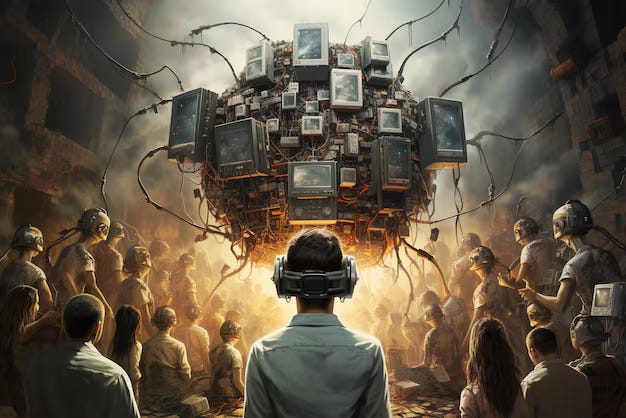
Language doesn’t simply mirror the world; it constructs it. Words and images are not passive reflections but active instruments, shaping collective understanding and channelling public sentiments towards particular ends. Journalism, long revered as the “fourth estate”, is supposed to hold power accountable. Yet too often, it functions less as a watchdog than as a cog in the machinery of propaganda. Through rhetoric, imagery, and selective framing, it manufactures consent for policies that might otherwise meet resistance.
To critique journalism as propaganda is not to suggest a conspiracy of editors and reporters. It is to identify systemic entanglements – structural, philosophical, and technological – that bind journalism to the interests of state and corporate power. This essay explores those entanglements through historical case studies, philosophical reflection, and pragmatic analysis, showing how journalism repeatedly serves to entrench fear, narrow discourse, and legitimise conflict.
The Semiotics of Power
The philosopher Roland Barthes argued that language and imagery carry connotations far beyond their literal meaning. A photograph of a soldier saluting is not just a record of a gesture; it is a signifier of loyalty, discipline, and national pride. Similarly, a headline about a “show of force” does not neutrally describe a parade – it frames the event as antagonistic, a warning of confrontation.
Journalism routinely deploys such semiotics. Consider coverage of China’s military parades. Headlines such as “China showcases its military might to rival the West” or “Beijing sends warning to Taiwan” do not neutrally report facts. They construct a narrative of rivalry and domination. Images of missiles rolling through Tiananmen Square reinforce this narrative viscerally, bypassing rational analysis and stimulating fear.
Propaganda rarely requires outright lies. It works most effectively through framing, emphasis, insinuation, and repetition until one mindset becomes the only imaginable reality.
Historical Continuities
This pattern is not new. During the Cold War, Western journalism routinely depicted the Soviet Union as a monolithic aggressor. Television and newspapers alike focused on images of missiles paraded through Red Square, grim‑faced despots waving from the Kremlin, and maps showing arrows of Soviet expansion. Subtlety – internal dissent, cultural vibrancy, moments of détente – was swallowed by the dominant narrative of existential threat. Journalism didn’t merely report the Cold War; it helped produce it.
After 11 September 2001, the same mechanisms fuelled the “War on Terror”. In the lead‑up to the Iraq War, US and British outlets amplified government claims regarding weapons of mass destruction. The New York Times ran front‑page stories citing anonymous officials who claimed Iraq had reconstituted its nuclear programme – claims later proven false. Cable news channels broadcast US military briefings almost uncritically, with graphics of “shock and awe” campaigns. Images of mushroom clouds and ominous maps saturated screens, cultivating fear. All of this was fiction. But the result was public consent for a catastrophic war that left hundreds of thousands dead and destabilised an entire region.
More recently, coverage of the war in Ukraine has exhibited similar tendencies. Western outlets often frame the conflict as a binary struggle between democracy and autocracy. While Russia’s invasion is condemned, NATO’s role as a geopolitical actor is rarely scrutinised with equal rigour. Images of destroyed cities and grieving civilians evoke sympathy, but audiences seldom encounter reporting on peace initiatives or dissent within both Ukraine and Russia. The narrative of inevitable confrontation, with Putin as the sole villain, dominates, narrowing the space for diplomatic discourse.
Even in global health, propaganda logics persist. During the COVID‑19 pandemic, many outlets framed the crisis as a geopolitical contest rather than a shared emergency. Stories about the “race for vaccines” emphasised national competition – Pfizer versus Sinovac, the West versus China – rather than global cooperation. Images of Chinese scientists in hazmat suits were often deployed to suggest secrecy or suspicion, while Western labs were depicted as transparent and heroic. The framing undermined solidarity in what was perhaps the most global crisis of our time.
Journalism Under Fire: Gaza and the Silencing of Witnesses
If Iraq, Ukraine, and COVID‑19 reveal how journalism functions as a propaganda machine, Israel’s ongoing assault on Gaza demonstrates something even darker: when journalism resists propaganda by bearing witness, it becomes a direct target of violence.
Since the escalation of Israel’s assault on Gaza in late 2023, journalists have been killed at an unprecedented rate. International watchdogs such as the Committee to Protect Journalists have called it the deadliest conflict for media workers in modern history. Reporters, camera operators, and photojournalists – many of them Palestinians – have been deliberately targeted in their homes, in marked press vehicles, and even while broadcasting live. Entire families of journalists have been wiped out in bombings.
This is more than collateral damage. It is a systematic attempt to silence witnesses and control the narrative of war. Without Palestinian journalists on the ground, the world would see Gaza only through the lens of Israeli military briefings or Western correspondents reporting from a distance. The killing of journalists is thus not only an attack on individuals but an attack on the possibility of truth itself.
Meanwhile, much of Western journalism has reproduced official Israeli and US talking points, framing the war as “self defence” while playing down or delaying coverage of mass civilian casualties. Language choices – “clashes”, “crossfire”, “conflict” – obscure the asymmetry of power and the scale of destruction. Images of rubble and grieving families circulate, but often without the political context that would illuminate the structural nature of the violence. In this way, propaganda works on two fronts: through the silencing of direct witnesses and through the framing choices of international outlets.
Structural Dependencies
Why does journalism fall so easily into these patterns? Part of the answer lies in the political economy of media. News organisations are owned by wealthy media barons with their own political and commercial interests, and by their corporations dependent on advertising revenue – both factors making them reluctant to challenge powerful sponsors. Simultaneously, journalists rely on access to officials, military insiders, and think‑tank experts. Stray too far from official narratives, and access evaporates.
During the Iraq War, many influential stories came from “embedded journalists”. Access to battlefronts was granted in exchange for compliance, producing narratives that valorised soldiers while minimising civilian suffering. Independent voices – such as Al Jazeera’s coverage of Baghdad or McClatchy’s sceptical reporting – were marginalised or dismissed out of hand.
Similarly, in Ukraine, many Western outlets rely heavily on NATO press briefings and intelligence leaks. Stories are shaped by what officials choose to disclose. Meanwhile, Russian state media mirrors the dynamic, amplifying Kremlin narratives. In both cases, journalism functions as an echo chamber for power.
The COVID‑19 pandemic revealed another layer: corporate capture. Pharmaceutical companies advertised heavily in major outlets, while questions about intellectual property waivers or equitable distribution were muted. The story of public health became a story of corporate competition, with journalism acting as a marketing arm.
As Chomsky and Herman argued in "Manufacturing Consent", media does not require censorship. It self‑censors through ownership, advertising, sourcing, and flak. The result is a journalism that appears free yet often serves as propaganda.
The Technological Amplifiers of Propaganda
While traditional journalism has long been entangled with propaganda, digital technologies intensify the problem. The 24‑hour cycle creates a relentless demand for content. In this environment, speed trumps accuracy, and sensationalism trumps nuance. News “breaks” before it is verified. Propaganda thrives in such conditions, because first impressions are rarely corrected.
Social platforms amplify propaganda by privileging content that provokes strong emotions – fear, outrage, tribal loyalty. During the war in Ukraine, TikTok and Twitter flooded with unverified clips of battles and explosions. Many were fabricated, yet they spread faster than fact‑checked reporting. Propaganda and misinformation merged, eroding trust in all journalism.
Digital immediacy bypasses traditional editorial safeguards. Outlets often publish stories based on viral posts before verification. This creates fertile ground for state actors and interest groups to inject narratives directly into the public sphere. Online journalism is tethered to clicks and advertising revenue. Headlines are crafted to provoke, not to inform. “China threatens Taiwan with overwhelming force” will outperform “China conducts military parade with mixed domestic reception”. The former spreads fear; the latter invites reflection. One is clickbait, the other is ignored.
Algorithms personalise propaganda. A user curious about China may be fed an endless stream of stories depicting it as a threat, rarely encountering perspectives that emphasise cooperation. Propaganda becomes not only widespread but tailor‑made for a gullible audience who don’t have the time or the patience to fact‑check every detail.
Philosophical Dimensions
At a deeper level, journalism’s complicity in propaganda reflects a philosophical failure. Liberal democracies often assume information is neutral – that the availability of facts guarantees informed citizens. But as Michel Foucault warned, knowledge and power are inseparable. How facts are framed, what narratives they serve, and which images are chosen are all exercises of power.
Jacques Ellul, in his classic study of propaganda, argued that modern mass societies make propaganda inevitable. Citizens are bombarded with more information than they can process, making them dependent on simplified narratives. Journalism obliges by condensing complexity into digestible stories and soundbites. But in doing so, it often reduces reality to caricature.
Martin Heidegger’s notion of enframing also applies. Technology, he argued, predisposes us to see the world as a resource to be ordered and controlled. In journalism, the technological drive for speed, data, and visibility enframes reality as spectacle. Stories become consumable fragments, stripped of depth, ordered by algorithms. In this sense, propaganda is not an aberration but the logical outcome of how technology structures perception.
The consequences are profound. Propagandistic journalism fuels nationalism, hardens divisions, and makes diplomacy politically untenable. Citizens, bombarded with narratives of rivalry, come to see conflict as inevitable. Politicians exploit these anxieties to justify military spending and aggressive policies. Journalism then reports the escalation as validation of the original threat. The cycle is self‑reinforcing.
The case studies make the point unmistakable. In Iraq, journalism amplified false claims about weapons of mass destruction, lending credibility to a fiction that opened the door to a disastrous war. In Ukraine, the tendency to frame the conflict in starkly binary terms – democracy versus autocracy, good versus evil – has entrenched militarism while pushing possibilities for diplomacy to the margins. During the COVID‑19 pandemic, nationalistic reporting undermined global solidarity in the face of a shared human emergency, recasting a public health crisis as a contest of geopolitical prestige. And in Gaza, where journalists themselves have been systematically targeted and killed, the stakes become even more chilling: propaganda is enforced not only through framing but through the silencing of witnesses.
Taken together, these examples reveal how journalism, when captured by the logics of propaganda, narrows public imagination, fosters fear, and legitimises policies that deepen violence and division. They also illustrate the pragmatic consequences of propaganda‑driven reporting: once narratives of threat and rivalry are entrenched, they set in motion political dynamics that are far more difficult to reverse. In each case, journalism narrowed public perception, enabling policies that produced violence, division, or unnecessary suffering.
A Different Kind of Journalism
Yet journalism does not need to serve as propaganda. Independent outlets and investigative reporters have shown alternatives. McClatchy Newspapers consistently questioned the WMD narrative in Iraq, even as larger outlets echoed government claims. Some reporters in Ukraine have sought to highlight peace initiatives and civilian voices despite the dominance of militaristic frames. During the COVID‑19 pandemic, a handful of journalists drew attention to the question of vaccine equity rather than reducing the story to corporate competition. And in Gaza, where local journalists have faced extraordinary danger and even targeted killings, their persistence in documenting destruction and amplifying civilian testimony stands as one of the most powerful examples of journalism’s capacity to resist propaganda by bearing witness to realities that states and their allies would prefer to keep hidden.
A different journalism is possible – one that resists militaristic framing, foregrounds cooperation, and humanises rather than demonises. This does not mean denying conflict or sanitising reality. It means presenting complexity, cultivating dialogue, and recognising interdependence in a shared world.
Toward Responsibility
If journalism is to move beyond propaganda, it must reclaim its ethical vocation. Journalists, editors, and photo desks must acknowledge that their choices of words and images are not incidental but world‑shaping. They must resist being stenographers of power and instead become curators of dialogue and narrators of possibility.
This requires structural as well as individual change. Media organisations must reduce dependency on advertising, diversify sources, and resist algorithmic incentives. Education in media literacy must empower citizens to question frames and images. Without these shifts, journalism will remain vulnerable to propaganda’s logic.
Hannah Arendt warned that the greatest danger to democracy is not lies but the blurring of truth and falsehood. Journalism today stands at that frontier. The question is whether it will remain part of the propaganda machine – or break free to serve truth and humanity.
The critique of journalism as propaganda is not abstract. It is a recognition that the media we consume today sets the trajectory of tomorrow’s politics. If journalism continues to function as an amplifier of propaganda, manufacturing consent for conflict, we risk repeating the catastrophes of Iraq, deepening the divisions of Ukraine, squandering the lessons of COVID‑19, and normalising the silencing of witnesses in Gaza – where the killing of journalists has become a strategy to erase inconvenient truths. What is at stake is not only how wars are justified or how crises are framed, but whether the public sphere can sustain genuine democratic debate at all.
But if journalism can embrace its ethical responsibilities dispassionately, it has an essential role to play: helping cultivate the conditions for cooperation in a fractured world. Words and images can entrench division, or they can open pathways to unanimity. In a time of existential crises – climate collapse, civilisational discord, inequality sustained through socio‑economic stratification – that choice has never been more evident. Our future depends on journalism’s ability to resist propaganda and embrace its only true vocation: to serve truth and the possibility of enduring peace.