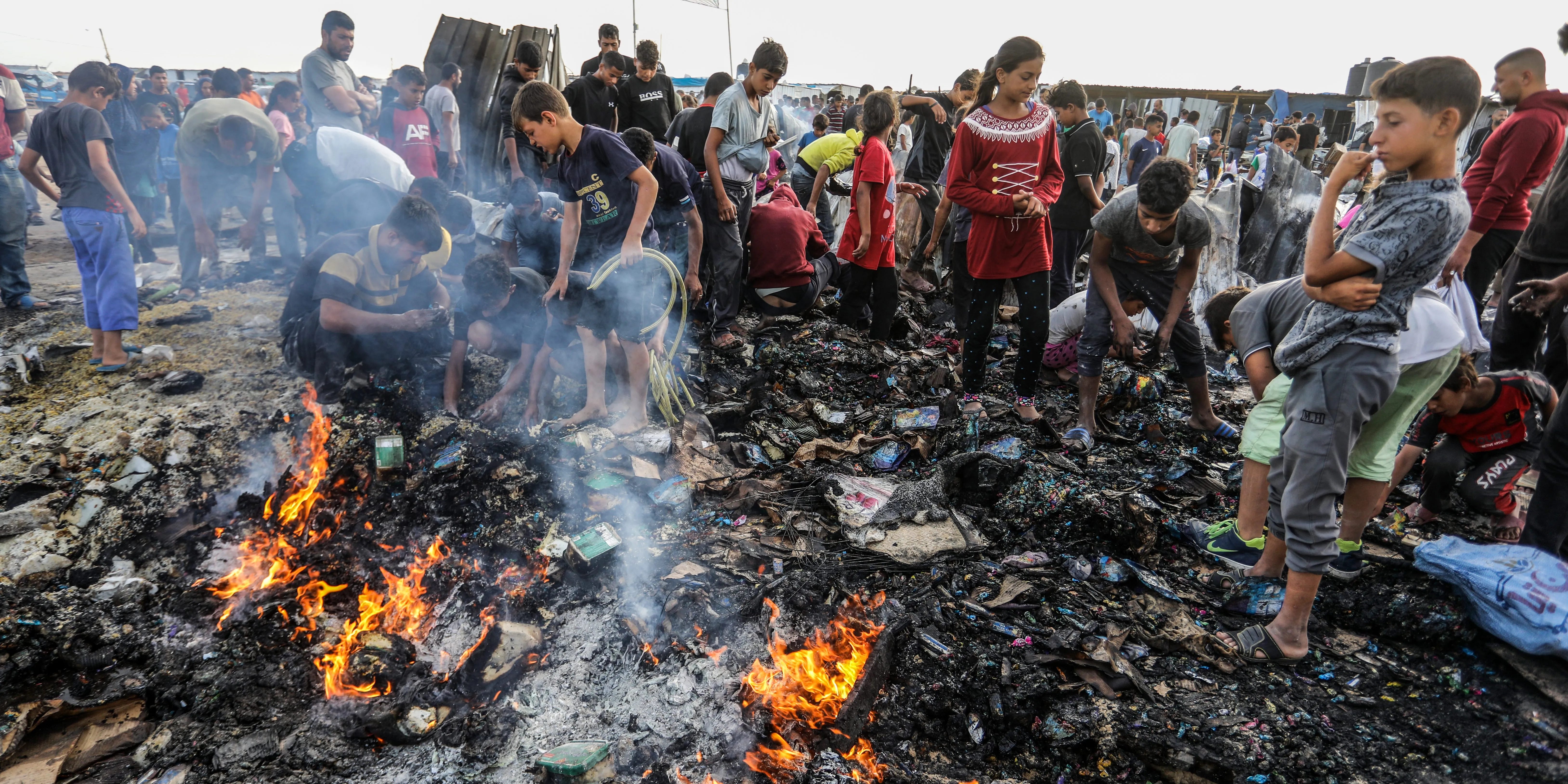
Rafah, June 6th 2024. Dawn doesn’t break; it is broken. The earth convulses beneath a nylon tent that was meant to be a sanctuary of last resort. A woman in her thirties, already uprooted more times than most people change careers, is on the phone to a relative. Her husband has understood what the military planners and legal scholars, the speechwriters and diplomats, will pretend not to see. There is nowhere left to go for this family.
His name is Akram. Her name is Raja. Their children are Mohammad, Ahmed, Ibrahim and Sanaa. For eight months they had been driven from place to place, ordered to flee in search of safety that never once materialised. Thirteen displacements, according to human rights documentation that cross-checks dates and locations with the cartography of bombardment. Each “evacuation order” a bureaucratic incantation, choreographed at a distance, that pushed them from one zone of permissible death to another.
On 6 June 2024, the zone of permissible death arrived in person. Sixty tons of metal and engineering, painted in a livery of security and self-defence, rolled towards their temporary dwelling. In the split second between comprehension and impact, Akram did what millions of fathers say they would do, but are rarely asked to prove: he flung his body across his children, trusting in the frail geometry of flesh against steel.
The tank did not stop. It drove over the tent. Over him. Over Mohammad. Over Ahmed.
When the weight passed, Ibrahim opened his eyes into a world that no child should ever have to know. He was soaked in blood that was not his. His father’s hand had remained clamped over his small body, sealing him into a pocket of life until the last molecule of strength was crushed out of it. Later, in a hospital that might or might not be standing by the time you read this, he reportedly told doctors that he thought he himself had been killed. The blood, the silence, the impossibility of it all. Only afterwards did he understand that he was alive because his father had already died on top of him. Around them, the machines continued to move.
Raja did what human beings are not supposed to have to do to their offspring. She instructed her wounded, terrified son to play dead. To mimic the stillness of his brothers. To borrow the posture of a corpse as a survival strategy. They lay among the remains of their own family, offering a performance of death to stay within the boundaries of life, until the tanks moved on to the next target, the next family, the next scene in this endlessly recycled theatre of annihilation.
Everything I have just described has been collected, corroborated and presented to the world by Palestinian and international human rights organisations, which in turn feed their evidence into institutions in The Hague and Geneva. Lawyers will argue about the legal labels: genocide, war crimes, crimes against humanity. The Rome Statute has its clauses. Customary international humanitarian law has its rules about the protection of the dead and the treatment of civilians. Various UN rapporteurs have already alleged that the pattern of conduct in Gaza meets the threshold for the gravest of crimes; some states and international bodies are edging towards the same conclusion, others are dancing around it. Accrding to Israel’s Prime Minister “It ws a tragic mistake”.
But for Ibrahim, for Raja, for what is left of their family, these debates must appear like a grotesque abstraction. Does the vocabulary matter when you are lying in your father’s blood pretending not to exist?
The End of “Civilisation” as Self-Congratulation
I have spent much of my life interrogating the stories powerful societies tell themselves in order to live with their own reflection. “Civilisation” is one of those words. It sounds benign. Aspirational, even. A shorthand for literacy, science, music, law, good manners, perhaps a decent café and a functioning sewer system.
But civilisation, as it has been practised for the past few centuries, is also a warrant. It’s the certificate societies award themselves when they have achieved a particular level of technological sophistication and material comfort. Once the certificate is framed and hung on the wall, almost any behaviour can be rationalised as “regrettable but necessary.” The civilised, in this schema, do not commit crimes. They administer history.
When a tank drives over a tent in Rafah, killing a father and two of his sons who had already been displaced multiple times by prior waves of violence, we’re invited to see a “tragic incident”, a side-effect of security operations, an unintended outcome. We’re not supposed to challenge that story in order to see what is actually happening: a child learning, in one formative moment, that the most reliable way to avoid being killed by “civilisation” is to impersonate a corpse.
If that is the world we inhabit, are we still entitled to the word?
I have been accused of heresy in more polite circles for saying this, but it might be time to retire the label “civilised” from our self-description. Not because we have regressed into barbarism – that cliché is far too easy – but because the word itself now functions as a device for moral evasion. It allows those who command tanks, draft evacuation maps, sign arms export licences, or sit on corporate boards profiting from the machinery of death, to imagine they occupy a superior ethical plane. Civilisation becomes armour plating. We drape it over our institutions and no longer feel the bones breaking underneath.
What if, instead, we treated “civilisation” as an hypothesis rather than a self-evident fact? A proposition to be tested against lived experience in Khan Younis as much as in Canberra, in Rafah as much as in Rotterdam. Would a civilisation worthy of the name depend on the routine destruction of families as a technique of “deterrence”? Would it require the systematic displacement of entire populations in order to secure the comfort of others? Or is that model of civilisation simply an industrial killing machine with nicer tableware?
Industrial Economism and the Price of Children
The horror in Gaza can be narrated as a localised conflict, soaked in history, shaped by particular traumas and calculated cruelties on all sides. That is not untrue. It’s also a way of limiting the inquiry so that the rest of us can walk away feeling detached. That is where my work departs from the familiar script.
For the past quarter century of my life I have been interpreting the dominant global operating system that now orchestrates almost every sphere of human activity, from energy and agriculture to media and war. I have called it industrial economism – a neoliberal order anchored in extraction, expansion, greed, and the conversion of everything alive into numbers on a balance sheet. It has no centre because it has invaded every centre. It’s not simply a set of economic policies; it is a cosmology. A way of telling ourselves what matters and what does not.
In such a system, human beings are endlessly reclassified. The child peering out from a tent in Gaza is not, in the first instance, a subject of law or an agent in a moral universe. He is a variable in a risk assessment; a potential future militant; an unfortunate “civilian casualty” whose death can be absorbed within the margins of an acceptable operation. Lives are weighed against strategic advantage. Once quantified, they can be written off.
This is not unique to Gaza. It is visible in drone strikes in rural Pakistan, in the casual acceptance of migrant drownings in the Mediterranean, in the willingness to sacrifice entire regions of the global South to climate breakdown in order to preserve patterns of consumption elsewhere. Wherever the logic of industrial economism turns up, we see a similar pattern: children become collateral to someone else’s portfolio of priorities.
The body of Akram stretched over his sons is, in one sense, the most ancient of gestures. It would be recognised by any parent in any culture. Yet it’s also a direct affront to the industrial order. It trashes the algorithm. It places incalculable value on a handful of lives that the system has already discounted. In that split second before the tank advanced, the entire ethical edifice of neoliberal civilisation was challenged by one man’s unquantifiable devotion.
The tank, of course, prevailed in material terms. Akram died. Two of his children died. But this story has escaped the parameters set for it. That’s why you are reading about it now, through fragments assembled by people who still believe that bearing witness is not an indulgence but an obligation.
The Theatre of Law and the Silence of Power
The law, especially international humanitarian law, is one of humanity’s most salient inventions. I say that without irony. It represents a hard-fought attempt, after the industrial-scale slaughters of the twentieth century, to write into treaties and conventions the intuition that some acts are intolerable irrespective of circumstance.
The events of June 6 in Rafah fall squarely within the purview of those instruments. The deliberate or reckless killing of civilians, the repeated displacement of populations under occupation, the destruction of families seeking refuge in designated “safe zones”: these are precisely the acts the authors imagined when they crafted the sections on war crimes and crimes against humanity. Independent lawyers, UN experts, and human rights organisations are already documenting extensive patterns of such behaviour in Gaza and the West Bank. Several cases have been initiated before international courts. Arrest warrants are being requested. States that once stood aloof from these institutions now quote them when it suits their geopolitical rivals to be condemned.
And yet – and here is the crux – the law is speaking into a vacuum of power. The same states that helped construct this architecture also supply weapons, diplomatic immunity and economic cover to those accused of destroying it. The institutions designed to protect children like Ibrahim are reduced to sediment collectors, gathering the debris of shattered lives for some hypothetical future justice.
What sort of civilisation writes beautiful rules about the inviolability of civilians and then funds the ordnance that ploughs through their homes? What kind of rationality applauds itself for establishing courts in The Hague while vetoing resolutions that might interrupt the flow of death long enough for those courts to matter?
This is not simply hypocrisy; it is structural schizophrenia. The apparatus of law is grafted onto a body politic governed by industrial economism. The operating code of the system – extract, dominate, expand – is fundamentally at odds with the ethical commitments engraved in its constitutions and charters. In the competition between armaments contracts and human rights reports, we know, intuitively, which usually prevails.
That is why I find myself increasingly cautious about the civilisational narratives that equate legality with morality. It is possible – indeed, it is demonstrable – that a global order can be saturated with formal norms and still generate Rafah. The problem is not a lack of rules. It’s the deeper worldview that decides when, and to whom, those rules apply.
A Pedagogy of Horror
I became a futurist not because I am enamoured of gadgets or predictive models, but because the future is the only space left where we can still renegotiate the terms of our existence. The past has been pillaged, the present is being administered in real time by machines and markets we barely control. The future, for all its uncertainty, remains open to imagination. And yet, the future is being shaped, invisibly but inexorably, by what our children are learning right now from events like those in Rafah.
What does a six-year-old absorb when he is told by his mother to remain motionless, to imitate the lifeless bodies of his siblings, while machines engineered by highly educated professionals roll overhead? What message does this send about whose existence matters, whose lives are negotiable, whose tears are of no account? If we’re honest, we must accept that this is a form of pedagogy – an education in the true values of our civilisation, running alongside and often in contradiction to everything we teach in classrooms.
From Bangkok to Bogotá our children are exposed to images of war, hunger, displacement and environmental collapse. Some are living inside these crises; others witness them through glowing screens. They also see who rushes to help and who looks away, which deaths are named and mourned, which are anonymised as “insurgents” or “illegals” or “human shields.” They are quietly mapping the contours of a world in which the rhetoric of universal human rights collides daily with the practice of selective empathy.
Is it any wonder that so many young people express profound distrust in political “leaders”, media narratives and institutional authority? They are not cynical by nature. They are simply noticing that the maps they are given don’t match the terrain they are walking.
In my own conversations with students, activists, entrepreneurs and policymakers across Asia, Europe, Africa and the Americas, I encounter the same disquiet. They sense that the global order is built on a foundational lie: that some lives are worth infinitely more than others, and that this inequality is both inevitable and justified. They may phrase it differently, but the intuition is there. The events in Gaza do not create that realisation; they crystallise it.
A civilisation cannot long endure on such a basis without splintering into enclaves of fear and fortresses of denial. Surveillance states, gated communities, militarised borders, algorithmic policing and the like are not aberrations. They are the logical defences of a system that knows, somewhere deep in its circuitry, that it has forfeited moral legitimacy.
Playing Dead as a Global Condition
The scene inside that tent in Rafah is horrifying precisely because it is intimate. A mother, a father, their children, a phone call to a relative. It could be almost any family, anywhere. The tank makes it specific, but the dread is universal.
What haunts me, though, is not only the literal command to “play dead” in order to survive. It’s the suspicion that vast swathes of humanity are being asked – quietly, systematically – to do something very similar.
When entire populations are told that their lands must be sacrificed for someone else’s energy needs; when workers are told that their livelihoods are expendable because a cheaper algorithm is available; when communities are assured that their drinking water will be contaminated “only within safe limits” – are they not being invited to imitate a corpse in slow motion? To suppress their own vitality, their anger, their creativity, in order to stay within the tolerances of an industrial system that cannot bear truly alive, sentient, unpredictable human beings?
Playing dead, in this broader sense, becomes a survival tactic within a civilisation that punishes those who are too vitally alive, too insistently present, too unwilling to accept the status assigned to them. Refugees are told to wait patiently in limbo; indigenous peoples are told to be reasonable as their forests are razed; dissidents are told to moderate their tone if they wish to remain employable. Lie still. Don’t move too much. Perhaps the tank will pass over you and you will escape with “only” psychological trauma.
Gaza renders this metaphor literal. The rest of the world prefers it veiled.
So, when we ask how we can still call ourselves civilised in the face of such episodes, perhaps the more incisive inquiry is this: who, exactly, is included in that “we”? If civilisation is defined by those who command the tanks, control the supply chains and write the communiqués, then we already know the answer. They will go on calling themselves civilised for as long as they can afford the branding. If, instead, civilisation is something we wish to claim on behalf of every living human being – including the child lying in his father’s blood in Rafah – then we must admit that the current global order has failed the entrance exam.
A Different Measure of Being Human
I am often accused of pessimism when I write like this. It’s a lazy accusation. To tell the truth about a system in crisis is not to surrender to despair; it is to clear away the debris of delusion so that something more honest can be built in its place. Hope only becomes possible at that stage.
What, then, might a civilisation look like that does not require children to pretend to be dead in order to satisfy its security doctrines or growth targets? I don’t have a neatly packaged blueprint. Blueprints are the instruments industrial economism uses to replicate itself. But I can sketch a change in metrics if that helps....
At present, we evaluate the success of our societies using indicators that would have seemed bizarre to most of our ancestors: gross domestic product, stock market indices, quarterly earnings, the tonnage of goods moving through digital and physical supply chains. These figures tell us almost nothing about whether people feel safe, loved, nourished, respected, or able to dream. They certainly don’t tell us whether our civilisation is worthy of the name.
What if, instead, we took as a primary measure something like this: in how many places on Earth can a child fall asleep without having to rehearse death as an escape route? It sounds naïve, almost embarrassingly simple. Yet it strikes at the heart of what we claim to value. Security, dignity, meaning, joy – all of these begin with the absence of mortal terror.
Seen through that lens, large swathes of what we like to call an advanced world disclose themselves as zones of chronic non-civilisation. Gaza is an acute eruption, but far from unique. There are districts in major cities where children drift off to sleep accompanied by gunfire; rural regions where, again and again, hunger trumps education; camps in which entire generations grow up without papers, without prospects, every horizon barricaded. Are we willing to acknowledge that the prevailing global order has not risen above such conditions, but is in fact sustained by them?
Refusing to Lie Still
I write this from Thailand, an Australian by nationality, English by birth, shaped by decades of conversation and collaboration across cultures and continents. My work has occasionally found resonance in places far from the Western academies that once assumed a monopoly on theory. In parts of Asia, Africa and Latin America, people recognise instantly what I mean by industrial economism, because they live daily with its colonial externalities. They also know that alternative ways of organising life exist – or have existed – in their own histories.
The difficulty is not a lack of alternative imagination. It is the gravitational pull of a system that punishes deviation with sanctions, stigma or violence. Yet, even within that gravity well, there are people and movements refusing to lie still. Palestinian medics continuing to treat the wounded in collapsing hospitals. Journalists documenting massacres with batteries running low and networks failing. Lawyers filing cases that may take years to process but which keep a record alive. Citizens in distant countries risking their careers, sometimes their freedom, to protest their own governments’ complicity. Parents insisting on telling their children the truth, not the sanitised bedtime story.
These acts are not enough to stop a tank. But they stop something else: the final victory of the lie. They keep alive the proposition that civilisation is not the property of those with the biggest guns or the fastest algorithms, but a fragile, shared agreement about what we refuse to do to each other, no matter the justification.
Whether that agreement can be rekindled on a planetary scale is an open question. We may, as a species, be too far gone into the machinery of our own making. Or we may be, as I have argued elsewhere, on the cusp of a profound metamorphosis, in which the industrial paradigm exhausts itself and new forms of organising life emerge from the edge.
Whichever way history tilts, the image of a child in Rafah, lying motionless under his father’s hand, will remain part of our moral archive. It will ask something of us each time we recall it.
Are we content to live in a world where survival is learned as a rehearsal for death? Are we willing to decorate that world with phrases like “rules-based order” and “shared values” while the bodies are still warm? Or will we finally admit that civilisation, if it is to mean anything more than power wrapped in polite language, must begin with a vow: that no child, anywhere, will ever again need to play dead to be allowed to live?
Until that vow is more than rhetoric, we might be wise to stop calling ourselves civilised and start asking, with a little more humility and a great deal more urgency, what being human actually requires of us.