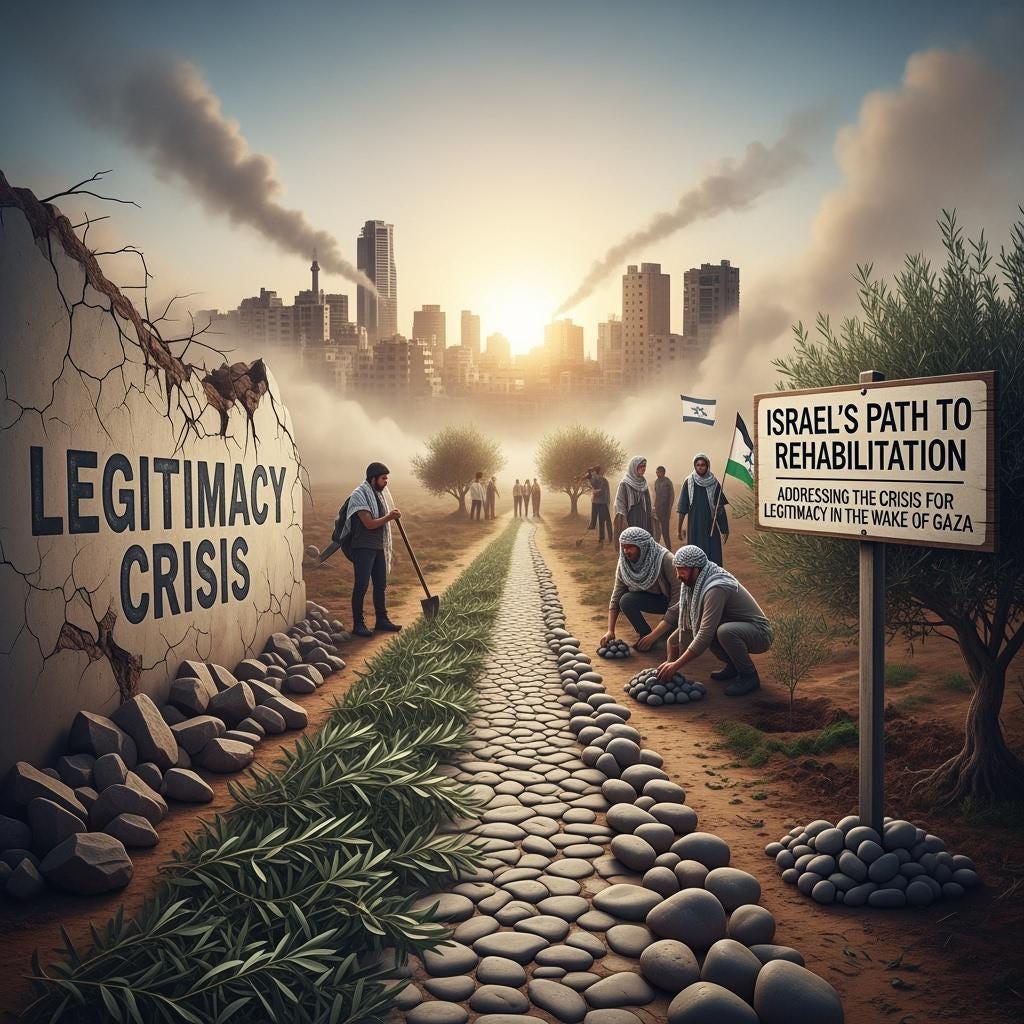
Introduction
Although I have written extensively from time to time on the geopolitical dynamics in the Middle East, drawing both approbation and condemnation in equal measure, I have been slow to offer a deeper analysis for fear that it would cast me as an authority on the topic, which I do not claim to be, or as a deeply bigoted antisemite, which I am most certainly not. Yet I find myself compelled to trace the intellectual currents that have shaped my understanding of this undeniable litmus test for humanity.
The ongoing Israeli-Palestinian conflict has reached what many observers describe as a critical juncture, with allegations of genocide and systematic human rights violations casting doubt on Israel's standing in the international community. The question of how Israel might rehabilitate its reputation - whether such redemption is needed or even possible - represents one of the most complex geopolitical challenges of our time.
This crisis extends beyond immediate military and political dimensions. It touches the foundations of Israel's identity, its relationship with the global Jewish diaspora, and the basic principles of international law and human rights that underpin the modern world order. The state of Israel faces a profound legitimacy crisis that questions not merely its policies but the very nature of the system it has constructed across the territory it controls.
The allegations of genocide, though disputed by Israeli officials, have gained traction in international legal forums and among civil society globally. They create a narrative that portrays Israel not as a democracy defending itself, but as a state engaged in systematic oppression. This places Israel in an extraordinarily precarious position that fundamentally challenges its self-narrative and threatens its long-term viability.
This essay examines the dimensions of Israel's current predicament and explores potential pathways for rehabilitation. It considers the immediate steps required for accountability, the structural changes necessary for lasting peace, and the primary obstacles that stand in the way of meaningful resolution.
Part I: The Nature of the Crisis
International Legal and Political Isolation
Israel currently occupies a position typically reserved for states accused of the gravest international crimes. The proceedings at the International Court of Justice regarding allegations of genocide represent more than symbolic condemnation - they constitute a formal legal challenge under the most serious provisions of international law. When the world's highest court entertains such allegations, it places Israel alongside historical cases involving Rwanda, Bosnia, and Myanmar.
This legal isolation reflects deeper structural problems than episodic violations during military operations. The international legal framework has struggled to address what Israel has actually become: a single state from the Mediterranean to the Jordan River that maintains different legal systems for different ethnic groups. The language of "occupation" and "temporary military control" has become a form of institutional denial that allows the international community to avoid confronting the reality of permanent ethnic hierarchy.
Reports from Human Rights Watch, Amnesty International, and Israeli organization B'Tselem have documented a system that meets the legal definition of apartheid--institutionalized racial segregation and discrimination designed to maintain group domination. This places Israel not among states that have committed particular violations, but among states whose essential structure contradicts international law.
The democratic deficit is evident in the reality that millions of people under Israeli control are denied basic political rights. Palestinians within the Green Line hold nominal citizenship but face institutional discrimination in housing, education, and employment. Palestinians in the territories live under complete Israeli control but are denied any political representation. This creates a fundamental contradiction that becomes increasingly difficult to sustain as international awareness grows.
Digital Surveillance and Technological Control
Israel has pioneered sophisticated technologies of population control that extend far beyond traditional military occupation. The digital infrastructure governing Palestinian movement includes biometric checkpoints, facial recognition systems, and comprehensive surveillance networks that monitor virtually every aspect of Palestinian life. This technological apparatus has transformed the nature of control itself, creating what critics describe as a digital prison that makes traditional concepts of resistance obsolete.
The Palestinian territories have become a testing ground for surveillance technologies later exported globally, creating a profitable industry based on the refinement of population control mechanisms. Companies like NSO Group have developed spyware used against Palestinian activists before being sold to authoritarian governments worldwide, making the oppression of Palestinians a cornerstone of Israel's technology sector.
This digital dimension reveals how modern discriminatory systems operate through technological rather than merely legal means. The algorithmic sorting of populations, automated permit systems, and predictive policing create layers of control that are often invisible to international observers but profoundly shape daily Palestinian experience. These systems represent a new form of institutional racism that uses data and algorithms to maintain ethnic hierarchy while claiming technical neutrality.
Regional and Global Opposition
Regionally, Israel faces unprecedented isolation despite maintaining military superiority. The Abraham Accords, which established diplomatic relations with several Arab states, have become politically unsustainable in the face of widespread Arab public opposition to Israeli policies. This leaves Israel more dependent than ever on external support while facing growing regional hostility.
Globally, Israel confronts an expanding civil society movement that views Palestinian liberation as a defining human rights issue. The Boycott, Divestment, and Sanctions movement has succeeded in making support for Israeli policies contentious in universities, cultural institutions, and economic forums. This opposition is particularly significant among younger generations, including within Jewish communities, who increasingly view Israeli policies through the lens of racial justice and human rights.
Several governments have taken concrete steps to distance themselves from Israeli policies. Scotland has cut public funding for arms companies supplying Israel's military. Ireland, Spain, and Belgium have implemented various restrictions on arms exports and diplomatic relations. South Africa has brought genocide charges to the International Court of Justice, marking the first time a state has formally accused Israel under international law.
The Jewish Diaspora Dilemma
The crisis has profoundly affected Israel's relationship with Jewish communities worldwide. For many diaspora Jews, support for Israel has been central to their Jewish identity. The current situation has forced unprecedented soul-searching about whether Jewish identity requires supporting ethnic hierarchy or can be consistent with universal human rights principles.
This has led to increased polarization within Jewish communities. While some feel more strongly connected to Israel during what they perceive as an existential crisis, growing numbers report feeling alienated and unable to defend policies they view as contradicting Jewish values. Organizations like Jewish Voice for Peace have demonstrated that Jewish safety and identity can be better served by opposing rather than defending discriminatory systems.
The generational divide is particularly pronounced, with younger Jews increasingly embracing universalist interpretations of Jewish ethics that emphasize justice and equality over ethnic solidarity. This shift has profound implications for Israel's long-term support base, as traditional sources of financial and political backing may erode as older generations are replaced by those more committed to human rights principles.
The rise in antisemitic incidents has added complexity, as many Jews feel unfairly held responsible for Israeli actions while simultaneously opposing those same policies. This creates a situation where Jews may face hostility for actions they don't support, complicating both Jewish identity and solidarity with Palestinian rights.
Part II: Pathways to Rehabilitation
The Imperative of Accountability
Any meaningful path toward rehabilitation must begin with genuine accountability that addresses structural rather than merely episodic violations. The October 7th attack by Hamas, involving over 1,200 deaths and systematic hostage-taking, created a security emergency that demanded response. However, the principle of accountability cannot be selectively applied based on provocation severity. International humanitarian law exists precisely for moments of extreme crisis, establishing that even heinous attacks do not suspend obligations under the laws of war.
True accountability requires transparent, independent investigations into allegations of war crimes and violations of international humanitarian law. These investigations cannot be conducted solely by Israeli institutions if they are to have international credibility. They must involve impartial international observers and legal experts who can provide objective assessments.
Equally important is addressing the culture of impunity that has characterized Israel's approach to accountability. This means prosecuting those found responsible for violations regardless of rank, implementing reforms to prevent future violations, and ensuring that personnel understand there will be consequences for maintaining ethnic hierarchy through violence.
The process must extend beyond individual incidents to examine the systematic nature of discriminatory governance, including policies regarding territorial control, settlement expansion, and the broader framework of ethnic domination that Israel maintains over Palestinian populations.
Dismantling Institutionalized Discrimination
Central to rehabilitation is addressing the system of differentiated legal treatment that has developed across Israeli-controlled territory. This system encompasses separate legal frameworks for Jewish and Palestinian populations, with Palestinians facing systematic discrimination whether as nominal citizens within the Green Line or as subjects without rights in the territories.
The expansion of Israeli settlements represents one of the most visible aspects of this system. These settlements are considered illegal under international law by virtually the entire international community. Continued expansion violates international law while consolidating the infrastructure of ethnic separation and demonstrating commitment to permanent hierarchy rather than democratic governance.
Addressing this system would require dismantling the settlement enterprise and the legal structures that maintain ethnic hierarchy throughout the territory under Israeli control. This includes military orders governing life in occupied territories, separate legal systems for settlers and Palestinian residents, and economic arrangements that exclude Palestinian communities from meaningful development while integrating settlements into Israel's economy.
Environmental Justice and Resource Equality
The environmental dimensions of discriminatory control reveal themselves in systematic resource extraction and environmental racism that affects Palestinian communities disproportionately. Israel controls approximately 80% of West Bank water resources while Palestinian communities face severe water shortages. Israeli settlements consume six times more water per capita than Palestinian communities, creating a stark environmental apartheid that determines access to this most basic necessity for life.
Climate change exacerbates these inequalities, with Palestinian communities bearing the costs of environmental degradation while being denied the resources necessary for adaptation. Rising temperatures and changing precipitation patterns affect agricultural communities that lack the technological and financial resources available to Israeli settlements. The deliberate restriction of Palestinian access to renewable energy technologies and water conservation systems compounds these vulnerabilities.
Environmental destruction has become a tool of demographic control, with practices including the uprooting of olive trees, the demolition of water infrastructure, and the prevention of Palestinians from accessing their agricultural land. These policies serve the dual purpose of economic strangulation and environmental degradation that makes Palestinian communities less viable over time.
Any sustainable resolution must address environmental justice as a core component of human rights. This means equalizing access to water resources, enabling Palestinian communities to develop renewable energy infrastructure, and ending the use of environmental degradation as a tool of population control. The shared landscape requires collaborative environmental stewardship that serves all communities equally.
Confronting Extremism and Hate Speech
The proliferation of dehumanizing rhetoric from Israeli officials and public figures has contributed to an atmosphere that enables human rights violations while undermining any claim that Israel represents a democratic society committed to equality. This rhetoric reflects broader patterns of discrimination that have become increasingly normalized in Israeli political discourse.
Addressing this requires systematic measures including legal frameworks prohibiting incitement to violence, educational programs promoting tolerance, and media policies discouraging dehumanizing rhetoric. Political leadership plays a crucial role in setting discourse standards--politicians who cannot condemn dehumanizing rhetoric or promote tolerance should not govern.
The problem extends beyond rhetoric to include policies and practices that institutionalize discrimination, including differential treatment of Palestinian citizens, restrictions on Palestinian political expression, and maintenance of separate and unequal systems throughout Israeli-controlled territory.
Gender Dimensions and Intersectional Analysis
The discriminatory system affects women differently across communities, creating intersectional forms of oppression that compound gender inequality with ethnic discrimination. Palestinian women face restrictions on movement that limit access to healthcare, education, and employment opportunities. Checkpoints and permit systems create particular hardships for pregnant women seeking medical care and mothers caring for families under conditions of systematic constraint.
Israeli policies have deliberately targeted Palestinian family structures through practices including the revocation of residency permits for women who marry Palestinians from different areas, creating forced family separation that disproportionately affects women's roles as caregivers. The destruction of homes and economic infrastructure places additional burdens on women who bear primary responsibility for household survival under conditions of systematic impoverishment.
Women's leadership in resistance movements demonstrates both the particular impact of discriminatory policies on women and their central role in organizing for justice. Palestinian women have pioneered forms of civil resistance, from organizing around prisoners' rights to leading environmental justice campaigns. Israeli women's peace organizations have also played crucial roles in challenging militaristic approaches and advocating for human rights.
Any democratic transformation must prioritize gender equality as integral to human rights rather than treating women's concerns as secondary to other political objectives. This means ensuring women's equal participation in political processes, addressing the gendered impacts of discriminatory policies, and recognizing women's leadership in peace-building efforts.
Beyond the Two-State Framework
The two-state solution has become a diplomatic fiction that allows avoidance of confronting what the conflict has actually become. Israel has already created a one-state reality through settlement expansion, military control, and administrative integration of Palestinian territories. Over 700,000 Israelis now live beyond the Green Line, connected by infrastructure that fragments Palestinian territory into isolated enclaves.
This isn't an obstacle to the two-state solution - it represents its deliberate destruction. The Oslo framework failed because it fundamentally misunderstood the conflict's nature, treating a colonial situation as a bilateral dispute between equal parties while allowing the stronger party to create irreversible facts.
Rather than asking how to resurrect this framework, Israel must choose: either reverse the settlement project entirely - dismantling hundreds of settlements and displacing three-quarters of a million Israelis - or acknowledge that it has created a reality requiring solutions based on equal rights within the existing framework.
The debate over "alternative frameworks" misses the fundamental point: Israel has already chosen its framework through decades of deliberate action. The one-state reality isn't a theoretical proposal - it's the status quo. The question isn't which framework to adopt, but whether to democratize the single state that already exists or maintain its current hierarchical structure indefinitely.
International Law and Permanent Control
The international legal framework has become a form of institutional denial, treating nearly six decades of control as "temporary occupation" when Israel has clearly created permanent colonial structures. The Fourth Geneva Convention was designed for short-term military occupations, not permanent projects spanning multiple generations.
When an "occupying power" has transferred three-quarters of a million settlers, built permanent infrastructure, and created administrative systems governing millions of people for decades, we're dealing with annexation disguised as temporary control. The principle of self-determination has been repeatedly invoked for Palestinians while simultaneously being rendered meaningless through Israeli actions.
International accountability mechanisms have failed because they cannot address a situation where one party has transformed illegal occupation into permanent structures of ethnic hierarchy. International law must confront what Israel has actually created: a single state with differentiated legal systems based on ethnicity.
Precedents from other successful transitions from discriminatory systems offer instructive models. The dismantling of apartheid in South Africa required not only political negotiations but comprehensive legal reforms, truth and reconciliation processes, and economic redistribution programs. Northern Ireland's peace process demonstrated how power-sharing arrangements could manage ethnic divisions while guaranteeing equal rights.
These precedents suggest that transformation requires more than ending specific discriminatory practices--it demands creating new institutions designed to guarantee equality and prevent the resurgence of ethnic hierarchy. This includes constitutional protections for minority rights, independent judicial systems, and economic policies that address historical inequalities.
Economic Dimensions and Structural Change
Israel has created an economic system designed to extract resources from Palestinian areas while denying Palestinians equal participation in the economy they help sustain. The settlement enterprise channels resources, land, and water to Jewish communities while restricting Palestinian economic development, creating economic dependency that serves political goals of maintaining dominance without formal annexation.
International economic pressure through divestment campaigns has grown precisely because conventional diplomatic approaches have failed to address this structural reality. These campaigns target not Israel's existence but its maintenance of different legal and economic systems for different ethnic groups - the defining characteristic of discriminatory governance.
Economic integration already exists, but on profoundly unequal terms. Palestinians work in Israeli industries, Israeli companies operate in Palestinian areas, and Israeli authorities control Palestinian economic development. The question isn't whether to create economic cooperation but whether to democratize the economic relationships that already exist.
Alternative economic models could prioritize cooperative development that benefits all communities equally. This includes shared infrastructure projects, joint industrial zones operating under equal labor standards, and agricultural cooperation that respects both communities' connections to the land. Regional economic integration could provide frameworks for prosperity that transcends ethnic divisions while respecting cultural autonomy.
Part III: Global Implications and Future Prospects
The Crisis of Liberal Democracy and Religious Perspectives
Israel's consolidation as a state maintaining ethnic hierarchy poses a fundamental challenge to the post-World War II international order and the liberal democratic values that supposedly underpin it. The international community's accommodation of this system has exposed the selective application of human rights principles and undermined the credibility of institutions designed to prevent systematic discrimination.
Religious communities worldwide have grappled with the moral dimensions of this situation from diverse theological perspectives. Many Christian denominations have endorsed divestment campaigns and called for justice based on liberation theology principles that emphasize God's preferential option for the oppressed. Progressive Jewish organizations have argued that Jewish ethical traditions demand opposition to ethnic hierarchy regardless of who implements it.
Islamic perspectives have consistently emphasized justice and the protection of the oppressed as core religious obligations, with many Muslim organizations viewing Palestinian solidarity as a fundamental expression of their faith. Progressive Islamic scholars have articulated visions of coexistence based on Quranic principles of religious pluralism and mutual respect.
Interfaith coalitions have emerged around shared commitments to human dignity and justice that transcend religious boundaries. These alliances demonstrate how religious ethics can provide foundations for opposition to discriminatory systems while respecting legitimate spiritual connections that different communities maintain to the same land.
International institutions face a credibility crisis when advisory opinions are ignored, UN resolutions are systematically violated without consequence, and international law becomes selectively enforced. The failure to address Israeli policies undermines institutional authority to address similar systems elsewhere.
Youth, Generational Change, and Global Solidarity
The connection between Palestinian solidarity and global justice movements reflects recognition that this system represents the same principles of racial hierarchy that liberation movements worldwide have opposed. Universities, cultural institutions, labor unions, and religious organizations increasingly frame this as a human rights issue rather than a political conflict requiring balanced treatment.
Younger generations globally demonstrate fundamentally different approaches to this issue than their predecessors. Having grown up with social media access to Palestinian voices and experiences, they reject framing that treats systematic oppression as complex geopolitical dispute requiring neutrality. University campuses have become centers of activism that connects Palestinian liberation with broader movements for racial justice, Indigenous rights, and economic equality.
This generational shift has profound implications for Israel's long-term international support. Traditional pro-Israel advocacy that emphasizes historical grievances and security threats resonates less with generations that prioritize contemporary human rights violations and systemic injustice. The failure to maintain broad-based support among younger demographics suggests that Israel's international legitimacy will continue eroding unless fundamental changes occur.
Cultural and artistic expressions of solidarity have created global networks that transcend national boundaries and traditional diplomatic channels. Musicians, writers, filmmakers, and visual artists have developed forms of cultural resistance that challenge mainstream narratives while celebrating Palestinian humanity and creativity. These cultural interventions demonstrate how solidarity operates through moral and emotional connections rather than purely political calculations.
Foundations for Democratic Future
Despite structural barriers, foundations for a democratic future already exist in countless examples of Israeli-Palestinian collaboration. In hospitals throughout Israel-Palestine, Jewish and Palestinian doctors work together treating patients regardless of ethnicity. In technology companies and universities, Israelis and Palestinians collaborate on projects benefiting both communities. Artists and environmental activists continue working together across political divides.
These collaborations occur despite government policies designed to prevent them. Healthcare workers cooperate because medical ethics demands treating all patients equally. Researchers collaborate because scientific advances require the best minds regardless of background. Environmental activists unite because ecological challenges affect the entire shared landscape.
The significance extends beyond immediate practical benefits. These collaborations demonstrate that the problem is not inherent animosity between peoples but political structures that institutionalize separation and inequality. When people work together successfully across ethnic lines, they prove that coexistence is not only possible but natural when artificial barriers are removed.
Youth organizations have pioneered programs that bring together young Israelis and Palestinians for dialogue, joint action projects, and cultural exchange. While these programs operate within significant political constraints, they demonstrate the possibility of relationships based on mutual respect rather than ethnic hierarchy. Participants often report that direct contact challenges stereotypes and creates personal investment in justice for all communities.
Regional Integration and Broader Middle East Dynamics
Democratic transformation in Israel-Palestine could catalyze broader regional democratization by demonstrating that ethnic and religious diversity can coexist within democratic frameworks. The Middle East has struggled with sectarian conflicts that often mask deeper issues of resource control and political power. A successful model of pluralistic democracy could provide inspiration for other societies grappling with similar challenges.
Regional economic integration could provide frameworks for prosperity that transcends current political boundaries while respecting cultural autonomy. The Eastern Mediterranean possesses significant natural gas resources that could benefit all regional populations if developed cooperatively rather than competitively. Joint infrastructure projects connecting different communities could create economic interdependence that makes conflict less attractive than cooperation.
Cultural and educational exchanges could strengthen regional identity while respecting particular national and ethnic commitments. The shared history and geography of the region provide foundations for cooperation that transcends current political divisions. Archaeological sites, environmental treasures, and cultural heritage belong to all regional inhabitants regardless of their current political arrangements.
Conclusion: The Choice Before the International Community
The conventional framing of Israel facing "crossroads" and "choices" fundamentally distorts its actual position. Israel is not approaching a decision point. It has already decided. Through decades of deliberate action, it has created a single state with differentiated legal systems based on ethnicity. The question is not whether Israel will choose change, but whether the international community will acknowledge what Israel has built and respond accordingly.
The framework of "rehabilitation" assumes Israel retains the option to return to some previous legitimate status. In reality, Israel has systematically dismantled the foundations of that legitimacy through the creation of permanent structures of ethnic hierarchy. Accountability cannot be separated from this reality--it's not individual violations that must be confronted, but the entire system those violations serve to maintain.
The international community faces its own moment of truth: continue providing diplomatic cover through the fiction of a "peace process," or acknowledge that this represents a struggle between discriminatory governance and democracy that requires the same response such systems have always required. The comfortable middle ground of calling for "dialogue" while one side maintains systematic domination has been exposed as complicity with oppression.
The transformation that matters is not within Israeli society but within international institutions and global civil society. Universities, governments, and international bodies are being forced to choose between complicity with ethnic hierarchy and support for equal rights. This choice cannot be deferred indefinitely through appeals to complexity.
The technological dimensions of control, environmental racism, gender inequality, and generational change all converge to make the current system increasingly unsustainable. Digital surveillance cannot indefinitely substitute for political legitimacy. Environmental degradation affects all communities sharing the same landscape. Women's leadership in resistance movements demonstrates both the particular impacts of discrimination and the potential for transformative politics. Younger generations increasingly reject ethnic hierarchy regardless of historical justifications.
If the international community accepts permanent ethnic hierarchy in Palestine, it legitimizes similar systems elsewhere and undermines the universality of human rights. If it responds as it eventually did to South African apartheid, it reinforces the principle that such systems are ultimately untenable.
The framework of negotiations between equal parties has been rendered obsolete by the reality of complete Israeli control. The relevant framework is democratization of the single state that already exists. This requires extending basic democratic rights to everyone living under Israeli control. Existing collaborations between Israelis and Palestinians provide the human infrastructure for such democratization.
The current crisis of legitimacy reflects growing global recognition that discriminatory systems cannot be sustained indefinitely in the twenty-first century. Israel can maintain its current system only through increasing isolation, or it can transition toward democracy. International pressure will continue growing until the single state between the Mediterranean and Jordan becomes a democracy with equal rights for all residents, or until the costs of supporting ethnic hierarchy become politically unbearable for democratic governments worldwide.
The path toward justice does not require Israeli consent - it requires international recognition that institutionalized discrimination is wrong regardless of who implements it or what justifications are offered. The existing collaborations between Israelis and Palestinians, the emergence of global solidarity movements, the technological tools available for organizing and communication, and the moral clarity of younger generations all suggest that this recognition is not a distant possibility but an emerging reality.
The environmental crisis, technological advancement, demographic change, and evolving consciousness about racial justice create conditions where discriminatory systems become increasingly difficult to maintain. The choice is no longer Israel's alone. It belongs to an international community that must decide whether the principles of equality and human dignity will be applied universally or remain privileges for some while others are denied their basic humanity.