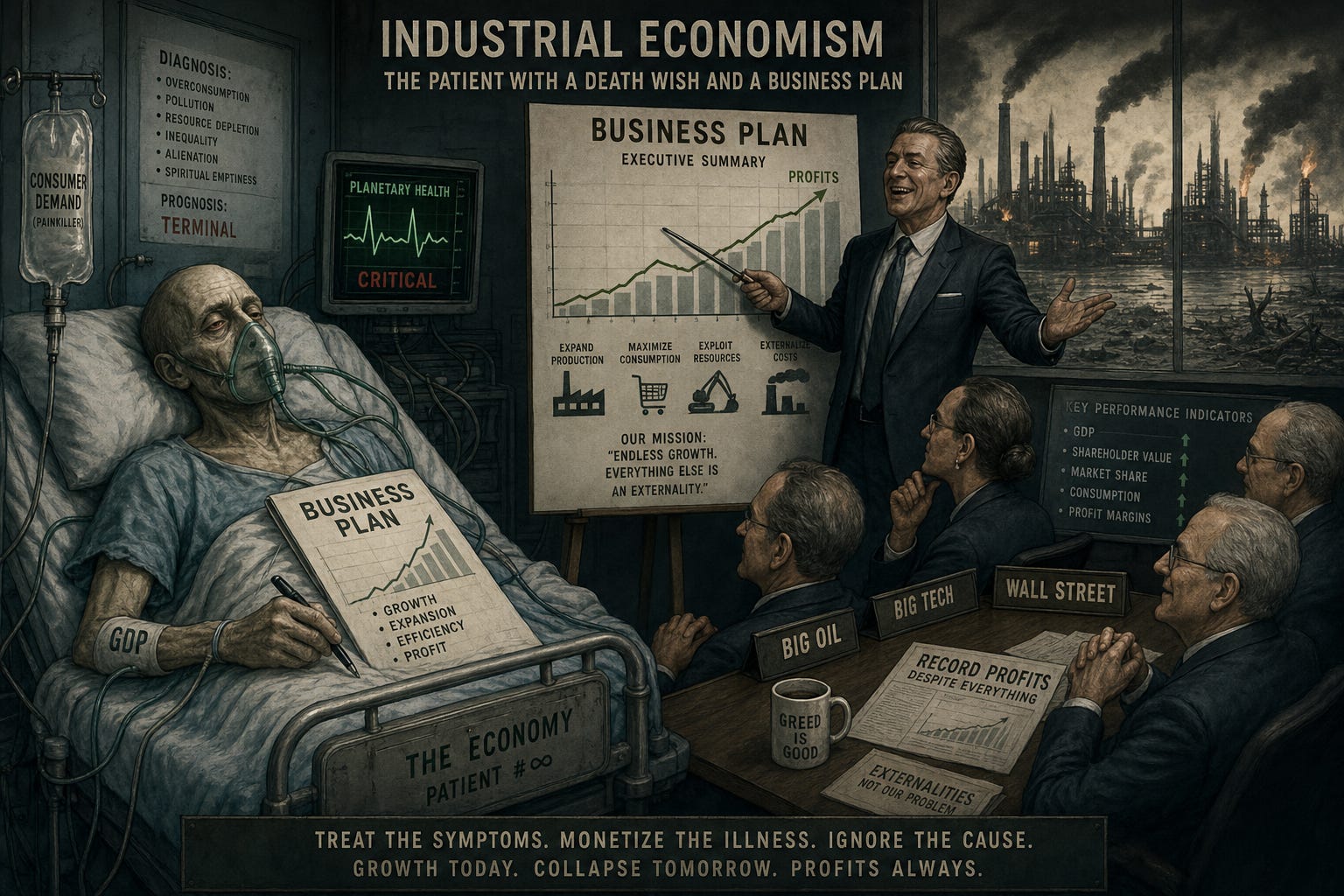
We have the plan. That is what almost no one says aloud, and it’s the only place a candid essay about the climate emergency can begin. We know what to do. We have known the pattern of it since the 1970s, and that pattern has only sharpened since.
So this is not, at heart, an essay about climate per se. It’s a study about why a civilisation in full possession of its own remedy decides, year upon year, not to administer it. The answer is not ignorance. It’s not cowardice, and it’s not for the want of one more lucid report. The answer is that the world-system holding the remedy in abeyance is not malfunctioning in its delaying tactics. It’s working well. You see, it has a plan of its own — coherent, costed, professionally managed — and that plan runs straight off the cliff. A death wish is bad enough. A death wish with a business plan is what we’re actually living with.
That world-system has a name. Industrial economism: an operating model that treats the living world as inventory, continuous growth as the only measure of health, and the future as a discount applied to the present. It’s not a political party or ideology you can vote out. It sits beneath both politics and ideology as an underlying code. It’s the air we breathe. And it’s also the patient with a death wish — not despairing, not asleep, but busy, organised, optimised, and executing its own ending with quarterly diligence. It calls this progress.
Beyond more failed summits, protocols, roadmaps, and broken promises, what can be done? Let’s begin by laying out what actions could be taken, in full, because the lesson only surfaces once the map is near-complete. Decarbonising two or three convenient sectors and declaring momentum proves nothing about whether emissions actually fall — the atmosphere keeps a gross account, not a net one, of good intentions. The whole terrain has to be visible before the pattern reveals itself.
Energy: Energy first, because it’s the keystone – roughly 34 per cent of emissions once you count the electricity that powers the rest. And, in the end, almost every other sector’s strategy is a bet that the grid behind it becomes clean. Replace coal and gas with solar, wind, nuclear, hydro, and geothermal. The generation problem is largely solved; the cheap electron has already won in most of the world. The binding constraint has migrated to the wires we can’t string fast enough and the permits that take longer to grant than the asset would take to build. Stop the methane leaking across the oil and gas chains – the fastest temperature lever we hold and almost purely a matter of enforcement. And manage the decline of extraction itself: the stranded assets, the workers who need somewhere to go, the petrostates whose entire fiscal existence dissolves the day we succeed.
Transport: 15 per cent here. Electrify the cars and light trucks, which are already underway on a cost curve with their own momentum. Then cut car dependence substantially through tighter zoning, better public transport, car-sharing incentives and bicycle lanes — because even the electric car carries its material and congestion costs into a world built around the private vehicle. Electrify lighter freight, and shift the long hauls to rail. Aviation is as yet unresolved for long-haul — the clean fuels are scarce and expensive — and the honest near-term answer is to fly less, which is a solution no one with a microphone will propose. Shipping has its ammonia and methanol and its slow steaming.
Construction: Buildings comprise 6 per cent directly and far more once you count what they draw from the grid. Swap furnaces and boilers for heat pumps; ban new gas connections so the problem stops growing while you work. Then retrofit old stock through insulation, windows, and wiring. This is the slowest task in the whole enterprise, because it means renovating a billion buildings one reluctant owner at a time. And build the new stock from materials that hold carbon rather than emit it — mass timber, bamboo, the engineered woods. A building’s emissions are not only what it burns once it stands but also what was burnt to raise it: a frame of grown fibre banks the carbon, whereas one of concrete and steel exhales it. Reform the zoning, because the low-density suburb is a carbon machine that compounds house size and car dependence and infrastructure per head all at once. And brace for cooling: as the Global South grows richer and hotter, the demand for air conditioning will climb a curve we’re still not ready for.
Industry: Around 24 per cent of the whole and the toughest part. Steel made with hydrogen rather than coking coal, and far more of it from recycled scrap. Portland cement is a cruel one. Around half its emissions come not from the fuel but from the chemical reaction at the heart of making it, so you’re rewriting a recipe two hundred years old. Chemicals and plastics want cleaner feedstocks, far more recycling, and, hardest of all, less demand. High industrial heat wants electrification where it can get it, hydrogen or capture where it cannot.
Food & Land: Possibly 22 per cent once you fold in what we do to the soil. Here sits the single largest demand-side lever in existence and the most politically untouchable: less ruminant meat and dairy in the wealthy world. Methane from livestock is attributable to feed and herd management. Nitrous oxide from fertiliser, a potent and neglected gas, answers to precision and green ammonia. Methane from the rice paddy is accountable to how we manage the water. The third of all food we simply waste, which means a third of agriculture’s footprint buys us nothing. And the forest, falling mostly to beef and soy and palm oil, makes deforestation a trade problem wearing a forestry costume. Restore the peatlands and mangroves. Build the carbon removal, biological and engineered, for the residue that will never reach zero.
Then the rules beneath these five major sectors.
· Materials and the churn economy: design for repair, reuse, recycling, and longevity, legislate the right to fix what you own, and confront the rebound that has eaten every efficiency gain we ever made.
· Finance: end the roughly $0.7 trillion in direct fossil subsidies, or the $6.7 trillion once you count the damage we decline to price; lower the punishing cost of capital that makes a clean project in the Global South pay two or three times the interest it would pay in the OECD — arguably the single binding constraint on the whole global effort, since that’s exactly where the emissions will grow.
• Governance: reform the permitting that currently makes it faster to keep a fossil asset alive than to build its replacement; break the specific veto points — the utility commissions, the dealer-franchise laws, the agricultural lobbies, the petrostate seat at every international table.
• Development: And beneath all of it the uncomfortable demography: that nearly every tonne of future growth comes from poor countries becoming less poor, so the character of that development — clean leapfrog or repeated coal — dwarfs in sheer scale every lifestyle adjustment the rich world might make.
• Demand and Desire: the deepest lever and the least technical. Fast fashion, the two-year phone, the perpetually obsolete wardrobe, the square footage and the second car as markers of having arrived — much of what we call consumption is not need but manufactured wanting, and an economy that must grow has every reason to keep manufacturing it. Efficiency cannot outrun appetite if appetite is the product being sold.
There it is. The remedy, near enough whole. Hand it to a competent planning ministry tomorrow and it would know what to do. The technologies are in hand or within reach. The money exists; but it’s currently invested in the disease. The arithmetic has been worked, and worked again, and confirmed. And yet we’re not administering it.
If we stand back from the whole of this catalogue of activity, it’s clear that the lesson is not in any one domain. It’s in the profile they all share.
Electrify everything and clean the grid, and you have solved something close to seventy per cent of the problem outright. The stubborn thirty are the countries where combustion was never the issue — where the carbon comes from chemistry and biology instead: the reaction inside the cement kiln, the digestion of a cow, the nitrogen in the soil, and the energy density jet fuel has and batteries do not. That tells you where to send the scientists.
The speed limit everywhere is the turnover of capital stock — a phone lasts two years, a car fifteen, a power plant forty, a building eighty, and a street grid for centuries — and that single ladder predicts almost exactly where the work goes fast and where it crawls. That tells you where to send the patience. Demand-side change works when it is structural and fails when it is exhortative: build it into the zoning and the price and behaviour moves; ask for it through the pledge and the awareness campaign and almost nothing happens. That tells you to stop moralising and start legislating.
All three are useful. But still they’re not the real lesson. That is the fourth pattern, and it’s not advice about where to take aim. It’s an explanation of why the aiming has failed for fifty years.
Every domain — every single one, without exception — has the same political shape. On one side, a small number of concentrated, organised, well-financed players who can see precisely what they stand to lose and exactly when: the utility with the stranded plant, the carmaker with the engine assembly line, the cattle lobby, the cement giant, the petrostate whose entire budget is its oil. A few, exceedingly well-coordinated, knowing each other’s names, willing to spend whatever it takes to defend a loss they can already measure. On the other side, potential winners are diffuse, unorganised, and often unborn. Everyone a little eventually. A cooler century. A child in 2070. A coastline that stays where it is. They don’t lobby. Many of them don’t yet exist, and those who do are spread so thin across the whole of humanity that no single individual feels the win sharply enough to fight for it.
This is the block. Not a knowledge problem — a power problem. And it repeats, unchanged, across every domain. Consider the firm that refused to sell cars. For many years a small British company has built a hydrogen vehicle it never intended to sell at all — you license mobility by the month, the maker keeps the car for the whole of its life, and its profit comes from the car lasting rather than from your buying the next one. It has been patient and unhurried, solving each problem as it met it: a light machine instead of the two-tonne battery SUV with its own buried scandal of extraction and embedded carbon, and beneath the machine a model that quietly dismantles the churn the entire industry is built upon. Longevity made the source of profit rather than its enemy, sufficiency rendered as a balance sheet. It is, in other words, right twice over: cleaner in the metal and cleaner in the incentive. And it has reached almost no one. Not because the idea is poor, but because the system was organised to carry the other answer, and a better one with no berth in the existing machine waits and goes on waiting. The judgement against it is always the same — that it has sold nothing — by people who have not noticed that selling nothing was the entire point.
Now we can see the death wish for what it is and why it comes with a business plan.
The concentrated losers are not a flaw in industrial economism. They are its institutional body — the organs through which it metabolises the future into this quarter’s return. And the genius of the system, the thing that makes it a death wish with a business plan rather than just blind drift, is that it doesn’t need to deny the remedy. It can absorb it. It can host the summit, fund the white paper, and appoint the chief sustainability officer to publish the net-zero roadmap dated comfortably beyond the tenure of everyone signing it. It can convert this catalogue — the real one, the sufficient one — into one more document in a literature, and that literature into a substitute for activity. And it manufactures the wanting that makes the growth feel like life rather than compulsion. This is the subtlest organ of the death wish: not the lobby that blocks the clean alternative but the advertisement that makes you desire the dirty one – that converts a stable, sufficient life into a deprivation and the next purchase into a reprieve. The system does not merely defend itself against us. It recruits us. We arrive at the showroom as volunteers.
This is what the sustainability industry, for all its sincerity, has largely become: the planning department of the death wish. It produces the reports that explain the loss to people who already grasp it and were never the obstacle. It draws the roadmap that treats an entrenched interest as an obstacle to be avoided rather than a power to be defeated. It drafts the pledge that asks an organised opponent to volunteer a defeat it has every interest in refusing. Each artefact performs comprehension where potent activism is required. The resulting performance is functionally soothing. We didn’t fail to understand what’s needed. The cattle lobby understands better than anyone; that is exactly why it fights.
Information doesn’t change systems. Power and its application change systems. But power has never once surrendered itself because someone produced a sufficiently elegant slide deck. The remedy will not be read into effect because it was never the reading that was missing.
So I will not end this essay where the genre demands — with the rousing call, the ten steps, the reassurance that awareness is the first step and you have just taken it. That ending is the disease wearing the costume of the cure. To write it would be to add just another well-meant page for consideration by the planning department of the death wish.
Here is the essence of it instead, without the comfort. We are not confused, and we are not under-informed, and we are not waiting on a technological breakthrough. We are a civilisation in full possession of a complete and sufficient plan to keep its only home habitable, declining to administer it — not because we can’t read it, but because administering it means defeating a power that has organised itself, with great competence and a coherent business plan, around our not implementing it.
The plan to save humanity exists. The plan to end us also exists — its lethality a byproduct of indifference, not malice — and it is better funded, better staffed, and further advanced.
We have the remedy. We have known what to do for half a century. What we have not yet decided is whether we will become the kind of force that can take it from the hands of those holding it shut. That’s not a question information can answer. It’s a question about power, and it’s addressed to us.