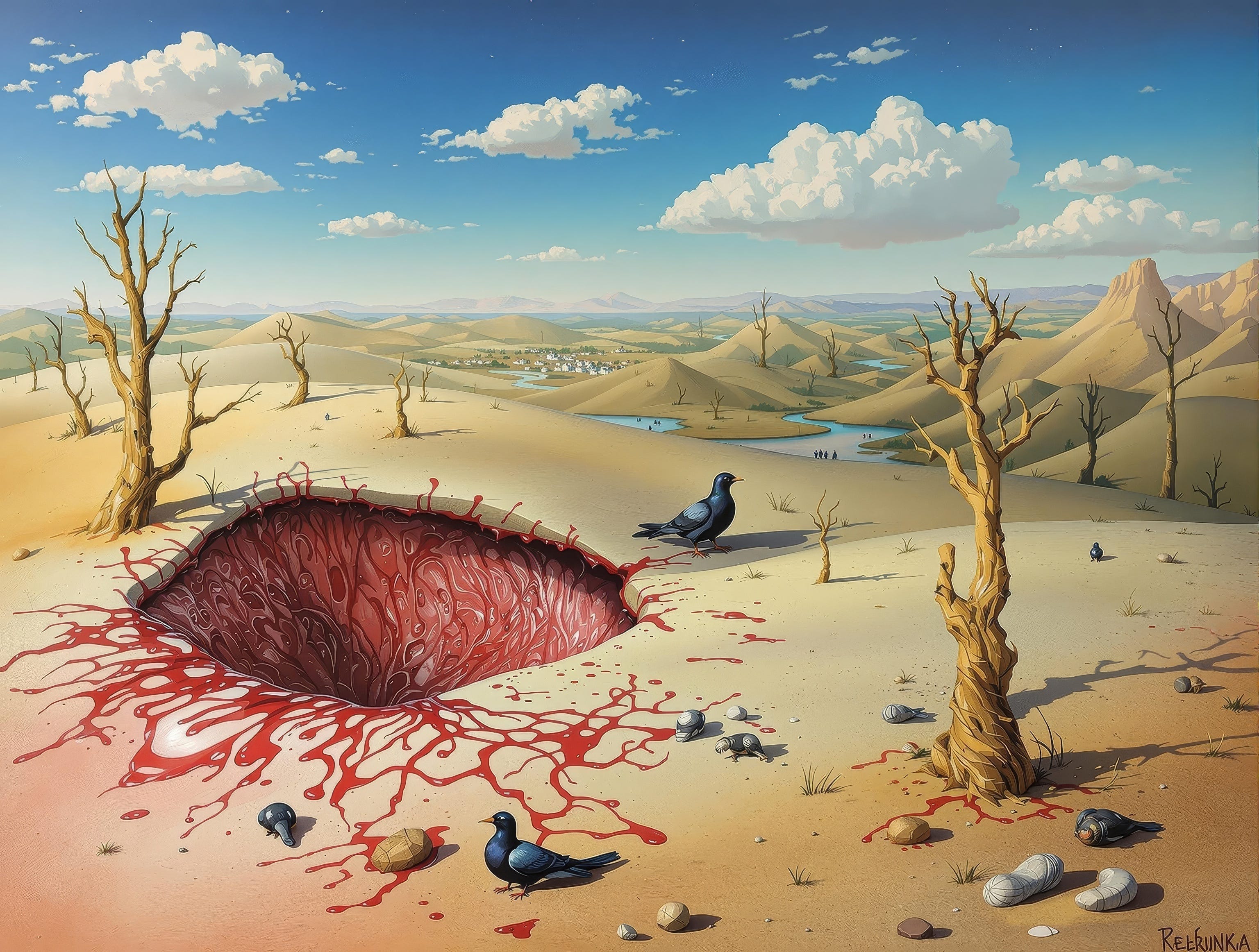
Imagine an open wound—raw, tender, and exposed. At first, it demands attention, the pain reminding us of our vulnerability. But when we clean it and protect it, something extraordinary happens: it heals itself. The body knows exactly what to do. Our role is not to impose healing but to create ambient conditions of cleanliness and care, so that nature can take its course. Healing is not something we force; it's something we allow.
This principle extends far beyond the physical. The wounds we carry within us—psychological, emotional, spiritual—also heal when afforded the right conditions. But here, the essential state is one of wellbeing. Not just physical support or comfortable circumstances you understand, but the freedom to feel whatever arises—joy, grief, anger, fear—without judgement or the need to prove worthy - of being loved, or taken seriously, for example. This level of care is rare in Western culture, where we're often granted conditional care—as long as we conform, meet expectations, or conceal parts of ourselves to make us acceptable to others. Conditional care keeps us tethered to external validation, trapped in patterns of control and suppression, unable to truly be ourselves.
If this is true for individuals, it's even more true for societies. The rifts that divide us—racism, inequality, religious extremism, injustice, arbitrary lines drawn on maps—are open wounds on the collective body of humanity. And just as with individual healing, the key to societal healing lies in creating the conditions for authentic wellbeing: compassion and equity being the two most indispensable factors in this regard.
Clearly, what we’re doing today isn’t working, mostly because compassion and equity are in short supply. The question is: What must we do to create the conditions needed for healing to occur consistently and at scale? The answer is staring us in the face. To encourage a more compassionate, equitable world, we must embrace ideas that challenge conventional norms, updating the ways we relate to ourselves, each other, and the systems that shape our lives.
Genuine societal well-being transcends physical and material security; resting equally on emotional and relational safety. To nurture it, we must expand our appreciation of well-being to include environments where individuals feel free to express their emotions, learn from their mistakes, and exist authentically, unburdened by the fear of being judged. Achieving this at a time when antisemitism and islamophobia are running rampant, while political correctness translates into not offending anyone's sensibilities, requires the embedding of emotional literacy and trauma-informed practices as essential skills woven seamlessly into the fabric of daily life.
Everyone has the right to experience a deep sense of belonging—one that's not conditional on conformity or the pursuit of perfection, but rooted in acceptance and sincerity. That means designing communities and systems that intentionally elevate inclusion, celebrate diversity, and promote equity as core criteria. This goes beyond surface-level tolerance to the active cultivation of environments where trust flourishes and vulnerability is met with empathy. By creating places where we can reveal our true selves without fear of judgement or rejection—we lay the groundwork for mutual support and the collective strength that arises when everyone feels seen, valued, and embraced.
We must also shift away from the knee-jerk use of punitive measures that perpetuate distress and low self-esteem, embracing restorative practices that give priority to healing and the repair of relationships. Such strategies target innate roots of conflict, encouraging reintegration rather than retribution. Schools, workplaces, and legal systems could all benefit by adopting community-based restorative justice programs that place reconciliation at their core, cultivating a culture where rehabilitation replaces punishment and justice becomes synonymous with compassion and growth.
Extending those principles into our education system is also vital. In order to prepare children adequately for enjoying a productive life, education must evolve from traditional schooling to collaborative learning - a curriculum designed not purely in pursuit of a career, but for psychological and relational well-being. Emotional intelligence, empathy, cooperation, negotiation and compromise must take their rightful place in school curricula, equipping students with the means to understand and manage their emotions, build healthy relationships, and contribute to the common good.
Perhaps even more critically, our economic systems must undergo a profound transformation if we're serious about prioritising human well-being and ecological viability over the relentless and enervating chase for growth and profit. The neoliberal model, driven by unrelenting competition and the accrual of individual wealth, invariably intensifies inequality, exploits natural resources, and undermines the social fabric needed for communities to thrive. Instead, we really must reimagine economic structures to focus on shared prosperity and sufficiency, ensuring that no one is left behind in the pursuit of progress.
To achieve this, we must undoubtedly embrace innovative and inclusive models that challenge the status quo. Cooperatives and mutual societies, for example, empower communities by democratizing ownership and decision-making, ensuring that profits are reinvested into the well-being of the collective rather than concentrated in the hands of a few wealthy owners. These models offer a more humane alternative to almost every other form of commercial enterprise.
Similarly, universal basic income (UBI) has the potential to provide a safety net that guarantees every individual the dignity of financial security, freeing people from the constant anxiety of having to meet basic needs. By redistributing resources more equitably, UBI allows individuals to pursue education, creative endeavours, or caregiving roles without the fear of economic ruin, ultimately enhancing societal well-being and unlocking human potential at the same time.
In addition, circular economies nested within industrial ecologies offer a framework focusing on resource efficiency and environmental stewardship. By designing systems of production that minimize waste, reuse materials, and regenerate nature, circular economies bring economic activities within the scope of the planet's ecological limits, ensuring that future generations become heirs to a world worth inheriting.
Together, these initiatives represent a shift away from the conventional shareholder archetype, toward an economy that values people and the planet as much as—if not more than—profits. Obviously, they defy the destructive cycles of overconsumption, exploitation, and inequality that have for so long characterized the paradigm of industrial economism. By focusing on well-being, we can create a world where economic success is measured not by the wealth of a few, but by the health, happiness, and well-being of all. And that must be one of our goals if we're serious about healing our society.
We must also confront what I personally hold to be the most egregious civilisational defect of our time. The narrative that equates vulnerability with helplessness and humility with frailty has to be reimagined. Why? Because vulnerability and humility are not flaws but the source of an indomitable devotion to all that life has to offer. When we share our stories and encourage public figures to display fragility, we point to a culture where 'weakness' can be expected but accepted. This shift of mindset is inseparable from the broader work of dismantling systemic racism, sexism, and economic inequality—forces that perpetuate division and oppression quite brazenly.
Confronting these ingrained issues requires bold policies that undo entrenched injustices and empower marginalized groups. Grassroots movements, which never tire of amplifying voices and advocating for justice, should receive unwavering support. They are the lifeblood of meaningful and substantive change within the context of societal healing.
And if they are the lifeblood, then the pumping heart of this transformation is the acknowledgement of our interconnectedness, the fact that we cannot exist alone; that we exist only in relation to one another, or what Thích Nhất Hạnh, the Zen Buddhist monk, refers to as interbeing.
Healing—whether personal, societal, or planetary—demands a collective pledge to unity. Initiatives like the United Nations Sustainable Development Goals and global climate action, though far from perfect, remind us of our duty to one another and to the Earth. By cultivating a sense of global solidarity, we can address urgent challenges together, recognizing that the healing of humanity's wounds is inseparable from the healing of the planet. Protecting ecosystems, adopting regenerative agricultural practices, and embracing sustainable lifestyles allow us to honour the interdependence of all life while deepening our own umbilical connection to the natural world.
To create such a world, we must shift our ethos away from the pursuit of individual achievement at any cost and more toward a collective flourishing. That presents those of us that live in the West with what I can best express as an 'existential' headache as we are impelled by a philosophy of independence from a very early age and our most life-critical systems are all engineered to that code.
When we think deeply about our life together, it should be obvious that success as a species is not and cannot be measured by wealth or status. It's the quality of our relationships, the depth of our impact, and the well-being of our communities that matter much more. When we concentrate on our collective well-being, we build a world in which everyone has the opportunity to thrive; one which honours our shared humanity and inculcates healing on every level.
A word of caution. Healing, whether individual or collective, is not about control or quick fixes. Real care is to do with creating the conditions for safety, trust, and transformation to prevail. It requires surrendering to the natural intelligence of life and allowing it to guide us toward wholeness. Achieving well-being is not superficial. On the contrary it's a profound cultural shift—one that begins with each of us embodying the principles of love and compassion in our own lives and communities.
When we do this, we swing open the door to a world where healing becomes a lived reality. In this world, wounds—both personal and collective—are not hidden scars that disfigure but reminders of our resilience and capacity for renewal. Well-being is no longer a privilege but a universal birthright, and the freedom to be fully human forms the foundation of a flourishing society.
This is the future I desperately want for my children and their children. It's the future we should imagine and the future we must co-create—one where healing, connection, and justice are not merely aspirations but the fabric of our shared existence.