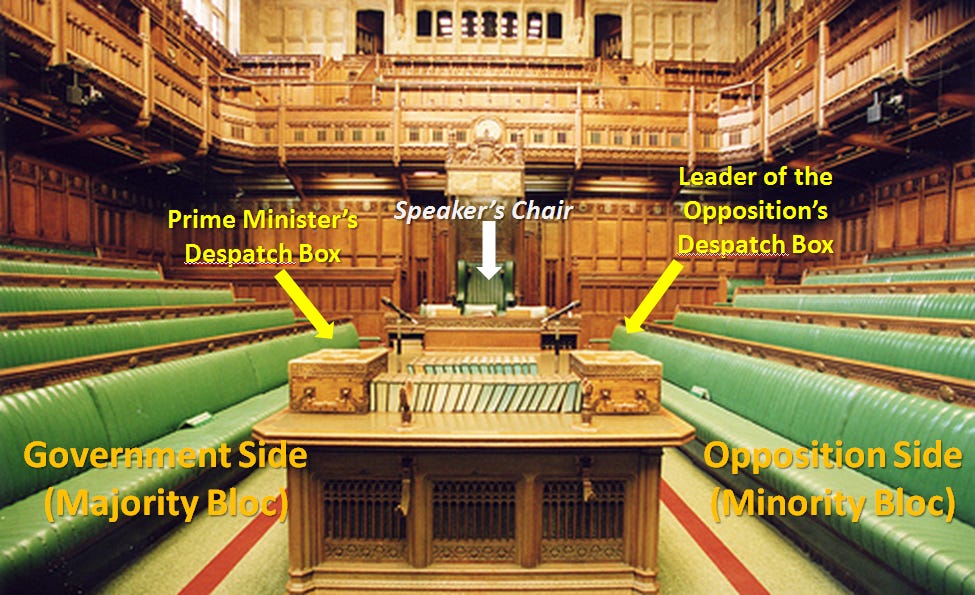
There comes a time when an old structure stops being merely inadequate and becomes actively treacherous. The Westminster model – exported, adapted, and ritualised in so many jurisdictions that like to call themselves “mature democracies” – has crossed that line.
It no longer simply misfires; it corrodes and it oppresses. Seduced and mediated by the drama of money and power, it trains citizens to mistake periodic theatre for influence, policy auctions for governance, and partisan warfare for civic deliberation. In the process it has lost sight of what governance is actually for: completing the unfinished work of decolonisation, cultivating collective wisdom, and nurturing an economics of wellbeing. Morality in governance means honouring the sheer privilege of being human, and using that privilege in service of the commons – awakening a deeper public consciousness and an ethic of care for each other and for the planet.
Instead, we cling to the old model the way an addict clings to a diminishing supply – mainly because we have forgotten that other ways of governing human affairs ever existed, and because too many careers, egos, and fortunes hang from its rafters. Meanwhile, the house itself is on fire.
If that sounds melodramatic, ask yourself why trust in parliaments is collapsing across continents; why campaign finance scandals have become seasonal events; why legislative bodies frequently become clearing houses for lobbyists rather than custodians of the commons. Look at any recent corruption inquiry in a Westminster-style jurisdiction and you will see the same leitmotif repeat: money laundering itself into influence, party machines shielding mediocrity, media cycles shaping policy in forty‑eight hour spasms.
So the question I pose is not whether this model can be patched up cosmetically with an injection of Botox and a new shade of lipstick. It’s whether we have the courage and imagination to step beyond it altogether – towards a polycentric, wisdom‑infused democratic culture already germinating in citizens’ assemblies, in MiVote‑style direct decision platforms, in networked municipal movements, and in the oldest continuing civilisations on earth that never forgot how to deliberate with Country, not just about it.
From Representation to Substitution
The Westminster system was never designed to cope with real‑time, planetary‑scale complexity. It was conceived in an age of quills and sailing ships, when information travelled by horse, and when the ruling class could persuade itself that “the people” were an amorphous mass needing benevolent supervision. The logic was crude but understandable given the constraints of the time: elect a small cadre of “better sorts” every few years, send them to a distant chamber, and trust them to decide in your name. Under sea‑lanes and semaphore, that template had a certain brutal efficiency. Under broadband, mesh networks and blockchain, it becomes a parody.
We now inhabit a civilisation in which information is instantaneous and asymmetrically distributed. The impacts of decisions cross borders in hours. Every citizen with a modest device in their hand can deliberate, organise and act. Yet we still pretend that deferring collective will to a professional political class – most of them filtered through party apparatchik pipelines and conditioned to treat power retention as the primary game – is the pinnacle of democratic maturity. It is closer to a feudal upgrade.
Across much of the Westminster world, a growing proportion of “representatives” have never actually lived in the worlds they claim to speak for. They move straight from university debating clubs into party youth wings, from there into ministerial offices, think tanks and factional backrooms – apprenticed to the machinery of power without ever having to earn a living outside it. By the time they arrive in parliament they are fluent in the idiom of spin and manoeuvre, yet largely illiterate in the rhythms of ordinary work and everyday struggle. Under those conditions, representation quietly mutates into a caste project: politics as a career track rather than a temporary duty of service.
In most Westminster arenas today, representation has further degraded into substitution. Parties decide the agenda. Donors frame what is “realistic”. Media moguls arbitrate visibility. Electors are wheeled on every few years to confer temporary legitimacy on choices made long in advance and in private. The people are not consulted between elections except as fodder for focus groups or as hashtags to be harvested.
In that sense, the model has inverted its own ostensible purpose. Instead of embodying the informed will of the community, it systematically distances public judgement from public decisions.
Industrial Economism in Parliamentary Clothing
The pathology runs deeper than personal venality or partisan incompetence. It’s anchored in the prevailing civilisational story – the industrial economism that has swept the planet over the past two centuries.
Within that story, the purpose of a society is reduced to the perpetual amplification of economic throughput – extraction, production, consumption, disposal – lightly glazed with talk of “freedom” and “progress” and “opportunity”. The earth becomes inventory. People become units of labour and demand. Political institutions become switching stations for capital flows.
The Westminster model, far from restraining this ideology, has become one of its favourite operating systems. Parties compete to promise growth. Corporate donors underwrite both sides of the aisle. Regulatory frameworks are written – and quietly amended – by those most affected. And the public sphere is colonised by advertising logics.
We should not be surprised, then, that so much legislation reads like a ledger; that environmental devastation is routinely traded off against “jobs”; that social policy is framed as a cost rather than an investment in collective flourishing. The system is doing exactly what it has been groomed to do: prioritise capital accumulation under the guise of democratic choice.
Corruption in this environment is not an aberration. It’s a structural lubricant. Gift‑wrapped influence, revolving doors between cabinet and boardroom, opaque foundations, private clubs where policy is whispered over fine wines – these are not bugs in the code. They are how an extractionist worldview outfits itself in constitutional costume.
The Urgency of the Present Moment
Why is the need to move beyond this model suddenly so acute? Because the buffer between political myth and ecological, social and technological reality has evaporated. We’re living through a convergence of crises: destabilised climate systems, mass displacement, algorithmic manipulation of attention, widening inequality, and growing disillusionment with formal institutions.
These are not “issues” to be added to the parliamentary in‑tray or dispatched during Question Time. They are symptoms of a society whose organising metaphors have run out of meaning.
This is a system that cuts decisions off from those who bear their consequences, encourages adversarial point‑scoring instead of collaborative insight, and distorts public reason through financial and media capture. It cannot possibly respond with the speed, depth or legitimacy now required. Tinkering with committee structures or tightening lobbying registers is akin to revising the sailing schedule after the hull has already split.
When the feedback loops between citizens, ecosystems and decision‑makers are this attenuated, failure is not episodic. It becomes endemic.
Polycentric Governance: Democracy as Ecology
If the Westminster model is a linear conveyor belt – input public sentiment amplified by the media circus at one end, output decrees at the other – then polycentric governance resembles a living watershed. Decisions are made in many places at once, across different scales, with overlapping jurisdictions that learn from and correct one another. Authority is not abolished, but distributed. Responsibility is not centralised, but shared.
Elinor Ostrom’s work on commons governance showed that communities are fully capable of managing complex shared resources without a single sovereign controller, provided a few conditions are met: clear rules, mechanisms for monitoring and sanctioning, layered institutions, and the possibility of local adaptation. Her insights, derived from fisheries, forests and irrigation systems across continents, dismantle the myth that only centralised hierarchies can cope with complexity.
In that sense, MiVote’s architecture – incubated at the Centre for the Future ten years ago – is less a “new app” and more an early prototype of a polycentric civic ecology. Local chapters, each with their own governance and ethics committees; a global council that safeguards core principles without dictating local content; a policy framework that insists on distributed information gathering, multiple lenses on each issue, and an independent ethics filter for bias – these are not incidental design choices. They prefigure a different relationship between power and place.
Instead of a single monolithic parliament pretending to speak for a heterogeneous society, we have nested forums of deliberation, linked through shared values and transparent procedures. Instead of policy being written behind closed doors and sold to voters as pre‑packaged “reforms”, we have topics emerging from the community, refined through open consultation, and presented as multiple possible destinations.
The key here is not just decentralisation in a technical sense. It is the maturation of political agency. Citizens cease to be spectators or supplicants. They become co‑authors of the norms that govern their lives.
Indigenous Wisdom: The Forgotten Lineage of Democracy
Modern textbooks like to depict democracy as a Greco‑European invention. Yet if we attend, even briefly, to the governance traditions of Indigenous peoples around the world, a very different genealogy emerges.
In many First Nations cultures – from the Haudenosaunee in North America to Aboriginal nations on the Australian continent – collective decision‑making was grounded in dialogue, consensus, ritualised listening, and obligations to land and future generations. Elders were custodians, not owners. Authority flowed from story, relationship, and demonstrated service, not from party endorsement or media charisma.
Crucially, time itself was held differently. Decisions were often weighed against their impact on those yet to be born. Landscapes were read not as real estate but as kin – complex, sentient webs to which humans owe care.
This isn’t romantic nostalgia as some insist. It’s a record of systems that sustained cultural continuity for tens of millennia without crashing their bioregions. Compare that with the mere few centuries it has taken industrial economism, abetted by Westminster‑style institutions, to push key planetary boundaries to breaking point, and one has to ask: What happens if we treat Indigenous wisdom not as a museum curiosity but as a living treasury of governance insight?
Suddenly, MiVote’s insistence on asking a destinational question – ‘What future do you want to build together?’, on using a consensus‑seeking phrase – ‘Can you live with this?’ rather than ‘Are you for or against?’, on subjecting decisions to long‑term, iterative review, and on elevating marginalised voices through open submission portals, starts to look less like a tech‑startup novelty and more like a digital re‑translation of very old practices into a contemporary medium. The architecture remains polycentric; the spirit is relational and intergenerational.
Direct Democracy Without Mob Rule
One predictable objection to direct democracy is that it invites tyranny by the majority – impulsive, ill‑informed swarms overwhelming the rights of minorities. This critique is not without historical warrant. Yet it says more about how we imagine “the people” under the current paradigm than about what is actually possible.
When citizens are fed a diet of polarising media; given only binary choices; excluded from meaningful influence between distant elections; they will indeed tend to respond in polarised, binary, and episodic ways. Rage becomes a substitute for agency.
MiVote’s policy and governance frameworks were designed precisely to subvert that pattern. Topic selection is open, but the framing of options is grounded in comprehensive research, community consultation, and ethics vetting. Four distinct destinations are crafted from the data, not from slogans. Each is presented with evidence, implications, and trade‑offs laid bare.
The voting question itself – “Can you live with this?” – invites nuance in internal dialogue instead of ideological reflex. A 60 per cent threshold for a majority position requires broad support, not a knife‑edge win. Where such support doesn’t emerge, run‑off votes or citizen juries come into play.
Here, direct democracy is not a free‑for‑all. It’s an orchestrated conversation, with transparent rules and visible scaffolding, designed to cultivate judgement rather than inflame opinion.
Leadership as a Collective Attribute
In Westminster settings, leadership has been conflated with personal dominance: the numbers man, the “decisive” prime minister, the charismatic party chief, the strongman. These archetypes are ideal for media dramatisation but disastrous in a world requiring collaborative intelligence.
A polycentric, Indigenous‑informed decision ecology redefines leadership as an emergent property of the whole society: the capacity of a community to notice what matters, make sense of it together, and act in ways that elevate the conditions for life. In this view, a MiVote‑powered “representative” isn’t a saviour figure but an envoy – mandated to carry the community’s position into formal arenas and to report back.
Term limits, strict bans on corporate funding, public transparency of all donations, and contractual obligations to vote in line with the community’s choices are not punitive measures. They are ritual boundaries, reminding everyone involved that the authority flows from the many, not the few.
When you take away the career ladder, the donor leash and the party whip, something interesting happens. Those who run for office tend, over time, to be those motivated by service rather than self‑aggrandisement. The office becomes a temporary role in an ongoing civic conversation, not an identity to be defended at all costs.
Technology as Servant, Not Sovereign
We live in an age where the word “platform” has been colonised by corporations whose main interest lies in harvesting data for profit. It’s therefore tempting to dismiss any digital mediation of democracy as just another algorithmic trap.
Yet technology, in itself, is not the villain. It’s both an amplifier and an accelerator. In the grip of extractive business models, it accelerates addiction, polarisation and surveillance. Embedded within a democratic model that’s been carefully designed for equality, transparency and accountability, it can accelerate deliberation, access, and inclusion instead.
MiVote made a deliberate choice to separate the social movement (a not‑for‑profit with strict limits on funding sources) from the technology developer (Horizon State), so that the tool (a smartphone app) would remain subordinate to the ethic, rather than the other way around. In that configuration, the blockchain is not a speculative casino but a public ledger for votes – offering anonymity, verifiability and auditability without centralised control.
Of course there are still questions – about digital divides, access in rural areas, the vulnerability of certain populations to coercion. A serious democratic project must face those questions head‑on, not dismiss them. But these are solvable design challenges, not fundamental flaws. Paper ballots are hardly immune to manipulation, and ignorance is not ennobled by being written in ink. The real issue is whether the technological environment is harnessed to deepen citizenship or to game it.
Why Incremental Reform Will Not Suffice
At this juncture, mild tinkering with the Westminster template is a form of denial. The rot is not confined to a few bad actors or to any particular country. It is systemic. Party funding models that embed permanent vulnerability to capture. Electoral geographies engineered to entrench incumbency. Media ecosystems whose business model depends on outrage rather than understanding and insight. Constitutional arrangements that centralise power while diffusing responsibility. A system so configured cannot simply be patched. It must be outgrown.
That doesn’t mean abolition overnight. It means building, alongside existing institutions, alternative architectures that embody different assumptions about power, knowledge and belonging. It means allowing those alternatives – polycentric, participatory, intergenerational – to demonstrate their competence in practice. Over time, as people experience that their voices actually shape outcomes, the old structures will wither in relevance, even if they persist on paper.
MiVote, and kindred experiments around the world, should be read in that light: not as apps competing for attention, but as early prototypes of a post‑Westminster civic metabolism. They weave together:
· Direct participation, without drowning people in every technical detail.
· Collective sense‑making, rather than partisan narrative warfare.
· Ethical filters, to prevent the worst impulses of the moment from being codified into law.
· A global network of local chapters, capable of learning from one another while remaining rooted in their own cultural soils.
There’s no guarantee that such experiments will always succeed. They will stumble, be co‑opted in places, be resisted by entrenched interests everywhere. But the alternative – clinging to a visibly corrupted, structurally captured and myopic system – carries a far greater certitude of harm.
A Civilisational Choice
Every civilisation tells itself a story about how decisions are made and who belongs in that conversation. For centuries, the Westminster story has been: “We, the enlightened few, will speak on your behalf, provided you choose between us every few years.” That story is no longer credible, if it ever was. It fails the tests of transparency, efficacy, and inclusion. It fails the ecological test. It fails the test of basic adult dignity.
An emerging story, echoing indigenous lineages and resonant with contemporary tools, especially in a country like Australia, sounds different: “We, the many, in all our diversity, will learn to think and act together. We will use every means at our disposal – from circle dialogues to encrypted ledgers – to ensure that no voice is systematically muted, no ecosystem treated as disposable, and no decision severed from its long‑term consequences.”
Polycentric governance is not an academic abstraction in that context. It’s what happens when that second story is taken really seriously. It is democracy ceasing to be a periodic event and becoming a living habit.
The urgency, then, is not just political. It is civilisational. The Westminster model, welded to industrial economism, is steering us towards a future in which governance becomes little more than crisis management on behalf of those still wealthy enough to insulate themselves.
We have, in our hands, the capacity to craft something else: distributed, wise, resilient, capable of hearing both the youngest and the eldest, the human and the more‑than‑human.
MiVote is one attempt to show how that might look in practice. Many others are sprouting in different soils. None of them are perfect. All of them are preferable to the compulsory cynicism of a politics that has forgotten its own purpose. The only real question is how long we insist on propping up a crumbling stage before we step into the open air and start rehearsing new kinds of conversation.