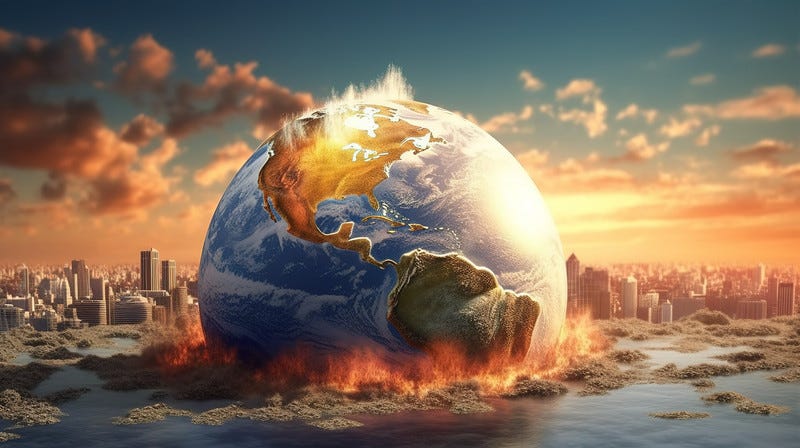
Collapse is not always a word to be feared. However, as I tend to use the word, it’s not intended as a prophecy. It’s a description of what happens when a civilisation insists that its stories matter more than physics.
For the past two centuries, industrial society has been organised around a particular fable: that the economy can expand without limit, that human ingenuity will always outrun constraint, and that the biosphere is a kind of stage set around which the real drama – our drama – takes place. Let’s face it: that fable has been extraordinarily generative. It has given us antibiotics, satellites, computers and instantaneous communication with almost anyone, at any time, and for any reason. It has also given us atmospheric chemistry unknown in human history, the sixth great extinction, oceans losing oxygen, and a food system that’s essentially a fossil fuel refinery with crops at the end of the pipe.
Also, when I say collapse is inevitable, I’m not suggesting a single cinematic event, the lights going out in one spectacular moment. I am pointing to something far less theatrical and far more structural: a civilisation built on a set of assumptions that have ceased to be true cannot endure in its current form. Whether that dissolution arrives as a long dismantlement, a sharp splintering, or a managed descent is an open question. What is not open – unless the laws of thermodynamics are suddenly willing to negotiate – is the belief that we can continue as we are.
The central article of faith in the modern worldview is growth. Growth of GDP, of production, of consumption, of financial claims on the future. In almost every capital city you can hear the same liturgy: growth will solve unemployment, pay off debts, fund hospitals, calm angry electorates. Growth is treated as a kind of secular grace that makes all other problems tractable. And it’s bunkum.
Growth, as currently practised, is inseparable from an increasing throughput of matter and energy. On a finite planet, this raises a question that is inconveniently down-to-earth: how many times can we double the physical scale of the human enterprise before it collides with biophysical limits in ways that cannot be finessed? When climate scientists speak of “planetary limits”, or when ecologists document collapsing insect populations or vanishing topsoil, they are not engaging in metaphor; they are describing the walls of the container in which the growth story is unfolding.
We have already pushed through several of these walls. The atmosphere has been treated as an open sewer for greenhouse gases. Landscapes have been reduced into monocultures. Rivers that once ran clear now carry chemical cocktails essential to our industrial mode of agriculture. The cumulative effect is that the stable Holocene conditions under which all known civilisations emerged are rapidly receding in the rear-view mirror. If civilisation is a pattern of relationships that presupposes a reasonably stable climate, predictable seasons, and abundant biodiversity, what happens when those conditions are withdrawn?
Energy is the most unforgiving of these constraints because it’s the master resource. Every other system – food, water, transport, healthcare, digital infrastructure – is ultimately a way of converting energy into order. Historically, industrial civilisation was built on extraordinarily rich energy sources. Early oil fields behaved like artesian wells of power. The ratio between the energy invested in extracting a barrel and the energy contained in that barrel was, for a time, astonishingly high. The surplus was vast enough to underwrite sprawling bureaucracies, standing armies, global trade, mass education, and the apparatus we have come to regard as “normal life”.
As those easy reserves have been depleted, we have been forced to go further offshore, deeper underground, and into more recalcitrant rocks. This is where the concept of return on investment becomes critical. When the energy you must spend to obtain energy rises, what remains for everything else declines. Various analyses differ on the precise arithmetic, but the broad trend is clear: the net energetic surplus from fossil fuels is eroding. If a barrel of oil once delivered scores of units of surplus energy for every unit invested, and now offers a fraction of that, what does that imply for a civilisation dependent on ever-expanding surplus?
Joseph Tainter’s work on complex societies raises another uncomfortable question here. If increasing complexity – more layers of administration, more specialised institutions, more infrastructure – is both enabled by surplus energy and consumes it, what happens when the surplus shrinks? Can we maintain the density of interlocking systems we currently take for granted, or must there be some kind of simplification? If simplification is unavoidable, who decides what is relinquished, and who bears the cost?
Nowhere is this energetic dependency more visceral than in our food system. Wherever I travel – from Europe to Asia, Africa to the Americas – I see variants of the same pattern. Tractors, synthetic fertilisers, pesticides, pumped irrigation, refrigerated supply chains, long-distance commodity flows, supermarket aisles groaning with products whose ingredients and packaging have each made long fossil-fuelled journeys. Remove the fossil energy and most of what we call “modern farming” magically disappears. And if that’s the case, what does “food security” mean in a world where the very fuels on which this system depends are both destabilising the climate and yielding diminishing net energy?
When energy, food, water, and climate are all entangled, collapse is not a single failure but a cascade of symbiotic breakdowns. A drought worsened by climate disruption undermines harvests; dwindling energy surplus raises the cost of fertilisers and transport; stressed governments subsidise what they can, cutting investment in other areas; people move, often across borders; social cohesion frays; authoritarian reflexes strengthen. We are already seeing fragments of this pattern appearing on every continent. The sequence differs from place to place, but the underlying dynamics are recognisably global.
If the growth‑and‑extraction model is running up against physical limits, why is our public conversation so determined to pretend otherwise? At least part of the answer lies in the stories we have built into our institutions. Corporations answer to capital markets wired for quarterly growth. Governments are elected for relatively short terms on promises of more and more stuff – more jobs, more consumption, more security, more infrastructure – and, invariably, lower taxes. In current political imaginaries, offering less of any of these is indistinguishable from failure. Development agencies in low-income countries are still encouraged to use the high-consumption societies of the OECD as a template, although the biosphere cannot tolerate another few billion people living in that manner.
We respond with three kinds of adjustment, which Bill Sharpe describes as different “horizons” of change. The first is to double down on the dominant system, tinkering at the edges while preserving its core assumptions. This is the logic of “business‑as‑usual plus a few fixes”: more extraction, more throughput, but hopefully with marginally better technology and marginally improved regulations.
The second is to innovate within that frame – green growth, ESG, cleaner production, sustainable brands. This is disruptive at the level of products and practices, but not vocabulary. Growth is still non-negotiable, extraction is still central, nature is still background scenery.
Then there is a third horizon of possibility, not yet fully intelligible to the incumbents, in which the economy is understood as a subsystem of the biosphere rather than the reverse. In this emergent space, the aim is not to extract more, or even merely to extract less destructively, but to participate in living systems in ways that regenerate rather than erode their capacity to support life. Whether such a horizon can mature quickly enough, and at sufficient scale, to avert the more violent forms of collapse is an open question. But the precondition for its emergence is clear: we must become aware that the first horizon is failing.
Collapse awareness, in this sense, is not an invitation to despair; it’s an invitation to step into greater coherence. It’s the moment when our mental models begin to match the biophysical reality in which they operate. When you see that an economic system demanding compound growth is colliding with ecosystems that don’t grow in that way, you’re no longer surprised by rising inequality, ecological degradation, or social unrest. You recognise them as structural features, not anomalies.
Unsurprisingly, this recognition can be profoundly unsettling. Many people understandably prefer to believe that a tweak in policy, a new technology, a more enlightened government, or the IPCC alarmists being proven wrong, will be sufficient. They look to solar panels, electric vehicles, or digital “efficiency” and ask whether these are evidence that we can decouple growth from environmental harm. It’s true that some renewable technologies already offer respectable energy returns over their lifetimes and that further improvements are feasible. There are studies suggesting that, if deployed wisely, they could maintain a level of net energy compatible with complex societies. The key word there is wisely. Are our current institutions capable of orchestrating such a transition at speed and scale, while also reversing biodiversity loss, restoring soils, and reducing material throughput overall, rather than simply substituting one form of extraction for another?
So far, the record is not encouraging. Emissions continue to rise. Forests continue to fall. Material use keeps climbing. Political systems, even in nominal democracies, show a tendency to be captured by incumbents whose wealth depends on delaying any genuine transition. In many countries, fear of short-term disruption overwhelms concern for long-term viability. This is not a question of culture in any narrow sense; whether we look to the United States, China, India, Brazil, Russia, or Europe, the pattern recurs with local variations. Different histories, different ideologies, but the same addiction to growth, the same reluctance to acknowledge limits.
Beneath these systems lie worldviews – shared and mostly unexamined beliefs about what is real, what is valuable, and what is possible. The dominant worldview of the industrial era portrays humans as separate from nature, individuals as fundamentally competitive, and value as something that can be fully captured in monetary terms. From that vantage point, a forest is worth more clear‑felled than left standing, a river more valuable when diverted through turbines than when meandering and supporting a mosaic of life, and a human being more “productive” when employed in the manufacture and consumption of goods than when engaged in unpaid care, the arts, or community work.
World‑systems are these worldviews made tangible. Legal codes, corporate charters, international trade agreements, central banking rules, media narratives, educational curricula – all are embodiments of a particular civilisational story. They don’t just describe reality; they embody it. And because they are human creations, they are continuously interpreted and reinterpreted by cultures, communities, and individuals whose mindsets are variable. In a village in the Sahel, a financial trader in Lagos, a software developer in Bangalore, a fisher in the Philippines, a student in São Paulo, people live in overlapping realities. Yet all are now entangled, however involuntarily, in an economic machine that insists on perpetual growth on a finite planet.
The question then arises: if the first horizon of industrial civilisation is structurally unsustainable, what does it mean to inhabit the moment of its decline responsibly? There are at least three temptations to resist. The first is denial – sticking to the conviction that incremental reform will suffice, that “the market” will sort it out, that someone somewhere has a plan. The second is fatalism – assuming that because we can’t preserve the existing system intact, nothing we do matters. The third is escapism – imagining that we can escape the consequences by insulating ourselves in enclaves of privilege, digital or physical, while the periphery burns.
None of these responses respect the reality that, although we cannot possibly control the larger arc of civilisational change, we’re not helpless spectators either. Every worldview shift in history has been enacted through countless local choices: how we grow food, how we share knowledge, how we raise children, how we respond to strangers, what we accept as legitimate authority. When enough of these choices cohere, institutions begin to bend. Occasionally they break.
From an evolutionary perspective, collapse is not an aberration; it’s one of the ways complex systems reorganise. Ecosystems burn and regrow. Empires rise and fall. Languages spread and then fragment. The novelty in our present situation is not collapse per se, but the scale and speed at which our decisions reverberate through the world‑system. For the first time, a single species has become a geological force. That is not a boast; it is a diagnosis.
If our current economic model is incompatible with the long‑term habitability of the planet, the issue is no longer whether it will change, but how. Will the change be forced upon us by cascading breakdowns, or can we cultivate forms of collective intelligence capable of anticipating and modulating those breakdowns? Can we imagine economies whose purpose is not to grow indefinitely, but to maintain and deepen the conditions for life? Can we create institutions that learn as fast as the crises they face unfold, rather than always lagging behind?
I don’t pose these questions for think tanks and conferences. They are not theoretical but immediate, practical, and everywhere. A community deciding whether to defend a forest or allow it to be logged. A city choosing between car-centred infrastructure and walkable neighbourhoods. A government weighing subsidies for fossil fuels against investment in public health and ecological restoration. A family considering how much of their aspiration is derived from advertisements rather than from their own sense of sufficiency and dignity. Each of these decisions either reinforces the first horizon or nourishes the emergent third.
Collapse awareness shifts the locus of responsibility. Instead of asking how we can save “our way of life” – an expression that usually means the lifestyles of a global middle and upper class – we can ask what forms of life are worth saving, and at what scale. It invites us to distinguish between what is essential – clean water, food, shelter, care, cultural meaning, a living biosphere – and what’s contingent – much of the manufactured scarcity, status, competition, and compulsive consumption that currently structure our days. If we discover that large parts of what passes for normality are actually forms of addiction, then withdrawal, however uncomfortable, becomes a moral necessity rather than a loss.
None of this implies a romantic return to some idyllic pre-industrial paradise. Billions of people quite reasonably aspire to reliable electricity, healthcare, education, and freedom from grinding labour. The question is whether those aspirations can be met without reproducing the same growth-imperative and extraction logic that’s dissolving the biophysical foundations of civilisation. Is it possible to have high-quality lives with far lower material and energy throughput, distributed more equitably across the human family? If so, what kinds of technology, culture, and governance would that require? And if not, what future are we choosing?
I don’t claim to possess definitive answers. Anyone who does should be treated with caution. What I can say is that as long as our collective attention remains fixated on preserving the first horizon, we will continue to misread the signals Gaia is sending. We will treat early manifestations of collapse – violent weather, crop failures, migrations, institutional paralysis – as isolated “crises” to be managed, rather than as symptoms of a deeper systemic contradiction. We will pour resources into shoring up the old architecture instead of learning how to inhabit the ruins with grace and imagination. Does any of that ring a bell?
In times like these, it’s our responsibility to help make visible the operating assumptions of our civilisation and to invite people to examine whether they still serve life. It’s to accompany individuals and communities as they loosen their grip on stories that no longer fit and experiment with practices that prefigure a different kind of world-system. It’s to insist that the future is not a linear extension of the present, but a field of possibility shaped by our willingness to question even our most cherished convictions.
Collapse, understood in this way, is not the end of the story. It is the end of a particular chapter – the fossil‑fuelled, growth‑obsessed, extraction‑driven chapter of human history. What follows depends less on our capacity to prolong that chapter than on our capacity to imagine, design and enact the next part of the human story.