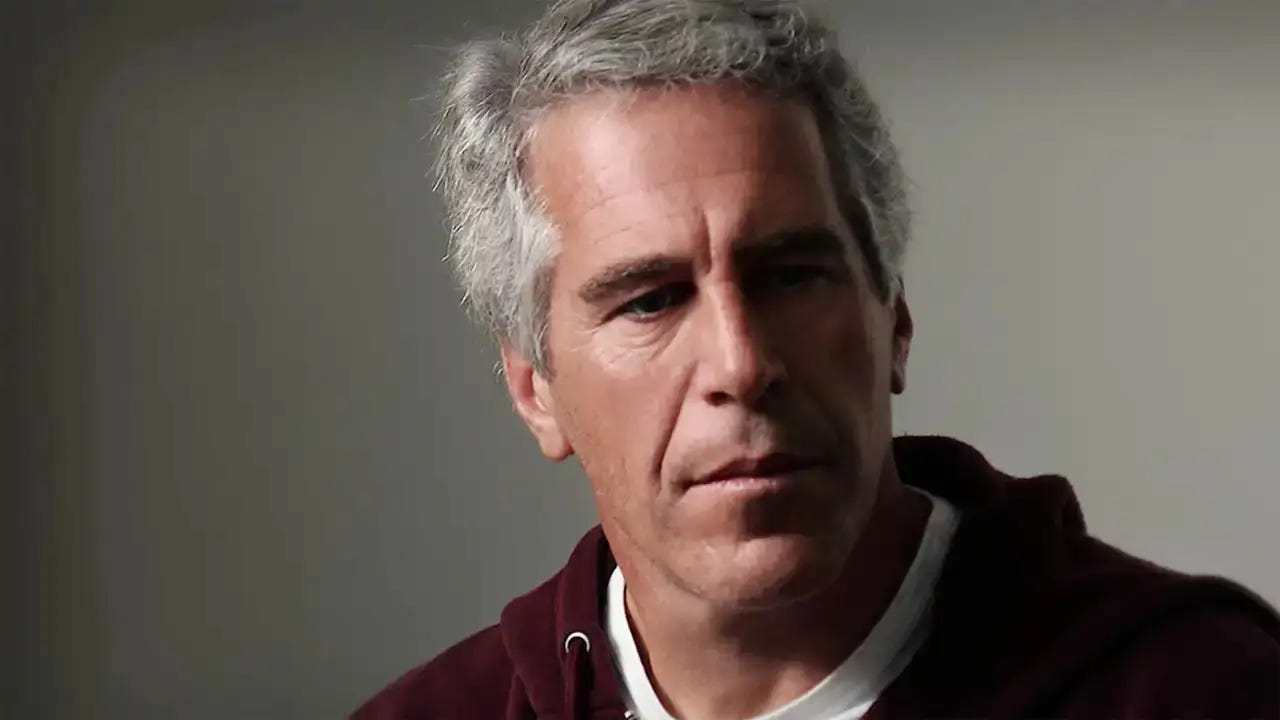
Every few months the same spectre reappears, dressed in slightly different garb. This time it’s Jeffrey Epstein strolling through the streets of Tel Aviv: tanned, nonchalant, resurrected by the alchemy of generative image engines and the gullibility of social media.
These pictures – which image specialists, fact‑checkers and even a cursory eye can show to be fabricated – are not really about Epstein. They are about us. They expose the neurological scars of a civilisation that no longer believes the stories it’s told, but has not yet learned how to tell itself more genuine stories.
We know – from autopsy reports, official records, court documents, and multiple investigations in the US and elsewhere – that Epstein died in custody in August 2019. That conclusion can be challenged at the margins, as any forensic judgement can be. But the claim that he is now living out his days in Israel, under the sun, requires a suspension of ordinary standards of evidence so radical that it must tell us something deeper than “people are stupid”. People are rarely stupid in the abstract. They are wounded, wary, and looking for a narrative that fits the texture of their disappointment.
The more interesting question is not whether Epstein is alive. It’s why the suggestion that he might be alive finds such eager hosts.
In mythic terms, Epstein is already more than a man. He is a totem of the industrial-financial order at its most obscene: a trafficker of young bodies, apparently protected by older men who held public office, chaired boards, edited newspapers, and funded universities. His death, in one of the most surveilled prisons in the world, in circumstances still cluttered with anomalies – malfunctioning cameras, inattentive guards, curious paperwork – occurred in a world where trust had already been hollowed out by banking crises, forever wars, pandemics, and the steady drip of official deception.
Under those conditions, the notion that “he got away” is almost too satisfying. It gives shape to a pervasive intuition: that people with sufficient money and connections are able to float, like scum on a polluted river, untouched by the law that drags the rest of us under.
So when an AI system, trained on billions of images and indifferent to truth, produces a plausible facsimile of Epstein buying groceries in a Middle Eastern street, it meets a certain psychic hunger. The image is absorbed, not as evidence, but as confirmation of a prior hunch: the game is rigged; they always get away. The irony is that this hunch doesn’t need digital fakery. The impunity is real enough without him being on the run. Strip away the synthetic photographs and the lurid threads on anonymous forums, and what remains is already intolerable.
We have ample documentation of a man who abused and trafficked minors over many years; who cultivated and was courted by financial magnates, political leaders, academics, and royalty; who secured a notoriously lenient plea deal in Florida that side‑lined victims and kept his network largely intact; whose accusers had to fight for years to be heard; and whose social web, even now, has only been partially untangled in public.
One doesn’t need speculative resurrection stories to detect collusion. The pattern of accommodation, protection, and strategic blindness is written into legal agreements, flight logs, email trails, photographs, and long‑buried complaints. The dots don’t need imaginative joining; they are already awkwardly close together. In that sense, the “Epstein is alive” motif functions as a convenient diversion. It diverts attention away from the more pedestrian and far more damning reality: the system didn’t need to fake his death in order to fail. It failed, repeatedly, while he was very much alive.
The harder inquiry is mundane in its horror: who enabled him? Who benefited from proximity to him? Which prosecutors, editors, bankers, university presidents, and intelligence officers looked the other way, and why? To what extent was his operation entangled with the standard operating procedures of a global order where bodies, information, and loyalties are routinely bought and traded? Once we lean into those questions, the cheap thrill of “I saw a photo of him in Israel” pales. Resurrection myths are a distraction from systemic diagnosis.
We like to congratulate ourselves on being sceptical. We announce that we “don’t trust the mainstream media”, that “governments always lie”, that “nothing is as it seems”. This stance which I’ve used myself on many occasions feels radical. In truth it can be another form of submission.
Scepticism has become a mask – something we strap to our faces in public – rather than a discipline. A discipline requires us to interrogate what we want to believe as fiercely as what we are told to believe. A mask merely swaps one priesthood for another: the talking head on a niche channel replaces the anchor on a state broadcaster; the anonymous “insider” replaces the official spokesperson. But the structure – deference without verification – remains curiously intact.
The Epstein saga gives us a vivid case study. On one side, we encounter official accounts that are thin, incomplete, and delivered by institutions with a lamentable record of candour. On the other, a free-for-all of speculation, in which AI fabrications, half‑remembered rumours, and deliberate disinformation jostle for our outrage. If all we do is invert our loyalties – disbelieve almost everything delivered with a government seal, swallow everything that circulates on an encrypted channel – we have not escaped the industrial paradigm. We have become its jittery shadow.
The more difficult stance, and the one we now desperately need, is unsentimental: to accept that power does lie and obscure, that official narratives are often partial or crafted for convenience; and simultaneously to insist that any counter‑narrative must be anchored in evidence that can be examined, questioned, and, where possible, corroborated by multiple independent sources. Otherwise, we’re not awakening from propaganda. We are bingeing on a new, more chaotic strain.
The Epstein-in-Israel images are an early glimpse of a world we’re already tumbling into. We now live in an infosphere where anyone with a laptop can summon, in a few minutes, a photorealistic “event” that never occurred: a politician committing a crime, a religious leader uttering blasphemy, a protest turning violent, a child being rescued or abused, or even an alien spacecraft heading in our direction. The effort once required to manufacture convincing fraud – the staging, the actors, the elaborate documentation – is collapsing to almost nothing.
In that world, the old question “is this true?” becomes harder to answer with a casual glance. Our eyes, honed over millennia to detect authenticity in faces and landscapes, are being asked to adjudicate on artefacts assembled by algorithms that have studied more faces and landscapes than any of us could in fifty lifetimes. This doesn’t make truth impossible, but it certainly makes truth lazier for those who crave attention. Why investigate complex financial ties, legal history, or institutional complicity, when you can simply generate an image that inflames, then profit from the resulting storm of clicks?
We need to understand that outrage itself has become an extractive industry. The industrial mindset, which once treated forests, rivers, and people as reserves to be mined, now treats our attention in the same way. Spectacle is the new ore. AI is just better digging equipment. The more we share, uncritically, the more that industry flourishes.
The fascination with Epstein’s possible survival is not confined to one country or culture. I encounter versions of it in Bangkok cafés and Johannesburg taxis, Beijing teahouses and London pubs. The names shift; the pattern remains. In every region I work in, there is a growing conviction that what we’re shown and told is a stage set erected in front of a very different backstage reality. A veritable Truman Show.
This intuition is not groundless. Neoliberal capitalism – what I refer to as industrial economism – has globalised a worldview in which almost everything is subordinated to financial returns. Governments compete for investment. Media companies compete for advertising. Universities compete for rankings and donors. Within that logic, telling the population an inconvenient truth is often framed as a “risk”; spinning or postponing it becomes a “strategic communication”.
For decades, this theatre managed to sustain itself. As long as living standards were rising for enough people, and the illusion of upward mobility held, the gap between what people sensed and what they were told could be managed. That compact is fracturing. Inequality deepens, environmental breakdown accelerates, wars drag on, and public services falter. The script begins to sound empty. Against that backdrop, the thought that a man like Epstein might stroll unmolested through a foreign city feels almost more credible than the notion that the system he inhabited will investigate itself with integrity. In other words, the rumour is parasitic on a deeper disillusion. But if we stay at the level of rumour, we never get to grips with the root causes of that disillusion.
Perhaps the most striking absence in the global conversation around Epstein is not a missing videotape or a mislaid document, but a sustained focus on the lives of those he damaged, and on run of the mill mechanisms that allowed that damage to persist.
Look at any social platform when his name trends. You will find speculation about flight logs, “lists”, intelligence ties, and suspicious deaths. You will find photographs circled in red and faces matched against headlines. You will find endless fascination with the psychology of the predator. You will rarely find prolonged attention to the teenagers he groomed, the women who tried to warn others, the communities that normalised his presence, or the years of institutional inaction. It’s as though our civilisation can tolerate abuse more readily as an abstract horror than as a specific, systemic failure that implicates prosecutors, police officers, school principals, journalists, hoteliers, airline crews, bankers, and dinner guests.
Yet if we truly wish to prevent repeats of the Epstein saga, that’s precisely where our gaze must linger. Trafficking and exploitation rely on networks. Not simply the glamorous, high‑level networks of finance and diplomacy, but the more modest circuits of silence: the driver who hears screams and shrugs; the official who misplaces a file; the colleague who “doesn’t want to get involved”.
Leadership, in the sense that interests me, arises when people in those spaces refuse to collaborate with the normalisation of harm; when they act together to alter conditions, not simply to eject an aberrant individual. Naming Epstein as a monster is easy. Asking how many people helped construct the labyrinth in which he hunted is far less comfortable.
We stand at an awkward threshold. On one hand lies a future in which truth becomes purely tribal: your narrative versus mine, each sustained by custom‑tailored media streams, each inoculated against contradiction. In that future, reality fragments into mutually exclusive myths. Every crime has a counter story; every photograph, a plausible “debunk”; every attempt at accountability, a counter‑accusation.
On the other hand lies a more demanding possibility: that we cultivate shared practices of inquiry sturdy enough to withstand both official propaganda and lucrative nonsense. That we accept how much we don’t know, and yet are willing to do the slow, unglamorous work of verification. That we teach our children – and ourselves – to ask simple but disciplined questions: Who is making this claim? What is their record? What evidence is offered? Who else has checked it? What are the interests at play?
In that world, the “Epstein is alive in Israel” motif would wither quickly, not because the authorities issue a stern denial, but because citizens, across cultures and classes, possess the habits of mind to recognise a synthetic bauble when they see one.
Those habits are not innate. They must be nurtured. Furthermore they must be nurtured in concert with a deeper shift away from industrial economism’s obsession with speed, novelty, and extraction. For as long as information is monetised the way fossil fuels once were, the easiest stories to sell will be those that ignite the most volatile emotions, not those that illuminate uncomfortable truths.
In the end, the fixation on whether Jeffrey Epstein is dead or alive is a kind of misdirection. His physical status, though relevant in a narrow legal sense, tells us little about the health of the civilisation that produced him. The more pressing inquiries reach in other directions.
What kind of global order generates men like him with such regularity? What cultural stories about male entitlement, wealth, and immunity still circulate, largely unchallenged, in our schools, movies, boardrooms, and parliaments? Which institutional incentives reward those who look away, or punish those who raise alarms? How might we re‑design the arrangements of power, surveillance, and accountability so that predation on this scale becomes far tougher to organise and far easier to interrupt?
These are not questions confined to any one geography, religion or ideology. They are questions for any society where money can bend rules, where celebrity can sanitise cruelty, and where the vulnerable are rendered voiceless by the stature of their abusers. If we exhaust our attention on the possibility that one particular predator escaped to Israel, we will miss the more terrifying possibility: that his methods, connections, and assumptions remain very much alive in dozens of other guises, inhabiting institutions we still trust and systems we barely notice.
Perhaps that’s the true heresy now: to insist that Epstein’s significance doesn’t depend on a posthumous plot twist; to refuse the cheap comfort of a tidy conspiracy; and to turn, instead, to the slow, exacting task of reshaping the conditions that allowed him to thrive.
Resurrection stories are irresistible. Transformation stories are far harder to tell – and to live. Yet if we cannot make that shift, we will simply rehearse the same drama with new names, new images, and the same underlying choreography: a civilisation still at war with its own conscience, looking for monsters in distant streets while the real work of healing is deferred once again.