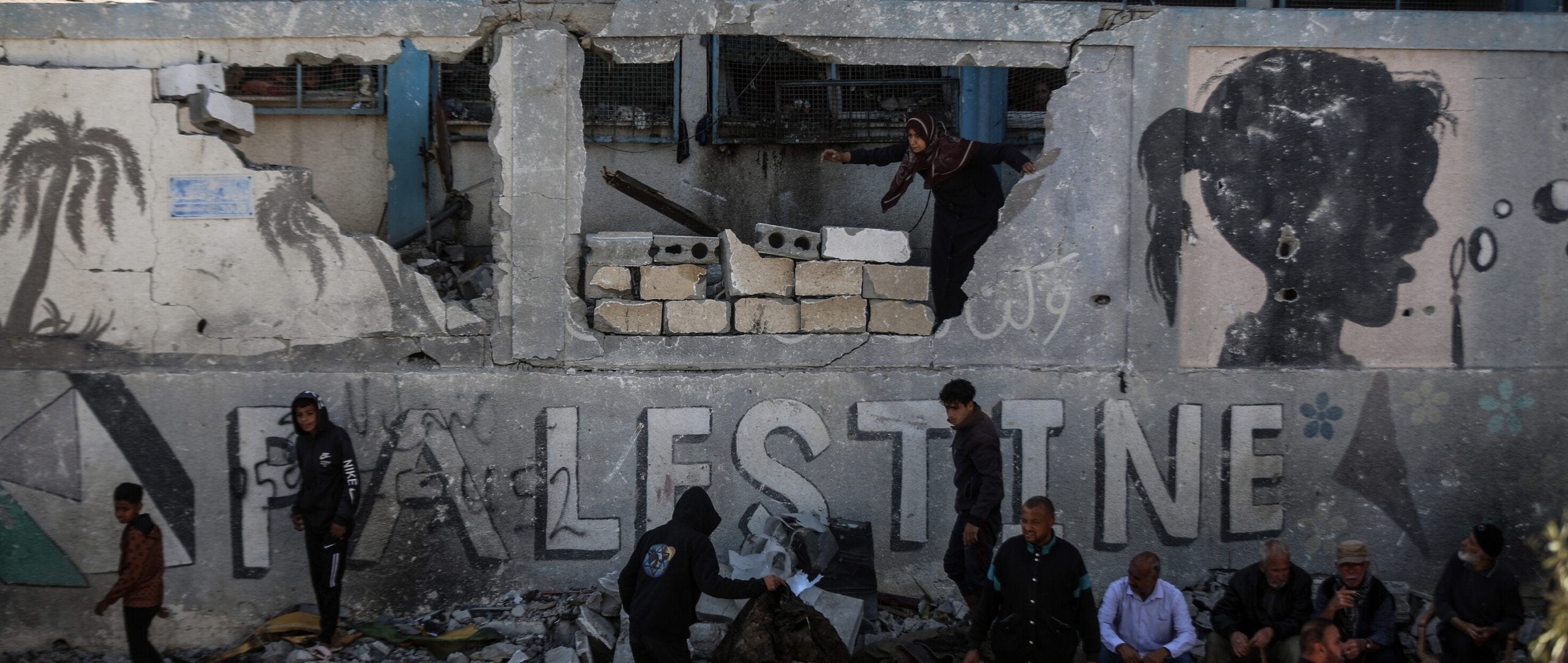
In a world grown weary of pious declarations and moral posturing, the gap between what nations say and what they do has become a yawning chasm. Roughly three-quarters of the world’s countries – 147 out of 193 United Nations members – have now formally recognised the State of Palestine. This is not a trivial diplomatic footnote; it signals an overwhelming global consensus on the legitimacy of the Palestinian quest for nationhood. Yet, even as this acknowledgement has spread across continents, the Palestinian people find precious little protection in it.
In Gaza, neighbourhoods lie in ruins, and over 66,000 lives – men, women, children – have been snuffed out in a matter of weeks. One report warns us to brace ourselves for a final figure that could exceed 680,000 deaths. Meanwhile the Gaza Health Ministry’s grim tally climbs by the hour, each number a human being with a story ended by violence. And still, the halls of international power echo with debates over terminology. The world watches a carnage in real time, collectively horrified – and then stalls, entangled in legal quibbles about whether this slaughter meets the formal definition of genocide. It's a grotesque paradox: when moral opinion has never been more unified, action has never been more paralysed by words.
Why does the international community, with all its supposed evolution since the Second World War, lapse into legalistic arguments at the very moment when decisive humanity is needed? The clue lies in the almost talismanic power of that word “genocide.” Under international law, genocide is not just a term of opprobrium; it's a precise legal category born from the ashes of the Holocaust. The 1948 Genocide Convention defines it as certain acts – murder, serious harm, inflicting destructive conditions – committed with the intent to destroy, in whole or in part, a national, ethnic, racial or religious group.
Proving that intent is infamously difficult. It requires uncovering the perpetrator’s mindset, a feat seldom possible until long after the atrocity (for example when diaries are found, orders declassified, witnesses testify). And yet, nothing less will do. The paradox is that everyone can see a people being systematically devastated, but unless a prosecutor can demonstrate the specific intent behind it, the law separates the horror before our eyes from the label “genocide.” It's a high bar to clear – perhaps too high. In theory, this rigour protects against frivolous or politicised accusations. In practice, it's become a convenient escape hatch for those committing atrocities: so long as they maintain a fig leaf of another motive (say, “self-defence” or “counter-terrorism”), they can massacre thousands and still argue it’s not technically genocide.
This legal hair-splitting might seem like a cynical farce to any normal human conscience, but it carries immense consequences. Label something genocide, and the Genocide Convention obligates signatory states not just to punish the perpetrators but to prevent the crime from continuing. That means every government would be legally bound to act, by force if necessary, to stop the carnage. Diplomats and generals alike treat the word like a live grenade: powerful, disruptive, and to be handled with extreme caution. Great powers often go to contortive lengths to avoid the g-word, because acknowledging it would force them to get off the fence. This is precisely why to date the United Nations has not formally declared the Gaza conflict a genocide – the political will to shoulder that responsibility simply isn’t there. Instead, we get condemnation in spades (“grave concern,” “disproportionate use of force,” and so on) which carries moral weight but little practical effect. It sometimes feels as if international law, conceived as humanity’s safeguard, has become a barricade against moral clarity. Leaders hide behind it, debating definitions while the death toll inexorably rises.
In the shadowed interstices of our global discourse, where the veneer of civility masks the raw mechanics of power, we must confront an even more insidious misnomer: labelling the devastation in Gaza as a "war." This term, with its connotations of symmetrical combatants locked in mutual strife, obfuscates the profound asymmetry at play—a dominant military apparatus unleashing its arsenal upon a besieged populace trapped in an open-air enclosure, devoid of escape or equivalence. This is not warfare in the classical sense, but a calculated campaign of attrition, where one side wields precision-guided munitions and impenetrable blockades, while the other grapples with desperation and improvised resistance. To dub it a "war" grants undue legitimacy to the aggressor, implying a balanced contest rather than the engineered subjugation it truly is, a semantic sleight that dilutes accountability and normalises the abnormal.
This linguistic sleight extends into the realm of legal contortions, where the very architecture of international justice twists itself into knots. Yet, in this theatre of evasion, we glimpse the outlines of a bolder proposition: what if we rejected the euphemism of "war" altogether and reframed the narrative as one of systemic erasure, demanding a paradigm where international oversight preempts such imbalances? Envision a reconceived global compact, not beholden to the outdated binaries of conflict, but attuned to the gradients of power in our asymmetric age. Here, algorithms could map disparities in real-time—tracking arms flows, satellite-detected demolitions, and biometric signals of distress—to activate "asymmetry alerts," compelling neutral coalitions to intervene not with force, but with economic circuit-breakers: automated trade halts, asset freezes, and digital quarantines that isolate the overpowered from the global commons. This is controversial territory, challenging the sanctity of national defence narratives and inviting accusations of overreach, yet it probes the heart of innovation: if "war" is a relic of symmetric eras, why not evolve beyond it to mechanisms that safeguard the vulnerable before the first bomb falls?
Such a shift would dismantle the fortress of sovereignty that shields disproportionate might, proposing instead a fluid guardianship where human security trumps territorial claims. Critics will howl at the dilution of state autonomy, fearing a slippery slope toward perpetual meddling, but consider the alternative—perpetuating a lexicon that sanitises slaughter. In Gaza's crucible, where recognition by 147 nations underscores a nascent statehood denied its breath, this reimagining becomes an imperative. It beckons us toward a future where language aligns with reality, and law serves not as a shield for the powerful, but as a scalpel dissecting injustice at its root.
Nowhere is this disconnect more evident than in the ongoing tragedy of Palestine. The world sympathises loudly with Palestinian suffering; governments issue statements, citizens march in the streets, the UN General Assembly passes resolutions. In an historic vote, the Assembly even voiced support for a future Palestinian government free of Hamas, tacitly endorsing Palestinian statehood and the hope of a peaceful polity. And yet, day by day, we witness the obliteration of Palestinian lives and communities largely as bystanders. In Gaza’s hospitals, medics run out of basic supplies, infants shiver in incubators as the electricity falters, snipers target innocent children along with members of the press, and entire families are buried under rubble. Such scenes prompt fury and despair across the globe. Still, powerful states hesitate.
Israel, for its part, vehemently rejects any accusation of genocide – calling such claims distorted, false, a calumny against the state’s right to self-defence. Benjamin Netanyahu and his cabinet colleagues insist that the civilian death toll, however regrettable, is not the product of an intent to annihilate a people, but of a war against “terrorists” shielded by a dense civilian population. This is the official narrative: tragic, yes, but genocide, no – merely the collateral damage of necessity.
Many observers are unconvinced. How, they ask, can the ongoing obliteration of neighbourhoods, the rhetoric dehumanising an entire population as an “enemy,” and the open talk by some officials of “wiping out” Hamas (knowing full well Hamas is entwined with the civilian populace) be seen as anything less than an attempt to destroy a people’s capacity to exist? Critics point to historical echoes – the forced displacement of entire communities, the bombardment of schools and hospitals, the cutting off of food, water, and fuel to a besieged populace – as tactics that ring tragically familiar to those used in some of the 20th century’s darkest episodes. And while Israel’s defenders bristle at the comparison, 147 nations recognising Palestine suggests that the vast majority of states see Palestinians as a people with a right to live freely on their land. So what does it signify when that same people is being decimated in plain sight? The dissonance between the world’s near-universal rhetorical support for Palestinian self-determination and its inability to shield Palestinian lives is painfully clear.
One cannot ignore the political calculus at play. The United States – a permanent member of the UN Security Council, and historically Israel’s staunchest ally – has repeatedly wielded its veto to prevent resolutions that might hold Israel accountable or grant Palestine full UN membership. In many ways, Washington’s stance encapsulates the problem: lofty ideals of human rights crash into geostrategic alliances and domestic politics. The result is a fetid stasis.
Other states, frustrated and outraged, are seeking alternative avenues. In capitals from Ankara to Caracas, officials have begun invoking universal jurisdiction and international law to launch their own legal actions against Israeli military and political leaders, accusing them of war crimes. These efforts face uphill battles – Israel’s allies block referrals to the International Criminal Court, and Israeli officials themselves dismiss the proceedings of foreign courts as illegitimate – yet the very fact that countries are attempting them signals a growing impatience with diplomatic dead-ends.
Likewise, an increasingly large chorus of nations (at least twenty-eight at last count) has called for an immediate ceasefire in Gaza – an appeal rebuffed so far by Israel and its key backers, who insist that any pause would advantage Hamas. And in a poignant show of solidarity bypassing state actors, a flotilla of civilian ships laden with aid recently set sail for the blockaded enclave; no fewer than sixteen countries publicly demanded that Israel allow this lifeline safe passage. These gestures, whether through legal forums, diplomatic pressure, or direct action, underscore a simple truth: the world’s moral compass is trying to point in the right direction, but the established powers are holding it askew.
So we arrive at the uncomfortable question: if the existing legal framework is inadequate to address such a blatant human catastrophe, should the framework itself be changed? This is not an idea the international community entertains lightly. Laws, especially those as foundational as the Genocide Convention, are something akin to holy writ in global diplomacy – products of historical trauma and high-minded resolve. But they are also, ultimately, human creations, subject to revision when they no longer serve their purpose. The difficulty of proving “intent to destroy” a group has stymied justice in case after case. It’s a loophole large enough to accommodate mass murderers. From the Killing Fields of Cambodia to the ethnic cleansings only half-recognised in various conflicts since, perpetrators have learned to dance around the strict letter of the law even as they massacre populations. Is it any wonder that some legal scholars now argue for broadening the definition of genocide, or at least reinterpreting it for our times? Their argument, essentially, is this: if the intent is hard to prove but the outcome horrifically clear, the law should not hesitate to call the crime by its name. Why should international action hinge on deciphering the inner psychology of the perpetrators, when the measurable reality is thousands of innocents dead or displaced?
One proposed concept has gained traction at the fringes of legal theory: “democide.” This term casts a wider net, encompassing any mass killing committed or orchestrated by a government against its own people or another population – regardless of motive. Genocide, politicide, ethnic cleansing, deliberate famines, indiscriminate bombing of civilians – all would fall under democide’s remit. Such a term tries to bypass the thorny question of intent and focus on outcomes: the deliberate mass killing of people by state power, for whatever purported reason. The advantage of this idea is moral clarity: what’s happening in Gaza – tens of thousands of civilians killed by a state’s military campaign – would unambiguously qualify. We would no longer twist ourselves in semantic knots; we would call it what it is, a crime against humanity on a colossal scale, and mobilise accordingly. But can international law, slow as it is to evolve, catch up to this clarity?
Altering treaties like the Genocide Convention or creating new international legal norms is no simple task. It requires worldwide consensus – the very thing that's so often thwarted by politics. Many governments, including those with generally humane reputations, grow uneasy at the thought of expanding definitions. They worry about the politicisation of the genocide label: might an expanded definition be misused to brand any military action one doesn’t like as “genocide”? Could the term be wielded as a geopolitical bludgeon without due regard for fine distinctions? These concerns are not frivolous. History offers examples of the genocide accusation being leveraged for political theatre, cheapening the gravity of the crime. States also jealously guard their sovereignty. To agree to a broadening of international criminal law is, in a sense, to accept that their own actions could more easily be put in the dock. It's asking a lot of any political leadership, especially those who suspect their militaries or allies might one day be accused. Thus, we face a catch-22: our laws on genocide are outdated and ill-suited to prompt action, but attempts to modernise them are seen as threatening by the very nations whose agreement is needed.
Must humanity remain forever a prisoner of this legal inertia? There are other avenues to justice that do not require redefining genocide overnight. War crimes and crimes against humanity – charges well-established in international law – do not hinge on proving an overarching intent to erase a people. The indiscriminate bombing of hospitals and schools, the wilful deprivation of food and water to civilians, the use of disproportionate force that slaughters thousands – all these can be prosecuted under existing statutes, genocide or not. Indeed, the International Criminal Court (ICC) is already empowered (in theory) to investigate and prosecute such egregious violations. The tragedy, of course, is that politics again interferes.
Israel is not a party to the ICC, and it fiercely contests the court’s jurisdiction over Gaza. The United States, while not directly involved on the ground, has historically been no friend to the ICC whenever its own officials or allies might be scrutinised. So we find even the alternate routes to accountability blocked or bogged down. The UN Security Council could refer the situation to the ICC – but the US veto stands guard. Individual countries can pursue universal jurisdiction cases – but these often end up dismissed or symbolic, given the difficulties in apprehending foreign officials.
All of this points to a deeper reality: law is only as effective as the collective will behind it. And right now, the collective will to enforce international norms is splintered. Global opinion is outraged at the bloodshed in Gaza – that much is clear in street protests and the voting patterns of UN resolutions. But global action is stymied by old power structures. We live in a world still largely governed by mid-20th-century institutions, struggling to cope with 21st-century conflicts. The UN, the ICC, the Genocide Convention – these were noble creations of a post-WWII order, designed to prevent a repeat of humanity’s worst crimes. They embody the ideals of an era when nation-states were the primary actors and when atrocities, though fresh in memory, were at least conceptually straightforward (one regime targeting one people, overtly, as in the Holocaust). Today’s murky conflicts, involving asymmetric warfare, non-state actors like Hamas, propaganda battles, and the cynical weaponisation of legal grey areas, have exposed the limitations of those once-forward-looking frameworks.
If there is any hope to be found in this impasse, it lies perhaps in the rising power of global civil society and the slowly shifting sands of international attitudes. Ponder the changes afoot: countries that once equivocated on Palestinian statehood are now coming off the fence. Australia, for instance, long reluctant to anger its American ally, has signalled a willingness to formally recognise Palestine. France and Luxembourg have similarly intensified discussions on recognition, and even the United Kingdom – hardly a dove on this issue – has hinted that under certain conditions it would lend its weight to Palestinian statehood. These are not empty gestures; they reflect pressure from citizens and an acknowledgement that to remain silent or non-committal is to be complicit in a great injustice. Likewise, the grassroots energy worldwide is palpable. Millions of ordinary people, from London and Sydney to Jakarta and Johannesburg, have taken to the streets demanding an end to the Gaza tragedy. They chant for ceasefire, for sanctions, for an end to what they perceive clearly as oppression and mass suffering. This groundswell of public conscience is slowly chipping away at the indifference of our so-called leaders. It suggests that the future of international norms might not be dictated solely by presidents and prime ministers, but by the common people.
Envision for a moment where this could lead. Future historians might note that in 2025, humanity reached a tipping point in its concept of sovereignty and accountability. They might write about a global consciousness that emerged – a recognition that the old doctrines of non-interference cannot justify inaction in the face of mass atrocities. Perhaps out of these dark times, a new understanding is being born: that sovereignty is not a privilege, but a responsibility. If a state will not protect its inhabitants or, worse, actively destroys them, then it is not violating only some obscure law; it is betraying the fundamental contract of civilisation.
In such cases, the duty to protect innocents should not stop at any border. We have flirted with this idea before. The Responsibility to Protect (R2P) doctrine, floated and adopted in principle by the UN in the early 2000s, was an embryo of this thinking – that when a state fails to safeguard its people from mass atrocities, the international community has a responsibility to step in. R2P was invoked hesitantly in places like Libya and Ivory Coast, then seemed to recede as geopolitical tensions reasserted themselves. But the ethos behind it has not died. It lives on in the moral convictions of younger generations and in the sleepless nights of those diplomats who genuinely care. It lives on every time a nation, even in the General Assembly’s non-binding votes, stands up and is counted for the oppressed against the oppressor.
To truly honour the promise of “Never Again” – that solemn vow made after the Holocaust – we may need to reimagine our global institutions from the ground up. Perhaps it's time to convene a new global congress of nations, scholars, activists and citizens to overhaul the laws that govern us. Why not update the Genocide Convention’s terminology? Expand its scope to include political and social groups, since mass violence isn’t always ethnically or religiously motivated. Clarify that intent can be inferred from sustained actions and outcomes – if an army pounds a civilian population without respite, do we really care whether they articulated a desire to “destroy the group” beforehand? Only lawyers and diplomats obsessed with form over substance would say yes. The rest of us recognise an attempt to destroy a people when we see one. Why not empower a neutral international rapid-response force, under UN or regional auspices, that can intervene to protect civilians even when big powers dither? Such ideas drift on the fringe now, dismissed as fanciful or too idealistic. But so once was the idea of a United Nations, or an International Criminal Court, or indeed the notion that rulers could be tried for crimes against humanity. Norms evolve. What seems unrealistic today can become the commonplace of tomorrow – if enough will and imagination is summoned.
None of this will happen, of course, as long as we remain shackled by outdated thinking and a fatalistic acceptance of the status quo. Breaking free of that calls for something more profound than legal acumen or diplomatic finesse – it calls for a moral and intellectual awakening. We must rediscover a truth that should be self-evident: laws are tools, not idols. If the current laws allow children to be slaughtered en masse while politicians and their advisers debate the fine print, then the laws are failing and must be changed. Clinging to legal orthodoxy in the face of slaughter is not prudence; it's a form of complicity.
Change of this magnitude will not originate from those comfortable in the halls of power – it must be demanded from below and above, by citizens and visionary thinkers alike. Educators, activists, jurists with conscience, humanitarian organisations, even enlightened politicians where they exist – all have a role. We need a collective effort to educate people about the early warning signs of genocide and mass atrocity (for they rarely come out of the blue – hate speech, dehumanisation, and political repression pave the way). We need journalists unafraid to shine a light on these signs, tech companies to curb the spread of incitement, and everyday citizens to refuse the lies that justify mass murder. We need mass movements that pressure governments to uphold human rights consistently, not only when convenient. This is not naive idealism; it's pragmatic survival instinct for a globally connected civilisation. In an age where a conflict in one corner of the world instantly resonates everywhere else, the old boundaries between “their problem” and “our problem” have dissolved. Either we all insist on the sanctity of life and justice, or we inch closer to a world where might makes right and no one is safe.
Looking at the Palestine-Israel conflict through this lens of future possibility, one thing becomes clear: it is more than a tragic regional quarrel. It has become a symbol of the international community’s impotence and lost direction. It forces us to ask what global civilisation truly stands for. As a futurist and strategist, I often try to envision the world decades from now. When I do so in light of Gaza’s ruins and the world’s vacillation, I see two divergent paths. Down one path, nothing fundamentally changes. The powerful continue to exempt themselves from rules. International law remains a fine set of principles applied selectively, if at all. Palestinians eventually emerge from this war battered and traumatised, still stateless, and the cycle of hatred deepens, as does global cynicism about justice. Other tyrants and fanatics around the world take note that mass violence still pays if couched in the right language. Human rights become an increasingly hollow slogan.
But there is another path. On this path, the shock of the Gaza war jolts the world awake. The sheer scale of the horror – beamed onto millions of screens worldwide – catalyses a long overdue reckoning. The discourse shifts from “Is this technically genocide?” to “How do we stop it and ensure it never recurs?” Nations large and small, prodded by their citizens, begin to muster the courage to reform the world-system.
Perhaps they start by curtailing the crippling veto power in cases of mass atrocities, so the UN Security Council can act even when a superpower objects. Perhaps concurrent efforts begin to modernise international law: a new convention against democide, for instance, gaining signatures from forward-looking states. Civil society networks might formalise into something resembling a “Global Citizens’ Assembly,” feeding into UN debates, providing a moral counterweight to state interests. These are bold, unconventional ideas – exactly the sort of thinking outside the mainstream that entrenched institutions scoff at. But every mainstream norm was once a radical idea.
I cannot resist noting the civilisational stakes. We are bystanders at a burning house – the house of our human values – debating which hose to use and whether the fire brigade has the proper mandate. It is, frankly, an adolescent stage in our species’ political evolution. It's time to grow up. Time to acknowledge that Westphalian principles of absolute sovereignty, and 20th-century legal narrowness, do not suffice in an interconnected reality where crimes against one people reverberate in the consciousness of all peoples. The recognition of Palestine by 147 nations should not just be a trivial news item — it should mean that those nations accept a duty of care for the lives and well-being of that nation’s citizens. Otherwise, that recognition is a charade, a diplomatic pat on the head while the children of Gaza scream under the rubble. If “Never Again” is to mean anything, it must apply even when the victims are not Europeans in the 1940s, but Arabs in the 2020s – or anyone, anywhere. The moral consistency of our civilisation is on trial.
Ultimately, calling Israel to account for its actions in Gaza is not just about one nation’s reckoning. It's about our collective humanity and whether we have the strength to align our laws and actions with our conscience. The law, as it stands, has faltered – but we are not prisoners of the past unless we choose to be. We can change the rules, if we truly will it. We can demand a world where no people have to endure what the Palestinians have endured, where perpetrators of mass violence know they will face universal wrath – legal, economic, and if necessary military – no matter who they are. This will require courageous introspection and bold innovation. It will require us to prune away the clichéd excuses (“it’s too complicated,” “nothing can be done,” "we tried that and it didn't work") that enable inertia. It will demand that we imagine a different kind of world order, one refocused around human life rather than the prestige of states.
The truly frightening possibility is that we shrink from this challenge. That we allow the ongoing horrors to be swept aside by procedural debates and willful blindness. If that becomes our legacy, then future generations will undoubtedly look back in anger and bafflement. They will have the right to ask: How could they know so much – see the corpses, hear the cries, count the nations in agreement – and still do so little? They will see our sophisticated global system as a cruel joke, full of laws and signatories and noble pledges, yet hollow when it mattered most.
I still harbour hope – a cause for cautious optimism – that this will not be our epitaph. The outrage and empathy unleashed by the images from Gaza could coalesce into something world-changing. Perhaps, just perhaps, we will choose the harder road of reinventing our frameworks over the easier road of business-as-usual. The call to account has been sounded – not just for Israel, but for all of us. Are we listening?
In the final analysis, conscience must overthrow complacency. When mass violence is happening before our eyes, it's too late and too cruel to hide behind legalistic smokescreens. Law must serve life, not the other way around. If our current laws inhibit rescue, healing and justice, we must gather the wisdom and will to reform them. That is how we honour the dead – by learning and changing, not by parsing definitions while more die. As a futurist, I often remind people that the future is a choice, not an inevitability. Right now, at this juncture, the choice is ours: continue to cling to a system that offers impunity to the powerful and excuses to the bystander, or forge a new paradigm that truly places human dignity at its core.
History is watching, and so is the future. It will judge us not by our sophisticated arguments nor by how precisely we kept to protocols, but by whether we acted when it counted. The State of Palestine is recognised by the world – now the people of Palestine need the world’s recognition of their plight in the form of tangible protection and justice.
The time for hiding behind words has passed. We owe it to ourselves – to the very idea of civilisation – to ensure that when such a gross affront to humanity occurs, our response is guided by moral courage and innovative thinking, not stuck in the quagmire of legal formalism. The lives lost demand nothing less. The future, I suspect, will demand much more of us – and it's starting now, in how we face Gaza, how we call Israel (and indeed any perpetrators) to account, and how we reimagine the world so that we do not keep failing the test that each genocide, each mass atrocity, sets before us.