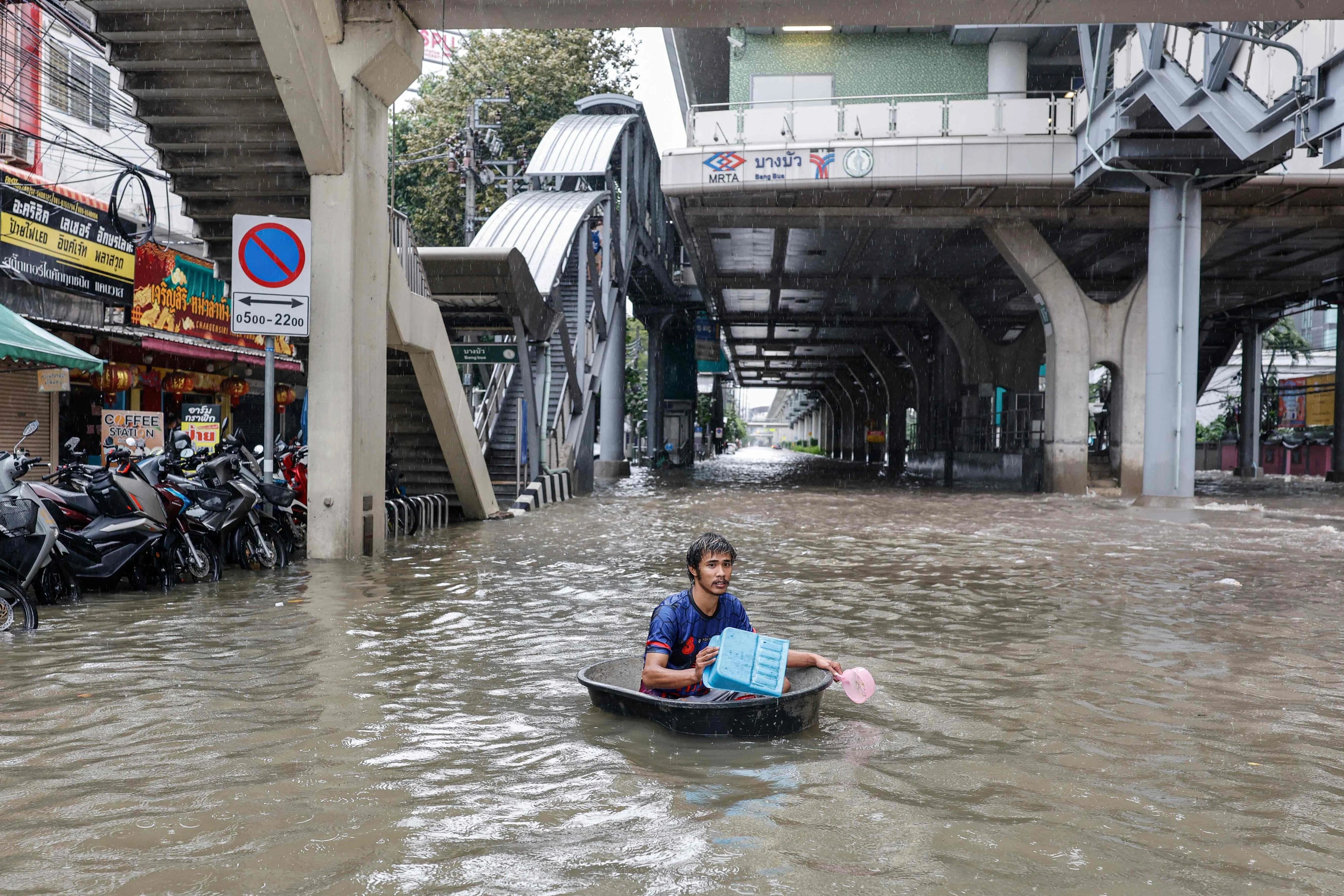
This week Bangkok has been in the headlines. Today the rain is easing, although nine of the city’s major roads are still under water and the pumps are still running as I write this. Across the capital, on shophouse walls and temple gates, a brown line marks where the flood stood. Within a month most of those lines will be painted over. Nobody will order it. Shopkeepers will want their walls back. More importantly, the city will want its story back, the one in which nearly three hundred millimetres of rain in two days was a freak, to be survived and then set aside.
Above the village of Aneyoshi, on Japan’s north-east coast, a stone stands on the hillside that no one paints over. Carved after an earlier tsunami, its inscription tells the villagers that homes built high secure the peace of their descendants, and that no house should go below the point where it stands. When the sea came again in March 2011, the village sat above the waterline. A boy of twelve later recalled his mother fetching him from school, and the whole village climbing.
Hundreds of these stones dot that coast. Many were ignored. As towns modernised and seawalls rose, people came to trust the concrete over the carving and built below the line — so the wall, raised to protect them, also taught them to forget.
Two lines, then. One painted over within a month; one kept for generations.
Bangkok knows this arc well. In 2011 the Chao Phraya drowned seven great industrial estates north of the capital and inflicted losses the World Bank put at US$46.5 billion — at the time, the fourth costliest disaster anywhere on earth. A 350-billion-baht programme for the whole basin followed. It was suspended by the courts in 2013, pending public hearings, and the coup of 2014 then swallowed it. After floods in the north in 2024, a reduced version was floated again. By mid-2025 the World Bank counted nine basin plans drawn up since 2011, of which only one or two had moved at all. And last week the same river was rising around the same temples in Ayutthaya, while monks and soldiers stacked barriers against it.
None of this requires villainy — just the ordinary routines of office. A prevented flood produces no photograph. A flood that arrives with such drama produces hundreds, with a minister standing in front of them in borrowed boots. Prevention is paid for now — in land, in displacement, in argument — while its reward comes later, invisibly, and usually to a successor. Budgets run for a year. Ministers rotate. Committees convene when the water is high and disband when it drains. The dry season is where floods are created, in zoning exemptions and deferred maintenance and contracts quietly allowed to lapse. And the dry season is precisely when those in authority are looking the other way.
Elsewhere the same routines have been run to their end. Above Derna, on Libya’s eastern coast, two dams had been warned about for years. A state audit in 2021 found that money allocated for their upkeep nearly a decade earlier had never produced the work. A Libyan engineer published a paper in 2022 predicting that a large flood would be disastrous for the city below. In September 2023 Storm Daniel arrived, both dams failed, and thousands died in a single night — at least four thousand by most official counts, far more by others. The following July a court sentenced twelve officials to between nine and twenty-seven years. The accountability was real. It arrived about four thousand lives too late.
In Valencia, in October 2024, Spain’s weather agency raised its highest warning at around half past seven in the morning. The alert to residents’ phones went out a little after eight that evening, more than twelve hours later, by which time water was already inside homes in the towns south of the city. Some 230 people died. The regional president resigned a year afterwards, still insisting the fault lay elsewhere. Then, in March this year, the region’s high court declined to investigate him, on the reported ground that emergency law gave the regional president no specific duties to breach. Read that finding slowly. At the moment of greatest danger, the law had arranged for responsibility to belong to no one in particular.
These are states with very little in common politically. What they share is a structure in which knowing and acting are held apart — by an office, a budget cycle, a legal silence... And the water finds the gap.
Water is simply the most understandable case. Heat kills quietly — its dead are usually tallied months afterwards, in excess-mortality tables few ministers read. Drought arrives too slowly for any single day to be photographed or run as the lead story on the evening news. Each tracks the same arc of alarm and amnesia, and each exposes the same fault beneath the offices. An economy organised around next year’s growth treats the flood and the failed harvest as interruptions, costs that fall outside the accounts, on someone else, later. Officials forget because the order they serve has been built to forget: to bank the profit from the riverside tower this year and leave the drowned ground floor to a future owner. Asking a ministry to remember the water, inside that order, is asking one organ to hold its breath while the body keeps running.
My own craft is implicated here, and I would rather say so than be caught out.
Twenty years ago, teaching a university course in Bangkok, I produced a set of scenarios for the city’s future with water. My students asked what would happen as the land sank, the sea rose, the rain intensified and the basin sent its floods south. These scenarios were discussed, admired, and filed. That’s what usually happens to scenarios. Foresight has become one of the ways governments manage their anxiety without actually acting on it. A study is commissioned, a consultant presents key findings, the report is received with thanks, and the commissioning itself becomes the proof that action was taken. A shelved scenario is forgetting with a receipt attached.
I don’t exempt myself. The profession I have practised for much of my working life has spent decades refining its descriptions of possible futures, and far less time asking why those descriptions so rarely alter what officials do between floods. If foresight owes anyone a duty now, it lies less in imagining the next catastrophe than in designing the conditions under which a government cannot look away from it.
There’s evidence that it can be done, and it comes from one of the most exposed coastlines on the planet.
In 1970 a cyclone struck what was then East Pakistan and killed somewhere between three hundred thousand and half a million people. In 1991 another killed around 140,000 in Bangladesh. When Cyclone Sidr came ashore in 2007, the dead numbered in the thousands. When Amphan came in 2020, they numbered around two dozen. The storms have not grown gentler, and Bangladesh remains far from rich. The change lies in where the remembering happens.
Since 1972 the country has trained a corps of volunteers — tens of thousands of them, living in the coastal villages themselves — who raise warning flags, ride bicycles with megaphones, knock on doors and walk families to the shelters that now line the shore. Before Amphan they moved more than two million people to safety. The knowledge of what a cyclone does is held by people who live where cyclones land, and rehearsed in drills while the sky is clear. A minister can be reshuffled. A village cannot.
Bangladesh tried a second idea in 2020. When forecasts showed severe monsoon flooding building in the north for the middle of July, a trigger agreed in advance released money on the fourth of that month — cash, animal feed and supplies reaching some 200,000 people before the water peaked rather than after. What matters most is who did not have to decide. The decision had been taken earlier, in calm, and written down as a rule: when the forecast crosses this line, the money moves. Nobody had to be brave on the day.
“Political will” usually closes discussions like this, but it explains so little. Will rises with the headlines and falls with them. What Aneyoshi and coastal Bangladesh show is that the record of a disaster survives when it’s moved out of resolve and into structure — into people, rules and stone. A handful of shifts would do that almost anywhere.
Assign the duty. Every warning system needs a legal answer to a plain question: who must act, on what signal, within how many hours, and what happens to them if they do not. Valencia’s court found, in effect, that the answer was nobody. A legislature can write over that silence within a single session.
Take the decisive choices out of the storm. Agree in the dry season, and in public, the forecast thresholds at which evacuation orders issue, gates close, schools shut and relief money moves. An official asked to decide at midnight, with the river rising and the facts contested, will hesitate — any of us would. An official following a rule adopted in March does not have to think twice.
Give memory a budget that outlives the government that set it. Thailand already has the scaffolding — a national water office since 2017, a water resources law in force since 2019, twenty-two river-basin committees — and still watched nine basin plans stall. Coordination without command is a filing system. Whatever body holds a basin’s plan needs money ring-fenced across electoral cycles and a mandate no incoming minister can quietly suspend.
Make the dry season visible. Each year, before the budget is set, governments exposed to flood should publish what they spent on prevention, what they cut, which audits raised which alarms, and which of those alarms were answered. The flood that never happened needs its own public accounting, or it will lose every argument to the flood that did.
Move consequence forward. Derna’s officials went to prison after the dams broke. The law could attach consequence at the moment an audit’s warning goes unheeded, when maintenance money is allocated and the work is never done, instead of waiting for a death toll to supply the evidence.
Hold foresight to its own account. A scenario that ends in a drawer has failed, however elegant its logic. What I would now ask of my own profession is more humble work: tie every scenario to a decision date and a specific office, return a year later and publish what became of it, and write the signposts — the budget line, the zoning exemption, the unfinished wall — in language a village can monitor as easily as a ministry. Futures that can’t be checked by the people they concern are just one more way of forgetting.
And carve the line. After every serious flood, mark the high-water level permanently on schools, markets, temples and public offices, in a form that cannot lawfully be painted over. It costs very little. It does what no report can: keeping the flood in front of the people who will be asked, years later, to approve a housing estate below it. Every new seawall should come with its stone, because the wall invites exactly the forgetting the stone resists.
None of these shifts will be volunteered by the offices they constrain. Each has to be demanded. The stone at Aneyoshi speaks to villagers, not ministers, and in Bangladesh it is the volunteers, not the ministry, who walk families to shelter. Officialdom remembers only when it’s made to answer to people who can’t afford to forget — and in most cities those people live below the line.
And none of these decisions will be made while the water is high. Floods produce solutions about pumps and sandbags. Decisions that shape the next flood get made in the season when the canals are low and the sky is clear, when the tourists return, when the public has moved on, and a developer waits outside the minister’s office with drawings of a riverside district and a drainage plan marked “to be addressed”.
By then the brown lines on Bangkok’s shophouses will have vanished under fresh paint, and with them the most honest record the city made of this week. In Aneyoshi they cut the line into rock. They knew what their grandchildren would do with paint.