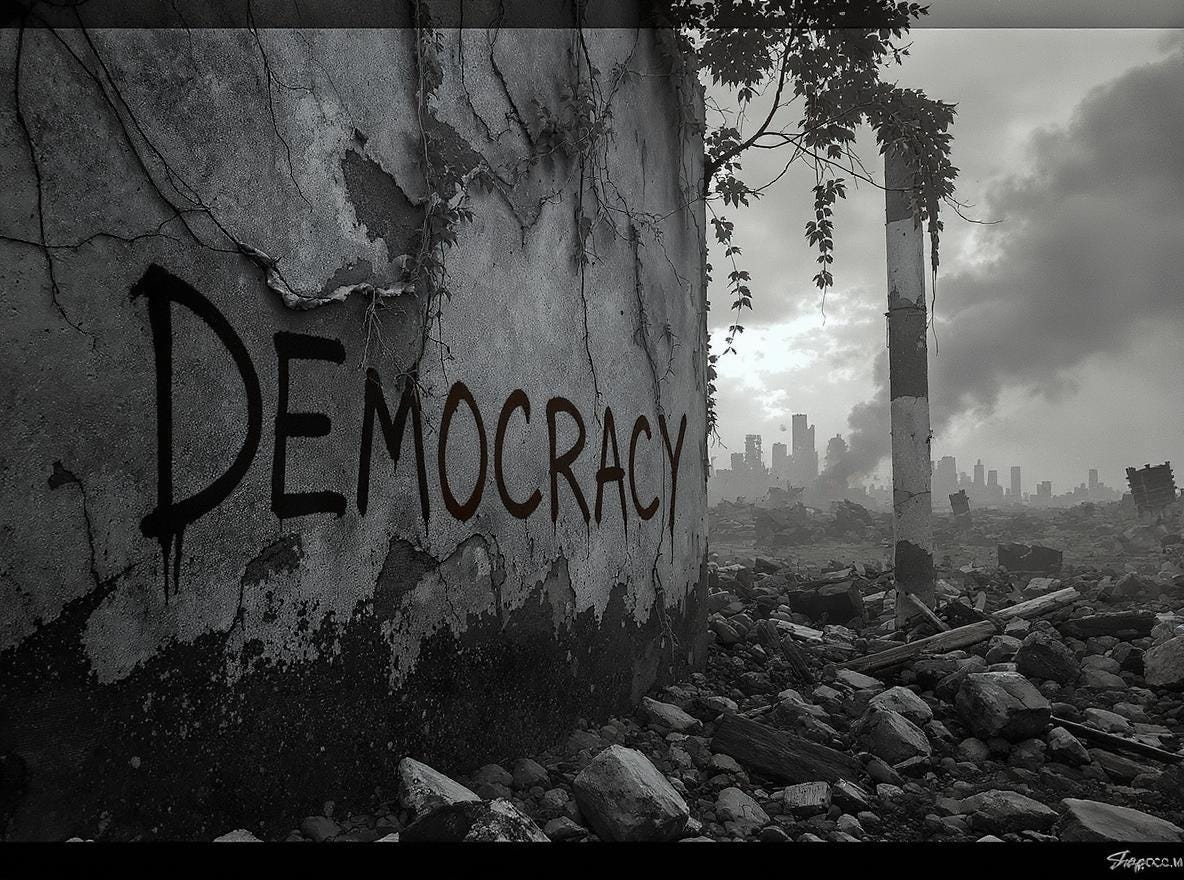
It seems to be that we're living through the end stage of a 250-year experiment in which the word “democracy” has become the polite alibi for a planetary machine of extraction. Representative institutions—once heralded as the immune system of the body politic—have decayed into a frail membrane encasing the tumour: porous to money, opaque to conscience, and rotting openly in Gaza.
The spectacle is grotesque in its naked audacity—a snarling "fuck you" to the world from Israel. Forty thousand dead Palestinians, the deliberate starvation of 2.3 million human beings, and the live-streamed demolition of every hospital in Gaza—yet the US Congress gives a standing ovation to the architect of this slaughter. The European Parliament wrings its hands, then just renews the Association Agreement. London, Paris, and Berlin all recite the same numb entreaty about Israel’s “right to defend itself”, as though phosphorus bombs on refugee tents were a valid form of self-defence. There is no geo-strategic dividend here for the West—only moral bankruptcy and reputational self-immolation.
So why the silence? Why the robotic compliance? Not strategy, I suspect; more like circuitry. The relay switches of Western politics have been rewired, one donation, one junket, one Kompromat file at a time. AIPAC’s open ledger—$150 billion in US aid since 1948—buys the appearance of consensus. But the real leverage is sinister: surveillance files, offshore accounts, the quiet promise that any dissent will be labelled antisemitic and career-ending, possibly even a mention in the Epstein files kept by Mossad? The result is a transatlantic political class that no longer represents citizens; it represents the risk profile of its own incriminating metadata. The system is not merely lobbied; it is blackmailed.
This isn’t a glitch in democracy. It’s the endgame design. The same institutional brittleness that allowed Trump to hollow out the US civil service and stack the courts is now allowing Netanyahu to normalise apartheid in real time. The filibuster, the Electoral College, the lifetime judicial appointments, and the revolving-door think tanks—all were built to dampen popular shocks. They now function as shock absorbers for atrocity.
So where is the circuit breaker? Not in the next election cycle; that's the treadmill on which the machine keeps us all jogging. We must look elsewhere—in the small, fast loops that moral signals can still travel if we re-engineer the pathways. The big, slow machinery we call “representative democracy” is jammed. It was built for horse-and-buggy speeds: one vote every four years, a letter to your MP that arrives weeks later, a committee that meets when Parliament resumes. By the time anything moves, the moral outrage that first sparked it has cooled, been edited, or been buried under new headlines.
Today's “fast loops” are simply a much shorter feedback path between what people feel is right and what actually happens. Think of it like this:
Moral signal = “This is wrong.”
Fast loop = the two hours it takes for a thousand dockworkers to scan a QR code on their phones, verify that the ship at Pier 7 is hauling 155 mm shells for Gaza, and grind it to a halt with a work-to-rule slowdown.
Result = the shells sit on the dock, a livestream shows the idle cranes, insurers recalculate risk within the day, and the arms company’s share price wobbles by nightfall.
In the old loop, the same outrage would have to climb the chain: union rep → local council → national minister → parliamentary committee → maybe, months later, a non-binding motion. By then the ship is long gone—and so is our attention.
Imagine a civic mesh-net: lightweight protocols that let any thousand citizens issue a provisional mandate in 48 hours, cryptographically signed, geotagged, and auto-escalated to every representative who claims to speak for them. If the representative stonewalls, the mandate instantly reroutes to the next layer—city councils, pension funds, university boards—forging a relentless, transparent audit trail no lobbyist can dodge. The technology is trivial; the habit is not. We have forgotten the daily exercise of sovereignty the way an astronaut’s muscles forget gravity.
Where could we prototype it? Start with the ports. The moment an arms ship docks in Genoa or Savannah, a thousand dockworkers, students, and grandmothers could trigger a live adjudication: unload or impound? Each container scanned, each manifest published on-chain. Within hours the capital flow reroutes; insurers recalculate; the share price of the arms manufacturer stumbles. Scale the experiment to the city pension funds holding Israeli bonds, to the universities licensing facial-recognition code to occupation forces, and to the churches whose endowments underwrite bulldozers. Make the feedback loop visceral: every Sunday collection plate posts its holdings in real time; parishioners vote on divestment before communion.
Dublin has already shown the vector. When the Irish parliament debated expelling the Israeli ambassador, the signal travelled not through parties but through WhatsApp clusters, GAA clubs, and teachers’ unions. The result was the first Western sanctions resolution with teeth. The protocol was human-scale, iterative, and fearless. Multiply it.
The real question isn’t whether democracy can limp on or how wretched it can get before it does a Titanic, but whether we’ll rewire its frayed nervous system before the patient flatlines. The hardware—blockchain, mesh radios, and zero-knowledge proofs—is ready. The missing piece is the civic muscle memory: the daily, joyful discipline of refusing to outsource conscience. Begin with a single port, a single campus, and a single pension fund. Iterate at human speed. The apartheid regime is brittle; it depends on our continued amnesia. Remembrance, weaponised by protocol, is the circuit-breaker we can still reach.