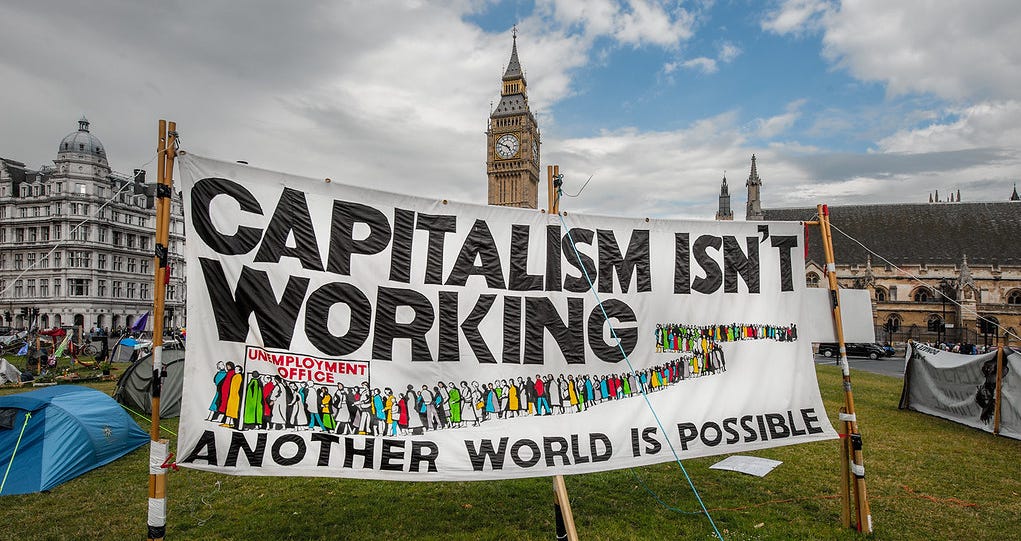
I am not referring to other political systems when I make the claim that democracy is being assailed from within. Neoliberalism, often characterized by a commitment to free-market capitalism, deregulation, and reduced government intervention in the economy, has become a dominant ideology since the late 20th century, and it's wreaking a trail of havoc and despair.
The neoliberal agenda has not been entirely immune from criticism in this billionaire age. It's a hard and uncompromising ideology, not comfortable with pandering to social niceties when GDP is threatened or a recession is on the horizon. However, censure is commonly based on issues that markets struggle with - like inequality, the insufficient provision of public goods, negative externalities, monopolistic practices, a focus on short-term gains, job insecurity, limited access to essential services, and economic volatility. What is rarely challenged is its hostile relationship with democracy and core principles of egalitarianism.
While proponents argue that neoliberalism fosters economic growth and individual freedom, a closer examination reveals some tenets that are fundamentally at odds with democracy. Indeed, left to its own devices, neoliberalism undermines democratic values, erodes public institutions, and exacerbates social inequality, ultimately threatening the very fabric of our way of life, at least in the West.
At its core, democracy is predicated on the idea of collective decision-making and the conscious inclusion of diverse, and sometimes competing, interests. In contrast, neoliberalism reveres the individual's right to pursue personal success and economic freedom, often prioritizing market choices over collective welfare and social responsibility. This emphasis on individualism, while enabling personal agency, can undermine social cohesion and the shared values that are so essential for a functioning democracy.
This ethos is most evident in the trend toward privatization, where public goods and services are assigned to private entities. While privatization may increase efficiency in some cases, at least initially, it often leads to the exclusion of marginalized groups from essential services. For example, if healthcare and education are treated as commodities, access becomes contingent upon one’s ability to pay, disenfranchising those people with fewer resources. The management of prisons by the private sector is another contentious issue where significant concerns about the treatment of inmates, the effectiveness of rehabilitation efforts, and the overall integrity of the criminal justice system have been justifiably raised.
Whatever one's beliefs, the end result of unconstrained privatization, where even essential services such as transportation and public utilities are sold off, is a society where economic power equates to political influence, undermining the democratic principle of 'one voice, one vote'.
Worse still, neoliberalism endorses a mechanistic approach to governance, invariably favouring market-driven responses to every problem, irrespective of its dynamic. This technocratic impulse reduces complex issues to one-dimensional solutions, commonly resulting in austerity measures and budget cuts aimed at reducing public spending. Such policies disproportionately affect the most vulnerable in society, further entrenching existing inequalities.
When governments prioritize fiscal responsibility over social investment, disregarding the needs of their citizens, they eventually erode public trust and diminish civic engagement. This erosion can be convenient for some, as more than one politician I know wishes that citizens would mind their own business and let him get on with the job of governing. Sadly, this mindset is quite common, leading to disillusionment and a sense of powerlessness among the populace. The result is apathy, detachment from the democratic process, and a growing mistrust of incumbent power.
It's clear from history that the concentration of wealth, assets, and control under neoliberal regimes poses significant threats to egalitarian ideals, particularly in communicating policy options and the consequences of certain decisions. So, for example, the concentration of media in the hands of a few wealthy moguls limits the diversity of perspectives, encourages biased reporting, and stifles public discourse. It can also sway the outcome of elections, erode accountability, and control dominant societal narratives in ways that benefit the owners of capital - but few others. The theory of 'trickle-down' economics started as a joke, and remains just that.
As economic disparities widen, so too does the influence of a wealthy elite in political decision-making. This phenomenon, often referred to as 'crony capitalism' results in policies that favour corporate and industry interests at the expense of the greater good. Lobbying, campaign financing, a career in politics, and the revolving door between corporate executives and public sector bureaucrats, further amplify this cocoon of incestuous coziness. As a direct consequence, the voices and concerns of ordinary citizens are drowned out, while democratic bodies become increasingly susceptible to manipulation by a few hugely powerful individuals and their acolytes.
We must also consider neoliberalism's damaging impact on social cohesion. By emphasizing individualism and competition over community and collaboration, the neoliberal code fosters a philosophy of division in which social bonds weaken and fray. This makes collective action far more challenging to organise. In this dynamic, citizens are pitted against one another in a tussle for resources, thus undermining any sense of kinship that's vital for a functioning democracy. When individuals identify each other as rivals in a struggle for survival rather than as allies with common goals, the potential for cohesion and community action diminishes, leading to a fragmented society that's far less capable of mobilizing for radical change.
Furthermore, the neoliberal agenda often involves a reduction in civil liberties and democratic rights under the guise of efficiency and security. Governments may justify surveillance, censorship, and a range of other authoritarian measures as necessary to maintain order in a volatile socio-economic landscape. Such activities create an atmosphere of fear and suppression that can stifle dissent and inhibit democratic freedom. It stands to reason that the erosion of civil liberties serves to further distance citizens from their governments, reinforcing the perception that power is concentrated in the hands of a few.
Neoliberalism represents a significant challenge to democratic governance. By prioritizing market logic over social welfare, promoting technocratic governance, concentrating wealth and power in the hands of a few, and undermining social cohesion, neoliberal policies chip away at the foundations of democracy. As citizens become increasingly disillusioned and disengaged, the principles of democracy and accountability are put at risk. This is perhaps the greatest threat to democracy.
Given the situation in which we find ourselves today, with numerous crises blending into a perfect storm, one might expect insightful action to be urgently taken impelled by a universal desire to change course. In fact the opposite is the case. Essential truths regarding nature's response to the destructive theatre of human activities, the fragility of our civilizational model, and the inevitable constraints imposed on what we can do, are too confronting for those with the resources to effect change. They are reluctant to bite the hand that delivered them such affluence. As a consequence, important truths are hidden from public gaze. Anything in the least bit controversial, including policies that run counter to conventional wisdom, is sidelined or denied by those with wealth who use all the means at their disposal to reinforce the approved narrative: 'Nothing to be seen here. Carry on. Everything will be just fine'.
In actuality, all available capital from excessive production is being captured by the ultra-wealthy and siphoned into preserving the status quo, a state of affairs that has served them magnificently until now. This results in very little money being available to overturn, redesign, or improve the system of industrial economism, and even less enthusiasm for initiating substantive change. As a result, the world-system continues to wind down, although we may not yet feel its full entropic impact. But if you cannot yet hear the death technologies exploding or if environmental threats still feel distant, press your ear to the ground - the entire Earth is crying for justice. Yet, still, neoliberal forces prevail.
To reclaim democracy, and to release common people from the invisible prisons of contemporary serfdom, it's essential to challenge the neoliberal paradigm along with the pursuit of power for its own sake. The time has come to advocate for policies that prioritize the greater good, promote social equity and cohesion, and empower all citizens to engage in creating a sustainable shared future. Only through such efforts can we hope to restore the balance between economic and political democracy, ensuring a more just and equitable society for generations to come.