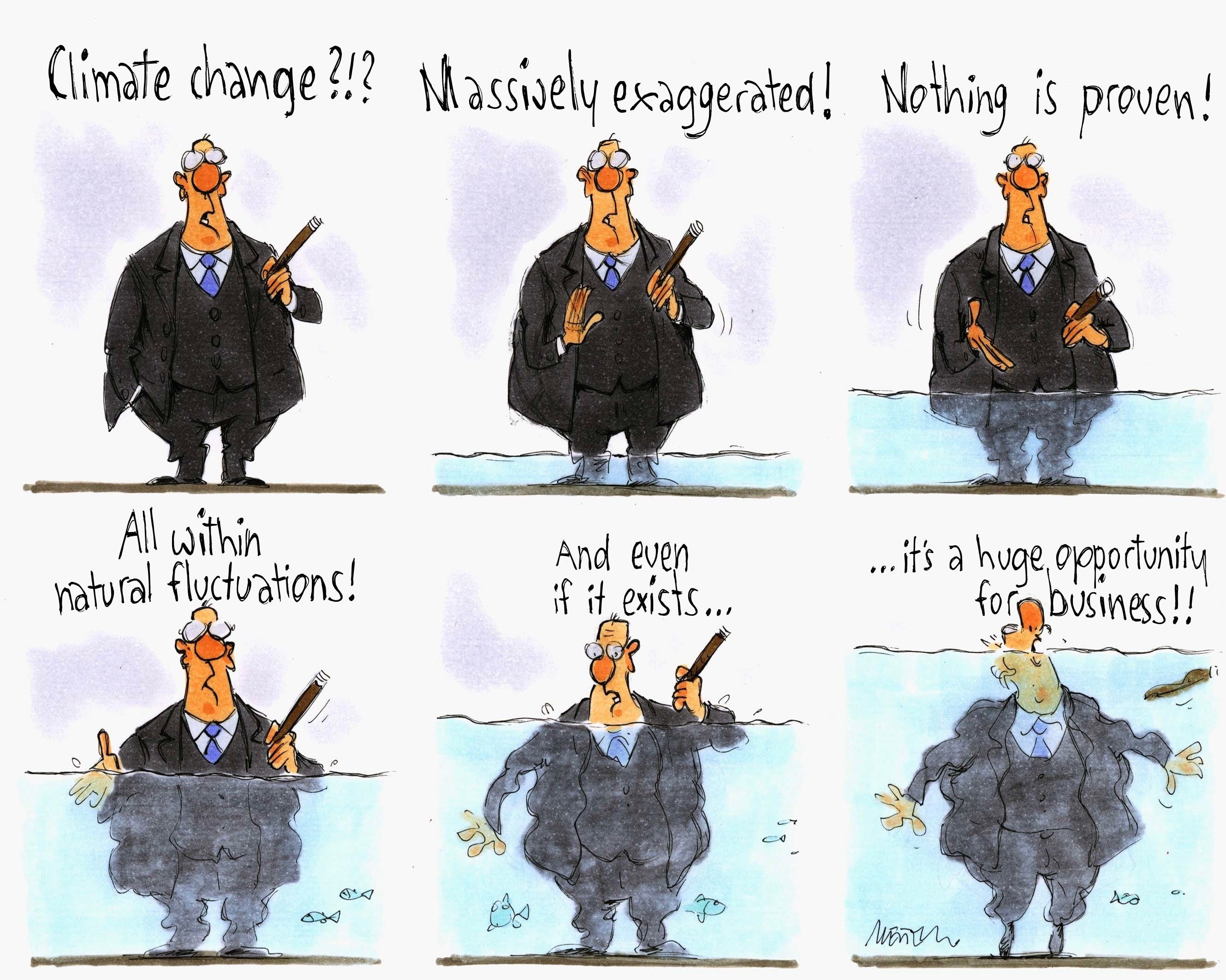
Across almost all the major crises of our time, denial acts as psychological protection, operating as an emotional “shield”. We have known, for several decades now, that the climate is changing in ways that threaten the continuity of human cultures, not just the comforts of a specific class. The climate has always shifted over geological time, but almost never at this velocity, under this level of human forcing, while so many people and artefacts are crammed into fragile coastal strips and arid margins. We can measure the heat content of the oceans, the changing chemistry of the atmosphere, the extinction pulse running through the biosphere. The diagnostics are no longer in doubt. Yet public belief and policy lag so far behind the evidence that it sometimes feels as though we’re living in parallel universes: one in which the house is visibly burning, another in which the smoke is mistaken for harmless steam rising on a hot day.
The standard explanation for this chasm – that climate deniers are ignorant, stupid, or just badly informed – is a comforting fiction for those of us who pride ourselves on being “evidence‑based”. It allows us to remain virtuous spectators. But it does nothing to explain why so many well‑educated people, with access to high‑quality information, remain unmoved. Nor does it explain the more curious phenomenon: individuals who can fluently recite the basic science and yet behave as though none of it applies to them.
If we take denial seriously as a sophisticated form of self‑defence, rather than a simple absence of information, a different picture emerges. Evidence alone is not rejected because it’s false. It’s rejected because it is dangerous to the stories people inhabit emotionally.
Identity as a Climate Firewall
The research is unambiguous that political identity, ideological posture and group loyalty often predict climate attitudes more accurately than scientific literacy. In some societies that manifests as a particularly fervent strand of libertarianism – where any admission of planetary limits is experienced as an assault on personal autonomy and market mythology. In others it may be linked to religious narratives about providence, or civilisational pride that resists the idea of human fragility.
In each case, climate denial functions as an oath of loyalty. To accept the scientific evidence is to risk expulsion from one’s tribe, to appear naïve, disloyal, or “captured” by hostile forces. In that sense, identity operates as a firewall against “inconvenient” information: anything that threatens the integrity of the group’s worldview is simply not allowed through.
This is one reason why fact‑based interventions perform so poorly. You can supply graphs, documentaries, policy briefs, and peer‑reviewed articles – all impeccably sourced – and still evoke nothing but a tightening of resistance. When a person’s stance on climate has been woven into their sense of who they are, and whose side they are on, you’re no longer in the territory of evidence. You are in the territory of belonging.
The Industrial Self
The story is not partisan. It is deeply civilisational. The dominant global worldview today – what I invariably refer to as “industrial economism” – defines human worth through the relentless machinery of production, consumption and competition. Growth is our secular sacrament. The “good life” is framed as an upward curve of acquisition and convenience – a steady escalation of access to energy, mobility, novelty and distraction.
Within this paradigm, climate change is not just an environmental issue. It is blasphemy. It points to the possibility that the entire developmental arc of the industrial era is structurally and even morally flawed – that our measures of success are entangled with ecological depletion. For those whose identity is bound to the righteousness and inevitability of industrial progress, acknowledging this is akin to heresy.
So climate denial – including the refusal to acknowledge granular facts such as rising temperatures and increasing ocean acidity – becomes a defence not simply of a lifestyle, but of a civilisational self‑image. It performs the psychic labour of keeping the industrial story intact: humans as masters of nature, technology as perpetual saviour, markets as the zenith of wisdom. When the climate system “speaks back” in fire, flood, drought and coral bleaching, denial translates that message into more familiar idioms: temporary fluctuation, natural cycle, act of God, or foreign plot.
Cognitive Dissonance and the Art of Self‑Protection
When our actions and our knowledge diverge too widely, most of us don’t change our actions. We change our knowledge. Or at least swapping the part of it that is allowed into conscious awareness.
Climate change presents a near‑perfect storm for cognitive dissonance. On the one hand, people are increasingly exposed to scientific warnings, as well as to personal experience of changing seasons, erratic rainfall, or unusual extremes of heat. On the other hand, their daily routines still depend on fossil‑fuelled infrastructure: cars, flights, air‑conditioning, meat‑heavy diets, imported goods and the like. Their livelihoods are embedded in systems whose profitability is strongly correlated with emissions.
To hold these two conflicting facts together – “my life is normal” and “my life is structurally implicated in mass harm” – is to invite anguish. So the mind performs a quiet negotiation. It can find a way out by blaming others (“it’s the corporations”, “it’s the government”, “it’s China”, “it’s the West”). It can insist on perfect certainty (“we must wait until all scientists agree completely”, even though they already do on the essentials). Or it can cling to the hope that a single miraculous technology will solve everything without requiring far-reaching change. After all, that’s what technology promises.
Each of these manoeuvres reduces anxiety by depreciating the significance of the threat or by displacing responsibility. They are not signs of stupidity. They are signs of a nervous system trying to keep functioning under the weight of intolerable facts and figures.
Cognitive Barriers Shaped in an Older World
Our perceptual apparatus evolved in small, local communities, tuned to immediate dangers: the approaching predator, the feuding neighbour, the sudden storm. Climate change is the opposite on almost every dimension. It is painfully slow, cumulative, global and statistical. You cannot point at “a climate change” in the way you can point at a burning tree. You can only infer it from patterns over time and space.
This mismatch gives rise to several well‑documented barriers. The environmental systems in which climate unfolds are complex. People rarely have the time, training or inclination to follow the chains of causality from their electricity usage to atmospheric chemistry to monsoon patterns. Uncertainty – a customary characteristic of complex systems – is widely misread as lack of knowledge rather than as a boundary of prediction.
Optimism bias whispers that things will “work out” as they always seem to have done. A sense of futility – what can one person do against the behaviour of billions? – renders the entire topic emotionally weightless. If my actions are drops in an unresponsive ocean, then better not to think too much about it at all.
These are not failures of intelligence. They are artefacts of cognitive architecture shaped in a very different ecological theatre, now operating out of its historical range. Industrial economism exploits these proclivities; it saturates our attention with urgencies of the immediate present, while the biosphere quietly unravels just beyond the horizon of the everyday.
The Veil of Psychological Distance
For many people, climate impacts remain framed as happening to “others”: other species, other nations, other generations. Even when local impacts are visible – rivers drying up earlier than usual, coral reefs whitening, harvests failing – they are often reinterpreted within older narratives: bad luck, poor planning, divine displeasure, or a particularly nasty El Niño year.
This psychological distancing is not only spatial and temporal. It’s also moral. If the people most visibly hurt are distant – whether in low‑lying Pacific islands or drought‑stricken regions of Africa or fire‑prone parts of Australia – their suffering can be abstracted into news footage rather than entering the heart as kinship. The global media system reinforces this dissociation by packaging such events as spectacles rather than as mirrors in which we might glimpse our own futures.
Closing that distance is not simply about information. It requires a different mode of attention – a willingness to feel implicated in events beyond our immediate circle, to sense that the boundaries of self extend into the forests, rivers and communities we will never personally touch. That is more akin to a spiritual practice than to a data acquisition exercise. Not surprisingly, it meets fierce resistance in cultures that have been schooled to prize individual autonomy over entanglement.
Conspiracies, Distrust and the Defence of Freedom
In a world marked by repeated abuses of power, mistrust of institutions is hardly irrational. Governments have lied. Corporations have concealed harms. Media have spun stories to suit their owners, even passing off fiction as news. Against that backdrop, climate science can easily be recast as another tool of control – a story wielded by the establishment in order to justify taxes, restrictions and surveillance.
Conspiratorial beliefs flourish where trust has been eroded. If someone already feels their freedom is hemmed in by distant authorities, then climate directives can be interpreted as the latest imposition. Masks during a pandemic, or bans on certain vehicles, or new rules about land use can be woven into a single tapestry of oppression. In such a worldview, to accept the climate evidence is to capitulate to one’s enemies.
This framing taps into a very real phenomenon: psychological resistance – the urge to do the opposite of what one is told when one’s autonomy feels threatened. When climate communication is experienced as moralising, shaming or prescriptive, it triggers exactly that response. The content of the message becomes irrelevant. What matters is the relational stance: who is telling me what to do, and on whose authority?
In some cultures this shows up as hostility to “globalist” institutions; in others as suspicion of Western science; in yet others as a revolt against urban elites. The specific enemy can vary, but the underlying pattern is always the same: denial operates as a defence of dignity and independence in the face of perceived condescension.
Risk, Loss and the Fear of Transformation
Accepting the seriousness of climate change carries with it a thick bundle of perceived risks. Will my job disappear if fossil fuels are phased out? Will energy become unreliable or even more unaffordable? Will my community lose its familiar landscape, its cultural practices, its sense of continuity? And at a more subtle level: who will I be if the story of endless personal advancement is no longer credible?
These are far from being trivial anxieties. They encompass financial insecurity, social status, emotional stability and temporal orientation. When people imagine a low‑carbon future, they habitually lock-on to worse case scenarios. Because of that tendency, many picture scarcity and loss rather than renewal or a different kind of abundance. They fear being left behind in a reshuffled social order. If every serious climate policy is framed as a sacrifice – higher prices, fewer flights, smaller homes, less meat, “going without” – it’s hardly surprising that those with the most to lose, or who believe they have fewer safeguards in place, will resist. Rejection of the science then becomes a pre‑emptive defence against the pain of anticipated disruption. Far better to deny that the bridge is collapsing than to step into an unknown landscape on the other side.
Comparing Ourselves into Complacency
People don’t form their climate attitudes in isolation. They look sideways: to family, colleagues, local celebrities, online communities. If nobody in one’s immediate circle talks about climate with any seriousness, it’s easy to infer that it’s not truly urgent. This is the dynamic of pluralistic ignorance: each person privately suspects that their concern might be warranted, but publicly downplays it because everyone else seems indifferent. The effect is self‑reinforcing. Because worry is hidden, it appears to be absent. Because it appears absent, it is suppressed still further. Within such a milieu, anyone who voices strong alarm risks being labelled hysterical, political or unpatriotic. Denial becomes the etiquette of the group – a way of maintaining social cohesion by not bringing unwelcome truths to the table.
This is amplified by the dynamics of social media of course, where algorithms reward outrage and identity signalling over reflection. A provocative denialist slogan travels faster than a carefully argued explanation of radiative forcing. People learn quickly which statements will win approval from their preferred audience, and which will invite attack. Many will quite rationally choose belonging over truth.
Sunk Costs, Momentum and the Weight of the Past
Our infrastructures – physical, institutional and psychological – carry enormous momentum. Cities have been built on assumptions of cheap fossil energy and stable climate patterns. Entire professions rest upon the continuation of high-emitting activities: aviation, meat processing, cement, petrochemicals, speculative finance. The material investments are mirrored within inner investments: habits, skills, and identities tied to those roles.
Sunk costs cloud judgment. If someone has devoted decades to developing expertise in an industry now portrayed as destructive, it is natural for them to resist that narrative. It threatens not only their income, but the story of their life’s contribution. When challenged, they may exaggerate the benefits of their work, minimise the harms, or emphasise ongoing “efficiency gains” that they argue will solve the problem without fundamental change.
At a collective level, entire nations have staked their geopolitical influence on fossil fuel exports or energy‑intensive manufacturing - my own country of Australia is one of these. For them, rapid decarbonisation is not simply an ecological shift; it is a potential loss of sovereignty and bargaining power. Denial can then be read as a geopolitical tactic as much as a psychological one – a way of delaying change until alternative sources of leverage are secured.
Inner Conflict, Motivated Reasoning and Soft Denial
Many people live in a state I think of as “soft denial”. Intellectually, they accept the reality of human‑induced climate change. Emotionally, they behave as though nothing fundamental needs to alter. They might confess to “worrying about the kids’ future” and yet calmly book long‑haul holidays, vote for parties with insipid climate policies, or invest in industries that perpetuate the problem.
This disjunction is sustained by a suite of inner strategies. Rationalisation reframes high‑emission choices as necessary, deserved, or trivial in the grand scheme of things. Wishful thinking inflates the prospects of unproven technologies that will supposedly scrub the atmosphere or draw down carbon at the last minute. Projection attributes responsibility to faceless “others”: corrupt politicians, greedy corporations, distant countries with rising emissions. In diffusion of responsibility, the individual concludes that if the problem is truly global, only “the system” can act. Personal agency collapses into an abstract fatalism. This is psychologically convenient because it removes the burden of decision. One can remain a spectator without feeling like a helpless bystander.
Narcissism, Collective Grandiosity and the Inconvenience of Limits
There’s also a strand of climate denial that emerges from wounded pride. At the individual level, narcissistic tendencies resist any suggestion that one’s pleasures should be constrained for the sake of unseen others. The very language of “limits” is insulting to an ego raised on the promise of boundless self‑expression. Collective narcissism operates in a similar vein. Some nations see themselves as chosen, exceptional, or indispensable. For such polities, acknowledging climate vulnerability and culpability can feel humiliating. It undermines their sense of special destiny. They may then emphasise their “right to develop” or their past sacrifices, using historical grievances to deflect present responsibility.
In both cases, denial operates as a shield protecting self‑importance. To confess that the atmosphere does not negotiate, that thermodynamics is indifferent to status, is to accept a kind of equality most empires – and many individuals – find deeply unwelcome.
Disengagement and the Luxury of Not Knowing
For a significant portion of the world’s population, disengagement from climate issues is not wilful denial but a by‑product of more immediate struggles: securing food, shelter, safety, basic healthcare. When your day is consumed by precarious work or political instability, the atmospheric concentration of greenhouse gases is not the most pressing concern, even though you may be among those most exposed to its consequences.
In wealthier segments, disengagement takes a different form – a cultivated indifference. People protect their mental health by looking away, choosing entertainment and lifestyle content over “depressing news”. Media organisations, tracking audience metrics, respond by muting or sensationalising climate coverage rather than treating it as a continuous background condition of all other stories. Low exposure thus becomes both cause and effect of climate apathy. In some countries, children can complete years of schooling without more than a cursory engagement with the science and ethics of the planetary crisis that will define their adult lives. When the topic finally enters their awareness, often through dramatic disasters, their conceptual scaffolding is too thin to make sense of it. Denial, or numbness, then fills the vacuum.
The Emotional Brain and the Poverty of Data Alone
Neuroscience and psychology have been telling us, for a long time now, that the emotional brain and the rational brain are not enemies so much as intertwined partners. The difficulty with climate change is that its time‑course and texture don’t readily light up the circuits designed for immediate threats. There is no tiger in the bushes ready to pounce, only a slowly rearranging pattern of seasons, species and storms.
Information presented as abstract data – curves on graphs, probabilities, degrees Celsius – rarely penetrates to the level where people make existential choices. Stories, metaphors and lived examples are needed to bridge that gap. Yet many scientific and policy institutions remain suspicious of anything that smacks of “emotion”, fearing it will contaminate their objectivity. The result is a curious impasse. On one side, a mountain of evidence diligently compiled but inadequately translated into human meaning and compellingly communicated. On the other, publics who respond more readily to narratives of national pride, consumer aspiration or religious salvation than to charts of ocean heat content. Climate denial thrives in the gap between these discourses, offering simpler, more flattering and less disturbing stories.
Denial as Rational Self‑Protection
If we pull these threads together – identity, cognitive dissonance, evolutionary limitations, psychological distance, distrust, perceived risks, social comparison, sunk costs, inner conflict, narcissism, disengagement and the limits of rational data – a pattern leaps out. Climate denial is not primarily a deficit of information. It’s a form of rational self-protection contained by a particular civilisational story.
Within the paradigm of industrial economism, to fully absorb the implications of the climate crisis is to face the possibility that our dominant metrics of success, the institutions we have built, and many of our personal aspirations, are misaligned with the conditions needed for life to flourish. This recognition is destabilising. It threatens comfort, status, routine, and meaning.
Denial then becomes a coping strategy – a way for minds, communities and entire societies to postpone an encounter with truths they do not yet know how to process. Dismissing deniers as “anti‑science” or “backward” may satisfy a certain moral itch, but it fails to grasp the depth of what is at stake for them. And, if we are honest, for us all.
Can Psychology Be Bypassed?
Some argue that instead of trying to change minds, we should change incentives: put a tax on carbon, subsidise clean technologies, make the greener choice the cheaper and more convenient one. There is evidence that well‑designed economic instruments can shift behaviour even in the absence of deep attitudinal change. If your rooftop solar reduces your electricity bill, you needn’t be a climate activist to install it.
Yet even this apparently “psychology‑free” strategy is saturated with assumptions about fairness, trust in authorities, and willingness to accept near‑term costs for long‑term gain. Policies that are not perceived as legitimate, or that appear to target some groups while sparing others, can provoke backlash and deepen denial. In other words, identity and emotion leak back into the supposedly neutral domain of economics.
Moreover, transforming the infrastructure of energy, transport, agriculture and industry at the required momentum will demand more than simple compliance. It will require forms of collective stewardship – that is, communities organising to reshape the conditions of their own existence – that cannot be summoned by price signals alone. People must, at some level, care.
Beyond Blame: Towards a More Adequate Understanding
If denial is, in part, an intelligent adaptation to a world built on contradictory promises, then any adequate response must move beyond blaming individuals. The question is less “Why do they not accept the evidence?” than “What would have to change in our shared stories, institutions and material conditions for this evidence to become bearable?”
That invites a different kind of inquiry. Instead of endlessly rehearsing the scientific consensus – important as that is – we might examine the deeper narratives of progress, freedom, security and identity that currently make full acknowledgement of the climate crisis so threatening. Might there be ways of telling the human story that do not pit flourishing against planetary boundaries? Could notions of status and success be uncoupled from high energy throughput and conspicuous consumption? What forms of belonging could arise that are not founded on the exclusion or denigration of out‑groups? Which rituals, arts and practices could help people stay present with grief, uncertainty and responsibility without collapsing into despair or denial?
These are not questions science can answer by itself. They belong also to philosophy, ethics, history, spirituality, and the everyday wisdom of communities already living on an ecological edge. They challenge the industrial imagination at its root. That’s why they are both so daunting yet so necessary.
In the meantime, we would do well to notice the climate denier in ourselves: the part that scrolls past difficult news, that assumes someone else will fix it, that hungers for reassurance more than for truth. Shaming that part is futile. Listening to it, understanding what it is trying to protect, and then gently expanding the circle of what we are willing to face – that might be a more promising beginning.
Denial, after all, is only the first line of defence. Once it becomes too obviously untenable, other possibilities open up: curiosity, grief, resolve. The task – if I dare use that word in this context – is to help create the conditions in which those more generative responses are not only possible but contagious.