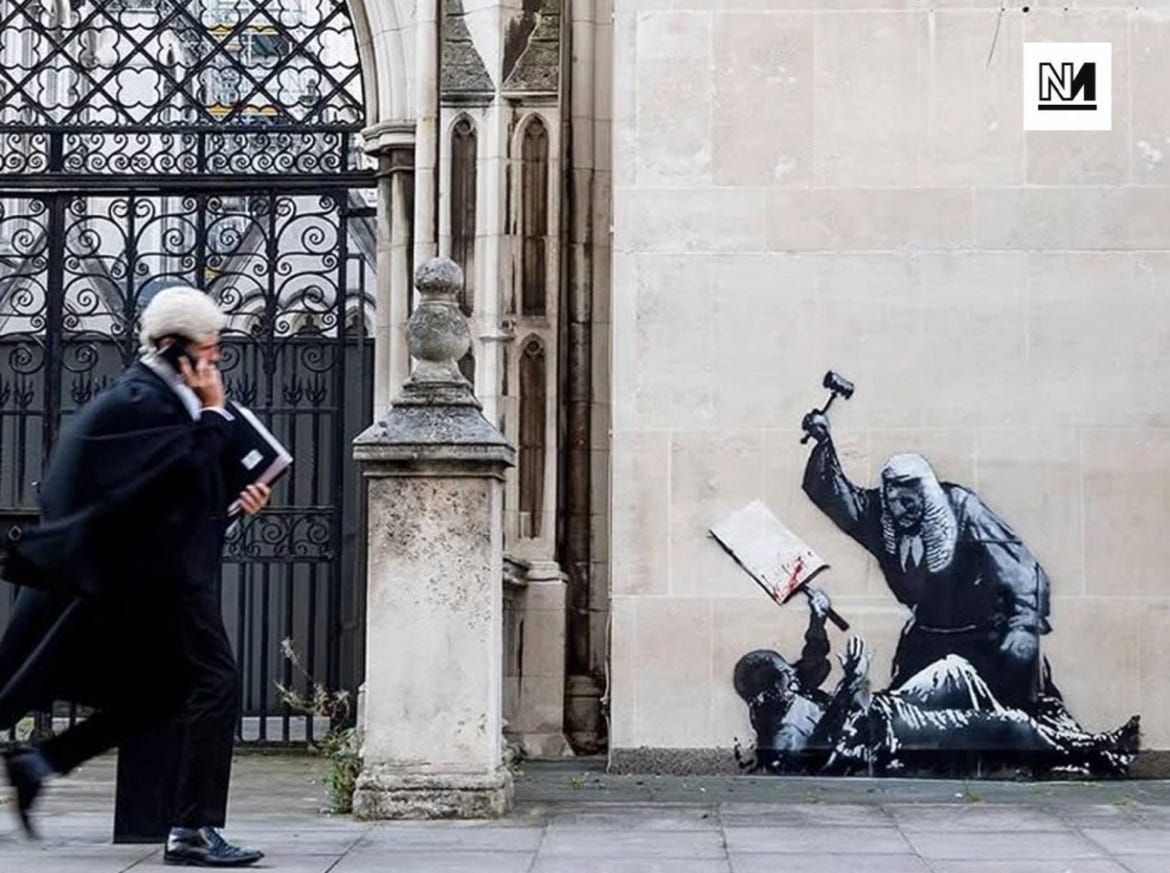
On September 6, 2025, the largest wave of political arrests in modern Britain played out on the streets of London. Eight hundred and fifty‑seven people were detained during a “Lift the Ban” protest, organised to challenge the Labour government’s decision to proscribe Palestine Action as a terrorist organisation. Police flooded the streets, citing Section 13 of the Terrorism Act 2000, which makes it a crime to wear or display articles that might indicate support for outlawed groups. Once the group is banned, ministers argued, protestors who so much as carried a slogan or displayed a badge could be treated as criminals—indeed, as potential terrorists.
Officials defended their actions with bureaucratic clarity. Palestine Action, they remind us, has carried out direct actions against companies in the arms trade—break‑ins, vandalism, and acts of sabotage. Criminalising such activity was, in their view, not only reasonable but urgent. And once Parliament had voted to proscribe the group, enforcement inevitably followed. The police, in their telling, had no choice.
But what unfolded on the ground told another story. Amnesty International observers described the protests as peaceful. Defend Our Juries—a grassroots group supporting the demonstration—saw nothing like the levels of violence officials alleged. Most arrests, in fact, were not for assaults or disorder but for displaying signs, banners, or pins with the Palestine Action logo. From the perspective of ordinary demonstrators, the arrests marked a collapse in proportion and a dangerous confusion of categories: peaceful citizens were being branded as terrorists.
This pattern is not abstract. In a smaller and more personal way, I once encountered it myself. In the 1970s, while living in Australia, I had to defy the law in order to educate my children at home. At the time, homeschooling was outside the bounds of legality. Yet it was only by stepping beyond those limits that change became possible. What was once treated as unlawful has since become an accepted option for thousands of families. Our experience was only one thread in this shift, but it illustrated the same dynamic: sometimes the law clings to old categories until reality forces it forward.
In Britain a century ago, suffragettes were jailed repeatedly under statutes designed to protect “public order”. Their hunger strikes were punished with force‑feeding. Prosecutors claimed neutrality: the law was being applied equally. Yet history has judged these episodes as brutal misuses of legality against an expanding moral horizon.
In the United States, civil rights demonstrators in the 1950s and 1960s were arrested for parading without permits, “disturbing the peace”, and trespassing on segregated buses. Southern officials defended each action as proper enforcement. But the wider truth was that legality itself had become a shield for injustice.
In South Africa, the apartheid regime declared anti‑apartheid groups unlawful, their supporters criminalised by statutes written with surgical clarity. By the forms of legality, each prosecution was airtight. By the standards of justice, the entire system was rotten. When it collapsed, its laws stood revealed as the machinery of repression.
The present echoes these legacies. What looks to the state like faithful enforcement looks to history like delay—law clinging to categories long past their expiration date. Nor is Britain isolated. The weaponisation of counterterrorism and public order statutes against dissent is becoming a global trend.
In France, the gilets jaunes protests of 2018–19 triggered thousands of arrests. Laws meant for counterterrorism were redeployed against street demonstrators demanding economic justice. Riot police tactics blurred the line between counter‑insurgency and crowd control. For many French citizens, the result was not trust in legality but suspicion of its impartiality. In Spain, the Ley Mordaza—the “gag law”—passed in 2015 with the promise of tackling extremism. It soon reached far beyond that goal. Citizens were fined heavily for unauthorised demonstrations, prosecuted for tweets perceived as glorifying terrorism, and even punished for photographing police. Music became evidence, and satire became a crime. Law’s teeth, sharpened for terrorism, were biting into everyday dissent.
China represents the most extreme form of this pattern. Its National Security Law for Hong Kong, justified as protecting sovereignty, criminalised secession, subversion, and terrorism on terms so vague that any act of protest could be reframed as a threat. Thousands were arrested; opposition newspapers silenced. The word “terrorism” was hollowed out entirely, deployed not to describe violence but to eliminate disobedience. Britain may not have crossed into authoritarian excess, but the parallels are glaring. To proscribe Palestine Action and then treat every symbolic gesture of support as a terrorism offence is to slide toward a grim, globally familiar playbook.
The problem is conceptual as much as procedural. Terrorism once meant deliberate violence against civilians to coerce governments. Now its boundaries have stretched to include banners, chants, placards, and symbolic disruptions. Each such expansion dilutes the term, blurring the line between violent extremism and nonviolent dissent. Once the public ceases to trust state distinctions, the legitimacy of counterterrorism itself collapses. If everyone is a terrorist, then no one is.
Underlying this collapse is the peculiar structure of law itself. In Britain, as in other common law nations, precedent reigns supreme. Cases are decided by reasoning backward. Precedent once provided stability. In an age of acceleration, it becomes a straitjacket. Movements now assemble within hours through encrypted networks. Hashtags mobilise thousands overnight. Local protests are amplified globally within days. Courts, chained to history, struggle to make sense of these eruptions. Outdated categories are stretched beyond recognition. Placards become terrorism. Protest becomes crime. The law, instead of guiding society, entirely mischaracterises it.
This misfit carries costs. For individuals, terrorism charges—even if eventually dismissed—leave scars. Employers, landlords, and universities, take note. Surveillance lingers. Bail conditions disrupt lives. For communities, the sight of peaceful members treated as extremists breeds alienation. The thin thread of trust between citizen and state frays even further.
Ultimately the state itself pays. Courts are clogged with prosecutions that achieve little beyond symbolism. Police resources are diverted from genuine threats. Britain’s hard‑won reputation as a defender of liberty falters on the international stage. Blind enforcement masquerades as order but seeds disorder instead. Tinkering is not enough. The problem is structural. The time has come for the law to reinvent itself. It must shift from a reactive archive of judgements to an anticipatory system capable of keeping pace with turbulence and complexity.
This means statutes that do not endure indefinitely but expire unless renewed in light of real-world outcomes. It means precedent that is no longer static but “living”—a record updated by the consequences of rulings in practice. Courts must consult not only the past but also the futures their decisions might generate. Judicial chambers must be expanded to include foresight specialists, sociologists, data scientists, and ethicists—an apparatus capable of stress-testing legal reasoning against systemic risks. In that context protest, finally, must be recognised as global. Like finance and climate, it transcends borders. To regulate it at the purely national scale is to misunderstand its nature.
Most of all, the purpose of law must shift. Enforcement alone cannot be its highest aspiration. The true task is stewardship—the nurturing of legitimacy, the preservation of civic trust, and the balancing of fragility under pressure. The law’s relevance must not be measured in arrests but in whether society still believes in its justice.
If Britain’s September 2025 arrests exposed the brittleness of legality in a new era, they also pointed toward new possibilities. Crisis almost always creates openings. Out of these ruptures can come designs for what might replace failing structures. Picture a legal order in 2050. Legislation is written with expiry dates, its continuation dependent on evidence of proportionality. Courts maintain a living library of precedent, enriched not just by logic but by the documented consequences of past rulings. Judicial panels evaluate disputes with foresight experts, testing judgements against plausible futures and their ripple effects across systems. Protest is governed not by parochial statutes alone but by transnational principles, forged by an international consortium dedicated to balancing security with the freedom to dissent. Enforcement still exists, but it's measured against a higher goal: stewardship of trust. Police and prosecutors understand themselves not just as technicians of control but as custodians of legitimacy. Law’s compass points forward.
This future is not inevitable. It depends on whether societies today can admit that commitment to precedent is insufficient. What matters now is fidelity to reality and fidelity to the future that reality foreshadows. If law insists on clinging to outdated categories, it will corrode, hollowing itself from within. If it chooses reinvention, it can still be what it claims: not repression dressed as legality, but a framework of justice resilient enough to survive in an age of speed, complexity, and interconnection.
The arrests of September 2025 will not soon be forgotten. They may be remembered as a punctuation point in the decline of civil liberty. Or they may be recalled as the spark of a legal renaissance, the moment a system finally admitted that it must reinvent itself or face irrelevance. That path remains open. But the lesson is clear: loyalty to precedent alone will not save the law. Loyalty to complex realities—and to the future taking shape—is the law’s best hope for remaining relevant.