Why Traditional Peacemaking Fails
Most peace efforts collapse because they rely on outdated, mechanistic thinking. Beyond more obvious political motivations—like Benjamin Netanyahu avoiding criminal charges by staying in power, or countries using foreign conflicts to distract citizens from domestic issues—there's a deeper structural issue visible in conflicts like those in the Middle East. Current diplomatic approaches treat only surface symptoms, ignoring deeper interconnected root causes of conflict.
Temporary ceasefires and one-dimensional negotiations can't address the tangle of historical trauma, economic inequality, and competing narratives that fuel hatred across generations. These outdated methods, most rooted in power politics, often reinforce the very problems they aim to resolve. In situations like the ongoing slaughter in Gaza, where distrust has become deeply ingrained through decades of violence, such approaches create no more than temporary pauses before the next inevitable flareup.
Instead of viewing hatred simply as a human flaw, we can see it as a sign that existing systems are obsolete. Rigid institutions amplify conflict, locking societies into destructive cycles. Breaking free requires a shift to third-order change—not just reforming systems, but reimagining their prime purpose and function. Peace emerges when we treat societies as learning ecosystems capable of evolving. By grounding strategies in an appreciation of patterns, consequences, and mutual interdependence, we should be able to create conditions where adaptation and trust replace cycles of violence.
What we observe in seemingly intractable conflicts is actually the functioning of what complexity scientists call "strange attractors"—self-reinforcing patterns that maintain their structure while consuming enormous amounts of energy. The Israeli-Palestinian conflict has evolved into such a system, where the very mechanisms designed to manage the problem have become part of the problem itself. Traditional diplomacy operates rather like treating cancer symptoms with painkillers when what we're dealing with is a metastatic pathology that's discovered how to evade the body's natural healing mechanisms.
The failure of conventional approaches stems from their linear hypotheses regarding cause and effect. Diplomats assume that if you identify the right sequence of concessions and compromises, you can engineer a solution. But complex social systems don't work like that. They operate through what I call "acupuncture points"—those places within a complex system where a small nudge in one element can change the energy and outputs of the whole. Most peace negotiations focus on the least powerful points of leverage—the parameters and structures of pacts and agreements—while ignoring the power dynamics that generate those structures in the first place.
Complex systems science reveals that lasting change requires intervention at multiple levels simultaneously, but not through the traditional top-down approach that focuses on elite negotiations. Instead, effective acupuncture interpolations must work from the inside out—beginning with how individuals process trauma and threat, expanding to how communities create meaning and identity, and ultimately reshaping how institutions channel human energy. Individual psychology, community dynamics, and institutional structures form an interconnected meshwork where each level influences and reinforces the others. These three levels form a natural hierarchy of transformation, where changes at deeper levels enable and sustain changes at more visible levels, creating the conditions where sustainable peace emerges from the bottom up through cascading changes in human consciousness, social relationships, and organizational design.
Three Levels of Intervention
1. Recognition and Rewiring
The first step must be to understand how small-scale trauma grows into large-scale conflicts through repetition and amplification. Empathy is not just a feeling in this context; it's an applied social technology that can disrupt such cycles. Individuals, communities, and institutions all have roles to play in this regard.
At the individual level, counteracting polarisation requires people to break free from their echo chambers by means of structured programmes that bring opposing groups together. When Israelis and Palestinians have worked together on water management or agricultural projects, for example, they have discovered shared interests that transcend political divisions. These exchanges don't eliminate difference. They work because they create what social psychologist Gordon Allport called "optimal contact conditions"—equal status interaction around shared goals with institutional support.
Communities need structured conflict navigation - protected spaces for storytelling and vulnerability where narratives of pain can evolve into shared understanding. Truth-telling processes should be designed as ongoing mechanisms for development, not one-time events. Localised therapeutic truth-telling could focus on specific shared histories, such as the displacement of Palestinian families or the trauma of Israeli civilians during rocket attacks. These methods work by transforming what narrative theorist Jerome Bruner called "landscape of action" stories—focused on events and causation—into "landscape of consciousness" stories that explore intention, motivation, and meaning.
Institutions can underwrite learning laboratories where grassroots groups experiment with innovative solutions to local conflicts. These labs can test methods for growing cooperation through neighbourhood projects that require mutual interdependence, such as renewable energy initiatives that create shared infrastructure and aligned incentives.
2. Addressing Root Causes
True peace is not the absence of violence or the mere cessation of hostilities. But it does build enduring justice by addressing the material and existential inequalities that fuel resentment and mistrust.
Economic cooperation through mutual dependence can build trust in ways that political agreements simply cannot. Israeli-Palestinian agricultural partnerships or shared infrastructure projects create tangible incentives for cooperation. These initiatives make violence economically and socially unrealistic by aligning common interests. The core insight I carry with me from network science is that interdependence generates "coordination equilibria"—conditions where everyone's optimal strategy involves cooperation rather than competition.
Diplomatic innovation must also evolve to function like platform design, creating modular security frameworks and resource-sharing agreements that make conflict utterly impractical. The European Coal and Steel Community, which laid the groundwork for peace between France and Germany, offers a model that could be adapted to the cooperative management of Jerusalem's holy sites or shared heritage zones. These frameworks succeed by creating substantive exit costs, making defection from cooperation more expensive than maintaining it.
Bias detection and intellectual humility can be cultivated through structured encounters that bring together people from opposing sides, such as the mothers of serving IUF soldiers with their Palestinian equivalents. These workshops can create conditions for what psychologist Daniel Kahneman called "slow thinking"—deliberate cognitive processes that interrupt automatic prejudices, enabling participants to question their assumptions while humanising those they previously saw as adversaries.
3. Transforming Historical Memory
One of the greatest challenges in peacemaking is breaking cycles of intergenerational trauma. Trauma often passes from parents to children, at times unconsciously prolonged in family rituals and commemorations, implanting distrust and hatred deep within cultures. Transforming how societies remember and process their past is critical.
Educational reform requires pairing symbolic gestures with tangible actions. Rwanda's reconciliation efforts succeeded because they combined identity-building and trust exercises with visible accountability, such as land redistribution and justice for genocide victims. In the Israeli-Palestinian context, truth-telling initiatives should be paired with reparative measures, like returning confiscated land or providing reparations to displaced families. This approach recognises what social psychologist John Darley called the "moral credential effect"—where symbolic acts of reconciliation can actually license continued harmful behaviour unless accompanied by structural change.
Building "dignity infrastructure" requires teaching people how social media algorithms and news cycles amplify outrage for profit. Critical media literacy programmes help communities recognise manipulation, redirecting attention toward curiosity and positive dialogue. These programmes work by developing what psychologist Paul Slovic called "psychic numbing" resistance—the ability to maintain emotional engagement with complex problems instead of shutting down when overwhelmed.
Emotional engineering through designed experiences can nurture empathy and understanding. Virtual reality programs allow participants to experience life from opposing perspectives, while in-person storytelling initiatives create moments of shared humanity. Public art projects and cultural festivals that celebrate shared histories can help reframe narratives of conflict by activating what neuroscientist Antonio Damasio called "somatic markers"—bodily feelings that guide decision-making below the threshold of conscious awareness.
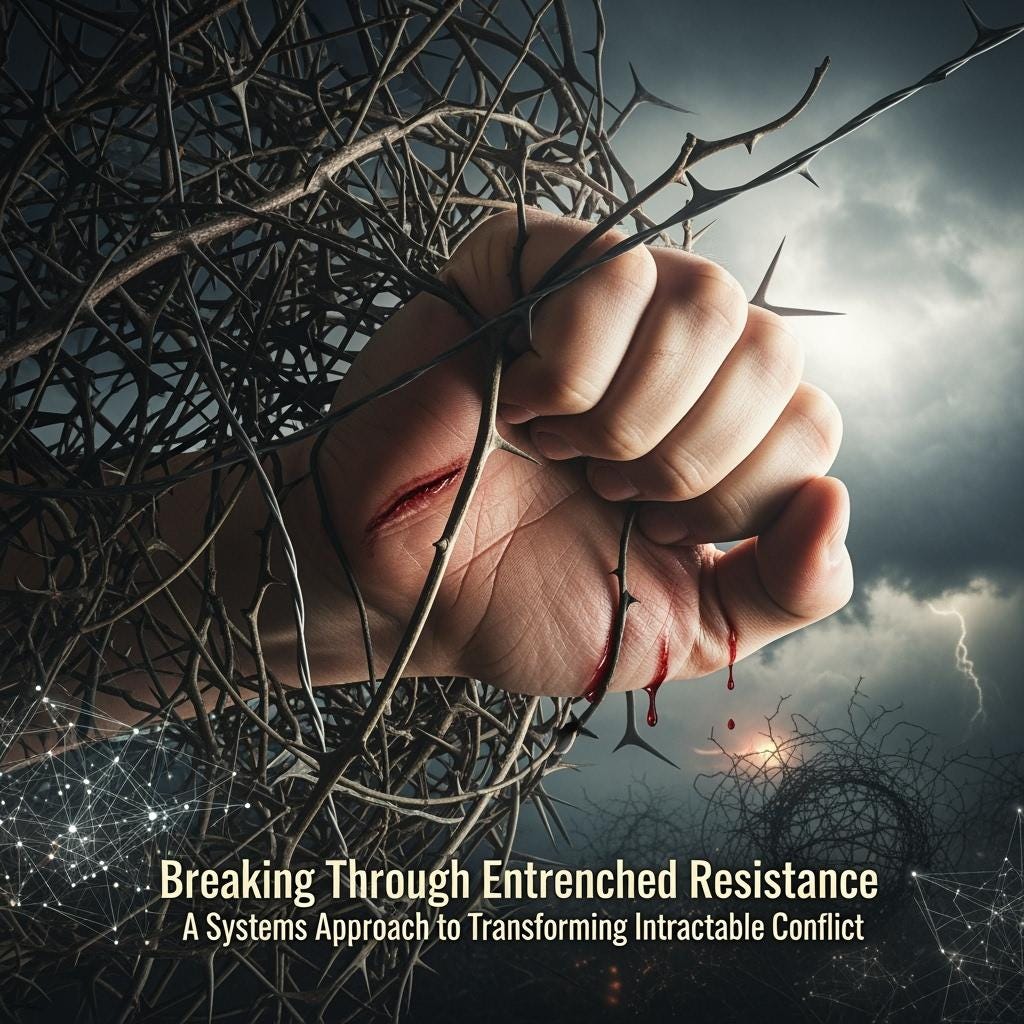
The Israeli-Palestinian Case: Breaking Through Entrenched Resistance
The Israeli-Palestinian conflict, while deeply entrenched, is not impenetrable. On the contrary, it offers an evolutionary opportunity. Despite decades of failed negotiations, escalating violence, and deepening mistrust, there are pathways to progress if we are up to reimagining the process. This requires moral inventiveness—the ability to envision coexistence not as an abstract ideal but as a tangible reality, built one step at a time through small-scale, practical experiments.
Gaza-West Bank Technology Corridors could foster collaboration through joint projects in technology and innovation, creating jobs and reducing economic disparity while offering tangible benefits to both sides. The shared governance of contested spaces like Hebron, rich in cultural and religious significance, could be jointly managed under international oversight, serving as a model for cooperation elsewhere. Likewise, cross-border infrastructure projects, involving shared water resource management, renewable energy grids, and waste treatment systems, can grow mutual trust and dependence.
These initiatives are not silver bullets but key stepping stones that can build momentum for whole-system change over time. However, pursuing these efforts requires finding a way through a minefield of powerful obstacles that reinforce the status quo. What we encounter here is not just resistance to change, but "autopoiesis"—the tendency of systems to reproduce their own organisation and maintain their identity even when that identity is destructive.
The Architecture of Perpetual Conflict
The persistence of the Israel-Palestine conflict demonstrates how it's become what complexity theorist Stuart Kauffman refer to as an "attractor basin"—a deep groove in the landscape of possibilities that captures and redirects all movement back toward itself. External interventions may temporarily lift the system toward different outcomes, but without reshaping the fundamental terrain, gravity inevitably pulls it back into the well-worn patterns of conflict.
The military-industrial complex represents one of the most powerful forces maintaining this attractor state. The conflict generates billions in arms sales annually, creating what economist Mancur Olson called "concentrated benefits and diffuse costs"—where small groups receive enormous profits from activities that impose much larger costs on society as a whole. Arms sales to Israel through US military aid flow back to American defense contractors, creating powerful lobbying forces that resist de-escalation. Similarly, arms suppliers benefit from providing weapons to militant groups like Hamas, whether through black markets or regional actors. These suppliers have no incentive to support peace initiatives that would reduce demand for their products.
Political elites on both sides have discovered that perpetual conflict provides protection rackets—where those who create problems also position themselves as the only viable solution. Israeli politicians like Netanyahu use the conflict to rally nationalist sentiment and distract citizens from domestic scandals, while the ongoing occupation allows Israel to maintain control over critical resources and strategic territories. Palestinian leadership, divided between Hamas in Gaza and the Palestinian Authority in the West Bank, benefits from maintaining control over their respective territories, often prioritising power struggles over broader peace efforts.
The occupation itself has created a network of economic dependencies and profiteers that would be threatened by peace. Israeli settlements in the West Bank have become economic hubs supported by industries that exploit Palestinian labour under unequal conditions. Control over natural resources like water and arable land disproportionately benefits Israeli settlers and companies, creating resistance to sharing or redistribution efforts.
Media and narrative control perpetuate the conflict through "motivated reasoning". This is the tendency to process information in ways that confirm existing beliefs rather than seeking truth. Polarised narratives on both sides reinforce zero-sum thinking that depicts the other side as irredeemable. Israeli media frequently focuses on security threats while downplaying Palestinian suffering, whereas Palestinian media highlights Israeli aggression without acknowledging internal divisions. On top of that, international media generally oversimplifies the conflict, feeding stereotypes and perpetuating polarisation rather than fostering understanding.
The conflict becomes further entrenched through the involvement of external actors whose interests align with its continuation rather than its resolution. Regional powers like Iran and Turkey extract geopolitical capital from Palestinian grievances, channeling support to militant organisations while using anti-Israel sentiment to bolster their regional influence. Global superpowers treat the conflict as terrain for broader competition, with US support for Israel reflecting strategic alliance structures and domestic political pressures, while Russian and Chinese positions often serve primarily to counterbalance American hegemony.
Strategies for Transformation
While these obstacles are formidable, they are not insurmountable. A key insight drawn from complexity science is that systems can undergo what physicist Per Bak called "self-organized criticality"—sudden phase transitions that reorganise the entire system when pressure builds beyond critical thresholds. Grassroots movements, supported by international pressure, can create these critical thresholds by challenging entrenched interests and building political will for transformation.
Empowering grassroots movements works because change often starts from the edges of systems rather than their centres. Grassroots initiatives that bring Israelis and Palestinians together around shared challenges like water scarcity, environmental degradation, or education create alternative realities that bypass entrenched elites. Citizen assemblies where ordinary people engage in dialogue and problem-solving foster mutual understanding and generate innovative solutions that professional diplomats, constrained by institutional positions, cannot explore. Joint agricultural projects and cross-border small businesses build economic interdependence that imposes costs for conflict and benefits for cooperation.
International pressure can be leveraged by targeting the economic incentives that sustain conflict. Advocacy campaigns aimed at reducing arms sales to the region can weaken the influence of the military-industrial complex, as grassroots movements in the US and Europe lobby for restrictions on arms exports. International bodies like the UN or EU can impose sanctions on entities that profit from occupation while offering incentives for cooperative economic projects, creating what economist Thomas Schelling called "focal points" that coordinate expectations around peaceful solutions.
Reframing narratives requires changing how the conflict is perceived to build public support for peace. Media literacy campaigns that teach people to become more aware of propaganda, and to critically analyse prevailing narratives, can reduce polarisation and promote understanding. Shared storytelling platforms where Israelis and Palestinians share personal stories of loss, resilience, and hope humanise both sides and foster empathy by activating empathic concern.
Engaging external actors constructively means aligning their interests with peace rather than allowing them to exploit the conflict. Economic diplomacy can encourage regional powers like the Gulf States to invest in joint Israeli-Palestinian projects as part of broader normalisation agreements. International oversight mechanisms can monitor and mediate shared governance arrangements in contested areas like Jerusalem or Hebron, providing what game theorist Robert Axelrod called "shadow of the future" effects that make reputation and long-term relationships more valuable than short-term gains.
Toward a Learning Ecosystem for Peace
Ultimately, peace cannot be achieved through force or negotiation alone. And it's abundantly clear that current efforts, for one reason or another, are not working. It requires creating conditions where societies can learn, adapt, and evolve beyond their current limitations. This means shifting not just what we think, but how we think and feel about the conflict.
Adaptive systems thinking treats the Israeli-Palestinian conflict as a complex system that can evolve through iterative experiments and feedback loops. Pilot programs like shared water management projects or joint education initiatives serve as prototypes for larger systemic changes, creating "learning by doing" processes that generate new knowledge through action rather than analysis.
Intergenerational healing requires investing in programmes that address trauma and build resilience across generations through truth-telling commissions paired with tangible justice initiatives. These programmes recognise that trauma is not just individual but collective, embedded in cultural narratives and social structures that must be consciously transformed.
Lasting peace is not an endpoint. It's a matter of continuing progress, where societies learn to navigate differences and build trust through repeated, conscious effort. But peace is unarguably a prerequsite if we're to avoid extinction. While the obstacles are immense in the Middle East, so too is the opportunity to create a new world-system—a new paradigm where coexistence is not just possible but inevitable. The Israeli-Palestinian case, viewed through this lens, becomes not just another intractable conflict but a laboratory for developing approaches that could transform how humanity deals with all complex conflicts in an increasingly interconnected world.
The question is not whether transformation will occur, but whether we will guide it through deliberate intervention or allow it to emerge through the prolonged agony of repeated crises. We retain the capacity to choose, but that capacity diminishes with each missed opportunity for conscious action.