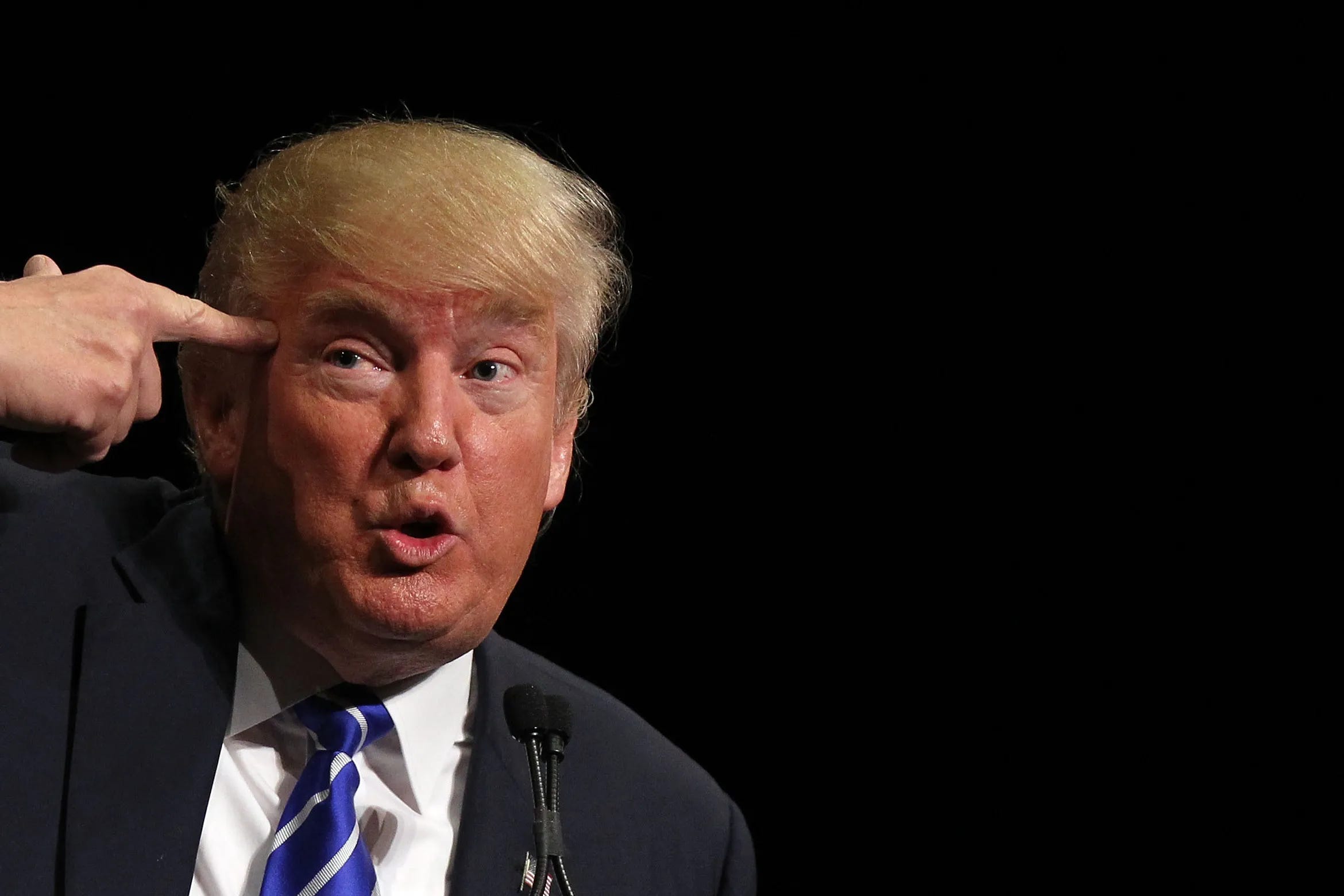
In my earlier essay, The Mirror Cracks, I suggested that Donald Trump is not a glitch in the American operating system but one of its more legible outputs: a lurid condensation of habits that have shaped the industrial era in its American guise – myth-making, extraction, spectacle, racial hierarchy, masculine anxiety. The figure matters less than what he makes visible. He is, in that essay, a cracked mirror in which an entire civilisation can glimpse its own lurid visage
Let’s now step closer to that mirror and ask a more unsettling question. Is there a pattern connecting all of these strands – the fortress fantasies, the evangelical bargain, the masculine wound, the racial stasis, the institutional vandalism, the epistemic fracture, the imperial twilight? And if so, what does that pattern reveal about the psyche of the man and the seduction he exerts on those who rally to him?
Trump may be peculiar, but the forces he rides are not. They are global, even when they speak with a nasal New York accent.
The psychic contract
The pattern I see can be stated with brutal economy: Trump offers a way to feel powerful within a collapsing order without having to change that order. That’s the unspoken contract between Donald Trump and his base. It is, I would suggest, the same contract offered by every demagogue thriving within the exhaustion of the capitalist credo, from Brasilia to Budapest, Canberra to Washington. The names and costumes shift with the local culture but the bargain remains uncannily similar.
In The Mirror Cracks I emphasised three losses: status, narrative, and control. Status loss as the privileges of whiteness, maleness, and being “Western” lose their automatic purchase. Narrative loss as the old stories of providential nations and benign markets disintegrate under the weight of Gaza, Guantánamo, sweatshops, species collapse, and the like. Control loss as work becomes precarious, communities are hollowed out, information splinters, and even the climate ceases to be predictable.
Trump’s peculiar gift is that he regulates himself to those three deficits like a tuning fork vibrating to a struck string. He doesn’t repair the broken instrument. He amplifies the sound and sells tickets to the concert. He does this by translating structural humiliation into personal absolution; systemic failure into a morality play. The villains are endowed with faces: migrants, feminists, “globalists”, Black activists, bureaucrats, public-health officials, queer kids, Palestinians, climate scientists, whichever group currently carries the stigma of spoiling the old story. The system itself—industrial economism in its neoliberal guise—is kept mostly offstage, shielded from too much forensic scrutiny.
In that sense, Trump is the system’s loyal showman. He keeps the machinery running while ensuring the anguish it generates is directed sideways, never upwards.
Truth as territory
In my earlier essay I wrote that Trump’s lies are better understood as theatre than as error. That observation points to a deeper shift: the migration of truth from shared commons to tribal territory.
The industrial paradigm has always required a certain kind of “truth”: quantifiable, instrumental, separable from meaning. That kind of truth built factories and rockets, but it also flattened other ways of knowing. As that paradigm frays, its official truths lose moral authority without entirely disappearing. They become just one story among many, and the ground opens for a new sort of epistemic politics.
What fascinated me in 2016 was that Trump intuited earlier than most that in such a landscape, authenticity would be measured not by empirical correspondence but by emotional resonance. Facts become less important than the feeling that “he speaks like us”. In The Mirror Cracks I deliberately described his rallies as secular revivals. The altar call is to belonging, not information.
The deeper pattern here is that Trump doesn’t merely exploit a fractured information environment; he offers his followers something far more alluring: a defended reality. Within that enclave, contradictions don’t matter. If two claims feel good—say, that the pandemic was exaggerated and also that foreign powers weaponised it—they can coexist without discomfort because their purpose is not to describe the world but to stake out territory within it.
This is why challenges from outside the enclave—journalistic investigations, court rulings, scientific data—simply bounce off. They are felt as incursions, not corrections. The charge of “fake news” is less an empirical claim than a border stone: you are either with us inside this version of reality or you are an invader.
This is no longer a peculiarly American pathology. We see similar enclosures forming around Modi in India, Erdoğan in Turkey, Netanyahu in Israel, assorted populists in Europe, and not a few authoritarian technocrats in Asia. Each builds a reality‑bubble defined not by evidence but by loyalty. Inside, doubt is taboo. Outside, facts are negotiable.
The masculine shell
In The Mirror Cracks I explored Trump’s crude gender theatrics: the brags about conquest, the contempt for weakness, the obsession with being seen as strong. It would be easy to dismiss this as undignified pantomime, a late‑night comedian’s dream. But in the industrial world, especially in its Anglo‑American variant, a specific kind of masculinity has served as the nervous system of the entire paradigm.
For generations, men were valued for their physical strength, command over dependants, and breadwinner status. Industrial economism exploited those traits while gradually making them redundant. As manufacturing moved offshore or into machines, as care work remained feminised and underpaid, as women and queer people asserted rights, a great many men found themselves called to perform a role the system no longer actually needed.
The result is a masculinity unmoored from function yet still loaded with expectation. One can see this, not just in the American Rust Belt, but in the bitter young men on social media who blame women, migrants, or minorities for their thwarted dreams; in the online “manosphere” that idolises strongmen and preaches contempt for vulnerability; in the cultish followings of figures who promise a return to male supremacy wrapped as self‑help.
Trump’s performance of masculinity speaks directly to that wound. His lechery, documented allegations of assault, and off‑the-cuff cruelty and derision become, for some, credentials rather than disqualifications. Each time he transgresses a norm and pays no cost, he enacts a revenge fantasy: this is what it feels like not to be scolded, not to apologise, not to submit to a world that keeps telling you you’re obsolete or toxic.
Here the fortress fantasy I wrote about in relation to borders reveals its deeper, intimate form. It is not only America that is to be walled off from “contamination”. It is the male self. Empathy, doubt, interdependence are recast as breaches to be sealed. Weapons proliferate, not only as tools but as talismans. The body of Trump himself—aging, medically compromised, yet insistently framed as vigorous—becomes a symbol of this refusal to acknowledge fragility.
We should not imagine this is confined to American men in red caps. The same brittle masculinity can be found in private security cultures in Johannesburg, among Russian mercenary formations, in Brazilian militias, and in the male‑supremacist online worlds now reaching teenagers from West Asia to East Asia. The demagogue does not invent this wound. He harvests it. He tells those men: you do not have to grow up; you can double down.
Sacred innocence and the hunger to punish
In The Mirror Cracks I puzzled over the evangelical bargain: how could a movement ostensibly founded on the Sermon on the Mount ally itself to a man whose life contradicts most of its explicit teachings? The answer, I suggested, lies in the transformation of religion into culture war. “Christian” no longer primarily means a demanding spiritual path. It names a tribe, and behind that tribe sits a claim: that we are the rightful custodians of moral order.
This, too, is not uniquely American. When Hindu nationalism fuses temple with flag in India, when Buddhist monks in Myanmar incite violence against Rohingya, when political Islam is merged with authoritarian states from Ankara to Riyadh, the pattern is similar. A faith that once carried universalist aspirations is recoded as an ethno‑cultural badge. Spiritual teachings that might soften the ego are subordinated to a politics that inflames it.
In that configuration, Trump—or his equivalents elsewhere—serves less as a saint than as an avenger. He is absolved from personal piety so long as he promises to defend “our way of life” against encroachment. That encroachment might be imagined as secularism, feminism, Islam, globalization, or merely the prospect that one’s children might not share one’s certainties.
What excites loyalty in this arrangement is not love but resentment. The leader names enemies and vows to hurt them. Clinics providing abortions. Teachers recounting colonial atrocities. Trans kids. Human-rights lawyers. Palestinian families. Environmental defenders. Anyone whose very existence calls into question the old story of innocence.
From the vantage point of Bangkok, where I now live, the American evangelical fervour around Trump looks increasingly like a local variant of a broader phenomenon: religious symbols repurposed to ratify a politics of punitive nostalgia. In each case, a sacred vocabulary that could have been used to confess complicity, to heal fractures, to imagine new forms of coexistence, is conscripted instead to deny guilt and sacralise revenge. This is not spirituality of course. It is sacramentalised denial.
Race, caste, and the refusal of history
In the earlier essay I called race the oldest unresolved question in the American experiment. That question has its cousins: caste in India, indigeneity in Australia, the displaced Romani in Europe, Palestinians in Gaza and the West Bank, Indigenous peoples across the Americas and Southeast Asia – and, more ambiguously, the long, precarious history of Jews in Christian Europe and its settler offshoots. In each case, an order was built on a foundational exclusion or subordination, then elaborated with laws, myths and habits.
Trump’s racial politics—birtherism, defence of Confederate symbols, “shithole countries” rhetoric, fear‑mongering about migrants—did not create that order. They made it explicit. If Barack Obama’s election briefly suggested that the United States might be outgrowing its original sin, Trump’s ascent was a reminder that such sins are not exorcised by symbolism alone.
The industrial paradigm has its own racial DNA. It emerged in European empires that ranked humans by supposed civilisation or biology, and it extended across continents through slave labour, land theft and extractive concessions. Some of that architecture has been revised; little of it has been dismantled. White Americans are not the only ones who sense that a deeper reckoning is overdue and are frightened by what it might entail.
This fear is rarely articulated as fear of justice. It’s spoken through other anxieties: about crime, about “illegals”, about “special treatment”, about “reverse racism”, about “globalists” giving the country away. It also shows up, more genteelly, in the fatigue many comfortable people express at being “made to feel guilty” by history. The demagogue hears that fatigue and offers a balm: you owe nothing; you were always the hero; they are ungrateful.
We saw a glimpse of another possibility after George Floyd’s murder, when multiracial crowds gathered in Minneapolis, London, Sydney, Cape Town, and Seoul to insist that Black lives matter, that history must be told in full. That glimpse, in the US at least, was rapidly met with a counter‑movement of “law and order”, curriculum bans, and “anti‑woke” crusades. Trumpism, even when he was out of office, surged through that backlash like an old river finding a newly cleared channel.
Wherever deep historical injuries are being raised to the surface—from Bandung to Birmingham, from the Amazon to Arnhem Land—there’s the same bifurcation. One path says: let us face what was done and is still being done, so that we can imagine a future not built on this pain. The other path says: enough; the past is past; your insistence on remembering is the real hindrance. The Trumps of the world are avatars of that second path. They offer, yet again, innocence without transformation.
Institutions as theatre
In The Mirror Cracks I described the way Trump has treated American institutions as optional scenery rather than serious constraints. Tax disclosures, conflict‑of‑interest norms, the firewall between justice and politics, the expectation that a losing candidate accepts defeat graciously: these were never hard rules in a legal sense, only shared assumptions.
Once someone sufficiently shameless is willing to ignore them, they dissolve like chalk in water. Even the constitutional limit of two presidential terms has been pulled into this theatre. The 22nd Amendment is, on paper, one of the firmest guardrails in the American system, yet Trump’s repeated asides about a third term – half‑jokes at rallies, speculative musings in interviews, knowing smiles when supporters chant “twelve more years” – function as a stress test. He is less outlining a realistic plan than probing the audience for signs that they would accept the idea that popular adoration cancels formal limits. The norm he is eroding is not yet the amendment itself but the shared instinct that such a prospect is unthinkable.
This unmasking of institutional fragility is not unique to the US. We can see similar erosions in the British government’s disregard for its own constitutional conventions, in Poland’s and Hungary’s capture of courts and media, in military coups festooned with legalistic justifications in Thailand, Myanmar and Africa. The habit of counting on “responsible adults” in suits to restrain the worst impulses of power is wearing thin.
What is peculiarly instructive in the Trump case is the transition from spectacle to machinery. In the early phase, his rule was chaotic, brash, performative, dependent on a mix of tweets and tantrums. But as I noted in the earlier essay, his second term began with a sheaf of executive orders and a more disciplined effort to re‑engineer the state: reclassifying civil servants as at‑will employees under “Schedule F”, subordinating nominally independent regulators to direct White House control, attempting to dismantle agencies like the Department of Education and USAID, and using federal contracts and security clearances as levers to punish critics.
This move from improvisation to blueprint is echoed in other countries where first‑wave populists have given way to second‑wave technocrats of illiberalism. The style remains populist; the practice becomes increasingly bureaucratic. We should be wary of assuming that authoritarianism always wears a clown’s mask. In many contexts it now speaks fluent legalese.
The psyche of the industrial paradigm
Up to this point, I have written as though Trump’s psyche is the principal object of study. That’s a useful fiction, but it’s not the whole story. What interests me much more is the mentality of the paradigm that produced him.
Industrial economism, as I have described elsewhere, is not simply an economic arrangement. It is a world‑story about what is real and worthwhile. That story exalts competition, extraction, control, endless growth and accumulation, and the heroic individual. It treats the more‑than‑human world as resource, other cultures as markets or threats, and human beings themselves as units of labour, consumption or “talent”.
For a while, and particularly after 1945, this story was able to present itself as progress. Life expectancy rose in many places; diseases were tamed; comforts multiplied. But as we move deeper into the twenty‑first century, its shadow side engulfs the stage: climate disruption, mass extinction, obscene inequality, loneliness, the anxiety of youth, wars on the poor dressed up as wars on drugs or terror, digital technologies that intensify surveillance and disinformation as enthusiastically as they improve medicine.
Trump is, in this sense, industrial economism in human form. His business history is one long fable of leveraged extraction and abandonment. His politics do the same to institutions, norms, even personal relationships. He takes trust, bleeds it, and leaves others to mop up.
That’s why his promise resonates so strongly with those who feel betrayed by the system yet cannot imagine any alternative. He offers them the thrill of rebellion while keeping them safely tethered to the precise order that’s chewing through their lives. He says: you’re not the problem. The problem is those people over there. Together we will teach them a lesson.
The Court of Davos
In The Mirror Cracks I described Trump as the loyal showman of industrial economism – the carnival barker for a civilisation that cannot bring itself to acknowledge its exhaustion. Nowhere is that dissonance more obvious than in a hall full of financiers, central bankers, CEOs and ministers who fly to the Swiss Alps each year to reassure one another that the machine can still be tuned, that “stakeholder capitalism” will be kinder than its older, brasher sibling, that a little more ESG here and a sprinkling of philanthropy there will suffice to keep things on an even keel.
Trump’s recent ninety minutes on the WEF stage – rambling, repetitious, peppered with boasts and half‑remembered grievances – was widely reported as an embarrassment: a man out of his depth among the grown‑ups. Camera shots of stone‑faced technocrats, the studied politeness of moderators, the awkward chuckles at his more egregious claims, have already been replayed to exhaustion.
But if we stay only with that reading we miss a far deeper irony. The disjointed monologue, looping back to his own greatness, skipping over the planetary emergencies the forum pretends to address, was not an interruption of the underlying story Davos tells itself. It was its unconscious handed a microphone.
For half a century the WEF has offered industrial civilisation a comforting script: globalisation can be managed; growth can be green; the winners can be persuaded to care for the losers; markets can be gently steered toward the common good. The language is smoother than Trump’s, the syntax less fractured, but the underlying premise remains identically anthropocentric and extractive: we will go on, accumulating and controlling, and the earth – and those at the margins – will adapt.
Trump simply spoke that logic without the pretence of refinement. Where they propose “public–private partnerships”, he demands deals. Where they rehearse concern for inequality, he relishes the spectacle of winners and losers. Where they claim to be data‑driven, he insists that reality be adjusted to his feelings. No wonder the room was uncomfortable. It was like watching a family dinner where the least inhibited uncle blurts out what everyone has silently arranged not to say.
From the vantage point of the extended thesis I’m writing here, the Davos performance becomes a minor but telling tableau of the psychic contract I sketched earlier. On stage: a man whose entire politics consists in offering his followers the feeling of power inside a system he has no intention of changing. In the audience: the high priests of that very system, momentarily confronted with a caricature of their own credo – growth without limits, power without accountability, reality as something to be managed by those who can afford the ticket.
The polite frostiness of the crowd, the media’s eager portrayal of the session as an outlier, help maintain a necessary illusion: that Trump is an aberration intruding into an otherwise rational conversation. Yet the spectacle only makes sense if we understand that the WEF itself is one of the principal theatres in which industrial economism rehearses its continued dominance. In that sense, the encounter was not between reason and madness, but between two dialects of the same language.
Dangers unseen and unheard
Observers more eloquent than I have catalogued the obvious dangers of such a figure: attacks on minorities, erosion of democratic rituals, casual flirtation with political violence. It’s not my habit to rehearse what can be found in any decent newspaper. The more subtle dangers are quieter and, I suspect, more enduring.
One of these is the institutionalisation of Trumpism without Trump. In the United States this takes the form of a cadre of trained loyalists prepared to occupy civil‑service posts, a national network of state‑level experiments in illiberal governance, and a legal movement testing doctrines that would entrench executive domination. Elsewhere we see similar patterns: legislatures hollowed out into rubber stamps, public broadcasters captured, judges appointed for their pliability, security services encouraged to see dissent as treason.
Once such an apparatus exists, it no longer requires a showman at the top. A duller, more disciplined figure can inherit it and apply it with far greater efficiency. The mirror may crack further; the machinery will grind on.
A second danger, which I touched on briefly in the first essay under the heading of the “epistemological break”, is the medicalisation of dissent. When Minnesota politicians floated the idea of diagnosing “Trump Derangement Syndrome” as a form of mental illness, it was treated by many as a joke. It should not be. The impulse to pathologise opposition—to say that those who cannot accept the leader must be neurotic or brainwashed—is an old reflex of autocracies.
We see early hints of similar gestures around climate grief, racial guilt, or even empathy for distant suffering. Instead of asking what these emotional responses might be telling us about structural violence, the temptation is to reduce them to private pathologies to be medicated or mocked. Authoritarianism then arrives not only in jackboots but in white coats and wellness slogans: be calm; trust the system; your agitation is the problem.
A third danger is that as populist contempt for “experts” intensifies, a mirror arrogance arises among some technocrats. I see this in the corridors of global institutions and think‑tanks: the belief that the public is too irrational, too inflamed, to be trusted; that democracy must be “managed” from above, perhaps quietly curbed in the name of stability. This coarsening of mutual distrust between governed and governing feeds a vicious circle. Each camp confirms the other’s worst stereotype.
A fourth danger is what I would call psycho‑social extraction. As the ecological frontier closes and cheap resources run short, extraction doesn’t stop. It changes form. Instead of grabbing minerals and forests in distant lands, the industrial mindset learns to mine attention, identity and divergence within its own populations. Social media platforms, outrage merchants, partisan media, and some “movements” themselves discover that indignation is profitable. They cultivate continuous crisis because calm does not pay.
Trump is a pioneer in this domestic extraction. He has shown how a politician can devour grievance and attention, not as a means to a policy purpose but as an end in itself. The more agitated his opponents and supporters become, the richer the data streams and the firmer his hold. This pattern is now being replicated across the political spectrum and around the world. The common resource being depleted is not oil or soil; it is trust.
The seductive promise
What, then, does all this tell us about the psyche of Trump and of those who cling to him like limpets to the hull of a listing vessel?
Trump himself—judging purely from public behaviour, court records, and lengthy observation—appears as a man whose grandiosity floats over a fathomless dread of humiliation. He cannot admit error, cannot bear loss, cannot share credit. Reality for him seems negotiable, so long as enough acolytes agree to shout with him. People appear as instruments or obstacles, never as equals. In that sense he is the purest child of the paradigm that birthed him.
His supporters are not a monolithic class. Among them are billionaires seeking deregulation, white supremacists craving racial hierarchy, and religious nationalists wanting their scriptures to carry the force of law. But millions more are far less calculating. They are simply exhausted. They feel dismissed by cosmopolitan elites, betrayed by employers, mocked by their own children’s values, frightened by rapid cultural and technological change. They know, in their bones, that something is failing. They are correct.
What Trump offers them is not a programme but a feeling: the feeling of being central again in a story where they had been marginalised. He tells them they are the real people, the backbone, the salt of the Earth. He tells them that their discomfort with change is wisdom, not bigotry; that their anger is righteousness, not resentment; that their suspicion of the future is prudence, not fear.
Above all, he offers them absolution. They can remain as they are and still count as virtuous. They do not have to examine their own complicity in the structures that hurt them; they don’t have to wean themselves off fossilised privileges; they don’t have to face the ecological and historical debts piling up in their name. All that’s required is loyalty; loyalty to the man and enmity toward his enemies.
This, in the end, is the most dangerous aspect of the Trump phenomenon and of its cousins worldwide. It doesn’t simply threaten particular policies or institutions. It offers an entire civilisation a way to dodge the moment of truth.
The mirror, the crack, and the invitation
I ended The Mirror Cracks with a warning: that to treat Trump as the problem is to miss the point. He’s not a cursed angel fallen from the sky. He’s a symptom, a sign, and an exaggerated cartoon of our own avoidance.
The cracked mirror still reflects. In it we see not only an aging showman with a failing circulatory system and an exceptional gift for turning scandal into oxygen. We see a paradigm that cannot imagine limits, a masculinity that cannot imagine tenderness without shame, a religiosity that cannot imagine repentance without loss of status, a whiteness (and its analogues elsewhere) that cannot imagine equality without annihilation, an institutional order that cannot imagine legitimacy without control, an information ecology that cannot imagine engagement without outrage.
The pattern that connects all of these is not American. It is industrial. Trump is simply one of its more lurid emissaries.
If there’s another way, it will not be found in swapping one strongman for a gentler face while leaving the underlying story untouched. Nor will it be found in retreating into gated communities of the mind, where “our side” is always right and “their side” is always deranged.
It will begin, if it begins at all, with a more terrifying prospect: relinquishing the convention and ceremony of innocence. Owning the harms done in our name. Admitting our entanglement in the same systems we oppose. Allowing grief, fear, and shame to be felt rather than displaced onto scapegoats. And then, from that less glamorous place, cultivating forms of collective leadership that don’t require a saviour at all.
Although I advocate an ecological civilisation, I am unsure whether such a model can be grown on the ruins of industrial economism. What seems clear is that men like Trump will keep stepping forward to offer an easier path: one in which nothing fundamental need change, and all discomfort can be blamed on enemies.
The more desperate the industrial paradigm becomes to preserve itself, the more seductive that offer will sound. The mirror remains cracked. The shards of glass have come loose. How we respond to what that shows us will say more about our species than any election ever could.