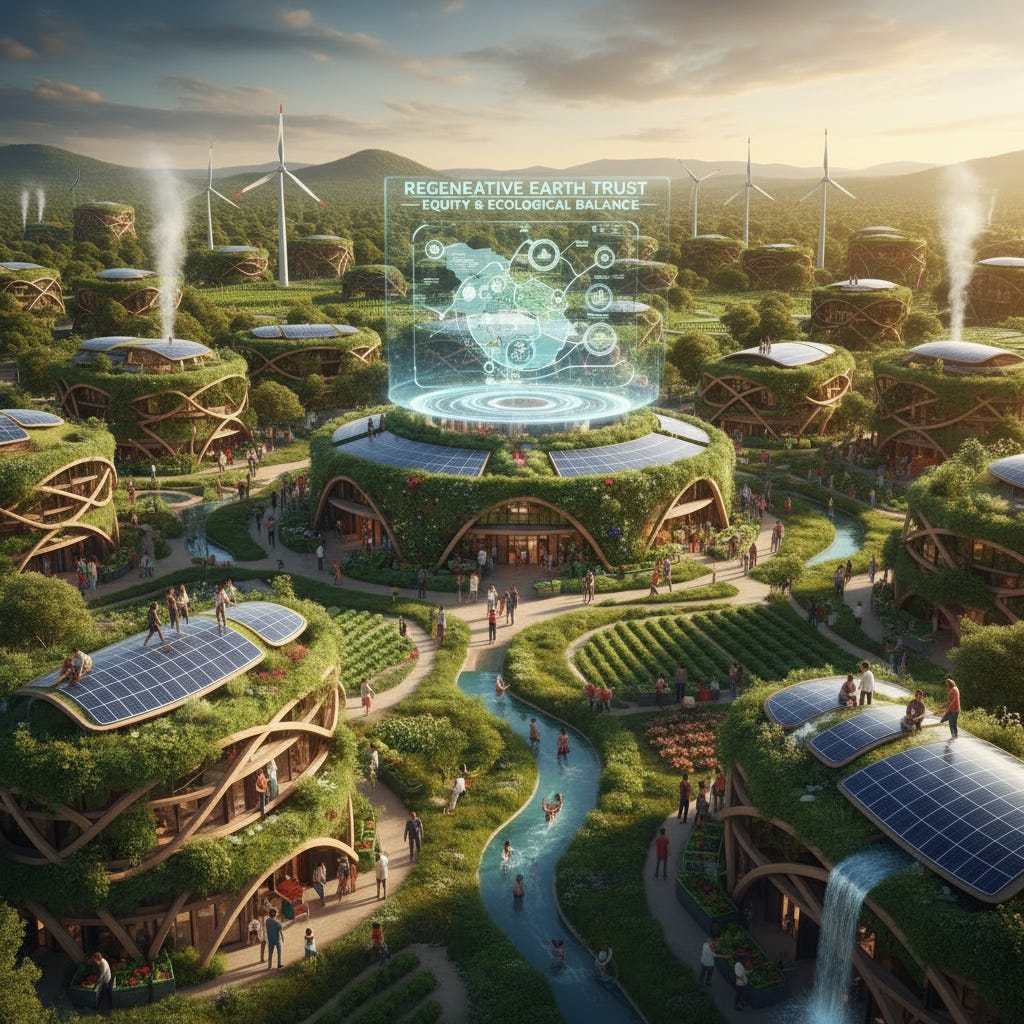
Across the extended arc of our history, from the river-valley settlements to today’s hyperconnected networks, societies have advanced by trial and fracture. Genres that once seemed unassailable—empires, monarchies, command economies—collapsed when their internal contradictions outgrew their capacity to reorganise. Capitalism, born of industrial upheaval, belongs to this same lineage: an invention of extraordinary power now straining against limits it helped create.
Its achievements must be acknowledged. In its restless drive, capitalism catalysed astonishing technologies and opened pathways for millions to escape deprivation. Trade, finance, and industry bound continents in webs of exchange that expanded the horizon of possibility. For a time, this looked like an enduring triumph. We should have known better. History is never static. The logic of perpetual growth—once a catalyst—has hardened into pathology. What began as an engine of ascent has become a machine of exhaustion: of justice, of ecology, and of trust.
From the beginning, there were shadows. Europe’s golden age drew on mercantile plunder, colonial extraction, and slavery—facts often airbrushed by the myth of pure enterprise. Periodic crises punctuated the ascension: the Great Depression, the oil shocks of the 1970s, the 2008 financial convulsion. Each rupture revealed volatility not as a bug but as code. Today’s ecological breakdown, spiralling inequalities, and democratic malaise are just the latest expressions of a centuries-long pattern.
Extraction remains the defining art. Productivity rises, wages stall, communities are hollowed while profits crest at all-time records. Wealth concentrates into dynasties; opportunity calcifies at the bottom. In the United States, the top one percent controls a vast share of wealth; globally, billionaire fortunes swell while millions sink into precarity. This is not mere cyclicality. It is structural concentration, reinforced by tax arbitrage, financialisation, and deliberate policy design.
And concentrated wealth does not sit idle, even when it's hoarded. It converts into power, bending democratic institutions toward private ends: legislation shaped by lobbying, regulators captured by the regulated, elections tilted by moneyed gravity. A society that claims to defend freedom delivers instead its darker doppelgänger. Workers bound to stagnant wages labour out of necessity, not choice. Debt scripting life in advance, rationing education, healthcare, mobility and shelter. Surveillance capitalism weaponises attention, converting our desires into data and then into behavioural nudges. Autonomy contracts into a manipulated menu of options.
Meanwhile, Earth pays a bill it can no longer absorb. Forests are cleared at industrial scale. Oceans choke on effluent and plastic. Carbon overload is upsetting a climate that was stable for all of recorded human history. Species are becoing extinct at rates hundreds of times higher than the natural baseline. These are not ill-fated externalities; they are the predictable outputs of an operating system that commodifies life and treats nature's limits as negotiable.
The injustice is global. Those least responsible for greenhouse gas emissions bear the brunt. Smallholders in the Sahel endure droughts they didn't cause. Pacific islanders face encroaching seas for which they are not to blame. Indigenous peoples—stewards of intact ecosystems for thousands of years—are displaced by the very industries that erode planetary stability. The legacy of colonial extraction reverberates through ecological imbalance: wealth amassed in one place at the cost of depletion in another.
Equally corrosive is the tyranny of inane measures. Gross Domestic Product tallies throughput, not wellbeing. Wars, oil spills, crime, environmental degradation and epidemics can swell the figure. Fossil subsidies fatten profit ledgers while hiding planetary costs. GDP asks nothing of nourishment, security, connection, dignity, or ecological integrity; it records speed, not direction. Beneath the metric lies a far deeper and more alarming distortion: the reduction of people to cogs in the machinery of production and consumption. This is alienation at civilisational scale.
Defenders of capitalism counter that it remains the most adaptive driver of innovation, that its variants—from Nordic social democracy to East Asian developmentalism—prove reform is possible. And they are partly right: institutional design matters. But adaptation has not cured core pathologies; indeed it has often shifted or outsourced them. State-socialist and pre-capitalist systems had their own records of inequality and environmental harm—human frailties are not unique to markets. Yet today’s crisis is historically distinct: a planetary overshoot that no prior order had the power to trigger. The issue we're grappling with is not whether “human nature” is selfish or altruistic; it's whether our institutions harness self-interest toward stewardship rather than depletion.
Technology and globalism amplify these dynamics. Automation boosts productivity while decoupling it from wages; digital platforms enable surveillance rents; global supply chains arbitrage labour and environmental standards. These are not separate from capitalism but accelerants of its incentives. Our task is not to renounce technology or commerce but to steer them more ethically: open standards over data enclosure; labour and climate floors in trade; public-interest algorithms rather than attention-maximising extractivism.
The goal should not be to abolish all markets but to subordinate them to principles beyond compromise: ecological thresholds, human dignity, intergenerational justice, and democratic accountability. Kate Raworth's model of Doughnut Economics sketches a safe and just space between deprivation and overshoot. Wellbeing budgets in places like New Zealand and city-level planning in Amsterdam demonstrate that alternatives can live within—and begin to reshape—market societies. Cooperatives in Emilia-Romagna, employee-owned firms like Spain’s Mondragón, and solidarity finance networks in Latin America show how ownership can be democratised and wealth kept rooted in communities. Community-controlled renewable projects in Denmark and Germany reveal that energy systems can distribute power rather than centralise it, creating citizens as co-owners of the energy transition and not just passive consumers.
But how does transition happen against entrenched resistance? Not by rhetoric that's for sure. At the very least it requires a theory of change that braids democratic mobilisation, institutional redesign, and incentive realignment.
Political power must once again be reclaimed from the shadows where money holds sway. This begins with mass membership organisations: the revitalised trade unions of Europe’s Green New Deal for Europe campaign, or the community assemblies that powered Chile’s recent constitutional debates. Power-building depends on solidarity across divides: the formation of climate-labor coalitions like Germany’s “Unions for Future,” which link decarbonisation not with job losses but with dignified work and wage security. It also requires new democratic ground rules. Ranked-choice voting in Maine, proportional systems in Scandinavia, and experiments in citizens’ assemblies in Ireland show how politics can evolve toward more representative and less easily captured systems.
Rules, once rewritten, alter the DNA of economies. Enshrining carbon budgets into law—as the UK’s Climate Change Act has attempted—provides a binding constraint that neither markets nor lobbying can easily erode. Biodiversity laws, like Costa Rica’s pioneering payments for ecosystem services, prove that living systems can be written into financial architecture. Antitrust enforcement, long ignored, is resurfacing in the European Union’s Digital Markets Act and the US lawsuits against corporate behemoths—embryonic but significant moves to decentralise power. Redefining fiduciary duty, as experiments in France’s “Entreprises à Mission” framework illustrate, acknowledges that firms must serve a plurality of stakeholders, not shareholders alone.
Public investment, too, is not theoretical; it's already underway. South Korea’s Green New Deal directs billions into renewable infrastructure and ecosystem restoration. Germany’s KfW Bank, a mission-driven public lender, guides capital flows toward clean energy and efficiency. In India, state-run railways are greening the largest transport system in the world. Universal basic services are no longer utopian slogans—Scotland is piloting free public transport, Barcelona has pioneered housing cooperatives linked with municipal support, Estonia provides universal broadband as a civil right. Each experiment demonstrates that the line between public provision and private capture is neither natural nor immovable.
Finance, the nervous system of extractive capitalism, can also be restructured. Wealth taxation, once considered out of bounds, is returning to the political agenda—from Argentina’s one-off solidarity tax on billionaire fortunes to debates in the US and Germany on inheritance and wealth levies. Job guarantee proposals, tested in pilots such as India’s MGNREGA scheme (the world’s largest public works program), show how governments can provide both income security and ecological repair in one stroke. Central banks are beginning—though hesitantly—to explore climate alignment: the European Central Bank now links bond purchases with sustainability metrics, while South Africa is designing Just Transition funds to support coal workers. Each fragment is a glimpse of financial plumbing that could one day be reconfigured at scale.
Trade and supply chains are also shifting. The EU’s Carbon Border Adjustment Mechanism demonstrates that carbon costs can be embedded in international trade, nudging exporters toward decarbonisation. The International Labour Organisation’s conventions offer a framework for enforceable labour rights that could be tied to trade deals; some Latin American countries have begun experimenting with exactly this. Meanwhile, movements for food sovereignty—from Brazil’s MST growing agroecology cooperatives across millions of hectares to urban farming networks in Detroit—illustrate how global supply chains can be complemented by resilient local provisioning.
Even consumer responsibility looks different when coupled with enabling structures. In Finland, deposit-return schemes for bottles and cans achieve recycling rates above 90 percent because infrastructure aligns with individual values. In Japan, the “Mottainai” ethic—backed by design-for-repair regulation and community collection—turns waste into resource. In Seoul, government subsidies for electric carsharing have shifted mobility norms rapidly toward low-emission transport. Personal choice always matters most when embedded in collective provision.
Measurement provides the feedback loops of transformation. The Wellbeing Economy Governments (WEGo) alliance—Scotland, Iceland, New Zealand, Finland, Wales—is already building national dashboards that privilege trust, ecological integrity, and equity over GDP. The UN’s System of Environmental-Economic Accounting now provides global standards for nature-adjusted accounts. Ecuador’s constitution famously enshrined the rights of nature itself, creating jurisprudence that has been invoked in protecting rivers and forests. Once dashboards and legal frames change, the imagination of what progress looks like changes with them.
Resistance will be fierce and quite possibly manipulative. Fossil lobbies will defend every subsidy; digital giants will resist every interoperability rule; financiers will obscure every loophole. Yet cracks widen every year. Fridays for Future shows youth refusing inherited scripts. The revival of organised labour—whether Amazon warehouse workers in the US or gig drivers in Indonesia—signals an awakening of class power. Porto Alegre institutionalised participatory budgeting, giving citizens direct sway over billions; the model has since spread worldwide. Paris is pioneering community land trusts to shield housing from speculation. Even finance is stirred: Norway’s sovereign wealth fund divests from coal, New Zealand’s government pension fund adopts nature-positive strategies, and shareholder revolts pressure oil majors to align with science. These are not outliers but harbingers of a new norm.
From here the path is plain, if arduous. Monopolies—industrial, financial, and digital—must be dismantled before they metastasise into empires immune to control. The EU’s insistence on data portability is one step toward turning corporate choke points into digital commons. Corporate purpose must be codetermined, as in Germany’s co-determination laws where workers occupy board seats; executive rewards must be tied to climate compliance, wage equity, and safety rather than short-term stock movements. Limited liability must be withdrawn from corporations that knowingly devastate ecological systems. Wealth must be circulated anew: Spain debates inheritance caps; Alaska’s Permanent Fund shows that resource wealth can be distributed universally; Singapore’s Temasek demonstrates how public wealth funds can invest with the long view uppermost in mind. Capital flows themselves must be reversed: the hundreds of billions now shielding fossil industries must be phased out, their public finance redirected into grid modernisation, battery storage, regenerative agriculture, watershed restoration, and adaptation for the most vulnerable. And GDP must finally be knocked off its illegitimate pedestal: life expectancy, child poverty, emissions footprints, human trafficking, housing affordability, biodiversity indices, social trust, and time sovereignty for example must become the true traces of prosperity.
History offers an unforgiving analogy. Previous systems collapsed under political or economic contradictions. Ours faces a contradiction that's planetary in scale. Capitalism wrote itself into modernity’s architecture; now, untended, it is erasing the living foundations of any conceivable future. Change will come—by hook or by crook. Meanwhile paradoxes sharpen our choice. Rockets pierce the stratosphere while millions still lack clean water. Stock markets soar even as wetlands disappear and arine life dwindles. Biopharma patents multiply while basic medicines remain scarce. Artificial intelligence accelerates at breakneck pace while care workers languish. These juxtapositions are no accident; they are the signature of a civilisation split from what sustains it.
And yet, as I have always pointed out in my writing, the tools of renewal are within easy reach. We have the frameworks, the policies, the pilots, the prototypes. We have countless communities already living fragments of the future: solar villages in Bangladesh, agroecological networks across Africa, cooperative digital platforms in Europe, zero-waste cities in Japan. There's so much happening that's good. The missing ingredient is obviosly not knowledge but courage—the courage to confront power, to resist delay, to rewrite incentives and institutions.
The future is never decided by change per se but by our willingness to steer it. If we shrink back, collapse will write the script of history. If we act, building coalitions, rewriting rules, investing in the commons, we can move beyond the breaking point toward an economy that safeguards life while widening human possibility: an order where prosperity resonates not against, but with, the living pulse of huanity on Earth.