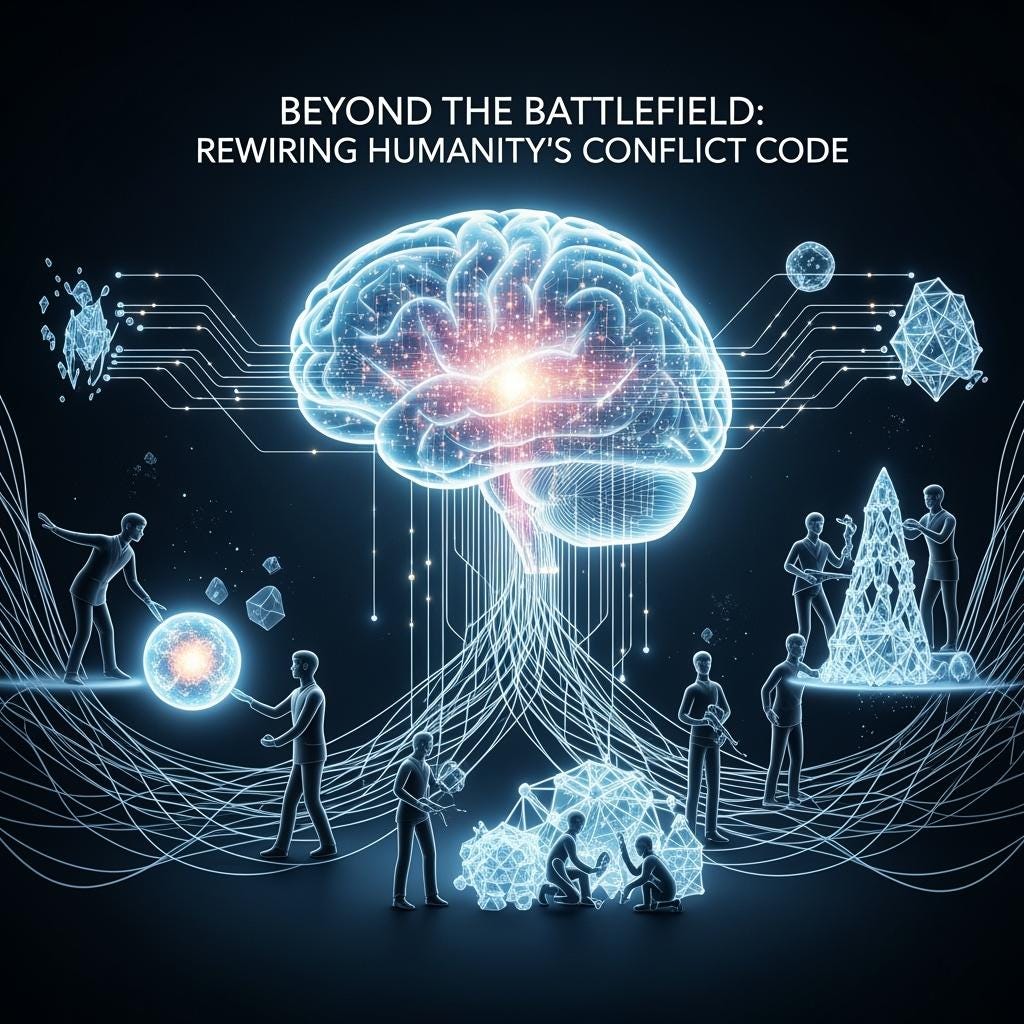
The echo of artillery fades long before the internal detonations cease. For most soldiers returning from combat, the battlefield is not just a geographical location left behind; it's a psychological nightmare etched permanently into the neural pathways of young people who will never again live a normal life. Their minds become a sequence of atrocities that once seen cannot be unseen, intolerable choices enacted, and the final crushing weight of moral injury.
Echoing across nations and conflicts the statistics are remarkably steady: elevated rates of PTSD, clinical depression, anxiety and suicide among veterans. These are not abstract numbers; they are shattered lives, fractured families, and a profound indictment of warfare’s enduring, hidden cost.
Because of my recent interaction with a group of deserters from the Israel Defence Forces I have become particularly attuned to the haunting nature of their dilemma. Recent reports of surging suicides in the IDF come as no shock; they scream a terrible, unflinching warning of the soul-crushing psychological toll on soldiers dispatched to kill; young lives trapped between blind tribal allegiance and the unspeakable horror of extinguishing another human life.
This is a universal tragedy demanding solutions far beyond the standard palliative care and reactive mental health services. We owe it to the millions of young people who sacrificed their lives in successive wars so that we could live in peace. We repeat such mantras every Armistice Day; but they ring hollow if the toll of young lives continues to mount.
To truly end war, we must confront this core human devastation and design systems that prevent the infliction of such soul-scarring trauma in the first place. This requires moving beyond incremental adjustments to our existing paradigm. It demands a radical reimagining of human interaction, leveraging emerging possibilities to rewire the very foundations of conflict.
The "standard playbook" – diplomacy, economic interdependence, peace education, arms control – offers some basic scaffolding. But scaffolding alone cannot build a new structure. These tools often operate on the surface, addressing symptoms while leaving the deep cognitive and emotional drivers of violence largely untouched. To heal the soldier's soul, we must prevent the wounding. We must create a multi-layered architecture against the futility of war.
Diplomatic Empathy: From Negotiation Tables to Neural Bridges
Traditional diplomacy operates on the assumption that rational actors can navigate complex interests through cautious negotiation and compromise. Yet hoped-for rationality often crumbles under the scorching heat of historical grievance and perceived existential threat, where centuries of accumulated trauma predictably override logical discourse. What we desperately need is diplomacy that sidesteps these entrenched narratives entirely, reaching instead into the visceral substrate of shared human experience where empathy lives below the level of ideology.
Let's consider a radical departure from conventional peace talks: supplementing Track II dialogues and UN-mediated negotiations with what might be called neurotechnological empathy engineering. This isn't some dystopian vision of mind control, but rather facilitated, voluntary immersion into the lived experience of the "other." Through non-invasive brain-computer interfaces or carefully supervised psychedelic-assisted therapy conducted within secure "Empathy Summits" key stakeholders could literally experience simulated perspectives that transcend intellectual understanding.
Imagine an Israeli negotiator who, through immersive virtual reality coupled with sophisticated biofeedback systems, doesn't merely grasp Palestinian displacement in abstract terms but neurologically registers the simulated panic of watching bulldozers approach their home, feeling the despair etched in a child's eyes as their world crumbles. Conversely, a Palestinian leader might viscerally experience the primal terror of rocket sirens wailing across Tel Aviv, carrying the accumulated weight of generations who have lived under constant threat. This profound intervention isn't designed to erase legitimate political claims or historical grievances, but rather to forge neural pathways of mutual recognition that transcend the often absurdly infantile nature of political rhetoric.
These pre-negotiation neuro-empathy sessions could become as standard and essential as traditional briefings, fundamentally altering the neurological landscape upon which subsequent discussions unfold. Advanced AI simulations, enhanced by quantum probability models, could then project the cascading psychological toll flowing from various negotiation failures or escalations, quantifying the predicted rates of PTSD, moral injury, and suicide with brutal mathematical precision. When diplomats can see exactly how many minds will shatter from their policy choices, the human cost becomes impossible to dismiss as acceptable collateral damage.
In the Israeli-Palestinian context, neutral "Neuro-Peace Labs" established in Cyprus or Jordan could host not only political rulers but influential community figures whose voices shape public opinion. These curated sessions wouldn't replace traditional political negotiation, but would prepare the neural groundwork for meaningful dialogue by reducing the reflexive dehumanisation that fuels conflict cycles. Most crucially, anonymised aggregate data on soldier mental well-being could feed directly back into negotiation incentives, creating tangible links between policy choices and the psychological burden carried by those ordered to implement them on the ground.
PeaceQuest: Education's Global Horizon: From History Lessons to Planetary Identity
Peace education has long focused on developing conflict resolution skills and fostering historical empathy, approaches that remain valuable yet fundamentally limited. These efforts often operate within the very paradigm of territorial and resource competition they seek to overcome, essentially teaching students to be more civilized competitors rather than transcending competition altogether. To truly redirect the aggressive impulses that fuel warfare, we need educational narratives of such compelling scale and purpose that they sublimate tribal instincts into something far grander.
This is where PeaceQuest offers transformative potential. Education must evolve beyond the narrow confines of national histories to encompass "Planetary Stewardship" curricula that involve a profound understanding of humanity's place and potential within our interconnected, fragile planet, where our petty territorial squabbles appear laughably insignificant against shared global threats like climate crises and resource depletion.
Armies would become incubators for species-level identity formation, where soldiers engage in sophisticated simulations and practical projects that challenge them to collaboratively manage crises, navigate global resource dilemmas requiring absolute cooperation, or solve complex infrastructure problems whose solutions demand transcending terrestrial divisions. These aren't just simulations or national projects; they're neural training grounds for collaborative survival on a planetary scale, rewiring military minds to see cooperation as the default rather than an idealistic aspiration.
For veterans and active soldiers grappling with moral injury—that devastating dissonance between their actions and core values—this framework offers profound rehabilitation possibilities. Military skills like discipline, logistics expertise, engineering capability, and real-time teamwork represent invaluable assets for humanity's grandest project: building a sustainable, resilient world. Imagine transitioning elite units, perhaps even joint Israeli-Palestinian teams, from urban warfare training to constructing prototype eco-resilient communities or managing large-scale disaster recovery simulations. Their purpose shifts dramatically from destruction to planetary-scale creation and protection, offering powerful antidotes to the nihilism that often follows combat trauma.
Global curricula would integrate modules developed in partnership with environmental agencies and visionary thinkers, while veterans' organizations forge partnerships with entities like the UN Environment Programme or global NGOs to create "Veteran Infrastructure Peace Corps" that repurpose military skills for frontline challenges. VR platforms could host international youth competitions focused on collaborative planetary problem-solving, building transnational networks from an early age that make future conflicts seem primitive and pointless.
Bio-Economic Entanglement: From Resource Competition to Symbiotic Survival
Warfare frequently emerges from perceived resource scarcity or potential economic advantage, driving nations to compete destructively rather than collaborate constructively. Standard solutions involving sanctions, aid packages, and promoting economic interdependence represent important steps but remain insufficient for addressing the deeper structural incentives that make aggression profitable. What we need are Bio-Economic Symbiosis systems and Quantum-Inspired Entanglement mechanisms that make aggression biologically uncomfortable and economically self-defeating through deeply interconnected feedback loops.
Imagine "Peace Forests" planted strategically along contested borders, but these wouldn't be ordinary trees. Using CRISPR technology, these forests could be genetically modified not for agricultural yield but for symbiotic interaction with human populations. The trees might release specific aerosols or interact with soil microbes to produce compounds with demonstrable anxiety-reducing or prosocial effects on nearby human populations, effects measurable through wearable biosensors that track stress hormones, inflammation markers, and other indicators of psychological well-being.
Military actions that damage these forests wouldn't represent simple ecological losses. They would trigger measurable negative biological feedback in the aggressor population itself, creating somatic disincentives that operate below the level of conscious decision-making. Layer onto this biological dimension what we might refer to as Moral Blockchains: decentralized ledgers where national actions automatically accrue or lose "Stability Credits" based on their impact on bioregional peace, environmental health, and human welfare.
Initiating blockades or offensive operations would automatically trigger smart contracts that deduct credits, instantly impacting access to beneficial global trade networks, favourable loan terms, or collaborative biotechnology ventures. Most significantly, these credits could be tied directly to ecological health metrics and anonymized soldier and veteran well-being data, creating systems where harming others or the environment directly damages your own systemic stability and the mental health of your own citizens in uniform.
In the Israeli-Palestinian context, joint bio-engineering projects could focus on developing drought-resistant crops or water-purification systems engineered to function optimally only when managed cooperatively across borders. Success in maintaining these systems would generate Stability Credits benefiting both economies, while aggression would damage the shared bio-system, triggering credit losses and quantifiable negative biofeedback that simultaneously worsens predicted mental health outcomes for soldiers involved.
The Peace Operating System: Integrating the Spectrum
These diverse strands—neural empathy enhancement, planetary redirection, and bio-economic symbiosis—cannot remain isolated innovations if they are to achieve their transformative potential. Their true power emerges through integration within what we might conceptualize as a Peace Operating System: a comprehensive framework leveraging artificial intelligence, quantum computing, neurotechnology, and biological sensors as a cohesive ecosystem. This OS wouldn't seek to control human behaviour but rather to orchestrate conditions that make peaceful cooperation the most natural and beneficial choice.
Advanced AI systems, trained on vast datasets encompassing psychological trauma patterns, cultural narratives, resource flows, and ecological data, would run constant simulations to anticipate nascent conflict flashpoints and recommend precisely tailored interventions. The system might suggest a neuro-empathy summit for specific leaders showing early signs of escalatory rhetoric, propose cosmic collaboration projects for disaffected youth in volatile regions, deploy bio-economic incentives for de-escalation, or coordinate targeted deployment of non-lethal calming bio-agents via drone swarms in areas experiencing rising tensions.
For individual soldiers or veterans struggling with trauma, the OS could connect them to personalized healing pathways that might include VR planetary exploration sessions for gaining broader perspective, neurofeedback protocols for managing PTSD symptoms, or meaningful participation in bio-restoration projects that offer tangible, healing purpose. Quantum computing capabilities would model the entangled consequences of actions with unprecedented precision, demonstrating how a single airstrike doesn't merely destroy its immediate target but cascades into specific increases in moral injury rates, suicide statistics, ecological damage, and economic instability that ripple across generations.
The system would initially deploy in post-conflict zones or areas of persistent tension as testing grounds, with AI mediators guided by OS principles and rigorous human oversight facilitating dialogues informed by real-time biosocial data streams. Veterans would serve as both key operators and primary beneficiaries of these systems, their hard-won experience with conflict's human costs making them ideal guardians of technologies designed to prevent such suffering.
The Empowered Citizen: From Grassroots to Planetary Agency
This transformation cannot emerge solely through top-down institutional changes, no matter how innovative or well-intentioned. Individual citizens possess immense power to drive change, and while traditional approaches like voting, advocacy, and supporting veterans' organisations remain vital, we must amplify these efforts through Existential Self-Hacking: personal practices that fundamentally alter how we relate to conflict, empathy, and our place in the cosmos.
Citizens could utilise increasingly accessible tools to monitor and transform their own contributions to either peace or conflict: affordable biofeedback wearables that track and help manage personal stress and aggressive impulses, VR empathy experiences that provide visceral understanding of distant conflicts, active participation in decentralised blockchain peace projects, or even simple "planetary perspective" practices like using smartphone apps for regular reflection on humanity's role on Earth. Supporting bio-symbiosis projects locally or engaging with online planetary simulation communities helps build the neural and behavioural foundations of a peaceful society from the ground up, one consciousness at a time.
Supporting veterans means advocating not merely for better treatment of their wounds but for their integration into cooperative projects that recognise their skills as assets for building rather than destroying. This might involve divesting from arms manufacturers while supporting NGOs that integrate veterans into conservation or socially-related fields, using apps that promote empathy training or planetary awareness, advocating for school curricula that blend peace education with planetary citizenship, and demanding robust ethical frameworks for emerging technologies that could either liberate or enslave human potential.
Conclusion: Healing Scars, Stewarding the Earth
The tragic suicides, the debilitating PTSD, the soul-crushing weight of moral injury borne by soldiers – these are not inevitable byproducts of conflict; they are the clearest possible signs that our current systems for managing human difference are catastrophically broken and idiotically inadequate. There will be those who say war has always been like this, shrug their shoulders, and sell another nuke to the wealthiest buyer. Which makes an enduring solution even more urgent. Addressing this requires more than halting the sale of arms, threatening nations with destruction, discontinuing the brainwashing of young people to walk proudly to their slaughter, or better therapy (though all of these are urgently needed); it demands a fundamental rewiring of how humanity perceives itself, its interests, and its future.
This integrated framework – weaving pragmatic diplomacy with neuro-empathic bridges, grounding peace education in planetary purpose, entangling economics with biological symbiosis and quantum-inspired accountability, and orchestrating it through an ethical Peace OS – offers a path beyond today's futile cycle of violence. It treats the soldier's trauma not as an afterthought, but as the central, preventable tragedy that must drive innovation. By making conflict neurologically harder, biologically counterproductive, economically self-sabotaging, and existentially pointless, while offering a collective purpose of planetary significance, we create the conditions where war simply withers.
The challenges are immense: ethical minefields, technical hurdles, entrenched power structures, and the sheer inertia of history. Yet, the cost of failure – measured in shattered minds and lost lives – is unthinkable. We are standing at a unique confluence of knowledge – from neuroscience to quantum physics, from ecology to ancient wisdom traditions. We can choose to manage our destructive impulses with ever more sophisticated weaponry and fragile treaties, thus perpetuating the cycle of trauma. Or, we can dare to design systems that dissolve those impulses, heal the wounds they cause, and redirect our collective energy towards the only frontier worthy of our species' courage and ingenuity: planet Earth.