The debates surrounding American global primacy tend to trace two separate but parallel paths that only rarely intersect in any meaningful way. On one track, we find the accumulated evidence of US meddling in the affairs of other nations across the second half of the 20th century and into the present day: events documented through government declassifications, investigative journalism, and an expanding base of historical scholarship. This is the ledger of facts—the coups, the covert operations, the wars, the sanctions and tariffs—etched into the empirical record and no longer dismissed as speculation.
The other level is conceptual, dealing with the deeper logics driving these actions. Here the focus shifts to the preservation of the dollar system, the curating of strategic alliances, and the deliberate blunting of rival architectures of power—from China’s Belt and Road Initiative to Russia’s Eurasian energy network and the growing institutional weight of BRICS. On this track disputes arise not from any secrecy about US aims but from the impossibility of fitting the complexity of global dynamics into one coherent framework.
The historical substratum is difficult to contest. From 1953 in Tehran to 1973 in Santiago, from Central America to Southeast Asia, the principal pattern is clear: the United States repeatedly tilted local political trajectories toward outcomes judged compatible with its own strategic interests. The instruments shifted over time—from paramilitary coups and armed insurgencies to election support programmes, legal pressure mechanisms, sanctions regimes, and media sponsorship. The vocabulary too has changed. Where once the language of anti-communism justified intervention, the rhetoric of democracy promotion, counterterrorism, and the "rules-based order" now fills the same functional role. Across multiple decades, the underlying philosophy was consistent: better to intervene and steer outcomes than to trust the uncertainties of global politics to evolve without American influence.
But this is not the whole picture. To assume every regional disruption is Washington’s design is analytically unsound. India and Pakistan’s rivalry, for example, emerges from their own partitionary trauma, not from Langley’s drawing boards. Thailand’s repeated coups grow out of internal civil–military fractures more than foreign manipulation. Nepal’s fragility and Georgia’s contested statehood each tell a primarily domestic story. What American interventions often do is act as accelerants. They can trigger shifts, aggravate divisions, or freeze contests, but they rarely create the initial kindling. Local agency remains the essential driver of international outcomes.
A critical factor too often missed is that US power rarely pursues a singular purpose. During the Cold War, anti-communist defence was the master narrative; after 1991 it gave way to counterterrorism, nuclear restraint, counter-proliferation, and most recently, great power competition. If one theme exists, it is economic: securing open access to critical resources, safeguarding financial flows, and defending the dollar’s role in the global monetary system.
Soft-power interventions illustrate the dual character of this approach. Civil society funds, judicial training, or independent media support are consistently directed at states diverging from Washington’s preferences. Sometimes these programmes help build capacity. At other times they destabilise fragile polities. In both cases, they reflect design, not chance. The presumption, almost always implicit, is that institutions designed in Washington carry universal applicability. In practice, this injects cultural hubris into policy, marginalising indigenous histories and generating resentment that undermines the very interventions meant to consolidate influence.
Against such critique, defenders of American influence point to the larger world system constructed under US auspices in the 20th century—the security of international sea lanes, the regulatory stability provided by Bretton Woods institutions, and the development of technological standards facilitating worldwide connectivity, for example. They argue this order produced growth unprecedented in scale and provided real security to many nations. There is truth here: the same military presence that projects coercion also shields maritime commerce; the financial ecosystem that underpins dominance also distributes liquidity to weaker economies. What is contested is not simply the existence of these contributions but the costs they displace, the hierarchies they entrench, and the lives they privilege.
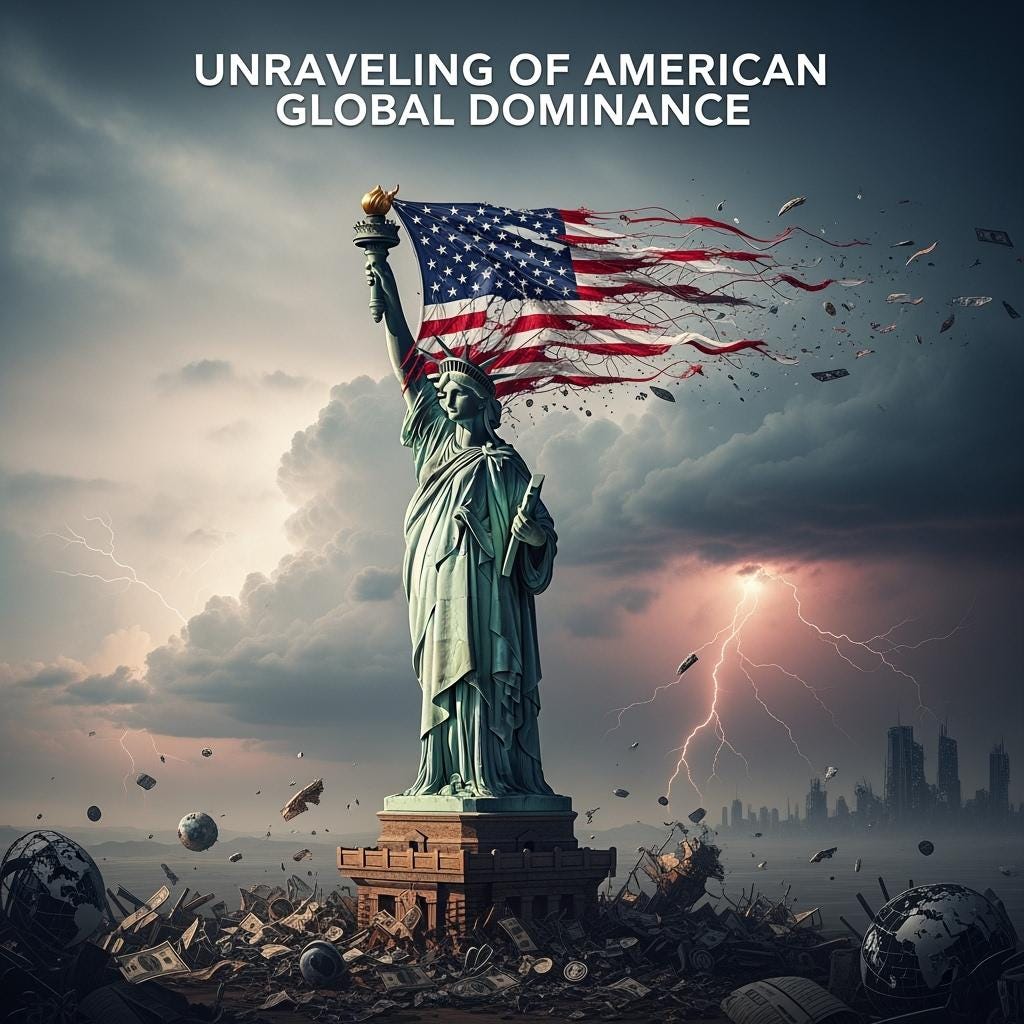
The crucial contemporary issue is whether Washington still exercises hegemonic control in the systemic sense. The post-Cold War unipolar moment has certainly weakened under centrifugal pressures. The United States still holds an unmatched global force posture, leadership in core technological domains, and critical positions within the financial architecture. Yet its share of global GDP has contracted, its wars have exposed hard limits to expeditionary military power, and rival states have consolidated counterweights. China’s industrial diplomacy ties nations increasingly to Beijing. Russia leverages energy and disinformation at scale. Middle powers like India, Turkey, and Brazil experiment with transactional autonomy rather than strict alignment.
Internally, polarisation undermines strategic continuity. Fiscal burdens and war fatigue limit the American public's appetite for expansive commitments. Each constraint narrows what Washington can achieve abroad, pushing reliance onto indirect or deniable instruments—precisely those “soft” interventions that straddle the borderline between development assistance and calibrated interference.
From this vantage point, framing USAID or the National Endowment for Democracy as “fronts” misses the issue. Legally distinct, they nevertheless operate in close alignment with US strategic objectives. In authoritarian systems they are routinely labelled as tools of interference; in democratic systems they merge into wider networks of aid and philanthropy, making their influence less visible. In both cases, the boundary between the promotion of norms and geopolitical leverage all but vanishes.
Synthesis lies here: the United States has an extensive, well-documented record of meddling that reflects security anxieties, ideological preferences, and economic imperatives interwoven with the global function of the dollar. These actions produce mixed results: some create stability, others unleash instability, and most generate unanticipated consequences. But the contemporary global stage is no longer directed by a single lead actor. Regional histories, rival powers, and domestic political economies exert equal weight. American influence, though still formidable, increasingly meets resistance, must negotiate, and operates within structural boundaries far greater than before.
What thus emerges is a reformulated understanding of hegemony: not as a settled arrangement but as a constant struggle to set terms, shape flows, and manage frictions in a system too distributed for unilateral control. Washington remains unmatched in its capacity to coordinate global responses and impose rules, but no longer does it command automatic compliance. The dialectic between critics who see coercive dominance and advocates who highlight the provision of public goods misses the central point—American primacy now coexists with powerful structural constraints both abroad and at home.
What follows from that is less a verdict than a caution. Over-assigning agency to Washington flattens the world into caricature and denies the autonomy of other actors. Under-emphasising US power sanitises its coercive record and ignores the hard edge of its soft power. To make sense of this historical moment requires holding both realities together: an interventionist superpower whose reach has been extraordinary and whose limits are now increasingly visible. The global order is no longer authored by one hegemon but shaped through constant friction among many.