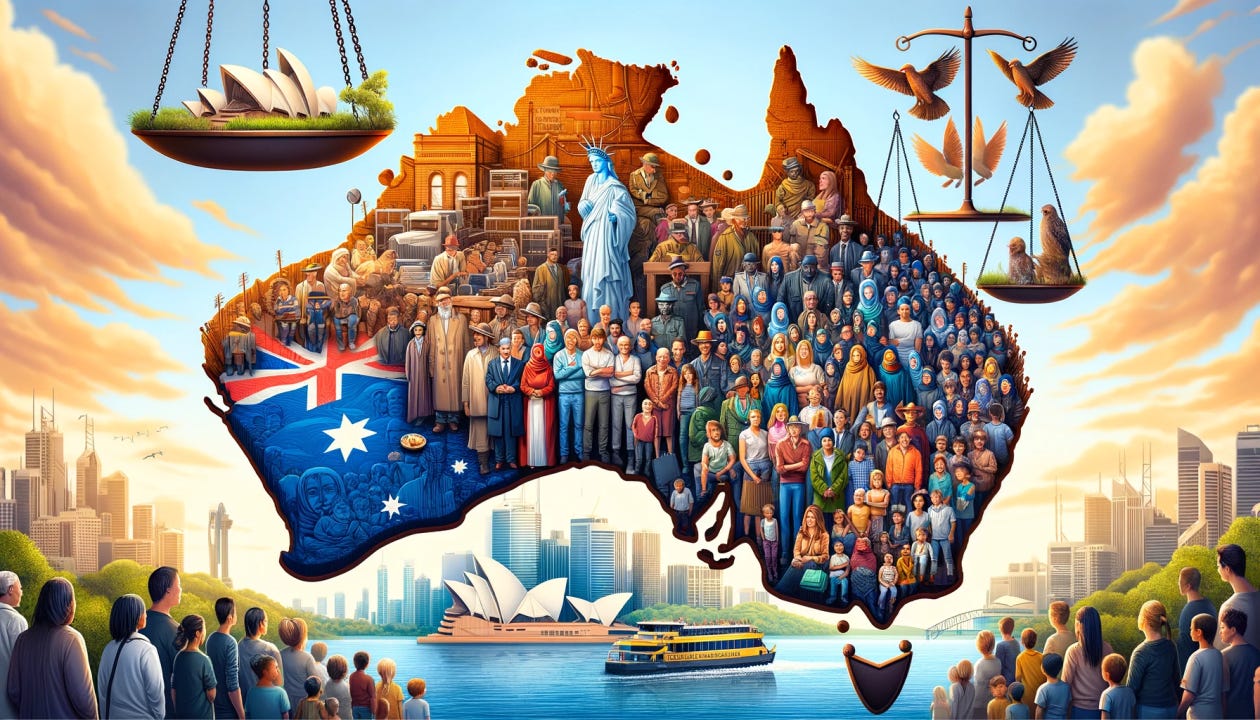
Australia today is living a demographic future its politics has barely begun to imagine. Melbourne, with close to two in five residents born overseas and many more connected by close family ties to other homelands, is the most visible edge of a wider civilisational shift. At the federal level, the pattern is the same: a society that has changed at extraordinary speed in who we are, how we live, and what we value, but which is still governed by institutions, habits and reflexes designed for an older, whiter, far more homogeneous country. The result is a profound representational deficit. Canberra does not yet know how to speak for the “new Australia” because the new Australia has not been allowed to re‑design Canberra.
My work over decades has been preoccupied with precisely this type of mismatch: the gap between worldviews that are shifting beneath the surface, and the world‑systems that were built to serve a different era. Every society lives inside a web of stories about who “we” are, where “we” came from, who belongs, and what counts as success. These stories congeal over time into institutional architectures: parliaments, parties, bureaucracies, legal systems, markets. Those architectures are not neutral. They are physical, procedural and symbolic expressions of an historic imagination. When the imagination changes, the architecture resists. It is slow, clumsy, and in the end, fragile.
Australia’s federal parliament is a case study in this phenomenon. Constituencies like western Sydney or northern Melbourne are now among the most culturally diverse urban zones on the planet. The national statistic – roughly a third of residents born overseas – places Australia at the leading edge of global migration societies. Yet step into the House of Representatives or the Senate, ignore the party colours for a moment, and ask: whose life experience is most visible here? Whose language, in the deeper sense of tacit assumptions and unspoken norms, holds sway? To what extent do the structures and rituals of Canberra still encode a mentality more at home in 1960 than in the mid‑21st century?
If this is true in Australia, what does it tell us about other nations? Europe is facing overlapping waves of migration and demographic change. The Gulf states host vast numbers of foreign‑born workers whose political rights are truncated or non‑existent. Cities in Africa and Asia are combining high internal mobility with external flows in ways that unsettle older categories of citizenship. In each case, do we see a congruence between who the people now are and how they are represented, or is there a widening gap between the lived complexity of the population and the narrow social base of those who claim to act on their behalf?
In Australia, the standard response is to count faces and claim progress. There are now more parliamentarians of non‑Anglo origin than there were twenty or thirty years ago. But is that really the metric that matters? Representation is not only about what an MP looks like, or whether their surname signals a particular ancestry. It’s about whether the logics that shape parliamentary behaviour have expanded to include fundamentally different experiences of belonging, ambition, obligation and security. It’s about whether the tacit rules of the game – how candidates are selected, how influence is accumulated, whose fears are taken seriously, whose aspirations are heard – have been re‑written by the arrival of a genuinely multicultural demos, or whether they have merely added a little colour to an old script.
At the federal level, both major parties continue to behave as if migration is an issue to be managed, rather than a constitutional fact that demands a redesign of the system itself. The Coalition appeals, at least rhetorically, to hard work, enterprise, family and personal responsibility – virtues that many migrant communities live every day. Yet organisationally and culturally, it still radiates a sense of closed networks, inherited privilege and insular loyalties. Labor, meanwhile, occupies most of the electorates where migrants live and toil, but has tended to funnel representatives through a narrow pipeline of unions, staffer roles and factional patronage. This is not unique to Australia; variations of the same pattern recur in Britain, Canada, even in parts of Asia where old party machines sit uneasily atop restless cosmopolitan cities. The question is whether this pattern can adapt, or whether it must eventually be displaced.
Underneath these surface arrangements lies a deeper clash of mindsets. Many first‑ and second‑generation migrants arrive with a lived sense of systemic fragility. They have known states that collapse, currencies that devalue overnight, regimes that turn against particular groups. Their faith in education, in entrepreneurial hustle, in resilient family networks, is not an abstract cultural ornament. It’s a survival strategy. By contrast, much of the inherited political class in countries like Australia has been schooled in a different reality – one in which the system is taken for granted, in which pathways to influence are thick with informal guarantees, in which politics is a career ladder to climb rather than a collective design challenge to re‑imagine and reinvent.
When these two sensibilities meet inside the same polity, whose assumptions prevail? Does the institutional culture expand to welcome the pragmatism and adaptive intelligence migrants bring, or does it press them into pre‑existing moulds, privileging those who learn to mimic the established style? If parliaments start to look more diverse but continue to operate as closed guilds, are we not simply updating the aesthetic of power while leaving its operating system untouched?
This question is not limited to ethnicity or migration. The same representational lag is visible in gender, in age, in class, in cognitive style. A world of distributed intelligence – where knowledge, money, care, even identity are globally networked – is still being administered as if hierarchy, territory and party loyalty were the only viable organising principles. That might have been understandable when borders were harder, communications were slower and life chances were more tightly bound to nationality. It is less defensible in an era when a student in Nairobi can collaborate in real time with a coder in São Paulo and an entrepreneur in Melbourne, and when a decision made in one capital can trigger cascading effects across entire ecosystems.
In my own work I have argued that we tend to confuse systems with the stories we tell about them. We assume that political structures are natural outgrowths of “human nature”, when in fact they are sedimented choices, often made under very different conditions from those we now face. What happens when a polity continues to use an institutional language that no longer fits the social reality it seeks to govern? Does legitimacy slowly drain away, or does it fracture suddenly? Does representation devolve to smaller, more agile circuits – local networks, diasporic alliances, digital communities – that bypass formal politics altogether?
If that’s the destination, then the lesson of places like Melbourne has global significance. Here is a city that has, in demographic terms, stepped into the future ahead of many others. If we cannot prototype a different relationship between population and parliament here, with all the advantages of wealth, stability and relative peace, what does that imply for megacities in more fragile contexts? How will Lagos, Dhaka or Jakarta handle analogous tensions between rapidly shifting populations and sclerotic political forms if even Australia, with its self‑image as an easy‑going, friendly, pragmatic society, prefers to avert its gaze?
Perhaps the most uncomfortable question is this: do existing parliaments actually want to represent the new societies they nominally serve? Or do they, consciously or not, function as defensive enclosures, protecting the privileges, languages and rituals of an old order against the perceived chaos of a more fluid, hybrid, unpredictable human mosaic? When we see both major parties in a country drawing most of their candidates from the same narrow social bands, when they cling to adversarial rituals that reward point‑scoring over inquiry, when they speak of “managing diversity” as though it were a cost centre rather than a source of systemic intelligence, what does that reveal about the underlying worldview?
If worldviews manifest as world‑systems, then the presence of large, diverse, mobile, highly networked populations should be altering not just who sits in parliament, but what parliament is for. Do we still believe that aggregating citizen preferences into a binary contest every few years, and handing the spoils to one disciplined party machine or another, is the most intelligent way for a complex society to govern itself? Might a genuinely post‑national, deeply intercultural demos require a more porous architecture of decision‑making – one that accommodates multiple layers of belonging, recognises overlapping identities, and treats migration not as an exception but as a default condition of human life?
The Australian case again offers a useful mirror. Migrant communities often exhibit strong loyalties both to their adopted home and to their places of origin. They straddle worlds. They send remittances, maintain kinship obligations across borders, follow news cycles in several languages, and sometimes move back and forth physically. In doing so, they embody a different model of citizenship: relational, networked, distributed. Yet federal politics continues to box them into a singular, territorial frame: you are an Australian voter in this seat, full stop. How long can such a truncated notion of membership hold when lived reality is so much more entangled?
This is not an argument for romanticising migrants, or for assuming that diversity alone will produce wiser governance. Every community brings its own blind spots, prejudices and power hierarchies. But the very existence of such hybrid populations exposes the fiction at the heart of many nation‑states – the fiction that there is a single “people”, with a single set of interests, that can be accurately channelled through a single institutional template. That fiction was always partial. Today it’s becoming untenable.
If parliaments are not up to the task of reflecting this complexity, where will representation migrate to? Already we see issue‑based movements, local experiments in participatory budgeting, citizen assemblies, digital platforms that mobilise opinion across borders, and a proliferation of informal leadership in communities that feel unseen by central institutions. Are these the early signs of a transition to new governance forms, or are they safety valves that allow frustration to be expressed without disturbing the core machinery of state power?
In Australia the complacent answer has been that the system basically works, that periodic adjustments are enough, that we can fold the new into the old with only superficial stress. Yet Melbourne’s electorate map and Canberra’s seating plan tell a different story. They suggest that an accelerating “new Australia” is being asked to inhabit an “old Australia” political shell. That shell is not only demographically out of date. It’s conceptually out of date. It carries within it assumptions about sovereignty, authority, identity and development that were forged under conditions that no longer exist.
This tension is not uniquely Australian, and that is precisely why it matters. Humanity is moving, mixing, reconfiguring itself at a rate unprecedented in our history. If our collective governance systems remain stubbornly committed to obsolete images of who “we” are, then the misalignment will not be a local inconvenience. It will be a global risk vector. Societies that fail to re‑imagine representation in time will find themselves brittle, prone to sudden breaks – not because people are inherently more fractious, but because their institutions refuse to accommodate the creative turbulence of a species that is, finally, encountering itself at scale.
The question, then, is whether we are prepared to treat parliaments not as sacred relics to be defended, nor as mere stages for rotating elites, but as designable interfaces between worldviews and world‑systems. If we accept that premise, the under‑representation of “new Australians” in federal politics is not just a local anomaly. It’s a signal that our political imagination lags behind our social reality. For a futurist, that gap is both a warning and an invitation: a warning that path dependencies can lock us into increasingly dysfunctional patterns, and an invitation to experiment with forms of representation better suited to a planet where no society can plausibly claim to be demographically, culturally or cognitively uniform.
Whether we will take up the invitation of becoming genuinely “global” – in Melbourne, in Canberra, and in the myriad other cities where the future is already present – remains an open question.