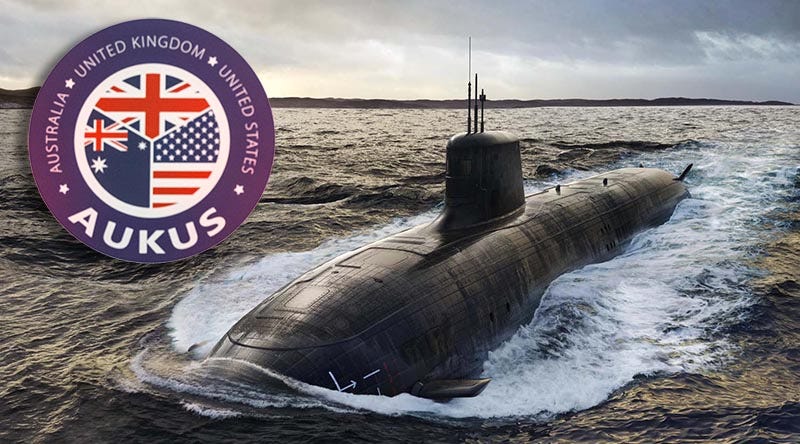
Australia’s government has been applauding the success of Prime Minister Anthony Albanese’s visit to the White House, engrossed in mutual back slapping and fake flattery from President Trump.
When the governments of Australia, the United Kingdom and the United States unveiled the AUKUS agreement in 2021, it was proclaimed as a bold reimagining of security for the Indo-Pacific. Described in the familiar lexicon of deterrence, stability and shared democratic values — it was framed as an alliance for a new age. It is anything but. For beneath the polished rhetoric, AUKUS exposed something far more illuminating about the condition of Western civilisation itself. This was not an act of foresight but of repetition: the reflex of a political culture unable to imagine a future that is not defined by fear.
At its core, AUKUS is not a strategy but a symptom. It reveals a collective anxiety — a longing for reassurance at a time when the certainties that once anchored the Western order are dissipating. Its advocates speak of strength, solidarity and technological progress. They celebrate the promise of nuclear-powered submarines and the deepening of bonds with trusted allies. But these promises rest upon assumptions that no longer hold. Their presumption is that power can still be projected linearly across oceans, that technological advantage ensures moral legitimacy, and that security can be constructed through the management of threat. These ideas belong to another century. They persist only because we’ve not yet learned how to think beyond them.
AUKUS tells a comforting story for conservatives. It reassures a nervous nation that it remains protected beneath the skirt of an old empire, that the machinery of deterrence still functions in a world that has moved on. Yet the real threats facing humanity today — ecological collapse, technological displacement, economic fragility, and social fragmentation — cannot be met with submarines or missiles. They demand wisdom, cooperation, and a deep knowledge of complex systems. In pouring billions into a weapons system that will take decades to deliver, Australia is not buying security; it’s mortgaging its imagination. The project is a gesture of belonging — a reaffirmation of loyalty to a fading geopolitical order — rather than a genuine response to the complexities of the age.
There is also the illusion of autonomy. AUKUS has been presented to Australians as a step towards strategic maturity, a claim to sovereignty through technological prowess. In reality, it represents a profound surrender of independence. Nuclear submarines are not stand-alone assets; they are embedded within entire ecosystems of foreign expertise, maintenance, and doctrine. They tether Australia’s future defence posture to the strategic ambitions of the United States and the United Kingdom, ensuring that decisions about deployment, technology, and even purpose will forever remain wedded to those of its larger partners. What is sold as empowerment becomes dependency. What is framed as partnership becomes obedience, dressed up in the language of an alliance.
This alliance is justified, as such things always are, by invoking the spectre of a rival. Every empire needs its adversary, and in this century that role has been assigned to China. The idea of a “China threat” gives coherence to the AUKUS narrative. It allows politicians to speak of danger and deterrence in familiar tones, to frame the world once again as a binary between freedom and authoritarianism. Yet this framing is dangerously simplistic. China’s rise is not an aberration but a return to historical balance — the re-emergence of a civilisation whose power was eclipsed only briefly by Western industrial expansion. To interpret its resurgence solely as aggression is to mistake inevitability for intention. By locking itself into an oppositional posture, AUKUS risks creating the very instability it claims to prevent. The story of threat becomes a self-fulfilling prophecy.
Even the technological promise of AUKUS — such as access to nuclear propulsion, quantum computing, and advanced cyber capabilities — conceals a deeper illusion, quite apart from the fact that in a field like quantum computing, for example, the Chinese are possibly five years ahead of anything in the West. A far greater problem in my mind is that the West remains seduced by the idea that progress is primarily a technical matter, that innovation in machinery can compensate for the decay of meaning. Yet technology, in the absence of moral intelligence, simply amplifies the dysfunction of the system that produces it. AUKUS channels scientific brilliance into instruments of destruction, while the tools that could truly secure our future — renewable energy, ecological restoration, ethical governance, social cohesion — remain underfunded and politically marginal. We are advancing in capability while regressing in consciousness. The result is not evolution but acceleration toward entropy.
The rhetoric of shared values that accompanies AUKUS is equally hollow. Democracy, freedom, and the rule of law are invoked as sacred principles, yet their application in all three partners has become performative. If democracy means accountability, why was the agreement negotiated in secrecy? If freedom implies autonomy, why does the alliance deepen dependence? If the rule of law is universal, why is it selectively applied? The invocation of values becomes a kind of moral camouflage, concealing the erosion of the very ideals it claims to defend. The West’s most profound insecurity today is not military but moral — paranoia about a fabricated “threat” and a loss of confidence in the ethical foundation of its own project.
Strip away the speeches and communiqués, and AUKUS reveals its true nature: a gesture of reassurance from a middle power uncertain of its place in the world. For Australia, it serves as an existential comfort blanket — a way to feel anchored amid the turbulence of global change. It is, in that sense, a psychological pact rather than a strategic one. Yet reassurance is not resilience. A nation that defines its future through the fears of others cannot evolve beyond them. Instead of becoming a bridge between civilisations, Australia risks becoming an anchor — tethered to an outdated order even as the world around it moves on.
Viewed through a wider civilisational lens, AUKUS is emblematic of a deeper pattern which I warn about continuously — the exhaustion of the old industrial-colonial worldview. The Western project, built on the pursuit of control, mastery, and separation, has reached its logical limits. It can no longer solve the problems it has created because it can’t think beyond the assumptions that engineered them. Climate instability, inequality, social fracturing and institutional decay are not anomalies; they are the consequences of a system that mistakes dominance for wisdom. AUKUS, with its billions in militarised spending and its faith in technological salvation, is simply the latest manifestation of that same story — a desperate attempt to preserve order through means that perpetuate disorder.
And yet, within this failure lies a hidden possibility. For in exposing the poverty of our imagination, AUKUS invites us to ask different questions: What if security were redefined, not as the management of threat, but as the cultivation of trust? What if technology were directed toward regeneration rather than control? What if alliances were formed around shared futures rather than shared fears? These are not questions of policy but of consciousness. They challenge us to evolve from a country obsessed with border protection to one capable of coherence — to shift from the geopolitics of fear to the ecology of belonging.
AUKUS, then, is not just a political arrangement; it is a mirror. It reflects a society that has lost faith in its own moral and imaginative capacity. We build submarines because we no longer know how to build peace. We chase technological advantage because we have forgotten how to nurture wisdom. We defend the familiar even as it fails us, because we have not yet learned how to trust the unknown. The real challenge before us is not to reform AUKUS or replace it with some new alliance. It is to transcend the mindset that made it seem necessary. For only by doing so can we begin to design a form of security that is truly worthy of the future — a security rooted not in dominance, but in the understanding that all life, human and planetary, is inseparably interconnected.
Civilisations do not collapse overnight. They decline through the repetition of obsolete ideas — through the insistence on solving new problems with old tools. AUKUS is one such repetition, a monument to the end of strategic imagination. Yet endings always contain beginnings. If we can see in this alliance not a triumph of strategy but a failure of imagination, we might also glimpse the faint outline of what must come next: a world in which peace is designed, not enforced; in which alliances are built on empathy rather than fear; and in which security arises not from the barrel of a gun but from the maturity of our community of mind. Only then will we be able to say that we have learnt from the long, anxious shadow of AUKUS — and begun, at last, to grow beyond it.