I have an insatiable habit of asking people I’ve only just met what most concerns them about the human condition. Is it technology, propaganda, a disconnect with the lifestyles, culture and language of youth, or the feeling that everything is speeding up? Having spent 80 years living on three continents and working in all five, I might have evolved a distinctly different view on this from most. What amuses me, however, is that the response I get is amazingly uniform: most people feel we’re drifting, sleepwalking into a prison of our own invention – a topic I have used consistently in my writing over the past three decades.
This construct isn’t built of iron and stone but of bits and bytes, of luminous code and the silent, perpetual gaze of the algorithm. The greatest threat to the freedoms we assume to be our birthright is not a singular tyrant or a cataclysmic event but a slow, metabolic shift in the very nature of individuality itself. Put another way, it’s the final, quiet erosion of the psychic space required for a “self” to cohere—the annihilation of privacy as the fundamental condition for a sovereign human consciousness. This is not only a political or a technological predicament; it’s a metaphysical one, a profound alteration of the human estate that strikes at the core of our being, our becoming, and perhaps most disturbingly, our capacity for collective flourishing.
Let’s apply an epidemiological lens to this situation. A pathogen spreads through contact – through the proximity of bodies sharing air in a confined space. We understand containment, quarantine, and the cordon sanitaire. Now, transpose this model to the digital sphere. Our data—our beliefs, associations, purchases, links and fears—are the novel pathogen. The state and its corporate adjutants are the epidemiologists, tracing its vectors, mapping its spread with a precision unimaginable in the physical world. Their goal is not to cure but to control, to preempt the outbreak of dissent, the contagion of non-compliance. The individual is just a host, one node in a vast, symptomatic network, their future behaviours predicted and their potential for social ‘infection’ neutralised before a single conscious thought has even been expressed. The sovereign self becomes the primary reservoir of a virus called dissent. This is public health reconfigured as social control, a prophylactic against the very unpredictability that defines a vibrant, evolving social culture.
From this vantage point, the psychology is apocalyptic. We are witnessing the systematic dismantling of what the mystics might have called the inner sanctum, the temenos of the soul. In traditions from the Indic to the Gnostic, the journey inward was paramount—a withdrawal from the collective noise of the world to encounter a deeper, often disruptive, truth. This sacred solitude is now being colonised. When every digital query, every hesitant search or exploration, and every intimate connection is logged, quantified, and fed into the analytic machine, the mind turns inward on itself – not in meditation but in a perpetual performative mode. We start to curate our own thoughts for an unseen audience, internalising the panopticon until the watcher is no longer externally located but a phantom limb of our own consciousness. The result is profound spiritual atrophy, a tragic loss of the creative ambiguity and unobserved becoming from which all genuine innovation and moral courage spring.
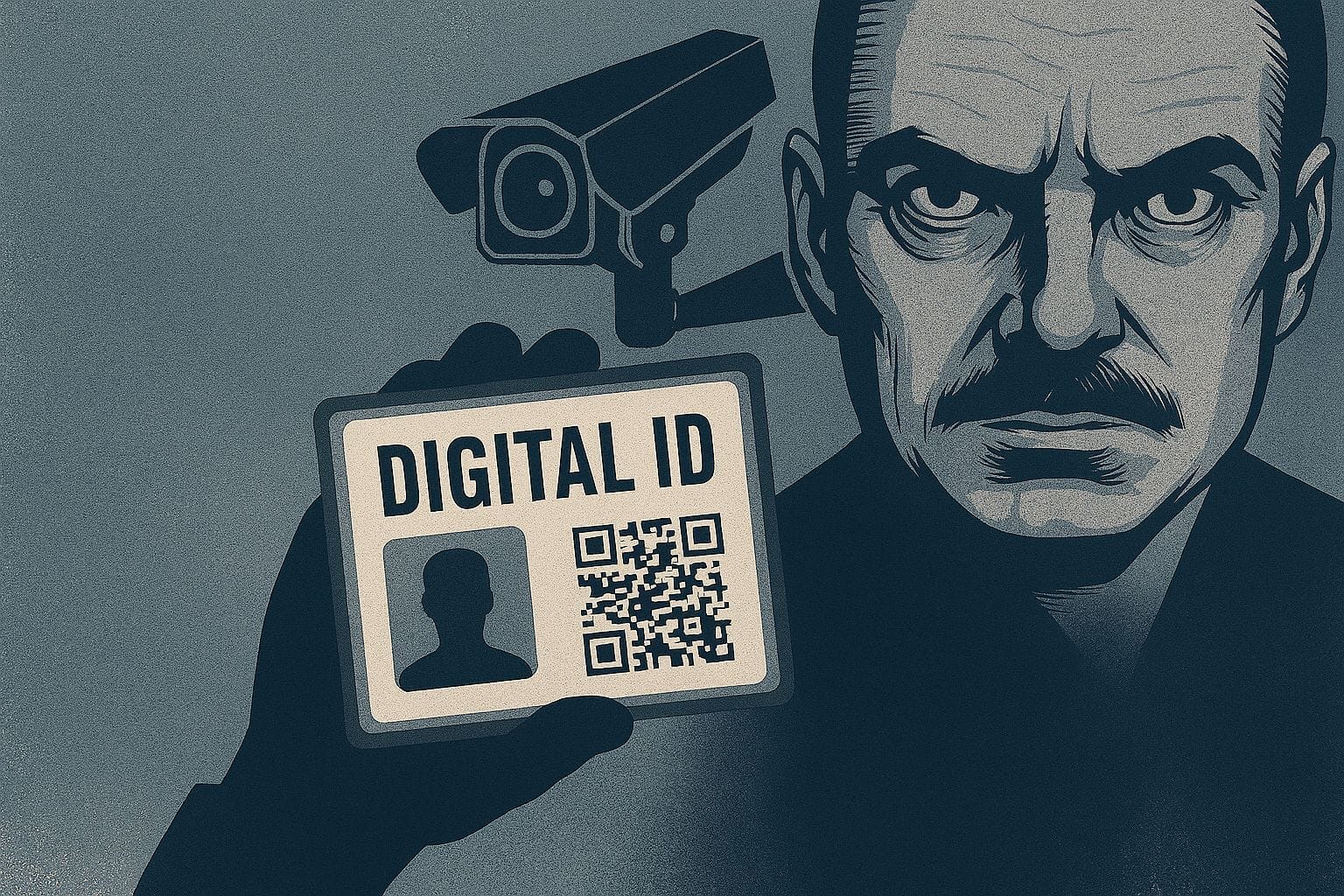
This brings us to the edge of our current metamorphosis: the imposition of biometrically confirmed digital identity. Framed by governments, banks, security firms and technology manufacturers as a tool of efficiency and security, digital ID is the mechanism through which the ephemeral threat to privacy becomes part of the corporeal world system. It’s the point of fusion, the unique identifier that binds the disparate strands of our existence into a single legible, and therefore controllable, narrative. But the real danger rests in the evolving conditions of its use rather than the credential itself. We’re moving towards a model of mandatory linkage, where this digital key becomes the sole gateway to existence within a modern polity. No access to finance, healthcare, education, or mobility without it. This is not a convenience; it’s a redefinition of citizenship from a right to a conditional privilege.
And just what are these conditions? We see their nascent forms in the social credit systems emerging in the Sinic world, a world system that interprets social harmony through a lens of absolute behavioural compliance. Here, the digital ID mutates from a static credential into a dynamic scorecard, a teleological instrument that judges you not only on your past actions but also on your predicted future community value. Your identity becomes a program that can be upgraded or downgraded, granting or denying access to the essential infrastructure of modern living. This is a perversion of the Ubuntu concept of humanity being realised through others—umuntu ngumuntu ngabantu—warped into a system where one’s humanity is validated by others, specifically by the algorithmic judgement of the state. It replaces the complex, empathetic web of communal relations with a cold, automated calculus of worth.
The ultimate synthesis, the point of no return, arrives with the fusion of this programmable identity with a programmable currency—the Central Bank Digital Currency. Just imagine a world where your means of sustenance can be made to expire so as to stimulate consumption; where your funds can be restricted from purchasing certain categories of goods, enforcing state-mandated morality; where your entire economic life can be switched off in an instant for stepping out of line. This is the materialisation of a world system that has abandoned all pretence of individual sovereignty. It’s a teleology of control, a future where freedom is not taken by force but gently, inexorably drained away through a thousand tiny, logical conditions.
One has to ask: what kind of human is fostered by such a system? The indigenous worldview, for instance, often sees the individual as an inseparable part of a living, spiritual cosmos, with responsibilities and relationships that are deeply contextual. This stands in blatant opposition to the Occidental drive to sort, quantify, and atomise. The emerging digital identity paradigm is the ultimate expression of this atomisation; it reduces the boundless, relational human spirit to a sterile data point in a centralised ledger. It’s a fundamental assault on the very notion of a worldview, seeking to replace the rich embroidery of global cultures with a single, homogenised, managerial mindset.
I find the ethical and philosophical abyss opening before us overwhelming. We are sleepwalking into a new form of social contract, one we have not debated, let alone consented to – one that’s not even on the radar of ordinary folk. This isn’t a contract between citizen and state; it’s a unilateral “terms-of-service” agreement for existence, where we trade our metaphysical autonomy for corporeal convenience. The great philosophical question of our age may well become: can a human be free if their identity is a leased asset from the state and subject to cancellation? Are we building a world where the price of participation is the actual soul of our individuality?
We must pause for thought before it’s too late. The policy framework being formulated right now demands a radical recalibration of our assumptions. We must champion friction, ambiguity, activism, and even the right to be forgotten. We must design our most critical life systems that are distributive by their very architecture that return agency and ownership of personal data to the individual. The fight for personal privacy has been our overarching task for the past 50 years. Are we ready to jettison all of that?
We must ask, with urgency and the level of gravitas this topic demands, how we can build a digital society that reflects the wisdom of the Ubuntu philosophy or the relational consciousness of indigenous cultures, rather than the centralising, controlling impulses of a failing industrial-age technocracy. The battle for our future is not being fought on a battlefield but in the silent, incremental choices we make about the architecture of our identity. It’s a battle for the essential core of what it means to be a human – unobserved, uncurated, untethered from the straitjacket of conformity and, ultimately, free. For in the unobserved moment lies the seed of all transformation, and in the uncurated life, the future of our species’ true potential.