Young Universe - Long Future
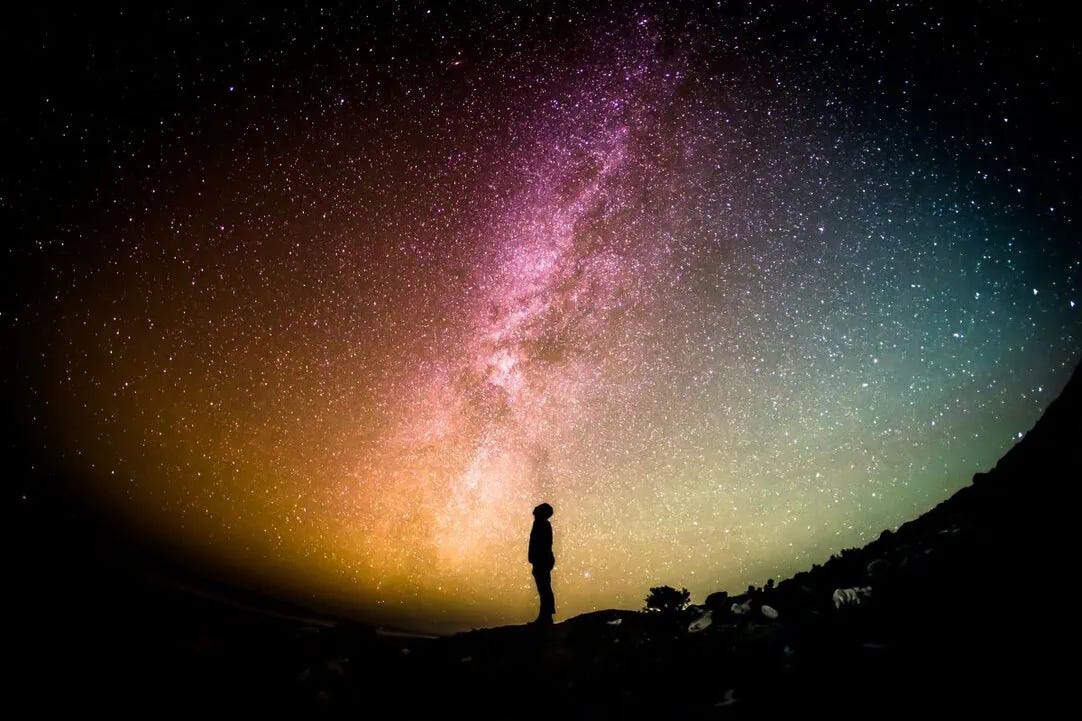
From our human perspective, the cosmos seems unimaginably ancient and vast. We look out and see galaxies billions of light years away and stars that lived and died eons before Earth even formed. Yet in cosmic terms, the universe is astonishingly young, and its story is only beginning. Current astrophysical data estimate the universe to be about 13.8 billion years old, based on observations of the cosmic microwave background radiation and the expansion rate measured by telescopes like Hubble and James Webb. This might sound old, but consider that stars and galaxies will continue to form for trillions of years to come. According to stellar evolution models, with the available hydrogen gas in galaxies, star formation could continue for up to 100 trillion years or more into the future. In other words, less than one ten-thousandth (0.01%) of the universe’s potential for forming stars has been realized so far. For every star shining today, thousands more have yet to be born.
What we view as a vast and ancient cosmos – full of glittering galaxies, quasars, and star clusters – is actually in its cosmic infancy. If the universe were a person, it would barely be out of diapers relative to the lifespan it might have. The era of star formation and cosmic evolution is not winding down; it’s just getting started. The Milky Way and other galaxies are dynamic, active systems, not fading embers of creation. Planets like our Earth, and the life it harbours, might be among the early bloomers in a much larger springtime of cosmic history. This perspective radically shifts how we see our place in time: humanity is living at the dawn of the universe, not its twilight.
One Universe Among Many?
Adding to this grand scale of time is the possibility that our universe is not the only game in town. Leading theories in cosmology hint at a reality even larger than the observable cosmos: a multiverse of many universes. Concepts like eternal inflation suggest that the rapid expansion that birthed our universe could be continuously spawning other universes, each with its own properties and laws. Similarly, the many-worlds interpretation of quantum mechanics imagines that every quantum event branches into different outcomes, effectively creating parallel realities. If any of these ideas are correct, our universe – with its 13.8 billion years of age and trillions of years to come – could be just one bubble in a vast foam of universes, or one branch on an ever-splitting tree of realities.
In such a multiverse scenario, what is happening "here and now" might be only one example among countless others. Each universe could have its own trajectory: some might expand forever, some might collapse and bounce into new big bangs, others might have different particles, forces, even different notions of space and time. Life as we know it could be a rarity in some universes and common in others. There might be universes that remain barren and dark, and some that teem with activity. We simply don’t know – but the possibility expands our perspective.
Humanity’s early epoch in this universe might have parallels elsewhere: other intelligent beings could be taking their first steps in their own young universes, or we might truly be unique. Either way, the existence of a multiverse would mean the cosmic drama is multiplied, with many variations of the "unfinished story" playing out simultaneously. Our situation, then, is not just that we stand at the start of a vast future – we may also be one instance of a broader reality beyond our comprehension.
Humanity as an Early Intelligence
Recognizing that the observable universe is at an early stage forces us to reconsider long-held assumptions. In many of our cultural myths and scientific prognoses, there’s an idea that humanity arrived late to the scene – that most of the cosmic story (galaxies forming, stars being born and dying, life’s spark igniting) has already unfolded without us. We often carry a notion that we’re living in an era of decline, perhaps even on the brink of an ending (whether due to religious apocalypse, environmental collapse, or eventual heat death of the universe). But with the knowledge that the universe’s star-forming days are far from over, an alternative picture emerges: we could be among the first wave of intelligent life in a universe that has barely begun to explore its potential.
Life on Earth began roughly 4 billion years ago, but the heavier chemical elements it depends on (like carbon, oxygen, iron) were forged in star cores and supernovae over billions of years prior. The earliest generation of stars contained only hydrogen and helium; they had to live and die to enrich the galaxy with the ingredients for planets and biology. This means the conditions for life as we know it have only become favourable in the recent cosmic epoch. Humanity might thus be one of the first intelligent civilizations to emerge—perhaps the cosmos had to age to a certain point, seeding the heavy elements and stable environments needed for minds to arise. If intelligence has a role in the grand story, then right now the curtain is just rising on act one.
Crucially, this perspective suggests that we do not exist in a time of cosmic aftermath or decline. Earth and humanity are not latecomers hurriedly making do in a used-up universe; on the contrary, we're pioneers at the beginning of a tremendous journey. Most stars have yet to form. Many planets and potentially living worlds are still latent as diffuse clouds of gas and dust, not yet condensed into suns and spheres. Opportunities for life, consciousness, and civilizations are still almost entirely ahead of us, like an open frontier. If the universe were a book with a thousand chapters, our existence might be somewhere in chapter one or two.
Seeing ourselves as an early intelligence can be exhilarating. In principle it means there's so much more "future" that could happen – so many discoveries, adventures, and creations that lie ahead not just for our species but for life and mind as phenomena in the cosmos. It hints that what we do matters, because we’re setting precedents. But it’s also humbling: being early means we are the novices in a very long game, and our survival is by no means assured.
Fate or Desire: Shaping the Future of Humanity
This grand cosmic context raises a profound question: Is the future of humanity a matter of fate or a matter of desire? In other words, given the youth of the universe and the potential ahead, are humans destined to play an important, enduring role – or must we choose and desire that future and earn our place in it through our actions? There are two contrasting ways to imagine humanity’s trajectory. One is to see it as fate or destiny: perhaps we are meant to spread life and intelligence through the cosmos, to be stewards of creation for eons to come. The other is to treat it as a matter of will and desire: the future we get will depend entirely on what we strive for and how we behave, with no guarantees.
It’s tempting to lean into the idea of destiny. If indeed we're among the first intelligent beings in a young universe – maybe even unique for now – one could imagine that we have a cosmic purpose. Our myths and even some scientific narratives often cast humanity as a central character: the creature through whom the universe becomes aware of itself. From this viewpoint, it almost feels like fate that we should survive, expand, and influence the universe on a grand scale. The vast timescales ahead invite dreams of civilizations lasting millions or billions of years, of humans (or our descendants) spreading to other planets and galaxies, perhaps even transcending our biological forms. Such thinking can imbue us with confidence, since it paints our future as something written in the stars – a grand mission we are bound to fulfill, as though the universe prepared this role for us.
However, history and science alike warn us that nothing about our future is guaranteed. Stars will continue to shine and planets will form no matter what, but whether humanity (or any intelligence) will be around to see it is an open question. The universe, as vast and law-governed as it is, does not bend its rules for the sake of any particular species. There is no obvious cosmic script that ensures we must survive or succeed. In fact, if we look at life on Earth, over 99% of all species that ever existed are now extinct. Extinction might be the rule, not the exception, even for intelligent life. If we assume it’s our fate to populate the stars or guide the universe’s future, we risk falling into complacency or arrogance. Fate can be a comforting idea – it makes significance feel inevitable. But in reality, it may be our desire, our choices and values, that determine what happens. The cosmos has opened a door of possibility (by being young and full of potential), but it’s up to us to walk consciously through that door.
Thinking in terms of fate can also be dangerous because it might justify any means to achieve what we believe is our "destiny." If we suppose humanity is meant to rule the galaxy, we might charge ahead without caution, assuming that whatever we do is part of a grand plan. Desire, on the other hand, implies responsibility. To say the future of humanity depends on our desires is to say it depends on our collective will, intentions, and activities. It frames the future as something we actively shape. In this view, the universe doesn’t guarantee us a starring role – we have to earn it, by adapting and making wise decisions.
In summary, then, we stand at a crossroads defined by these two outlooks. Down one path, we imagine a fated future where human brilliance inevitably shines across the cosmos (or, conversely, a fate where we are doomed regardless of what we do). Down the other path, the future is the result of deliberate pursuit – our aspirations to survive and flourish balanced against our capacity for self-destruction. The truth may lie somewhere in between: the universe’s laws and initial conditions set the stage and offer possibilities, but it's our desires and choices that determine which possibilities become reality for us.
The Risk of Overconfidence and False Destiny
If humanity embraces the notion of a cosmic destiny without humility, we risk a recklesness that could hasten our end. The realization that we are early in the universe’s story can inspire us, but it might also inflate our ego. It’s a short leap from "we might be among the first intelligences" to "we're the chosen ones destined to shape everything." Throughout history, groups of humans often believed they were favoured by fate or the gods, only to fail due to their own hubris or mismanagement. On a cosmic scale, a similar trap awaits us if we’re not careful.
Imagining that we are "key figures" meant to influence outcomes over trillions of years can lull us into a false sense of security. We might assume that because the universe has such a long future, we have plenty of time to solve problems or that somehow we’ll be kept around to fulfill some higher purpose. But the physics of the universe offers no special protection for our dreams. Natural laws won’t bend to prevent ecological collapse, climate change, nuclear war, or any other self-inflicted disaster. There’s no cosmic referee ensuring the "first intelligent species" gets to survive by default. If our civilization collapses next century, or if we wipe ourselves out, the universe will simply carry on. Galaxies will keep rotating, stars will keep forming and dying, utterly indifferent to our fate. In a multiverse, countless other universes (or alternate timelines) would continue unfolding whether or not ours includes a long-lived human species.
This is a humbling truth: our existence could end with barely a ripple in the cosmic ocean. We could vanish tomorrow, and from the perspective of the universe, it would be as if a mayfly’s flicker of life ended – hardly noticed in the grand scheme. All the potential we talk about – trillions of years of stars and life ahead – could belong to others (other species, or just nature itself) if we don’t get our act together. The only way we matter in the long story is if we actually survive and contribute something enduring. Overconfidence in a destined future might cause us to ignore the very real dangers and responsibilities of the present. In short, if we trust blindly in fate, we may forfeit the future that could be ours.
Short-Term Thinking in a Long-Term Universe
To truly earn a future measured in cosmic timescales, humanity must confront a sobering fact: our current behaviour is unsustainable, even on much shorter timescales. In spite of knowing we’re at the start of a potentially immense future, we often act as if there's no tomorrow. Since the Industrial Revolution – a mere 250 years ago, the blink of an eye in comparison to 13.8 billion years – we have treated our planet’s resources as inexhaustible fuel for express growth. We burn through fossil fuels that took millions of years to form, drain groundwater aquifers faster than they can recharge, deplete fisheries beyond their ability to recover, and extract minerals with little thought of recycling.
This short-term, extractive mindset has put us on a precarious path. If we cannot manage a single planet’s ecosystem sustainably for a few centuries, how can we expect to navigate millennia, let alone millions of years of future? At this moment, humanity’s collective actions resemble a youthful spendthrift who inherited a vast fortune (Earth’s biosphere and rich resources) and is squandering it rapidly without a plan for the future. If we carry this approach into the wider cosmos – say, if we begin mining asteroids, colonising planets, or harnessing star energy with the same zeal for exploitation – we might burn through the cosmic "inheritance" just as quickly on a larger scale. An industrial civilization that spreads into space but remains addicted to unchecked growth and consumption could deplete or destabilize its environment faster than it expands, leading to collapse on multiple worlds instead of one.
It’s chilling to think that the early phase of intelligence in the universe could repeatedly end in self-destruction. Perhaps in many young civilizations (wherever they may arise), the easy access to plentiful resources triggers a kind of "boom and bust" cycle: rapid expansion, resource exhaustion, and collapse, before they ever reach maturity. In such a scenario, the abundant hydrogen fuel for new stars or the plethora of planets in a galaxy won’t automatically help—because those civilizations might never last long enough to use them wisely.
Our own trajectory currently hints at this pattern. We are exploiting Earth at a breakneck pace, driving global heating and biodiversity loss, which could easily undermine our civilization in the coming centuries. Without a dramatic shift in perspective, we might fulfill a dark fate: to become an early intelligent species that flames out, its potential unrealised, leaving the stage empty for eons until maybe another intelligence arises eons later – if at all.
Learning from the Cosmos: Creation Over Consumption
If our current path is problematic, where can we find a better model? Unsurprisingly, the universe itself offers guidance in how it manages resources and fosters growth. The cosmos operates on principles of conception, transformation, and recycling that put our wasteful habits to shame. Stars, for example, are alchemists turning simple hydrogen gas into heavier elements, releasing light and warmth in the process. When massive stars die in supernova explosions, they scatter those new elements into space, seeding future star systems with the ingredients for planets and life. Nothing is simply used up and thrown away – it’s repurposed. Every atom in your body, from the calcium in your bones to the iron in your blood, was forged in a star and then incorporated into Earth by cosmic processes of recycling. The universe runs on cycles of abundance: gravity pulls scattered gas into new stars; stars shine and die, enriching the medium for the next generation. Even black holes, often seen as sinister, may play a role by powering jets and stirring galaxies, influencing where new stars form.
Contrast this with our human systems that often emphasise scarcity and competition. Our economic theories tend to start from the idea of limited resources and endless wants, leading to a scramble of each against all. We have acted as if the only way to thrive is to continuously consume and expand our take, fighting over slices of a fixed pie. Yet, on the cosmic scale, creation outpaces destruction. There is a vast "bakery" constantly making new pies – new stars, new worlds. Scarcity is relative: on Earth it feels real because we're depleting things faster than they regenerate. But in the larger universe, energy (sunlight, for instance) pours forth freely, and raw materials are immense in quantity. The key insight is that our limitations come not from a lack of cosmic resources, but from how we harness and distribute them.
If humanity could align its practices more with these cosmic principles, we might find a path to sustainable abundance. Imagine an economy where virtually everything is recycled just as nature recycles elements, where energy comes from renewable sources (like the sun’s fusion reactor in the sky) instead of finite fuels, and where the goal is not endless consumption but equilibrium, sufficiency and creativity. In such a system, growth would mean growth of knowledge, beauty, and insight rather than just growth of material throughput. The universe shows us that it’s possible to have constant creation without razing everything in the process – stars are born without extinguishing the legacy of all previous stars; they add to the richness of the cosmos. Likewise, human civilization could create technology, art, and well-being without exhausting the foundation it stands on.
This shift from a mindset of scarcity and extraction to one of creative synergy with natural processes is fundamental. On Earth, examples of this approach include regenerative agriculture that rejuvenates soil, industries designing products to be fully recyclable or biodegradable, and energy systems powered by the sun, wind, waves and other renewable flows. If we scale such principles up, a spacefaring humanity might build habitats and industries that use cosmic resources (like asteroid metals or solar energy) but do so in a way that is regenerative and non-destructive—more like tending a garden than strip-mining. In doing so, we would be treating the universe not as a bank to be looted, but as a partner in growth. The cosmos favours ongoing creation; if our desire is to be part of that creation, we must act in harmony with these larger patterns.
Evolving Values for a Cosmic Timescale
All of these insights point toward a need for new values and very different priorities. It’s one thing to recognise that the universe is vast and teeming with potential, and another to actually change our habits to match that reality. Ultimately, it comes down to what we hold to be important – our ethics, our goals, and our vision of a good future. Right now, most of our institutions and cultures are oriented toward the near-term. Governments plan around election cycles just a few years ahead. Corporations chase quarterly profits or annual growth targets. Many individuals focus on personal success, retirement, or at most the world their children will inherit – maybe a few decades forward. Even religions and philosophies that speak of eternity often concentrate on immediate moral rules or personal salvation rather than concrete plans for humanity’s survival over millennia. In short, our scope of concern is typically measured in years or decades, while the universe unfolds over eons.
If humanity is to flourish in the unfinished cosmic story, we need to broaden our value horizon to centuries and beyond. We may not be able to truly grasp a million-year plan (our brains didn’t evolve to visualise such spans), but we can start by valuing the distant future more than we do now. This means instilling a sense of stewardship – the idea that we owe something to future generations and even to life itself. It means adopting humility in place of unchecked ambition: recognising that we're not masters of the universe but participants in it, and thus we should work with cosmic and natural processes, not against them. It also means cherishing stability and resilience over momentary gains. A civilization that lasts 10,000 years with modest, steady progress is ultimately far more meaningful (and more likely to reach the stars) than one that flares brightly for 200 years and then collapses.
Furthermore, if we consider the multiverse idea, the question of values gains another layer. In a multiverse, there could be countless versions of intelligent beings, each perhaps making different choices. This amplifies the significance of our decisions: it’s as if reality is running many experiments. In some universes, perhaps civilizations choose judiciously and endure; in others, they might choose poorly and perish. While we can’t know or affect what happens in those other realities, thinking in this way underscores that there are many possible paths – nothing is preordained. We should strive to be the version of civilization that gets it right. Whether or not other universes exist, acting as if our choices truly matter on a cosmic scale can be a powerful motivator for ethical progress. It reminds us that our desire for a certain future must be backed by values and responsibility that make that future possible.
Some key values and shifts in perspective that could guide us are:
Long-term Responsibility: Expand our moral circle to include future humans (and other life forms) not just one or two generations down, but tens of generations down the line. For example, when making policies or building new technology, ask what impact it will have in 100 or 1,000 years. Eventually, perhaps plan for 10,000 years (as projects like the Clock of the Long Now encourage).
Stewardship Over Exploitation: See Earth (and other worlds we might touch) not as soulless resources to pillage, but as living systems to care for and nurture. This means shifting from dominating nature to partnering with nature. In practice, it might mean conservation, restoration of ecosystems, and prudent management of any planet or habitat we inhabit so it can sustain us indefinitely.
Modesty and Humility: Embrace the idea that we aren’t all-powerful. Even if we unlock awesome technologies – from genetic engineering to planetary engineering – we remain subject to physics and ecology. A humble approach would have us test our actions, expect surprises, and respect the complexity of the universe. Humility also means being open to learning from mistakes and from other viewpoints, rather than charging ahead convinced of our own rightness.
Cooperation and Empathy: On a small planet moving into a vast universe, humanity simply cannot afford to be endlessly fractured. Valuing cooperation over narrow-minded competition could help us solve global problems that threaten our survival. Empathy, extended not just to our tribe or nation but to all people (and arguably to other conscious creatures in the "more-than-human" sphere), lays the basis for a stable, peaceful and enduring civilization – a prerequisite for any far-future scenario. In a multiverse sense, one could imagine that only truly cooperative, wise species get far; those mired in conflict might self-destruct early.
These values might sound idealistic, but they are increasingly practical. A young civilization aiming to reach an old age must cultivate wisdom to match its knowledge. If our desire is to see humanity thrive for millennia, we have to start behaving in ways that make that outcome feasible. We have to believe such a future is worth sacrificing some short-term comforts or advantages for. This cultural transformation is daunting, but it may be the price of admission to the cosmic longevity club.
From Vision to Action: Practicing for the Long Future
Changing values is important, but values mean little without concrete actions to back them up. It’s not enough to speculate about "fate or desire" – we have to act on the desires that lead to a better future and avoid the false comfort of fate. What might preparing for a trillion-year future (or even just a ten-thousand-year future) actually look like in practice? It requires small daily habits in addititon to grand projects that align with long-term thinking. Here are a few ways humanity could start living up to the challenge of its cosmic potential:
Preserving Knowledge: One immediate practical step is to safeguard the knowledge we’ve accumulated so it’s not lost even if our society falters. We take for granted that data and books exist now, but over millennia, materials decay and libraries can burn. To counter this, we could create ultra-long-lasting archives – for instance, storing encyclopedias on stable mediums and placing them in locations relatively safe from planetary disasters or the passage of time. Concepts have been proposed like encoding data in synthetic sapphire crystals or DNA, and burying time capsules on the Moon or in deep caves. By building libraries intended to last tens of thousands of years, we act as if the future matters. Even if our civilization fell, a distant future society (or visiting extraterrestrials) might find these archives and learn from them. In a multiverse sense, if there were any way to send information across universes (a highly speculative idea), having durable records increases the chance that somewhere the story of humanity is known. At the very least, preserving knowledge is insurance that we don’t force any future survivors to start from scratch.
Sustainable and Restorative Technology: Transition our industries and infrastructure to technologies that work with Earth’s natural cycles instead of against them. This means a full embrace of renewable energy – tapping the virtually inexhaustible power of sunlight, wind, and other sustainable sources, rather than burning fossil fuels that fill the atmosphere with waste. It means designing products and buildings for longevity and reuse: a practice often dubbed a circular economy, where materials continuously cycle through use, recycling, and use again, instead of ending in landfills. It also involves restorative practices like replanting forests, rebuilding soil health, and cleaning up pollution we’ve created. By proving that we can pull back from the brink and restore balance on Earth, we demonstrate a maturity that could be carried into managing environments beyond Earth. If one day we terraform Mars or travel to other star systems, that same mindset of nurturing rather than exploiting should guide us. In effect, we need to become stewards of ecosystems, not merely consumers of resources.
Cultural Diversity and Resilience: A long-lived civilization is a flexible one. We should encourage a rich diversity of cultures, ideas, and experiments in living – as long as they’re aligned with peaceful cooperation – because no single culture or system has all the answers for every challenge. Monocultures, whether in agriculture or ideas, are brittle; one disease or one bad idea can wipe them out. Diversity gives resilience. As we face changing conditions (climates shifting, new technologies emerging, even the eventual need to adapt to space environments), having multiple ways of thinking and problem-solving is a strength. This means protecting the linguistic, artistic, and intellectual variety we have on Earth. Indigenous knowledge, for instance, may teach sustainable ways of living with the land that high-tech industrial society can learn from. Conversely, scientific knowledge provides tools that can empower local solutions. In a multiverse metaphor, one might say each universe explores different physical laws or outcomes; within our single universe, each culture explores different social laws or lifestyles. Maintaining many "experiments" in how to live increases the odds that some will find paths that work for the long haul. It also makes life richer and more worth sustaining.
Signaling and Connecting: If we seriously view ourselves as participants in a broader cosmic community (be it communicating across the galaxy or even dreaming of contact with other universes), we might start sending out signals or at least be open to receiving them. Projects like SETI (Search for Extraterrestrial Intelligence) are a start – they listen for signs of other intelligences. We could also think about what messages we’d want to beam out or inscribe for the distant future. The Voyager spacecraft, for example, carries a golden record with sounds and images of Earth out into interstellar space. That’s a lovely gesture of outreach. We could expand on this by building beacons or monuments that might last in space for millions of years, broadcasting who we were and what we learned. Such efforts show a desire to reach beyond our own time and place – to say "we were here, and we cared to greet others or our future selves." It’s a symbolic act, but symbols can be powerful in shaping our mindset toward the future.
Every step toward long-term thinking and endurance reinforces a narrative in which humanity’s future is guided by wisdom and a deliberate desire for survival and growth. These actions, small and large, represent a shift from being passengers of fate to co-authors of our destiny. They also cultivate the qualities any civilization would need to last through the turbulence of time: foresight, patience, adaptability, and cooperation.
Divergent Paths: Many Futures for Life and Intelligence
The truth is, the story of life in the universe could unfold in a number of very different ways, and we don’t know which one will come to pass. The outcomes for humanity (and other possible intelligences) range from incredibly uplifting to very bleak – and everything in between. This uncertainty is not cause for despair, but a call to awareness that what we do now influences which future becomes reality.
One possibility is a cosmos filled with life and mind: trillions of civilizations blooming over billions of years, expanding across galaxies. In this optimistic scenario, humanity might be a trailblazer – one of the first, yes, but followed by others, or joined by other early intelligences we haven’t discovered yet. Over immense timescales, these civilizations could potentially meet or communicate, forming networks of knowledge that span not just one galaxy but many galaxies. If physics allows (and that’s a big if), some might even find ways to traverse the stars quickly or use phenomena like wormholes to bridge vast distances. It’s mind-boggling, but imagine an era when the Milky Way has many inhabited systems exchanging art, science, and ideas, or when clusters of galaxies are interconnected by ancient, wise species who have learned to navigate the dark between galaxies. In the farthest-out speculation, if multiple universes exist and advanced beings find a way to sense or jump between them, perhaps even the boundaries of our universe could be crossed. That would mean the story of life extends into the multiverse itself, with intelligences in different universes somehow aware of each other or leaving each other traces. This ultra-visionary future is like a cosmic utopia: intelligence not as a fleeting candle in the dark, but as a flame that spreads and lights up countless worlds, maybe even countless realities.
There are, however, darker possibilities. It could be that intelligent life is extremely rare – maybe we're the only technological civilization in our galaxy right now, or even in the observable universe. If that’s the case, then our failure would mean a profound silence until perhaps something else evolved far later. Some scientists have proposed the idea of a "Great Filter," a stage in cosmic evolution that is extremely hard for life to get through (possibly the jump from simple cells to complex life, or from life to intelligence, or from intelligence to sustainable civilization). If the Great Filter is mostly ahead of us – for example, if almost all civilizations self-destruct when they discover advanced technology – then the common outcome may be extinction. Perhaps in universe after universe, or galaxy after galaxy, life arises on fertile worlds, a few species gain intelligence, they burn bright for a short time, and then vanish when their untenable leaps catch up with them. In that bleak scenario, the universe could have many dead worlds with fossils of civilizations that never made it to the cosmic adulthood. The night sky would remain essentially quiet, not because life never started, but because it always ended too soon. Our own Earth might become one of those worlds – geologically scarred by our presence, but quiet in the eons that follow, with only remnants like plastic or radioactive isotopes to whisper that we were here (and those too would eventually erode away).
There’s also a middle path: perhaps life is common but intelligence rarely becomes powerful. Many planets might teem with bacteria, plants, even animals, but never or very seldom yield a species that builds technology. Or intelligent species might choose paths of harmony that don’t lead to radio signals or rocket ships – perhaps they integrate into their ecosystems so well we wouldn’t notice them from afar, or they develop philosophies that shun expansion. In such a universe, the stars could be full of living things and even wisdom, but it’s quiet and hidden, each world a self-contained Eden or tragedy.
Crucially, none of these outcomes is predetermined. We cannot yet say whether the fate of the universe is to be filled with life or mostly empty, whether intelligence will thrive or snuff itself out. It’s entirely possible that right now, in this early era, there is a mix of fates playing out on different worlds. Earth might be one of the first tests – a kind of early experiment in how an intelligent species handles the transition to technological power. In the multiverse frame, one might imagine that every possible outcome does occur in some branch of reality: there is a version of humanity that destroys itself, one that finds balance and survives, one that never develops beyond a certain point, and so on. But in our single tangible timeline, we will experience only one of those outcomes. It’s not fate that decides which – it’s us. Our desires, fears, wisdom or folly will shape the story that actually unfolds here. This realisation – that many futures are possible but only one will become our legacy – should motivate us to work towards the future we truly want.
A Critical Juncture at the Dawn
All signs indicate that humanity is at a critical juncture. In the lifespan of an individual, this might be analogous to late adolescence – a time when you have gained some power and independence but haven’t yet proven you can handle it responsibly. Our technological prowess has grown explosively in the last century, giving us abilities undreamt of by our great-grandparents: we can alter the climate, decode and edit genes, explore beyond Earth, and instantly connect with almost anyone across the globe. Yet our ethical and psychological maturity hasn’t fully caught up. We still squabble over trivial matters, cling to short-term interests, and habitually use technology in reckless ways. In other words, we have the tools of grown-ups but often the mindset of infants when it comes to long-term consequences.
This era of the early 21st century might be the most important crossroad we’ve ever faced. It’s a point where our path could swing toward a flourishing future or toward collapse. The decisions we make in the next few decades — about climate action, resource management, war and peace, how we handle emerging technologies like AI or biotechnology, how we govern ourselves globally — could lock in trajectories that are hard to reverse. If we continue on the path of "business as usual", characterised by overconsumption, rivalry among nations, and neglect of environmental warnings, we might trap ourselves in a downward spiral. We could see increased catastrophes, resource wars, terrible ecological breakdown, and perhaps global tyranny or chaos as conditions worsen. In that case, the endpoint might be civilizational collapse, whether sudden or slow, from which we cannot recover. We might preside over our own extinction or irreversible decline, all while the wider universe is just getting started. Such a fate would be tragic not just for us, but it would also waste the unique opportunity we have as one of the first lights of intelligence in the cosmos.
On the other hand, if we recognise this moment as pivotal and choose a different path, we could begin a new chapter that sets humanity on a potentially unending journey. This would involve radical changes: investing in sustainable technologies, forging international cooperation on issues like climate and disarmament, and educating generations to think about the long term. It would mean collectively deciding that we want a future measured in thousands or millions of years, and thus we will act to make our society resilient enough to last that long. This is where desire comes in as a driving force — the will to survive and flourish must overcome apathy and fatalism. We’d have to desire our own collective future strongly enough to change course now.
If we manage this turnaround — if we survive our technological growing pains and become wiser — then incredible possibilities open up. We could become an "old" species in time: one of those rare beings that lives to see many of its own "tomorrows." Imagine humanity or its descendants thriving not just next century, but 100,000 years from now. By then we might have colonies on many star systems or have evolved into forms we can’t currently imagine. We could witness close approaches of stars (as happens over long periods), the drift of continents, even changes in the galaxy.
Over millions of years, we might spread life to lifeless corners, guiding evolution consciously. Over billions, perhaps we could even influence the destiny of star systems, harnessing energy on stellar scales in a controlled, sustainable way. If intelligence endures, it might eventually find ways to mitigate even cosmic threats (like diverting asteroids, or one day migrating away from a dying Earth or Sun). In the very far future, truly advanced civilizations might grapple with cosmic events like the death of stars, and find ways to transcend even those – keeping lights on in the darkness of a fading universe, or moving into new universes if such a thing is possible. These ideas sound like science fiction today, but they illustrate the immense horizon of possibility that opens if we get through our precarious beginnings.
At this juncture, the key is recognising that our choices now carry enormous weight. We are, in a very real sense, deciding the fate of not only our species, but perhaps the fate of intelligence in this corner of the cosmos. If life is rare, our failure would mean the universe’s grand experiment with self-awareness goes dark here for a long time. If life and mind are common, our failure would still be a sad tale, a lost chance among others. Conversely, our success – even modest success at first – could ripple outward. It would prove that it’s possible for a young intelligent species to navigate the perils of its own power. That knowledge (if shared or observed) could inspire other civilizations or, at least, ensure that this part of the universe has a mindful presence to experience it.
In moments of crisis, it’s easy to feel that forces beyond our control (economic systems, human nature, "fate") are dragging us toward disaster. But remembering the cosmic perspective can inspire us to rise above those feelings. Fate is not sealed; desire and determination can redirect the path. It falls to us to decide whether we will treat the future as an inevitable doom or an open landscape we passionately care about. One path leads to resignation and likely downfall, the other to hope and concerted effort.
Joining the Cosmic Story – Or Missing It
The universe has only begun to shine. The vast majority of stars and planets that will ever exist haven’t even formed yet. Galaxies are engines of creation, not ruins. We live not at the end, but at the brilliant dawn of the cosmos. In this context, humanity’s existence right now is both precious and precarious. We have the chance to become a lasting part of this "awakening universe," to witness and contribute to the unfolding story for ages to come – but that outcome is by no means guaranteed. The cosmos will continue its dance of creation with or without us.
Our fate, therefore, is best seen not as a predetermined script but as a responsibility and an opportunity. If humanity’s future were simply fate, we might sit back and wait for destiny to play out. But all evidence suggests that what happens to us is intimately tied to our choices. In a sense, the universe has entrusted us (for now) with awareness and creative power, but it does not promise us a second chance if we squander them. We must show that we desire a future long enough to make the difficult changes now.
Imagine looking up at the night sky a thousand years from now, knowing that human eyes are also looking up from the surfaces of Moon bases, Mars colonies, or habitats orbiting other stars. Imagine ten thousand years from now, humanity (or our evolved descendants) having spread out so far that every part of the sky contains a star that someone, somewhere, calls their sun. Such a future won’t happen by accident or by divine decree – it would happen because people dreamed of it, worked for it, and avoided the pitfalls along the way. Our desire to explore, create, and connect could become the engine of a sustainable cosmic presence. In doing so, humanity would fulfill not a fate handed to it, but a purpose it chose: to be a way that the universe comes to know itself and cherishes its own beauty.
Alternatively, one can imagine a future where Earth lies silent and dark, with no sign of the civilization that once flourished on its surface. The moon would still hang in the sky, but no astronauts bounce across its surface. The sun would rise and set on a planet gradually healing from our impact, or perhaps permanently scarred by a runaway climate or nuclear fallout. In this scenario, humanity’s great potential would be remembered nowhere – our monuments eroded, our cities buried, our radio signals long faded into background static. The universe would be no less magnificent, but one bright spark of consciousness within it would have been snuffed out. This would be a fate of unfulfilled desire, a future lost because we didn’t muster the will to avoid it. It would be as if a promising young protagonist in a novel exited the story in chapter one, leaving the rest of the book blank.
Between these extremes lies the unfolding reality that we get to shape. The universe, with its abundance of time and worlds, invites us to participate in its future, but it doesn’t beg us, or force us. It’s an open invitation, and we must choose whether to RSVP yes or no. In making that choice, we should remember that while we might be early, we are not invincible. Humility and wisdom are our best guides. Our knowledge of astrophysics tells us about the physical fate of stars and galaxies, but the destiny of life and intelligence is something more malleable — something subject to the influence of will, innovation, and moral courage.
Conclusion: Fate or Desire – The Choice is Ours
Humanity’s place in the unfinished story of the universe will be determined by how we answer this fundamental question: Do we treat our future as fate or desire? If we slip into thinking it’s all fate, we might drift aimlessly or make rash moves, assuming it will all work out (or that doom is unavoidable). But if we recognise the power of desire – our agency to shape outcomes – we take ownership of our role in this cosmic drama. It may be our fate to be among the first intelligences, but it's our chosen desire that will decide if we remain a meaningful part of the story or fade away early.
The stars are just beginning to shine on the cosmic stage. The era of minds has only dawned. We stand at the threshold of incredible possibilities, our gaze turning from our small world to the vast heavens above. The universe is awakening, developing complexity and consciousness through us and perhaps others. Will we continue that awakening, guiding it with care and wonder, or will we close our eyes and stumble in the dark? The answer lies in what we do next.
In the end, the future of humanity is not written in the stars – it's written in our hopes, values, and actions. Fate has given us the opening scene, but desire will write the rest of the script. And if we write it well, with wisdom, wwith an open heart and an open mind, the story of humanity could echo through time and maybe even across universes – as a testament to life’s potential - an integral thread in the tapestry of an awakening universe.