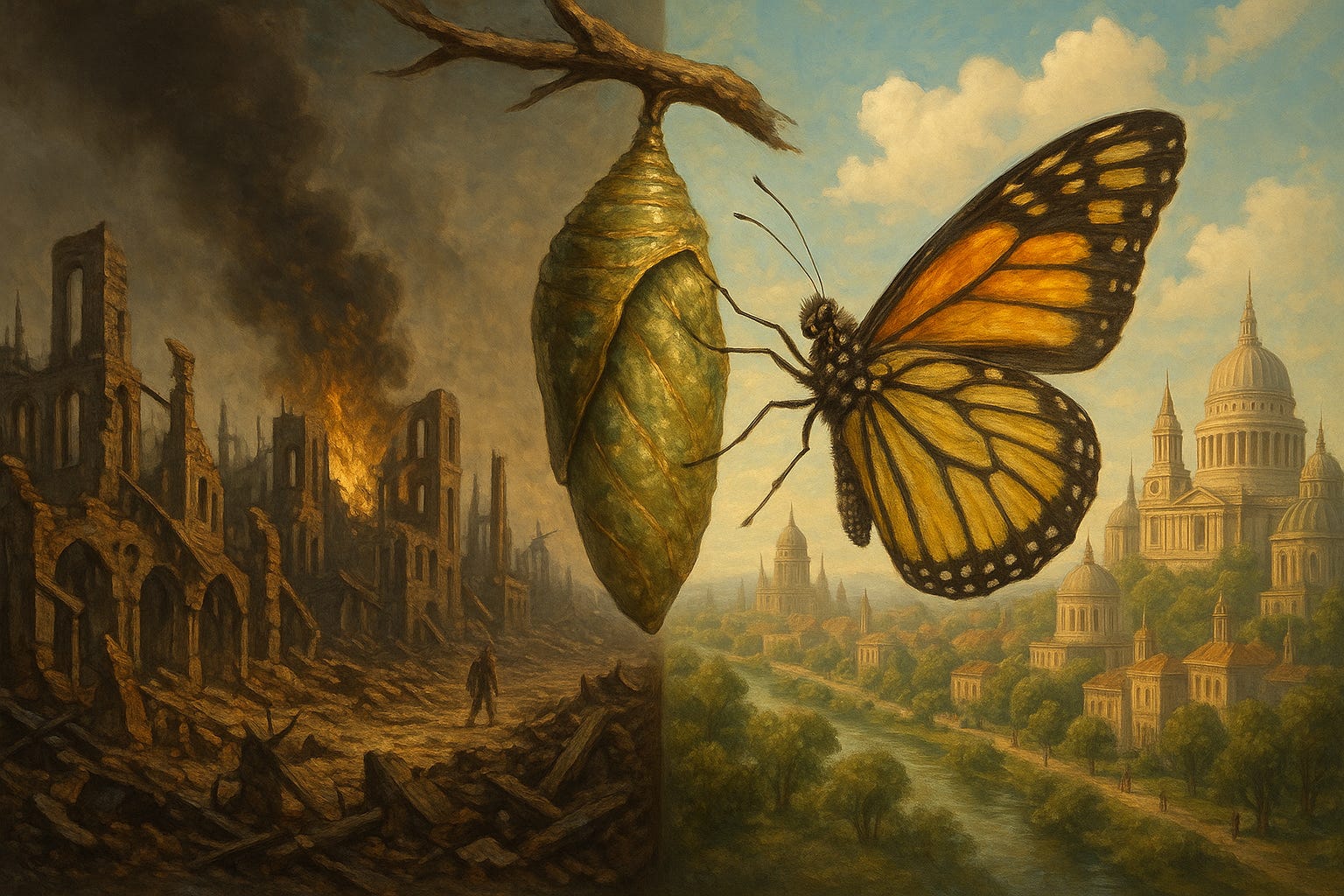
There’s a question that doesn’t appear in the standard commentary on civilisational crises, and its absence is itself revealing. The question I ask myself constantly is not what’s going wrong — that’s the question the doom-and-gloom commentary industry has been answering, loudly and competitively, since the birth of the internet. The more pertinent question is what’s already going right in the exact sense of what’s already starting to reorganise itself along different principles, in different places, according to a different understanding of what human life on this planet is for.
Asking the right question at the right time is so important. The distinction I am pointing to here matters more than it might initially seem. A civilisation that’s only failing is a different kind of phenomenon from one that is simultaneously failing and metamorphosing. By any external measure, the caterpillar in the chrysalis is dissolving — its organs liquefying, its structure becoming unrecognisable, its previous functional coherence as a caterpillar entirely gone. Someone that didn’t know about butterflies, observing only the chrysalis, would conclude that it was witnessing death. It would be wrong. The dissolution is the mechanism, not the outcome. But you can’t see that from inside the frame that treats the caterpillar’s form as the only available one.
It’s the same with industrial economism. The worldview that now governs the world-system’s organising logic, which is saturated in institutions, laws, educational curricula, and the common sense of people who have never heard its name — is in precisely this condition. Its structures are liquefying. Its contradictions, long suppressed by the sheer momentum of its productive power, are now visible everywhere simultaneously: in the climate disruption that its own accounting system can’t price, in the inequality that its own growth imperative generates and deepens, in the brittleness that its own efficiency doctrine has built into every supply chain on the planet, in the democratic exhaustion that its commodification of politics has produced, and in the loneliness that its atomisation of social life has normalised. The caterpillar is dissolving.
What the commentary industry — the crisis narrators, the doom merchants, the celebrity pessimists with their reliable audiences — cannot accommodate is the second part of the biological story. Dissolution, in metamorphosis, is not an ending. It is the precondition for a reorganisation that the previous form could not envisage, least of all accomplish. The imaginal cells — present throughout the caterpillar’s life, dormant in its tissue, carrying the blueprint of a different form — begin, when the dissolution reaches a certain depth, to organise. The old immune system attacks them. For a long time they are suppressed, dismissed, marginalised, and tolerated as eccentricity while the real decisions happen elsewhere. But the imaginal cells don’t disappear. They multiply. They find each other. At a critical density, the immune system’s assault fails — not because it is defeated but because it is outweighed. The soup reorganises around the new blueprint. The butterfly doesn’t come from somewhere else. It emerges from what the dissolving made possible.
The question worth sitting with — seriously, without the comfort of either optimism or despair — is whether the imaginal cells of a post-industrial civilisation are present and what they look like.
They are certainly present. And they look nothing like what the crisis narrators expect, because the crisis narrators are looking for a programme, a movement, a named political project that declares itself the alternative. The imaginal cells of civilisational metamorphosis don’t announce themselves that way. They are recognisable not by their ideology but by their structural coherence — the fact that, across enormously different cultures, disciplines, geographies, and contexts, they express the same underlying architecture, independently, as if responding to the same invisible attractor.
Consider Pakistan. Two hundred and forty million people, one of the planet’s most economically precarious nations, generating twenty per cent of its electricity from rooftop solar by 2026 – the fastest energy transition ever recorded, anywhere. Not driven by climate policy or international finance or state planning. Driven by ordinary Pakistanis who lost faith in a grid that kept failing and an electricity bill that rose by a hundred and fifty-five per cent in three years. A mosque in Islamabad could no longer afford to run fans during heatwaves; the congregation pooled money for rooftop panels; the neighbourhood watched the bill fall to almost zero; and within months the revolution was visible from space, blue panels carpeting the rooftops of every major city. “Individuals have made this decision,” said the chairman of the Pakistan Solar Association. “It’s a democratisation of solar.” The imaginal cells do not need a manifesto. They need the conditions that make the alternative more rational than the incumbent.
In Colombia, the Constitutional Court granted legal personhood to the Atrato River in 2016, using what it called a biocultural rights paradigm — recognising the “profound unity between nature and the human species” and mandating collaborative guardianship between communities and the state. In New Zealand, a mountain added itself to a slowly accumulating jurisprudence: Taranaki Maunga granted the same legal standing in 2025 as the Whanganui River had received eight years earlier, the third natural entity in the country to acquire rights, duties, and representation in its own name. These are not sentiments. They are architecture — a different premise about what has standing in law, expressed through the existing legal system’s own mechanisms, rewriting from within what counts as a subject rather than a resource.
In a poor neighbourhood on Amsterdam’s eastern periphery, an NGO in 2019 began signing what it called ‘doughnut deals’: a self-managed biogas facility, schools teaching repair with reclaimed materials, and residents collectively insulating their homes. Nine deals signed, combining social and ecological targets without identifying with any ideology, in one of the city’s least affluent districts — the opposite of the boutique progressive experiment the immune system expects to be able to dismiss.
In Reggio Emilia, a school system that has been quietly demonstrating for seventy years that young children, given genuine agency and a prepared environment, will teach each other things no curriculum anticipated — not as a philosophy of education but as a documented, replicable, structurally coherent alternative to the pipeline model that industrial economism requires.
The commentary industry barely noticed any of these. The imaginal cells keep building regardless of whether they are observed.
These are not marginal experiments or boutique alternatives. They are the leading edge of a distinct pattern. Their significance is not their current scale — they are, by the metrics of industrial economism, tiny — but their structural coherence. They share something more fundamental than any political programme: a different premise about the relationship between human beings and the natural world they inhabit.
That premise is what I call ‘ecority’ — a word coined because no existing word describes precisely the work required and because the concept it names is genuinely new, at least in the sense that it has not previously been articulable within the dominant worldview’s vocabulary. Ecority holds that ecology and security are not in tension but are in fact the same thing viewed from different angles: genuine security — the kind that can be sustained across generations rather than extracted and exhausted — is only available through ecological relationships, through the recognition that human flourishing is not separable from the flourishing of the living systems in which it’s embedded. Integrity is an associated term: the commitment to building that relationship honestly, without the evasions that industrial economism uses to maintain its mythology – the accounting fictions that exclude ecological costs; the growth metrics that count a divorce or the sale of cigarettes as progress; prisons as a growth industry; the unpaid labour of every parent who ever raised a child as nothing at all; and the security doctrines that mistake military dominance for the conditions of a liveable life.
Ecority is not a policy platform. It’s not the name of a party or a movement or an institutional proposal. It is an ontological reorientation — a different account of what’s real, what’s valuable, and what a human life well-lived actually comprises. It is, in that sense, a worldview – but a worldview in the full sense of the term, which means not an opinion or a preference or an ideology, but the atmosphere in which plans ripen or rot, the water in which thought swims without noticing it’s swimming. Industrial economism became the dominant worldview not because people chose it but because it congealed into the world-system — into legal systems, educational curricula, the design of cities and supply chains and financial instruments — until it no longer needed to argue its case. It simply was the case. Ecority’s task is not to win a debate but to become the new water in which we swim.
The gravity of ghosts is the phrase I use for the mechanism that makes this transition so slow and so arduous. Obsolete worldviews don’t simply evaporate when they stop being adequate. They persist as structural hauntings in the institutions they built, continuing to exert their pull on behaviour long after their intellectual credibility has expired. Legal frameworks that treat the natural world as property. Educational systems that instruct for an economy that’s already dissolving. Financial architectures that make short-term extraction rational and long-term regeneration unfinanceable. Political systems calibrated to electoral cycles of four and five years, governing a civilisational challenge that unfolds across centuries. These are not policies that can be changed by electing different people. They are the gravity of ghosts — the weight of a worldview that has sedimented into stone, exerting its pull on people who would not describe themselves as its adherents and who, in many cases, actively oppose it but who nonetheless make decisions inside the structures it built.
This is why the imaginal cells face such sustained assault. They are not merely proposing different policies. They are threatening the architecture. The immune system’s attack is therefore structural rather than simply political — it’s not primarily about ideology but about the survival of the form that the old worldview built and then cherished. A cooperative that demonstrates that democratic organisation can outperform hierarchy doesn’t threaten any particular corporation. It threatens the premise that hierarchy is the only rational form of productive organisation. A river with legal personhood doesn’t threaten any particular property owner. It threatens the premise that only humans have genuine legal standing. A school that produces ecologically literate, uncertainty-navigating, self-directed learners doesn’t threaten any particular teacher. It threatens the premise that education is preparation for employment in an economy that’s already long past its shelf life.
The resistance is therefore proportional to the threat, which means it is fierce. It’s also sophisticated because the immune system of industrial economism has had two and a half centuries to develop its defences and because the worldview it protects is extraordinarily good at absorbing and neutralising challenges by recoding them in its own language. ESG — environmental, social, and governance investing — is the most recent example: a genuine impulse toward accountability absorbed and metabolised into a metrics exercise that leaves the underlying extraction logic intact. Green growth. Sustainable development. Net zero by 2050. These are industrial economism’s immune system doing what immune systems do, identifying the imaginal cells as foreign and recoding them into something the old form can accommodate.
The task of the imaginal cell is therefore twofold. The first is to persist — to keep expressing the new blueprint despite the assault, to maintain the structural coherence of the alternative in the face of constant pressure to be absorbed and neutralised. The second is to find the other imaginal cells. This is more than networking. It is recognition. It’s the moment when communities and individuals who have been developing their alternatives in apparent isolation discover that they have been working from the same blueprint. The moment when their independent experiments converge on the same underlying architecture. The moment when they realise they’re not alone and they’re not marginal but are, in fact, the plurality that the old form can’t see because it has no category for them.
What makes the current moment different from previous moments of civilisational stress — and there have been many — is the simultaneity of the dissolution. Industrial economism is not failing in one domain while holding in others. It is failing simultaneously in its ecological assumptions, its social contract, its ideological legitimacy, its supply chain architecture, its energy model, and its epistemic foundations. The caterpillar is dissolving everywhere at once. This creates an urgency that previous transitions didn’t have, because there may not be time for the imaginal cells to find each other gradually, across decades, in the way that previous civilisational transitions unfolded.
But it also creates something else: visibility. When dissolution is partial and localised, alternatives appear eccentric — experiments at the margins, interesting, perhaps, but not necessary, easily dismissed as the enthusiasms of people who have not had to face the real constraints. When dissolution is total and simultaneous, alternatives become understandable as responses rather than eccentricities. The question stops being “why would anyone want to do it differently?” and becomes “how do we build what we’re already sensing we need?”
That shift in question is the signal that the critical density of imaginal cells is approaching. Not reached — the outcome is not guaranteed, and the forces of premature reconstitution are powerful; the pressure to rebuild the old form in slightly modified versions is immense. But imminent. And the essay you are reading now, and the conversations it will provoke, and the communities it will reach, and the recognition it may produce in people who have been building different things in different places without knowing they are building from the same blueprint — these are the things that imaginal cells do. Not a programme. Not prescribe. Recognise. Signal. Cluster.
There’s a temporal dimension to this that the commentary industry consistently misses, because it runs on news cycles and the imaginal cell process runs on something closer to geological time, except compressed. The expanded now—the practice of holding past, present, and future simultaneously in perception rather than treating the present as the only real tense—is not a philosophical luxury. It’s a navigational necessity for anyone trying to understand what is actually happening in a civilisational transition.
From within the contracted “here and now” of news cycles and quarterly earnings and electoral terms, the dissolution looks like crisis after crisis, each one apparently unprecedented, apparently requiring emergency response, apparently disconnected from the others. From within the expanded now, the pattern is visible: these are not separate crises but facets of a single structural failure, the simultaneous expression of the same underlying design flaw in multiple domains at once. And within the same expanded temporal field, the imaginal cells are also visible — not as solutions to individual crises but as early expressions of the architecture that comes after the dissolution.
The attractor is real. It’s not utopia — utopia is a no-place fantasy imposed on reality from the outside. The attractor is an emergent property of the system as it actually is, the direction that the dissolution is already organising toward, visible if you know the patterns to look for and have the temporal field to look in. A living civilisation that knows it belongs to the Earth, not the other way around. Where sufficiency replaces accumulation not as sacrifice but as a more accurate account of what human beings actually need to flourish. Where stewardship replaces dominion not as restriction but as the only relationship with the living world that is ultimately compatible with human survival. Where wisdom — the capacity to hold complexity, to navigate uncertainty, to make decisions across time scales longer than a career — replaces the management of decline.
This is a description of what imaginal cells are already building, independently, in thousands of places around the world, from the same or similar blueprint. The butterfly doesn’t need to be designed. It needs to be recognised in what is already forming, in the dissolution that’s already advanced, and in the critical density that’s already forthcoming.
The commentary industry will not tell you this. Catastrophe is attention; attention is their currency, and the attractor is not either. It’s something quieter, more patient, and considerably more consequential — the reorganisation of the dissolving paradigm around a new form of life that the old form never knew was possible because the old form never needed to dissolve far enough to find out.