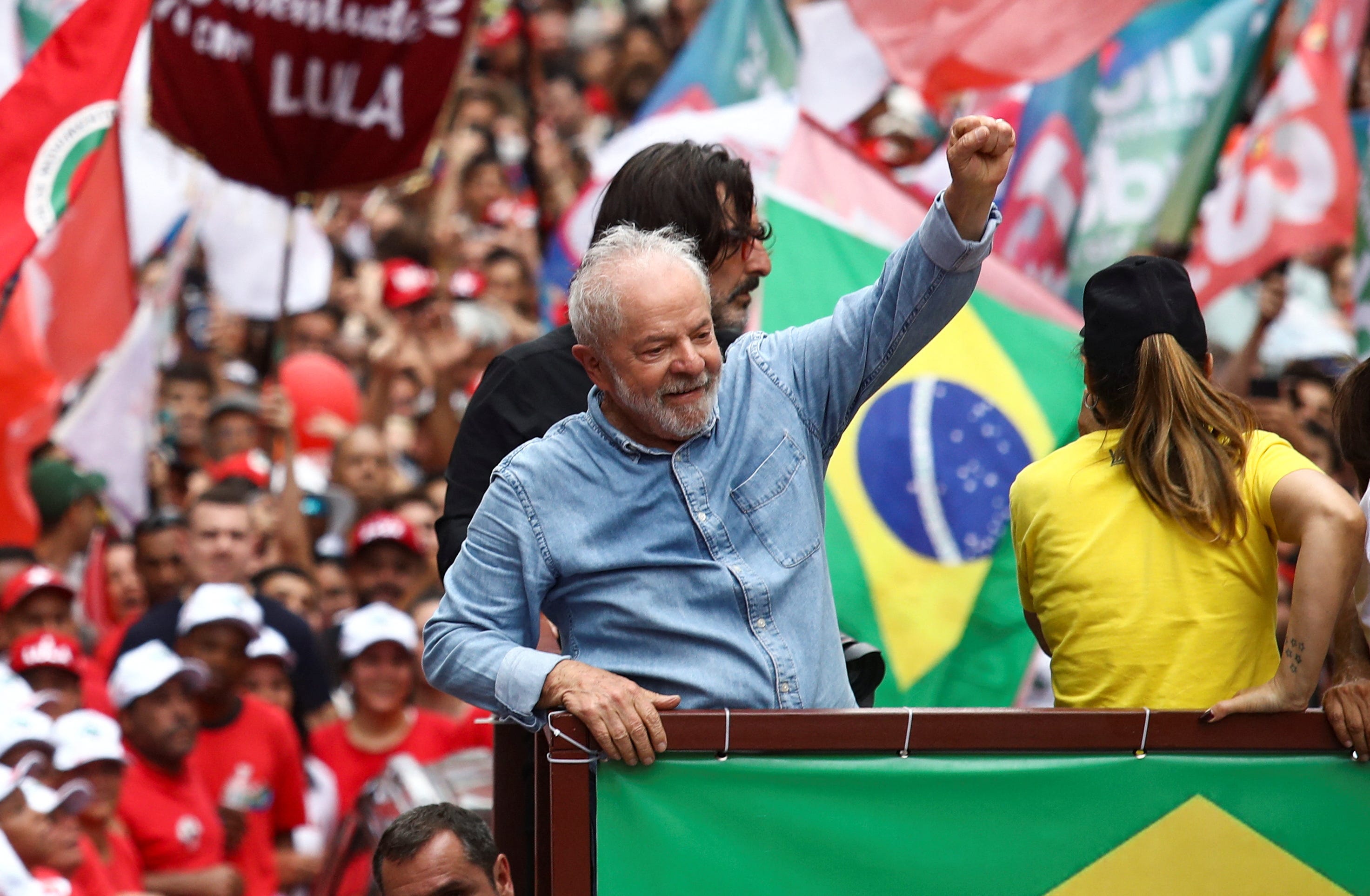
Synopsis: Politicians in democracies around the world could do well to note what’s happening in Brazil. Lula’s comeback in the election is already being turned into lessons for politicians elsewhere. Some of what happened can travel, because it rests on principle. Most of it can’t, because it’s specific to Brazil.
During the first round of Brazil’s presidential campaign, one television advertisement for the incumbent was given over entirely to rare earths. Rare earths! Somebody in Lula’s team obviously approved it. Probably several capable people did, convinced that a country sitting on minerals the great powers covet ought to hear about sovereignty, strategic reserves and its place in a reordered world. They weren’t mistaken about the minerals. They were sadly mistaken about who was actually listening, or about who had already stopped.
On 4 October roughly 33 million Brazilians didn’t vote. That’s about a fifth of the electorate, the highest abstention in a general election since 1998, in a country where, like Australia, voting is compulsory. Luiz Inácio Lula da Silva finished some two percentage points behind Flávio Bolsonaro, a gap of about 2.2 million votes. Three weeks later he won the runoff by close to 52 per cent to 48, a margin of more than four million. Since direct presidential elections returned in 1989, no candidate who trailed in the first round had come back to win. Bolsonaro has refused to accept the outcome and says he’ll seek its annulment, pointing to a late court decision that kept polling stations open two extra hours. Whatever is written about this result today is written about a result still under challenge. So what happened?
Within days of the first round, according to Reuters, the campaign had begun tearing up its communications strategy. Lula reportedly blamed the messaging for failing to reach young people and women, while party figures complained that his strategists had leaned on remote themes like sovereignty and critical minerals. He told allied lawmakers it was the most disorganised campaign he had taken part in since 1989. Control of the digital effort passed to a younger generation of elected officials. A WhatsApp channel launched by André Janones, a deputy from Minas Gerais, under the banner of Lula’s army, drew more than eight million followers within days. The campaign went looking for those who had stayed home, as well as the nine million or so who had backed candidates now eliminated.
The tone changed with it. Food prices. Debt. Wages, pensions, the bus fare. A proposal for free public transport at weekends, debt relief for microentrepreneurs. On 16 October, nine days before the runoff, Congress promulgated a constitutional amendment ending the six-day working week, lowering the weekly maximum from 44 hours to 40 in stages without any cut in pay. Alongside the promises came what insiders reportedly referred to as the fear strategy: reminding voters how much of their social protection a Bolsonaro government might take away.
It’s tempting to read all this as a story about money, which was indeed considerable. The Senate’s Independent Fiscal Institution put the benefits, subsidies and credit lines mobilised by the government in 2026 at nearly R$300 billion, though most of that is subsidised lending meant to be repaid; a little over R$90 billion falls directly on the public purse. Public debt stands at around 83 per cent of GDP. Yet the largest single cash gesture, a 15 per cent rise in Bolsa Família that lifted the minimum monthly payment from R$600 to R$691, was signed on 17 September. That was before the first round. Lula lost that round anyway.
So the cash arrived first yet still failed to turn the tide. What came after was a change of focus: who was spoken to, about what, and who was invited to do the speaking. Lula’s opponent understood the household just as well. Flávio Bolsonaro took to filming himself in supermarkets beside the shelf prices, pinning the cost of food on the government. By the end both campaigns were standing in the same aisle. What separated them was who held the phone.
Even the pivot was an import. One analysis argues that Brazil’s left drew its lesson from the defeat of Iván Cepeda in neighbouring Colombia, where a campaign heavy on grand themes lost to one fluent in daily anxieties. If that reading is right, what crossed the border was an orientation. Every detail had to be rebuilt on Brazilian soil.
This is where conventional advice to politicians from staffers and consultants alike tends to go wrong and where, I’m sorry to say, the advisory trade has a commercial interest in its going wrong. A victory gets compressed into a sequence of tactics, the tactics acquire labels, the labels are sold in other capitals with the confidence of a recipe. Mobilise your abstainers. Build a messaging army. Raise the transfer. Frighten them about the other fellow. Some of it may even succeed, once, somewhere. Yet two quite different kinds of counsel have been folded together, and confusing them is how sound advice becomes damaging.
The first kind proceeds from principle and from ethics. It holds in any territory because it concerns how people are treated, whatever they happen to be given. The second kind is tailored to a particular situation: one electorate, one body of law, one history, one set of fiscal constraints. Its detail will always differ from place to place. Principles can be offered to anyone who governs. Tailored advice can be offered only by someone who knows the ground intimately, and it expires when the ground shifts.
What seems to endure at the level of principle is modest, and harder to practise than to state. Speak to the life people actually lead. A citizen counting the cost of rice, beans, cooking gas or a bus fare hears a speech about mineral sovereignty as proof that the speaker lives on another planet. That verdict is reached as fast by a dockworker in Chittagong or a care assistant in Leeds as by a cleaner in São Paulo. People given a part in an outcome behave differently from people who are constantly lectured and spoken at. The eight million who joined that channel were asked to do something, which is a totally different invitation from being asked to agree. Trust accumulates over decades and can’t be manufactured in a fortnight. Lula was a metalworker, then a union leader in the 1970s, a founder of the Workers’ Party, a candidate who lost three presidential races before winning in 2002. No strategist could have invented that biography in three weeks. They could only stop hiding it behind rare earths.
Principle also asks for honesty about cost. A promise whose bill falls due after polling day is a loan taken out in the voter’s name, and the voter deserves to be told who will repay it. Generosity isn’t the fault. Silence about the bill is.
Fear is where principle and result part company. It plainly moved people in this runoff, or at least didn’t stop them shifting. An adviser coming from an ethical base still can’t recommend only that, for reasons as practical as they are moral. Fear mobilises people against a future, giving them nothing to build toward, and a government elected on alarm inevitably inherits a population primed to see half its compatriots as a menace. Both campaigns in Brazil taught that lesson to their own supporters. The refusal to accept the count, whatever its legal merits, now lands among people well rehearsed in dread of one another.
Then there’s the detail, which belongs to Brazil and almost nowhere else including other countries in South America. Mobilising abstainers meant one thing in a country where voting is compulsory and where the Workers’ Party read those 33 million absences as apathy, not hostility. In a voluntary system the stay-at-homes may have been gone for a generation; elsewhere abstention can be a protest, or a reasonable fear of being seen at a polling station. Same tactic, different people.
A WhatsApp army functions where most of a nation lives inside one messaging app, where data is cheap enough, and where an electoral court is willing to order a platform owner to treat candidates evenly, as Brazil’s did with Meta. Transplant it to a state that monitors such channels, or throttles them at election time, and the army becomes a list of names handed to the police.
Raising Bolsa Família presupposes a register built over more than two decades, reaching tens of millions of households, and a sovereign that borrows mostly in its own currency. A government under an IMF programme, or servicing debt in dollars, faces an entirely different arithmetic. The shorter working week needed a Congress in which the opposition also voted yes: the amendment passed the Senate 75 to one, with Flávio Bolsonaro among the ayes.
Australia, which shares Brazil’s compulsory voting system, shows how differently the same principle has to be tailored. There’s no reservoir of 33 million stay-at-homes waiting to be summoned back. Turnout at the 2022 federal election was close to 90 per cent, the lowest since compulsory voting began in 1924, yet still a figure most democracies would envy. The disengaged Australian rarely stays home. He or she turns up, is crossed off the roll, then votes for someone other than the two parties that once took turns at governing. And the runoff Brazil staged over three weeks happens in Australia on a single ballot paper, through preferences. Courting the supporters of eliminated candidates becomes a matter of preference flows, how-to-vote cards pressed into hands at the school gate, arrangements struck long before polling day. A strategist arriving from Brasília with a plan to mobilise abstainers would find far fewer of them than expected, while missing the contest that actually decides seats.
A further caution belongs here. The result tells us Lula won. It can’t tell us which of these measures won it, or in what proportion. The Northeast swung the count in its later hours, loyalties formed over fifty years did their part, and the opponent’s own weaknesses will have mattered too. Anyone selling a single cause is selling a story to the gullible.
There’s a larger pattern underneath, and it isn’t Brazilian. Across very different democracies the contest keeps collapsing toward the checkout: grocery prices, fuel, the monthly rental instalment. That convergence is partly healthy, a refusal by citizens to be lectured in abstractions. It’s also a symptom. A society that has taught its people to experience the state chiefly as a price, a transfer or a debt will elect whoever addresses the price most convincingly in the final fortnight, then punish them when the maths catches up. Australians have watched a version of this at close range. In February 2025 Anthony Albanese’s net approval sat at a record low. By May his government had won Labor’s largest margin since 1943, on a campaign the Treasurer cast as a referendum on Medicare, with more bulk-billing, a fifth wiped off student debts and rebates on power bills. Eighteen months later Labor’s primary vote is at historic lows in several polls, One Nation leads on first preferences, and one recent survey has the Coalition level with the government after preferences. Polls aren’t verdicts, and the causes are argued over. Still, the arc is recognisable on both sides of the Pacific: relief delivered, then forgotten by the next bill. Industrial economism has made the household budget the last place where politics is still felt, so that’s where politics is now fought. The principle that a leader must speak to lived circumstance is sound. What it can’t do, by itself, is widen the circumstance people are permitted to imagine.
For Brazil the tailored advice now concerns 2027, when the weekly maximum reaches 40 hours, when weekend fares have to be paid for, when subsidised loans begin returning to a Treasury already carrying debt near 83 per cent of output, and when the millions who came back to the polls this month find out whether being addressed directly was the beginning of a different relationship with those who govern them or a technique that lasted exactly as long as the count.