This post is a self-indulgent novelty. One for the archive! It was typed on 20th August 1989. By then I had made the decision to stop writing music and had made the move into management consulting. I had already started sketching my first book, “The Management Myth” which was to become a best-seller. That year I was employed as an Associate Director of Executive Management Services P/L in Sydney, working with a broad range of industry and government clients on strategic organisational design and development. At AFTRS I had been responsible for developing an experiential model of “dynamic learning” which effectively positioned the School in the vanguard of educational practice. I can’t recall in which journal this article was published. But in an explanatory note it made clear that I had recently completed a string quartet for the Arditti Quartet and a large music-theatre work, “Danses Gothiques”, was about to be premiered at Monsalvat in Melbourne by Elision Ensemble and Handspan Theatre. It also noted that I had seven musically talented children, all of whom were educated at home. I now have ten children and 17 grandchildren - but that’s another story.
I am a fan of Jerome Bruner’s claim that we’re in an epistemic age, an age where we must begin our investigations into what we do, and how we do it, by questioning our assumptions about knowledge and about our ways of knowing.
Learning “as the perception of newness” is itself a creative act. In the field of music education innovation and what might be called interactive self-perception - the ability to explore the inner self as discreet from, and in addition to, the external environment - are preeminently significant. It follows that if tomorrow’s artists are to continue to innovate in such a way as to add to our understanding and appreciation of human creativity they must be educated in an environment which itself is characterised by intelligent and articulate innovation.
To some extent the excellence of any arts training organisation can be measured by the immediate impact it makes on the profession. More importantly, it must strive to significantly assist all those associated with the art form to meet future responsibilities. It must remain innovative, nurturing interactive links with the community and facilitating learning as a creative and ongoing process.
The need for continuing innovation in the arts, and in the education and training of contemporary artists, is self evident. But can I, dare I suggest, that as the most time-tabled, inflexible, repetitious phase of our life occurs in the classroom we’re mindless before we ever reach the concert platform. How else could we sit down to watch a programme on television and accommodate severe disruptions in the performance at regular intervals by inane advertisements trying to convince us to change brands of toothpaste or washing powder or motor car.
Early in 1986 a report was released in the USA of an exhaustive study of the needs of teaching as a profession for the 21st century. Contained within it were two particular sentences which gave enormous heart to those of us who, for the previous ten years or so, had been battling to give life to a new model for education. The Carnegie Report stated that “the students of tomorrow must be active learners, busily engaged in the process of bringing new knowledge and new ways of knowing to bear on a widening range of increasingly difficult problems. The focus of schooling must shift from teaching to learning, from the passive acquisition of facts and routines to the active application of ideas to problems”.
My own modest initiatives at Dartington in the UK and then at the Victorian College of the Arts and eventually the Australian Film, Television and Radio School, where I was Head of School, was based firmly in these notions of the need for new ways of knowing - themselves reflecting the need for new reasons for knowing and for active application of ideas to problems.
For as long as we have had formal education it has been plagued by huge differences between two major traditions of scientia on the one hand, and techne on the other. These two basic educational traditions are so different and in so many ways that they have spawned their own careers and professions, their own institutions and associations, and certainly there own passionate supporters and ardent critics. The type of knowledge with which each approach is associated, and the ends to which such knowledge is put, are as markedly different as the methods of instruction used to impart them; and I used the verb “to impart” advisedly. The convention of scientia has become grounded in propositional knowledge, historical facts, theories, laws, principles, axioms, etc. which are generated by some (teachers) and communicated to others (students). This is the world of harmony text books and so often to the chalk and talk of the pedantic pedagogue. Techne is about doing. Here, knowledge is of the practical kind. If the focus of scientia is disciplines, then that of techne is crafts. Techne is the world of hands-on learning; of competence, and knowing how to do things and the carefully controlled instructions of the master artist-teacher.
As already implied, both of these traditional approaches are as old as education itself and commitments to their different ways of doing things can be easily seen in the separate development of our universities on the one hand (scientia) and our conservatoria on the other (techne). The more recent demise of the Colleges of Advanced Education, and their failure to establish a unique identity, has as much to do with an ambivalence about which of these two “traditions” to support as anything else. They have fallen victim to the “either/or” culture. Meanwhile our secondary schools tend to be highly biased towards the former with facts and theory being prime.
Both approaches are valuable however, and although each neads the other there’s an awkward and sometimes unbridgeable gap between them. Even when they can be integrated, however, they still together exclude a vital dimension: learning to know plus learning to do does not add up to learning to be.
Of prime concern to me as a practising artist working in education, for example, was the reconciliation of the almost obsessive commitment of many young creative arts specialists with the need for an informed outlook which places the obsession in a more realistic and wider cultural context. The real dilemma of any music school today is that the dictates of traditionally rarefied concepts of training leave little room for manoeuvre, to the extent that student frustration remains inarticulate and fundamental questions of pedagogy are distorted to fit the existing receptacle.
Rather than entering the debate about the relative merits of the existing “traditions” and how any imbalances between them could be redressed for more effective arts curricula, I intend shifting the focus to the re-emergence of a tradition based on “learning to be” - equivalent to Carnegie’s “new ways of knowing”.
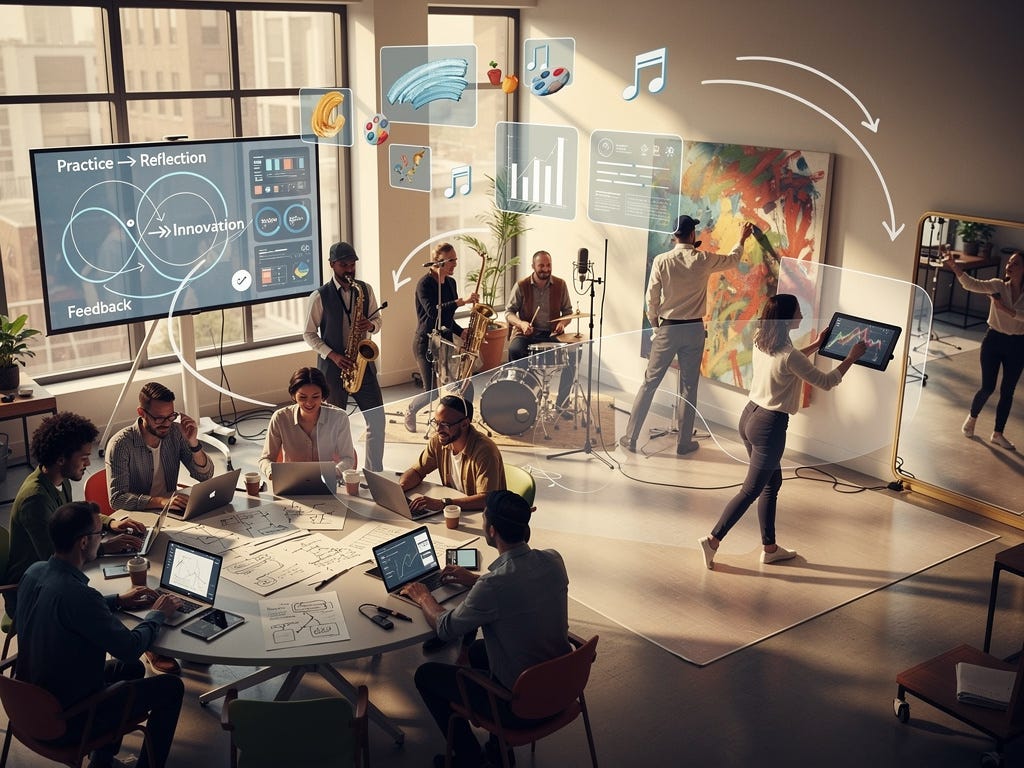
Learning in the creative arts should be an action-packed, hustling-bustling process, by which each of us adapts to changes in our environments. Learning, in such a personal context, is the transformation of our direct experiences into knowledge as meaning as a precursor for action. As a process it involves us intimately with the various worlds around us - encouraging us to feel and to sense and to value, as well as to think and reflect, and finally to act. Above all it’s a creative process. We can portray it as a flux between “finding out” about our world (and our own relationships with it), and “taking action” to change (our relationship with) it.
Knowledge in this model is experiential and the tradition of creating it for action is termed praxis. In presenting praxis here as a third and integrating tradition I affirm my belief that it represents a vehicle for fundamental curricular reform appropriate to music institutions, and which:
introduces students to a form of learning which of us is of immense value to them as they attempt to daily sort out issues related to who it is they are hoping to become, rather than what it is they have to know, or have to know how to do;
affords a way of exploring complex, changeable, and ambiguous issues in their everyday lives for which there are no clear propositional answers, nor currently existing practical solutions;
provides a focus for learning as the personal process of improving situations in which the artist is actively involved; and
emphasises interactions between individuals and (i) other individuals, and (ii) their artistic environments, with a sense of wholeness and purpose.
We should expect our students to learn through doing (through the conduct of self-directed learning and real world learning projects); to reflect deeply on their learning; and to develop values, knowledge, and competencies, plus ways of valuing, knowing, and becoming competent, at managing the complex and dynamic changes occuring in our contemporary world.
Perhaps the whole notion of formal arts education for a post-industrial, information-rich world, needs to be reconceptualised, and a new system built from the emergent maps. This model would be idiosyncratic and creative and based on experiences real to each learner. It would address competencies, and multiple intelligences, and feelings, and listening, and thinking, and doing. In effect the environment I seek would come awfully close to that described by Carl Rogers as:
1. Having the quality of personal development: the whole person, in both their feeling and cognitive aspects, is involved in the learning situation
2. Tending to be self-initiated: even when the primary impetus and stimulus come from outside the sense of discovery and of reaching out, grasping, and comprehending, comes from within
3. Inclining to pervasiveness: it tends to make a real and perceptible difference in the behaviour, the attitudes, the psyche, and even the personality of the learner
4. Being largely evaluated by the learner: the locus of evaluation is resides in large part in the learner
5. Having personal meaning as its essence: when learning takes place, the element of meaning to the learner is built into the whole experience.
The experiential model enables learning through the active exploration of issues which are of personal significance to the learner. It encourages them to focus equally on their values and attitudes, their knowledge and their overall competencies, and to integrate all of these domains into their growing “knowledge-for-action-for-change” - both of themselves, and of their environments, all considered with a sense of wholeness.
During their experiential learning, they will access propositional knowledge as well as gaining practical knowledge. The tradition of praxis therefore provides both the focus and an intrinsic motivating force for the expansion in both scientia and techne traditions. It’s an integrating mechanism, as well as being a learning tradition in its own right. We can therefore visualise three domains of learning as one systemic whole; an intellectual map of arts education which offers an absolute ocean of opportunities for reform.
Using it I can imagine how arts, sciences, technologies, humanities, and personal development can all be related in meaningful ways. I can picture how individual and group activities can be planned, and how a whole host of relationships can be restructured. Indeed how the whole purpose and functions of music departments within schools, colleges, and universities, might be changed in ways that sees such institutions and their communities in dynamic co-adaptation with each a part of a dynamic whole, learning culture: where the natural tendency is to enquire into change, to conceptualise it, and to base such adaptations on such understanding: where schools, arts communities, entrepreneurial organisations and services, all behave as vital systems, openly interacting with their environments instead of being reactive or (even worse) hermetically closed to the outside, and apparently immune to change - i.e. frozen in time.
Under my guidance, the Australian Film, Television and Radio School was working towards becoming one such open system. Thus our curricula were genuinely transformational and in constant evolution. The basic experiential model remained central to the whole initiative and changed little. But the nature of the projects, and of the inter-relationships with others in the arts, media, broadcasting, and telecommunications industries, was constantly changing. These dynamic changes were reflected not only in new student activities, but also in the whole purpose of the teaching faculty, which emerged as a resource open to all in the radio, film, and television industries, who were keen to “learn how to learn in new ways”, ways which coincided with the needs of their daily lives and the ambiguities and changes associated with them. In essence, we were becoming a community of learners sharing ideas and ideals and experiences. Who now were the teachers, and who the learners?
And all of this led to vigorous organisational and educational change - a fundamental reform far removed from the “tinkering with curricula” that’s used so often, through either apathy or self-interest, as a means of avoiding real reform. At AFTRS we demonstrated that reforms beyond the “tinkering with curricular” syndrome are both desirable and feasable. Even more importantly, we were using conceptual models informed by an ever-growing and rigorous body of theory to guide us in our experiential quest. These reforms effectively repositioned the AFTRS from being yet another educational institution working on the periphery of the industry to an experiential laboratory, research, and resource centre, whose work is now considered to be a vital catalyst in determining the future health of the local film and broadcasting community.
Today we need urgent reform of all our learning institutions if we’re going to “learn how to be”; if we’re going to learn how to develop sustainable relationships with our environments, both economic and socio-cultural based on self-knowledge and insightful adaptation; and if we are to learn how to create and sustain the futures we want.
The implementation of a viable experiential model might well provide the impetus for genuine synaesthetic experiments and interdisciplinary work within the arts, and would particularly facilitate contact, exchange, and interaction, between artists and new technologies.
It might also serve to re-order priorities, and change emphases sufficiently to curtail some of the more blatant compromises and conflicts that have grown like topsy in our music training institutions - such as the fallacious debate regarding the relative values of craft versus expression, or the prevalent attitudes concerning the promotion of technical advancement often to the detriment of personal development, for example.
Incidentally, it might also encourage the continuing emergence of an authentic, non-derivative, Australian culture. Given such a short history of settlement, Australia seems in an ideal position to develop a new moral operating code, based on a multi-cultural impulse and direction. It seems to me that the aesthetic traditions of Europe are almost totally misplaced in the local context unless they are absorbed into a culture able to transcend their origins.
Of equal importance from an educational standpoint is the adoption of suitably synergistic mechanisms for communicating knowledge, as an alternative to the conservative pedagogical format. For if learning really is the creative process by which each of us transforms our personal experiences into our personal knowledge, cannot the “lecture as standard” method be challenged as an effective medium for learning? At least in the field of creative and performing arts?
All institutions of learning should be open networks - systems where diverse and controversial ideas can interrelate to form a larger context of interdisciplinary community; dynamically evolving, learning entities, openly interacting with their environments and, in turn, creating conditions whereby those environments can themselves learn from the system.
As an innovating organisation, with outputs of innovations, as well as of innovating people, such an entity within the context of our profession would be creating new ways of thinking and, most importantly, new ways of practice. It would be recognised for the profundity of its theoretical base, the clarity of its philosophical stance, the effectiveness of its practises, and its sheer utility.
Whatever else I have learned from working in and around education, the primary lesson must have been that this kind of entity does not yet exist within the arts in Australia. In terms of the music profession, if we’re to adapt to the changing needs of society as we enter the last decade of the 20th century we shall need urgently to adopt innovative measures. But innovation demands exceptional talents of leadership to create and sustain a climate of positive change, alongside the creativity to manage change effectively.
This leadership must combine support with challenge, vision and strategic thinking with pragmatism and operative actions, and a relentless commitment to both personal and systems learning. Unfortunately such leadership is in extremely short supply. I am also sensitive to the fact that:
“There is nothing more difficult to take in hand, more perilous to conduct, or more uncertain in its success than to take the lead in introducing a new order of things”.
Niccolo Machievelli