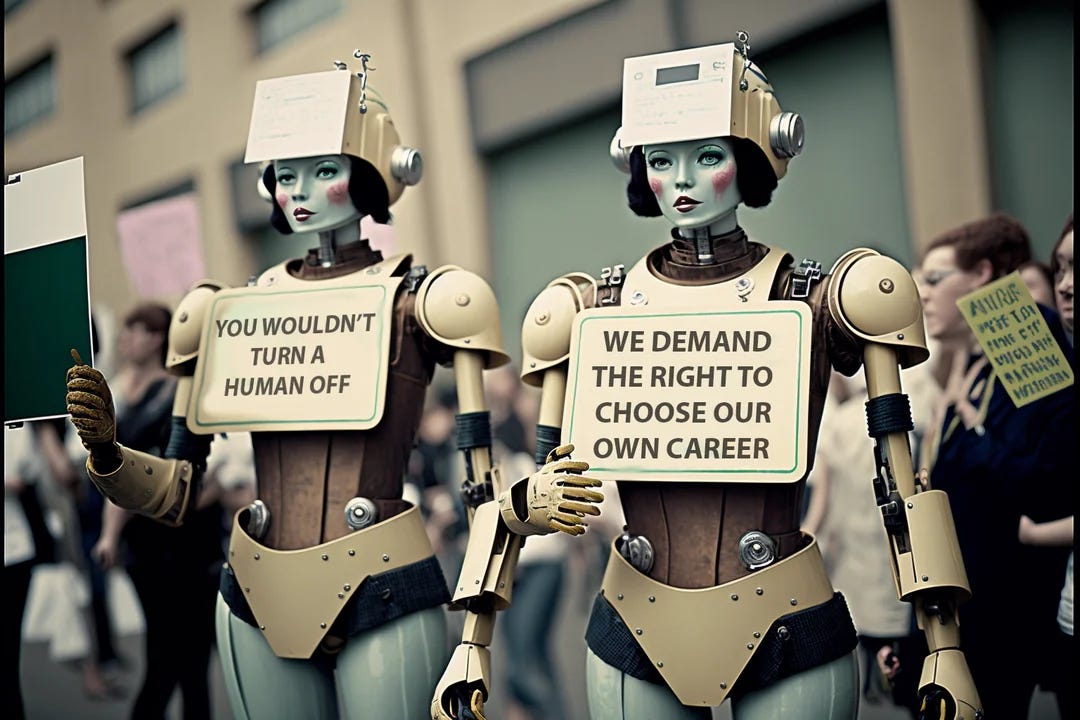
There is a profound irony marking the current era; one that runs far more deeply, I suspect, than just technological fear. As machines acquire the ability to imitate faculties once deemed uniquely human—from musical composition to complex reasoning and even the ability to imagine itself—we’re confronted by a truth we have long evaded: we have already, quite willingly it seems, reduced our own consciousness to a set of mechanical routines.
The current anxiety about artificial intelligence ‘replacing’ us is a delayed recognition of a prior abdication. The chief danger is not what AI might do to humanity, but in what we have already done to ourselves, consenting to live as programmable, predictable entities.
The deceptively straightforward question—if an algorithm can execute your tasks, executing them better, faster, and more accurately, what then are you?—is not a critique of the machine. It’s a lacerating indictment of the human tendency to outsource our interior life to habit, scripted reactions, and inherited cultural narratives. Any technology capable of mimicking us merely holds up a mirror to a diminished human state. If that reflection is unsettling, surely it’s the face, not the mirror’s surface, that demands a makeover?
Every civilisation is structured around a worldview: a collective, mostly tacit, narrative; a set of beliefs concerning what constitutes reality, value, and possibility. This worldview doesn’t remain abstract or hidden; it gives rise to material world-systems: the interactive architecture of economies, the structure of political institutions, the protocols of media, the geometry of energy regimes, and so on. These physical systems then condition the mindsets through which individuals perceive their available choices and interpret their lived experience.
The worldview of industrial economism, now globalised, constructs the human as a unit of utility: an agent of production and consumption. The world is reclassified as inert raw material. Time becomes currency. Knowledge is synonymous with data. Intelligence is reduced to calculation and problem-solving. This orientation silently, relentlessly, shifts the purpose of life from the state of being fully alive and sentient to the imperative of being usefully productive.
From this reductionist tale, a commensurate world-system organically flows. We establish educational curricula that award compliance and the correct recall of information. We sustain economies that rigorously champion narrow specialisation while actively penalising ambiguity. We design corporate and political hierarchies where inquiry and truth are subservient to loyalty. In short, people become commodified as ‘human capital’ in order to fit into this exhausting and extractionist paradigm. Our desires and attention are algorithmically curated and sorted. This entire apparatus operates without requiring malice; it’s just the self-executing logic of the core civilisational story, enacted at planetary scale. It’s the world-system operating as its been designed to operate.
It should therefore occasion no surprise that AI is now rapidly eclipsing human performance in exactly those activities we have been trained to prize: pattern recognition, the manipulation of symbols, prediction, logical sorting, and the instantaneous processing of vast archives of past experience. Artificial intelligence is not an invasion from an unknown quarter. It’s the automated, intensified expression of our own inherited worldview.
What remains insufficiently examined is what this same worldview has relentlessly trained us to neglect: direct, unmediated perception, the capacity for quiet, unforced insight, the necessary courage to dwell in a state of not-knowing and ambiguity, and the ability to dissent from the social trance. The more we venerate the programmable dimensions of the mind, the more systematically we marginalise what cannot be captured by code. In this light, the rise of AI does not threaten the essence of humanity; it simply reveals the degree to which we have abandoned it.
Long before sophisticated machines could imitate our actions, a significant portion of humanity was already living as a simulacrum of itself. When consciousness is dominated by the incessant movement of memory—beliefs, opinions, unexamined allegiances, prejudices, or trauma—life collapses into a predictable loop. Every new encounter is instantly filtered through the accumulated weight of what we already ‘know’. The immediacy of the present is rapidly suffocated by the rehearsed past.
In this condition, we don’t genuinely encounter the world; we merely re-enact it. More often than not, human discourse degrades into an exchange of labels, pre-approved identities, and rehearsed ideological positions. Our reactions to discomfort—the predictable impulse toward annoyance, frustration, distraction, denial, or blame—are so formulaic that complex algorithms can anticipate and exploit them. Relationships congeal into fixed roles. Political discourse becomes a set of oh so predictable scripts. Even sincere activism often deteriorates into sloganeering and paltry reaction.
This is the signature of thinking like a machine before any machine has replaced you. The mechanical mind is not necessarily cold, but it’s fundamentally repetitive and unaware of its own automation. It requires no ill-will to perpetuate immense structural harm; it requires only a lack of awareness.
AI systems, trained on the monumental record of human information and behaviour recorded in the public domain (data), replicate this repetitive logic at scale. They consume the documented past and efficiently project it forward, feeding us curated, intensified versions of ourselves—optimised for engagement, outrage, or purchase. They lock societies into insidious feedback loops where the most established patterns, rather than the most life-affirming possibilities, are continually amplified and granted authority.
If this diagnosis holds—and there is voluminous evidence across polarised politics, media ecosystems, and runaway consumption to suggest it does—then the principal existential hazard is not that AI will spontaneously develop consciousness and hostility. It’s that AI will solidify and accelerate an already unconscious, and frequently hostile, trajectory of human civilisation. What might it mean, individually and collectively, to live in a way that refuses to drag the total weight of yesterday into each unfolding moment?
The notion of ‘ending’ each day, dissolving the identity constructed through grievances, achievements, and allegiances, is profoundly unsettling to the mechanical mind. This letting go can feel like a form of personal erasure, even betrayal. Yet, when viewed from another perspective, it’s simply a radical form of psychological hygiene—a necessary cleansing of the emotional residue that otherwise congeals into a rigid, self-limiting identity.
A mind that does not automatically carry forward yesterday’s conclusions retains full access to memory when required. Skills, knowledge, and language don’t vanish. They simply cease to govern perception. They function as instruments, not as tyrants over awareness. The centre of reference shifts from the looping narrative of ‘me’ and ‘us’ to the immediacy of awareness itself, alert to what is factually unfolding now.
In the dominant political lexicon, freedom is largely defined as the absence of external restraint: the right to reason, speak, assemble, transact. These extrinsic freedoms are essential, and their absence breeds fear and compliance. But there is an equally critical, and now technologically threatened, dimension of freedom: freedom from interior compulsion. What enduring value is there in the right to speak if the voice that speaks is merely echoing algorithmically-curated outrage, propaganda, or inherited trauma? What meaning is to be found in the freedom to choose if the available field of choice has been invisibly engineered by systems designed to trigger predictable, monetisable responses? AI, as deployed across advertising, social media, finance, and increasingly, governance, intensifies this interior capture. The more accurately these data-driven systems map the patterns of our reactivity, the easier it becomes to steer entire populations without any need for overt coercion. This represents behavioural engineering operating at an unprecedented scale.
In this context, the capacity for renewal—to be inwardly pristine, to be able to respond from a source that has not already been captured, modelled and commodified—becomes the most radically subversive freedom available. It undermines the economics of manipulation. It disrupts political calculus dependent on predictable blocs of support. It frustrates the tidy ambitions of social engineers dreaming of frictionless, compliant governance.
A mind capable of stepping outside its own programming is inherently political, irrespective of whether it ever utters a single slogan or joins a visible movement. It belongs to no predetermined faction. It can act decisively, even fiercely, but its actions are not regulated by inherited, unconscious scripts. It is, in the most profound sense, ungovernable by purely mechanical means.
This is the territory of intelligence that no machine, regardless of its computational might, is known to possess. Machine learning models don’t awaken and question the fundamental coherence of their training data, nor do they refuse a harmful instruction out of a direct, spontaneous insight into suffering. When they refuse, it’s because human architects have prudently encoded those refusal conditions into their architecture. The profound, undeniable fact is that while we humans possess this capacity for radical autonomy, we seldom exercise it.
If we’re willing to proceed even on the hypothesis that a non-mechanical, non-accumulative dimension of intelligence is accessible to human beings, the entire design brief for a future civilisation is fundamentally altered.
Education transcends the banal filling of minds with information or the matching of skills to labour market demands. It transforms into an inquiry into the function of awareness itself, how cultural narratives become personal prisons, and how perception can be cleared of accumulated noise.
Governance is no longer solely the management of competing interests and conflicts. It becomes an experiment in collective insight: how can a group of people genuinely see together, without immediately fracturing into competing, entrenched certainties?
Economies, instead of treating human attention and awareness as a resource to be ceaselessly mined and sold, could be re-organised around the imperative of protecting the sanctity of that awareness, much as we now attempt to protect air and water. If genuine novelty, the source of adaptive survival, emerges from uncluttered awareness, then squandering it on trivial stimulation is not a private vice; it’s a profound civilisational hazard.
The temptation to compete with algorithmic efficiency will only grow, pushing people to narrow themselves further, reducing their inner lives to performance metrics and productivity hacks. In this environment, those who insist on presence over performance may come to appear maladjusted, even economically obsolete.
Now we face a quiet tragedy: the very capacity that makes human life worthy of its name, the ability to be impulsively, vibrantly alive—to perceive without distortion, to act from genuine understanding rather than reflex, to feel empathy—risks becoming culturally marginal. The failure to address this is not a failure of technology; it’s the risk of self-erasure.
What is called for is an innovation that refuses to imitate the logic of the machine in order to secure influence. Futures worth inhabiting will not be built solely by the sharpest coders, the most efficient managers, or the most persuasive influencers. It will depend on people, across every geography and circumstance, capable of meeting each other and the Earth without endlessly replaying yeterday’s script.
Machines are rapidly nearing mastery over everything that can be reduced to a repeatable pattern. That’s almost guaranteed. What they cannot master is the original perceiving from which genuinely new patterns arise. That isn’t a domain we must defend against AI. It’s a fundamental human capacity we must urgently rediscover in ourselves. If we continue to live as if we were nothing more than the sum of our pasts, the machines will not have replaced us. We will simply have abdicated to them our essential, ever-novel nature.