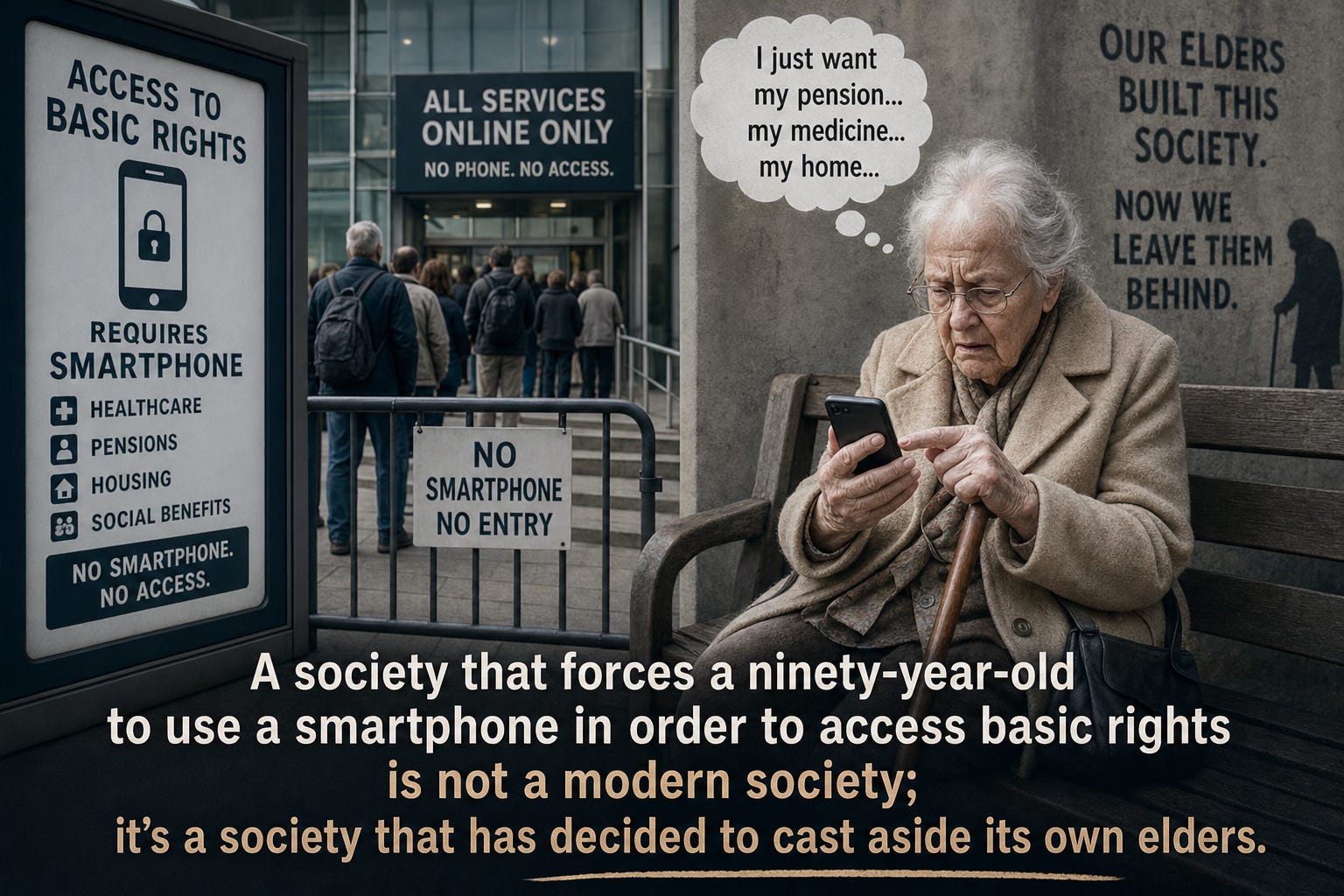
There’s a passage circulating online — one of those unsigned reflections that gains traction precisely because it names something people feel instinctively but haven’t yet articulated:
“A society that forces a ninety-year-old to use a smartphone in order to access basic rights is not a modern society; it’s a society that has decided to cast aside its own elders.”
It lands with me personally because it identifies something many societies are quietly normalising: the automatic conflation of digitisation with progress. And it raises a question far more uncomfortable than most institutions are prepared to answer.
For the last two decades, governments and corporations – from Apple to Google to public service agencies across the so-called ‘developed’ world – have operated under a foundational assumption so pervasive it has gone largely unexamined: namely, that efficiency equals improvement and that improvement benefits everyone.
The logic appears self-evident. Digitise a process, reduce friction, eliminate queues, and cut costs. From the institutional vantage point, the equation is elegant. A banking app replaces a branch. An online portal replaces a waiting room. A QR code replaces a printed menu. Each iteration is faster, cheaper, and more scalable. But efficiency for institutions can actually mean exclusion for citizens.
When access to healthcare requires navigating a patient portal. When banking demands biometric authentication on a device. When public transport operates through contactless payment systems with no cash alternative. When government services — pensions, housing applications, tax returns — migrate to digital-only platforms. In each case, those without digital fluency are not simply inconvenienced. They are effectively disenfranchised.
This is not a marginal population. In the United Kingdom alone, approximately 2.4 million people over the age of 75 have never used the internet. Across the European Union, nearly one in five citizens over 65 lack basic digital skills. In developing nations, the figures are even more stark. And these numbers don’t capture the millions of people who can perform simple tasks on a device but can’t navigate the increasingly complex architectures of multi-step verification, app updates, cloud-based document storage, and algorithmic customer service pathways that now stand between a citizen and their entitlements.
The innovation narrative tells us these people will “catch up”. That digital literacy programmes will bridge the gap. That time itself will solve the problem as younger, more digitally native generations age into these systems.
This is both empirically questionable and morally insufficient. Empirically questionable because digital systems don’t stabilise. They iterate. The interface a seventy-year-old learns today will be redesigned within eighteen months. The app they master will require an update their device can’t support. The process they memorise will migrate to a new platform. Digital exclusion is not a static gap to be bridged — it’s a moving threshold that outpaces those with the least capacity to adapt by design.
And it is morally insufficient because it places the burden of inclusion on the excluded. It says, in effect, ‘The system is not failing you; you are failing the system.’ Strip away the specifics — the smartphones, the apps, the QR codes — and what remains is a question of civilisational architecture: Who is society designed for?
This is not, at its core, about elderly people and technology. It’s about what a society reveals when it constructs systems that are structurally incapable of accommodating those who can’t keep pace with their evolution.
Every civilisation makes implicit decisions about who belongs within its functional boundaries. These decisions are rarely announced. They are embedded in infrastructure, in policy design, and in the assumptions encoded into systems long before any individual encounters them. The Roman road network determined who could trade. The printing press determined who could access knowledge. The automobile reshaped cities around those who could drive.
Digital infrastructure is no different. It’s not neutral. It carries within it a set of presuppositions about the competencies, resources, and capacities of those it serves. And when those premises go unexamined, they function as a filter — silently sorting populations into those who remain visible to the system and those who become invisible within it.
A civilisation reveals its moral architecture not by how it treats those at the centre of its systems, but by how it treats those at the margins. The issue is never whether a society can innovate. It’s whether it can innovate without abandoning those for whom innovation was never designed.
I’m a great admirer of Hannah Arendt, who warned that systems built around abstraction eventually detach from lived human reality. That bureaucracies — and we must now include digital bureaucracies — develop their own internal logic, and it’s invariably one that prioritises procedural coherence over human outcomes. The system becomes its own justification. Its efficiency becomes its own ethic. And those who fall outside its parameters are not oppressed in any dramatic sense. They are simply… unaccounted for.
This is what makes digital exclusion so insidious. It carries no malice. It requires no villain. It’s just the cumulative consequence of thousands of rational decisions, each defensible in isolation, that together produce a landscape in which participation in civic life becomes conditional on technological competence.
There’s a structural inversion occurring across modern service design that deserves more scrutiny than it receives. Modern systems increasingly optimise for the provider, not the recipient.
Consider the following. Automated hospital check-ins reduce staffing costs — but transfer the cognitive burden to the patient. QR-only restaurant menus eliminate printing expenses — but assume every diner carries a charged, internet-connected device. Digital identity verification streamlines institutional processing — but demands that citizens maintain current hardware, remember passwords, and navigate multi-factor authentication. Chatbot-only customer service reduces call centre expenditure — but forces users through decision trees designed around the company’s categorisation of problems, not the customer’s experience of them.
In each case, what’s marketed as “convenience” is convenience for the institution. The friction has not been eliminated. It has been transferred from the organisation to the individual. And that transfer is not distributed equally. It falls heaviest on those with the fewest resources to absorb it: the elderly, the disabled, the digitally disqualified, the cognitively impaired, and the economically marginalised.
This inversion is profound because it’s invisible to those for whom the system works. If you are forty-three, digitally fluent, and carrying a recent-model smartphone, the world appears to be getting simpler. Frictionless. Efficient. You don’t see the exclusion because you’re quarantined from it. The system is designed around your capacities, and so it feels natural — inevitable, even.
But design is never inevitable. It is always a choice. And the choice being made, repeatedly and at scale, is to design for the median user while treating deviation from that median as the individual’s problem to solve.
Beneath the surface of every digital-only system lies an assumption so uncomfortable that it’s rarely spoken aloud: If you cannot adapt to the machine, society has decided you are no longer worth designing for.
This is not phrased this way in any policy document I can use as evidence. No government minister announces it. No corporate mission statement contains it. But it’s the functional reality for millions of people in advanced economies today.
When a bank closes its last physical branch in a rural community and directs customers to its app. When a GP surgery moves to online-only booking and offers no telephone alternative. When a government department eliminates paper forms and provides only a web portal. The message, stripped of its bureaucratic language, is ‘We have moved on.’ Keep up or be left behind.
This is a form of structural abandonment. Not dramatic. Not intentional in any individual decision. But cumulative, systemic, and — for those on its receiving end — absolute.
The ninety-year-old who built roads, paid taxes for seven decades, and raised children who now staff the very institutions that exclude her hasn’t failed society. Society has reorganised itself around an assumption that no longer includes her. She has been architecturally removed from the civic landscape.
And she is not alone. She is simply the most visible case of a much broader phenomenon: the emergence of a class of people who are citizens in name but excluded in terms of function. Present in the population, absent from the system. If I were to distil this into a single thesis – one aligned with the broader concerns The Hames Report has long explored systemic fragility, civilisational design, and the trajectory of technological societies — it would be this:
The greatest danger of technological progress is not that machines become more intelligent. It is that societies become less compassionate by designing systems that reward adaptability over dignity. The future doesn’t fail when technology breaks down. It fails when humanity is treated as legacy infrastructure.
That phrase – legacy infrastructure – is borrowed from the language of technology itself. In software engineering, “legacy systems” are those deemed outdated, inefficient, costly to maintain, and scheduled for decommissioning. They are tolerated only until migration is complete. Then they are switched off.
When a society begins — even unconsciously — to apply this framework to human beings, something has gone profoundly wrong. Not with the technology, but with the civilisational logic that governs its deployment.
We’re not witnessing a failure of innovation. As in so many other domains, we’re witnessing a failure of imagination. In this case, an inability to conceive of progress that doesn’t require exclusion as its byproduct.
So this is not really about ageing. Ageing is simply the most immediately sympathetic lens through which to view a much larger structural shift. What we’re witnessing is an early warning sign of a civilisation optimising itself away from empathy. This pattern is consistent: systems become more abstract, more automated, more self-referential. They develop internal logics that reward speed, scale, and standardisation. Human variance — the slow, the confused, the non-standard, and the unconnected — becomes friction. And friction, in the language of optimisation, is something to be eliminated.
But human variance is not friction. It’s the essence of a healthy society. A community is not a user base. A citizen is not a customer. A life is not a workflow. When we forget this — when we allow the logic of systems to override the logic of social cohesion — we don’t become more advanced. We become more brittle. More efficient in our operations and more impoverished in our humanity. More capable of processing and less capable of caring.
The societies that endure are not those that innovate fastest. They are those that maintain the widest circle of belonging—that refuse to allow the pace of change to determine who remains inside the boundaries of civic dignity.
Technology should surely serve people. All people. Including those who will never download an app, never remember a password, never navigate a chatbot. Their claim on society is not diminished by their inability to interface with its latest systems. It is, if anything, strengthened because a society is ultimately judged not by the sophistication of its tools, but by the breadth of its compassion.
Solutions are not technically complicated. They are politically and commercially inconvenient, which is precisely why they are not implemented. Off the top of my head, for example:
Mandatory non-digital alternatives for all essential services—healthcare, banking, government, and transport. Not as afterthoughts or temporary accommodations, but as permanent, funded, first-class channels of access.
Design standards that require human fallback at every critical decision point. Not a chatbot that eventually escalates to a person after forty minutes of navigating menus, but immediate, accessible human contact as a baseline entitlement.
Regulatory frameworks that treat digital-only service provision for essential functions as what it functionally is: a restriction of access. Subject to the same scrutiny we would apply to any other barrier placed between a citizen and their rights.
And perhaps most importantly: a cultural shift in how we conceptualise progress itself. Progress that excludes is not progress at all. It is merely change — change that benefits some and abandons others, while calling itself inevitable.
Nothing about this is inevitable. Every system was designed. Every default was chosen. And every choice can be made differently. The question is not whether we can build a future that includes everyone. We self-evidently can. The question is whether we will — or whether we will continue to mistake the comfort of the connected for the advancement of all.
When we leave behind those who came before us, we are not evolving. We are merely becoming more comfortable — and more selfish. Sometimes the unsophisticated observation is the most precise.