I am increasingly concerned that we are the victims of a manufactured consent, where the vocabulary of transformation has been weaponised against the very possibility of radical change.
This essay is part of a growing library of articles on the Western civilisational worldview and its significance for life on this planet. In this article I will focus on just one mechanism - a mechanism that's at the heart of the industrial world-system. I will explain as best I can why it disturbs me, and end by proposing other, more viable alternatives.
A cautionary note. I have no interest in presenting a balanced view. Nor have I gone out of my way to accept partial, ultimately inadequate, accomplishments of present-day global sustainability structures. What follows is an unashamed work of critique, focused on exposing certain structural and systemic flaws within schemes such as the Sustainable Development Goals (SDGs) and the WEF's "Great Reset". My analysis aims to interrogate underlying power dynamics and mechanisms of control that perpetuate ecological destruction and global inequality under the guise of acceptable 'transformation'.
The United Nations is far too sprawling and bulky to ever be perfect. I'm even beginning to suspect that it is flawed beyond redemption. Most of what it does in the sphere of peace keeping and the prevention of conflict is futile - stymied by the 'veto' available to Security Council members - however well-intentioned.
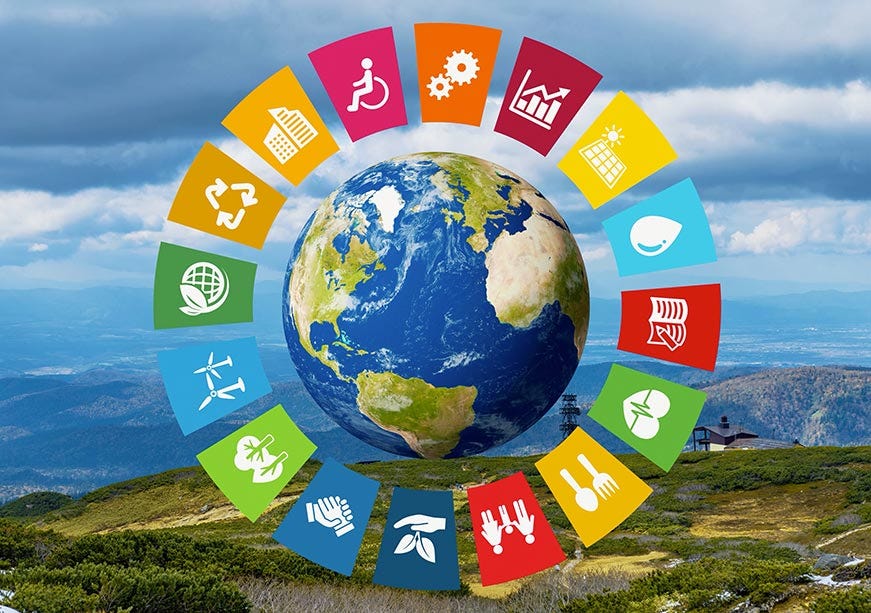
But the Sustainable Development Goals [SDGs]—those pristine icons of supposedly enlightened global governance—deserve not our reverence but our most rigorous cynicism. What presents itself as 17 ways to salvation is, under the most comprehensive interrogation, a masterfully orchestrated refinancing of imperial control.
For the most part, the SDGs operate as a linguistic sleight-of-hand, where the urgent need for planetary healing has been seized and converted into financial instruments. This is not accidental. On the contrary it's strategic; it is impossible to interpret it in any other way when you scrutinise the underlying ethos. The global financial elite have not suddenly had an epiphany on the road to a COP, nor have they miraculously discovered an ecological conscience. They've realised that our ecological crisis presents unprecedented opportunities for asset capture on a planetary scale.
Consider the team orchestrating this grand production: Goldman Sachs veterans, World Bank technocrats, and asset management titans like BlackRock's Larry Fink. These are not disinterested planetary stewards but the very engineers of extractive financialisation who have perfected the alchemy of transforming human suffering into quarterly returns. With breathtaking audacity, the architects of systematic instability now position themselves as the indispensable saviours of stability.
The financialization of survival
The SDG framework represents not a departure from economic colonialism but its sophisticated advance. The debt mechanisms underpinning the SDGs—particularly across the Global South—function as precision instruments of policy control. Nations already buckling under unsustainable debt burdens are now offered a Faustian bargain: accept additional conditionalities in exchange for slight debt restructuring. All of this is wrapped in the language of environmental stewardship.
These 'debt-for-nature swaps' and 'climate finance initiatives' comprise the largest transfer of sovereignty since the colonial era, executed not through military occupation but through financial obligation. Creditors gain de facto control over vast territories and resources while positioning themselves as benevolent climate saviours. This is empire by spreadsheet—bloodless but no less complete in its domination.
The concept of 'fiscal space' deployed throughout UN documents functions not as a technical term but as a rhetorical device justifying unlimited financial encroachment into sovereign affairs. Real economic resilience—built on localised production, full employment, and democratic resource control—has been systematically sacrificed to maintain the illusion that sustainability can be achieved while leaving the fundamental power relations of global capitalism intact.
The monetisation of existence
In truth, "financialisation" only partially captures the profound transformation at hand. What we seem to be witnessing is the monetisation of existence itself—a far more comprehensive process where most of life's fundamental necessities are not just financialised but systematically converted into revenue streams and risk instruments.
This is the commodification of survival—where air, water, shelter, and ecological stability cease to be common birthrights and instead become premium services accessible through financial gatekeeping. It represents the transformation of necessity into markets, where the basic conditions for continued life on Earth become subject to pricing models, yield calculations, and return-on-investment metrics.
Perhaps more accurately, we face the conversion of planetary boundaries into asset classes—the final enclosure, where the remaining ecological systems capable of sustaining complex life are transmuted into financial assets, their preservation contingent on the capacity to generate acceptable returns for their investor-owners.
The brilliance of this maneuvre lies in its perfect circular logic: the very systems that have methodically destabilised planetary ecosystems now claim exclusive rights to monetise their restoration, establishing a perpetual extraction cycle disguised as planetary stewardship. Nothing captures this so well as the SDGs.
Corporate capture masquerading as partnership
The most revealing element of the SDG framework lies in Goal 17: 'Partnerships for the Goals'. Here, what presents itself as inclusive multi-stakeholder collaboration reveals itself as a highly sophisticated corporate capture. The United Nations has basically outsourced global governance to an alliance of financial bodies, technology monopolies, and philanthropic capitalists who function as unelected policy architects.
The Glasgow Financial Alliance for Net Zero (GFANZ) exemplifies this structural coup. This consortium of financial institutions—collectively managing over $130 trillion in assets—now positions itself as the legitimate arbiter of climate transition. Through this mechanism, banks implicated in decades of ecological devastation have rebranded themselves as climate champions while securing unprecedented influence over resource allocation in the very regions they have historically exploited.
When the UN calls for 'policy coherence', it's not advocating democratic alignment but demanding the subordination of diverse economic approaches to a unified framework dominated by Western financial interests. National sovereignty becomes conditional—respected only when it aligns with the imperatives of this new sustainability-industrial complex.
Beyond false promises
Many observers, including people like me who live and work in Asia and across the Global South, take some comfort in the emergence of alternative power centres—BRICS, the Shanghai Cooperation Organization, the Belt and Road Initiative—believing these represent genuine counterweights to Western financial hegemony. Such hope is probably misplaced. These emerging powers are not dismantling the architecture of financial control but competing for positions within it.
The fundamental logic of extraction, accumulation, and ecological subordination remains intact; unchallenged across all these power configurations. Russian oligarchs, Chinese state capitalists, and Western financiers may compete for influence, but they share a common interest in preserving hierarchical control over resources and labour. The SDGs serve as a universal grammar through which these competing elites negotiate the terms of their dominance while maintaining the appearance of working toward collective salvation.
Empire's latest costume
If we have the intellectual courage to accept the SDG framework not as an escape route, nor redemption, but a sophisticated reconfiguration of control mechanisms, then we must confront the essential question that automatically follows: what genuine alternatives remain? Incremental tweaking will not suffice. The answer requires a fundamental reimagining of our relationship with each other and the living world.
And here we encounter the World Economic Forum's 'Great Reset'—perhaps the most transparent example of crisis opportunism in recent memory. If the SDGs represent control mechanisms draped in the language of development, the Great Reset uncovers the same structural design with barely concealed technocratic ambition. The WEF's initiative is not a departure from the SDG framework but its logical acceleration—a more brazen articulation of the same underlying consolidation of power.
Consider the essential components: 'stakeholder capitalism' (corporate power rebranded as inclusive governance), 'Fourth Industrial Revolution"' (surveillance infrastructure presented as inevitable progress), and 'build back better' (disaster capitalism disguised as recovery). Each element serves not to transform the system but to salvage and strengthen it, preserving hierarchies of wealth and power while neutralising any demands for structural change.
The revealing aspect is not the stated goals—after all who could oppose 'sustainability' or 'resilience'?—but the chosen mechanisms: public-private partnerships that systematically transfer public assets to private control, digital identity systems that enable unprecedented behavioural monitoring, and financial inclusion initiatives that subordinate the world's unbanked populations to algorithmic governance.
The Great Reset and the SDGs spring from identical ideological soil: the conviction that planetary crises can be solved (or exploited) through intensified market mechanisms and technological optimisation rather than through fundamental redistribution of power and resources. Both frameworks insist that those who engineered and profited from system failure should lead the redesign, a proposition so absurd yet offered as pragmatic realism.
Where the SDGs at least pretend to have emerged from inclusive multilateral processes, the Great Reset abandons even this charade, emerging directly from the alpine enclave where billionaires and politicians meet annually to ensure that necessary changes remain cosmetic rather than structural. It represents not a break from the SDG framework but its logical culmination—a moment when the architects of managed decline no longer feel compelled to disguise their intentions behind development jargon.
In both cases, we confront not salvation but sophisticated systems of control—different masks worn by the same face, different vocabularies describing the same fundamental program: the preservation of hierarchical power structures through selective adaptation to planetary boundaries. Neither is able to offer an effective alternative to the extractive logic driving ecological collapse and social disintegration.
Our task remains unchanged: to develop and enact fundamentally different relationships with each other and the living world—relationships based not on extraction and control but on reciprocity, regeneration, and distributed authority. These alternatives will emerge not from Davos or UN headquarters but from communities refusing the false choice between managed collapse and unmanaged catastrophe, instead creating resilient systems in the expanding fissures of a failing order.
Reclaiming our collective future
Having recognised both the SDGs and the Great Reset as sophisticated reconfigurations of control rather than paths to genuine transformation, we must confront the cardinal question: what alternatives remain? Neither incremental reform of compromised frameworks nor cynical resignation to collapse offers even a hint of a viable way forward. What we require instead is a fundamental reimagining of our relationship with each other and the living world—one that moves beyond false dichotomies presented by institutional power and allows space for radically different possibilities to evolve.
The ways forward don't need a new set of acronyms, but a radical reinvention of power—from centralised financial institutions to bioregional communities, from extractive technologies to regenerative systems, from our colonised and compromised knowledge base to pluriversal wisdom. This is not a utopian fantasy but the only rational response to a system that has financialised the conditions of life itself.
1. Sovereign debt rupture
The first act of genuine liberation must be a coordinated rejection of illegitimate debt—not as economic self-destruction but as the necessary dismantling of the primary instrument through which former colonial powers maintain their stranglehold on the Global South. The mathematics are unassailable: the resource transfer from South to North through debt service payments exceeds every bit of aid, investment, and climate finance flowing in the opposite direction. This is not development; it is systematic extraction.
What the technocrats call 'credit events' and 'sovereign defaults', we must recognise as declarations of economic sovereignty. When Argentina, Ecuador, Lebanon, Greece or Ghana buckle under impossible debt burdens, engineered by the same institutions now marketing green finance solutions, they are not failing—they are being set up for failure by a system designed for their perpetual subordination.
The collective repudiation of odious debt—synchronised across enough of the Global South to prevent isolated retribution—would not cause the global economy to collapse but rebalance. This would force a fundamental renegotiation of economic relationships currently disguised as technical inevitabilities. The unavoidable economic disruption would be significant but transitory, while the liberation of productive capacity from debt servitude would generate unprecedented resources for genuine ecological restoration.
2. Bioregional regeneration
The SDGs' fatal flaw lies in their attempt to solve systemic problems through the very global frameworks that created them. Genuine sustainability cannot be imposed from above through standardised metrics. It can only emerge from the grassroots and through bioregional self-organisation—local groups operating at scales appropriate to ecological realities rather than financial convenience.
This means dismantling the one factor that's doing most of the damage—the myth of infinite growth on a finite planet—and replacing it with circular economies calibrated to regional carrying capacities. It means replacing the absurdity of shipping identical products in opposite directions across the ocean, with nested networks of production addressing actual local needs. It means recognising that 'efficiency' without social resilience is merely streamlined fragility.
The bioregional alternative rejects both the false universalism of global technocracy and the dangerous parochialism of ethno-nationalism. Instead, it offers nested scales of democratic governance—from watershed councils to continental federations—where decision-making authority resides at the most local level capable of addressing the issue at hand. This is not a rejection of coordination but a recognition that genuine cooperation can only occur between entities that possess actual sovereignty.
3. Technological disobedience
The digital infrastructure undergirding the SDGs—from satellite monitoring systems to algorithmic impact measurements—are not neutral tools but power-concentrating technologies; they are designed to render local knowledge irrelevant and community governance obsolete. The replacement is not a retreat into primitivism but technological disobedience—the deliberate repurposing of technological capacity toward democratic, regenerative ends.
This means deploying community-controlled renewable energy systems that prioritise sufficiency over surplus extraction. It means developing open-source manufacturing platforms to enable local production of life-essential goods without dependence on global supply chains. It means creating communications infrastructure that facilitates genuine knowledge exchange rather than surveillance capitalism.
Most radically, it means dematerialising prosperity—recognising that human flourishing doesn't require exponentially increasing consumption but secure relationships, meaningful work, cultural expression, and ecological embeddedness. The technological capacity to meet genuine human needs while dramatically reducing material throughput already exists—what's lacking is not innovation but liberation from the growth imperative.
4. Knowledge decolonisation
Perhaps the most insidious aspect of the SDG framework is its ingrained epistemological imperialism—its presentation of Western techno-managerial approaches as universal while marginalising all the various knowledge systems and wisdom traditions that have maintained genuine sustainability for millennia. The alternative begins with a radical epistemic pluralism—acknowledging that indigenous, peasant, tribal, and indeed most non-Western approaches to human-environmental relationships, contain refined insights that have been systematically excluded from global governance frameworks.
Civilisations dismissed as 'underdeveloped' by the metrics of GDP and the Human Development Index have often maintained complex their social and environmental systems in dynamic balance over centuries or millennia—a claim no industrial society can make. Their knowledge systems do not need 'integration' into Western frameworks but equal standing in a pluriversal exchange that recognises multiple valid ways of knowing and being in relationship with the living world.
This decolonisation of knowledge is not just emblematically ethical but down-to-earth—offering validated approaches to ecosystem restoration, conflict resolution, and collective governance that transcend many of the limitations in market fundamentalism and associated bureaucracy. What the SDGs dismiss as 'traditional' often represents advanced and adaptive strategies refined through generations of careful observation and collective experimentation.
5. The politics of possibility
And then we come to the greatest tragedy of the SDGs. This lies not in their failure but in their success at channeling genuine ecological concern and social justice aspirations into instruments that reinforce rather than challenge the systems producing our planetary emergency. They have masterfully colonised the language of transformation while vaccinating against the possibility of actual 2nd- and 3rd-order change.
Our task is not to improve the implementation of this compromised framework but to create parallel systems that demonstrate the viability of radically different relationships between humans, technology, ecologies, and governance. Don't expect these alternatives to be permitted and embraced by incumbent power. They must be enacted despite them, in the expanding cracks of a system increasingly unable to deliver on its promises.
Conclusion
This is not utopian thinking but clear-eyed pragmatism in the face of converging crises that the current worldview and world-system are incapable of addressing without undermining their own intrinsic tenets. When the continuation of life itself has been rendered negotiable in service of abstract financial metrics, the truly irrational position is to expect solutions from the same logic that created the crisis.
The architects of collapse offer us sophisticated variations of the same fundamental proposition: that planetary boundaries can be respected while preserving the very hierarchies of wealth and power that drove us beyond them. This contradiction cannot be resolved through clever frameworks or technological panaceas—it requires a fundamental reimagining of what it means to be human in relationship with the living world.
The future of homo sapiens on Earth belongs not to those who perfect the art of sustainability theatrics, but to those with the courage to enact genuinely different ways of living—grounded in reciprocity rather than extraction, regeneration rather than depletion, and distributed wisdom rather than centralised control.
This future will not arrive through declarations in conference halls, but through the cumulative impact of communities choosing to live as if the necessary transformation had already begun.
Because, in truth, it has.