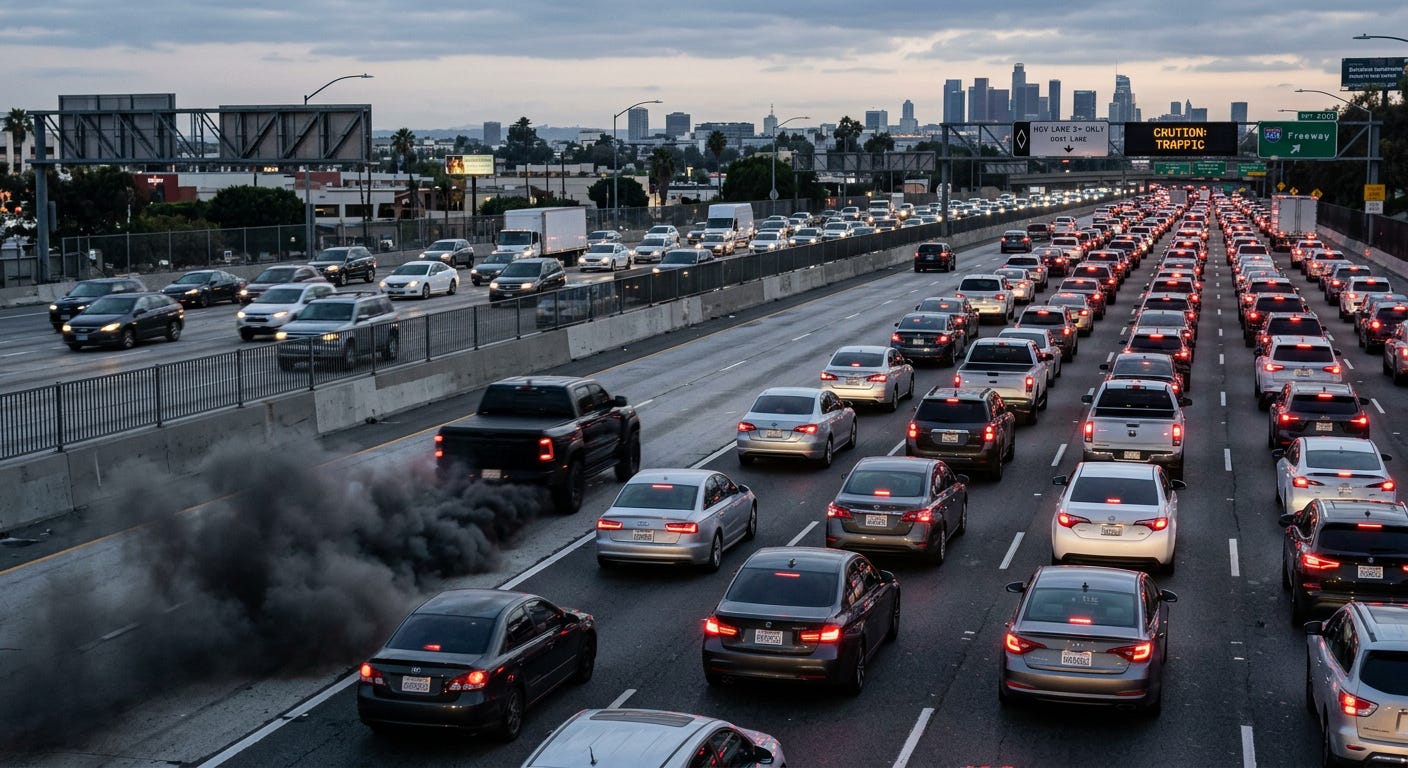
In Bangkok the electricity sometimes announces itself by failing. A lift stalls between floors. A mall flickers, recovers, and pretends nothing happened. The air-conditioning falters for long enough that everyone in the room remembers the climate from which the building has been defending them. On the expressway below, motorcycles weave through traffic with the improvisational intelligence of fish in a reef, while a convoy of cars sits almost motionless, each one carrying a private atmosphere, a private soundscape, a private impatience.
This is usually described as traffic congestion. It’s actually far more than that. It’s a civilisational self-portrait.
The modern car has always been sold as a device of freedom. The open road beckons. A personal choice. Escape. Privacy at speed. Yet anyone who has watched the morning traffic in Jakarta, Los Angeles, Nairobi, or London knows that the promise has curdled. The machine that liberated the individual has multiplied into a collective immobility so complete that we’ve learned to call it normal. We are no longer surprised by the absurdity of two tonnes of engineered material inching forward in order to move a single body and a laptop bag across town.
Electrification doesn’t abolish that absurdity. All it does is to change the chemistry.
This is the first mistake in much of the argument about transport. We have mistaken the propulsion system for the problem. Petrol against battery. Battery against hydrogen. Hybrid as truce. The debate moves with the confidence of people comparing engines while standing inside a culture that has never seriously asked what the vehicle is for, what kind of settlement pattern required it, which hidden subsidies made it desirable, or why a society rich enough to produce astonishing machines remains poor enough in imagination to put most of them in traffic jams.
Nor was this arrangement inevitable, though it now pretends to have been. The internal combustion engine didn’t triumph in an empty field of neutral choices. It prospered inside an oil economy eager for demand, road-building states eager for expansion, and an industrial culture already disposed to confuse motion with progress. Around that engine we laid asphalt, stretched suburbs, dispersed work, redesigned shopping, normalised long commutes, and taught children that adulthood would arrive with a set of keys. After a while the technology no longer looked like a decision. It looked like the character of life itself.
That is how lock-in works. A technological preference becomes an infrastructure. The infrastructure becomes a habit. The habit becomes common sense. By the time a society asks whether the original choice was wise, the question has become almost impolite, because too many livelihoods, balance sheets, rituals, and private dreams have been cemented into the answer.
Strategic foresight can only begin when the object under discussion stops being the object. The future of personal transport is not a contest between battery electric vehicles and hydrogen fuel-cell vehicles, though that contest does matter. It’s a test of the assumptions smuggled into the word personal. Personal convenience. Personal ownership. Personal range anxiety. Personal status. Personal safety in a public realm we have allowed to become hostile. Behind the dashboard sits a worldview: that autonomy is best expressed through possession, that energy should be available on demand, that speed is a proxy for agency, and that the consequences of scale can be deferred until someone else’s infrastructure breaks.
Infrastructure is where deferred consequences report back.
For a century the petrol station made the energy system feel entirely effortless. Fuel arrived from elsewhere. Its geology, extraction, shipping lanes, refinery politics, military entanglements, local pollution, and atmospheric burden were folded into the price per litre. The driver didn’t need to know. That ignorance was woven into the experience.
Battery electric vehicles have made parts of that hidden arrangement visible again. The car now arrives home and asks the house a question. The house asks the street. The street asks the substation. The substation asks a grid that was built for historical patterns of demand and is now being invited to feed not only homes, factories, hospitals, data centres, cooling systems, and appliances, but a growing fleet of mobile batteries whose owners expect speed, availability, and reassurance.
This doesn’t necessarily make battery electric vehicles a mistake. In many uses they are plainly the most elegant answer now available: quiet, efficient, mechanically simpler than combustion vehicles, and well suited to short and medium journeys where charging can happen slowly during the long hours in which cars are otherwise asleep. A small battery vehicle charged from a decarbonising grid is among the more sensible artefacts the industrial imagination has recently produced. But sensible at one scale can become brittle at another.
A city of home-charged small cars is one proposition. A nation of large battery sport utility vehicles, public fast chargers, motorway queues, apartment dwellers without dedicated parking, commercial fleets needing high utilisation, and distribution grids already wrestling with heat pumps, air-conditioning, and growing numbers of energy-thirsty data centres is quite another. The distinction matters. Foresight is less interested in whether a technology works than in the conditions under which it ceases to work well.
The same question must be asked of materials. A battery is not an idea. It is lithium, nickel, manganese, graphite, copper, aluminium, sometimes cobalt, increasingly alternative chemistries, increasingly clever recycling, and always a wager that extraction, processing, labour, geopolitics, and disposal can be made subordinate to a clean narrative. Perhaps they can. Perhaps they can in part. But no transition that depends on multiplying material throughput at civilisational scale should be allowed to call itself clean without an argument.
Nor should hydrogen be allowed an easier passage. Hydrogen has been surrounded for decades by a haze of technological promise, corporate demonstration, political subsidy, and inconvenient arithmetic. It’s not an energy source. It’s a carrier, and usually an inefficient one if judged narrowly from electricity to wheel. Green hydrogen must be made, compressed or liquefied, stored, transported, and converted back into electricity inside a fuel cell. Each conversion exacts a toll. Anyone pretending otherwise is simply peddling a slogan.
And yet efficiency is never only a laboratory ratio. The energy system of the future will not be built around a single measure, however beloved by engineers. It will be shaped by time, geography, storage, intermittency, grid capacity, strategic resilience, public tolerance, mineral constraints, land use, political economy, and the different rhythms of use across human communities. A vehicle charged slowly at home in a temperate suburb belongs to one energy story. A refrigerated truck crossing a continent, a bus depot in a grid-constrained city, a port handling heavy vehicles, a mining region far from strong transmission, or an archipelago needing stored renewable energy, belongs to another. The future rarely chooses one winner. It differentiates.
This is where the battery-only imagination begins to look less like ambition than habit. It repeats, in cleaner language, the old industrial preference for monocultural solutions: a single dominant technology, one scaling curve, one infrastructure logic, one investment story. Monocultures are efficient until conditions change. Then they are famines waiting for a change in the weather.
A resilient energy ecology will need several species. Direct electrification where electricity can be used directly. Batteries where storage is short-duration, distributed, and materially proportionate. Hydrogen where energy must be stored for longer, moved differently, or delivered quickly to vehicles whose economics depend on being used rather than parked. Synthetic fuels in narrow cases where neither battery nor hydrogen is adequate. Less movement where movement was compensating for poor design in the first place.
The least glamorous item in that list may be the most radical. Less movement.
Not immobility. Not austerity. Not the punitive scolding that so often passes for environmental seriousness. Simply the recovery of proximity as a civilisational competence. A society that requires every adult to command a private vehicle in order to buy food, earn money, educate children, visit friends, or receive care has not solved the issue of mobility. It has outsourced social design to transport hardware.
Still, cars will no doubt remain. So will vans, buses, trucks, two-wheelers, taxis, shared vehicles, emergency fleets, farm vehicles, and the untidy miscellany of machines by which human beings move themselves and each other through landscapes that were not designed from a single ethos with a plan. The question for a foresight practitioner is not which technology deserves ideological loyalty. It’s which combinations preserve optionality while reducing harm. Here hydrogen re-enters the picture with a different face.
The weak argument for hydrogen in personal transport is that it lets the old driving experience continue almost unchanged: refill quickly, drive far, emit water, avoid the inconvenience of charging. This argument once sounded stronger than it does now. Battery charging has improved markedly. Many drivers don’t need five-minute refuelling most of the time. Passenger hydrogen infrastructure remains sparse in many markets and has contracted in some. The old sales pitch has thinned.
The stronger argument is systemic. Hydrogen can sit between renewable generation and transport demand in ways batteries cannot always match. It can absorb surplus electricity when wind or solar production outruns immediate use. It can be produced near resources, ports, industrial clusters, or regions with stranded renewable potential. It can serve heavy and high-utilisation fleets where downtime is expensive and payload matters. It can help decouple some mobility from the local distribution grid, not because the grid is irrelevant, but because no sane energy transition should concentrate every new demand on the same wires at the same hours. That’s not a manifesto for hydrogen. It’s an argument against an ingrained monoculture.
Foresight practitioners are trained, or should be, to distrust inevitability. The future presented as inevitable is usually somebody’s capital expenditure seeking moral cover. We have seen this so many times before: highways as progress, nuclear power as too cheap to meter, plastics as modern hygiene, digital platforms as liberation, global supply chains as frictionless abundance. Each contained a partial truth. Each also concealed the conditions under which that truth would become dangerous. Battery electrification contains a truth. Hydrogen contains another. Neither is large enough to house the future alone.
The more interesting question is what kind of economic arrangement each technology invites. A battery vehicle sold into the conventional car market can still reward weight, status, accelerated replacement, proprietary repair, and the profitable churn of consumer aspirations. A hydrogen vehicle can do the same. There’s nothing inherently virtuous in a fuel cell. Technology doesn’t rescue a predatory business model from itself; in fact it often gives that model a cleaner costume.
This is where the conversation turns. The survival question in transport is not only how energy enters the vehicle. It’s how value moves through the whole system. If a manufacturer profits by selling more units, heavier units, more frequent replacements, and more expensive repairs, then the efficiency of the powertrain is only one moral detail in a larger machine of waste. If, however, the provider retains responsibility for the vehicle, the fuel, the maintenance, the materials, the end-of-life recovery, and the customer’s experience over time, the incentive field alters. Durability becomes revenue. Lightness becomes margin. Repairability becomes intelligence. Waste becomes a design failure that returns to the balance sheet. That’s why the most interesting experiments in transport may not be technological at all. They may be fiduciary, contractual, and ecological.
The automobile as a service, if designed seriously rather than as a subscription gimmick, changes the entire metabolism of the ecosystem. The user buys mobility, not metal. The provider carries the cost of inefficiency. Materials are borrowed from the earth rather than squandered into landfill. Components are designed for return because return is no longer an afterthought. Insurance, fuel, maintenance, and residual value cease to be scattered anxieties borne by the individual and become design variables within an accountable enterprise.
There are obvious dangers here. Dependency can easily be renamed convenience. Subscription can become enclosure. Data extraction can hide inside service. Those risks are real, and any serious model must be judged by how it governs them. But the underlying shift remains important: a transport economy built around long-lived assets in continuous stewardship behaves differently from one built around episodic sale and disposal.
This is the territory in which a company like Riversimple becomes interesting. Not as proof. Not as an heroic exception. Not as a company immune to the brutal problems of capital, production, regulation, infrastructure, consumer trust, and timing, but in terms of impact. Riversimple has been attempting something far more significant than building a hydrogen car. It has been trying to braid an ultra-light fuel-cell vehicle, circular design, regional manufacturing, and mobility-as-a-service into a single viable proposition. The point is not the romance of a small Welsh company taking on the automotive giants. Romance is cheap. The point is that its model recognises a truth most of the industry still evades: the environmental burden of mobility is produced by the whole system of ownership, use, maintenance, energy, materials, and disposal.
That’s why I have held shares in Riversimple. Not because hydrogen has already won the race. Not because the passenger fuel-cell market is moving smoothly in its favour. Not because small companies deserve sentimental protection against incumbents. They do not. I hold them because Riversimple is asking a better question than most of the transport industry has allowed itself to ask: what would personal mobility look like if the provider were rewarded for using less, lasting longer, recovering materials, and designing the customer’s convenience inside ecological constraint rather than outside it? A question can be investable before it is proven.
That sentence will make some people nervous. It should. We have lived through too many speculative bubbles in which the language of transformation was used to excuse indiscipline, vanity, and fraud. But the opposite error is just as dangerous: to demand that every necessary experiment resemble yesterday’s successful business before it’s allowed tomorrow’s capital. Civilisations decay when they can fund repetition more easily than learning.
There’s no doubt in my mind that the future of energy in personal transportation cannot be settled by a single breakthrough. It will be composed, unevenly and argumentatively, from thousands of decisions about grids, streets, chemistries, mines, tariffs, depots, homes, ports, software, public trust, and the unobtrusive politics of who bears inconvenience. Some places will electrify rapidly and sensibly. Others will improvise hybrids of necessity. Some will leap into shared fleets. Some will cling to private ownership long after its costs have become indefensible. Heavy transport may pull hydrogen into maturity while passenger vehicles remain sceptical. Or hydrogen may remain a specialist species, useful but never dominant. The honest foresight practitioner must keep all of these possibilities alive.
What can’t be kept alive is the fantasy that substituting one propulsion system for another will redeem a civilisation built on excess movement, excess extraction, and excess confidence in its own cleverness. The car was never the point. The battery is not the point. Hydrogen is not the point either.
The point is whether we can still design systems in which convenience doesn’t require blindness, freedom doesn’t depend on waste, and mobility doesn’t ask the future to stand quietly at the roadside while the present disappears in a cloud of its own exhaust.