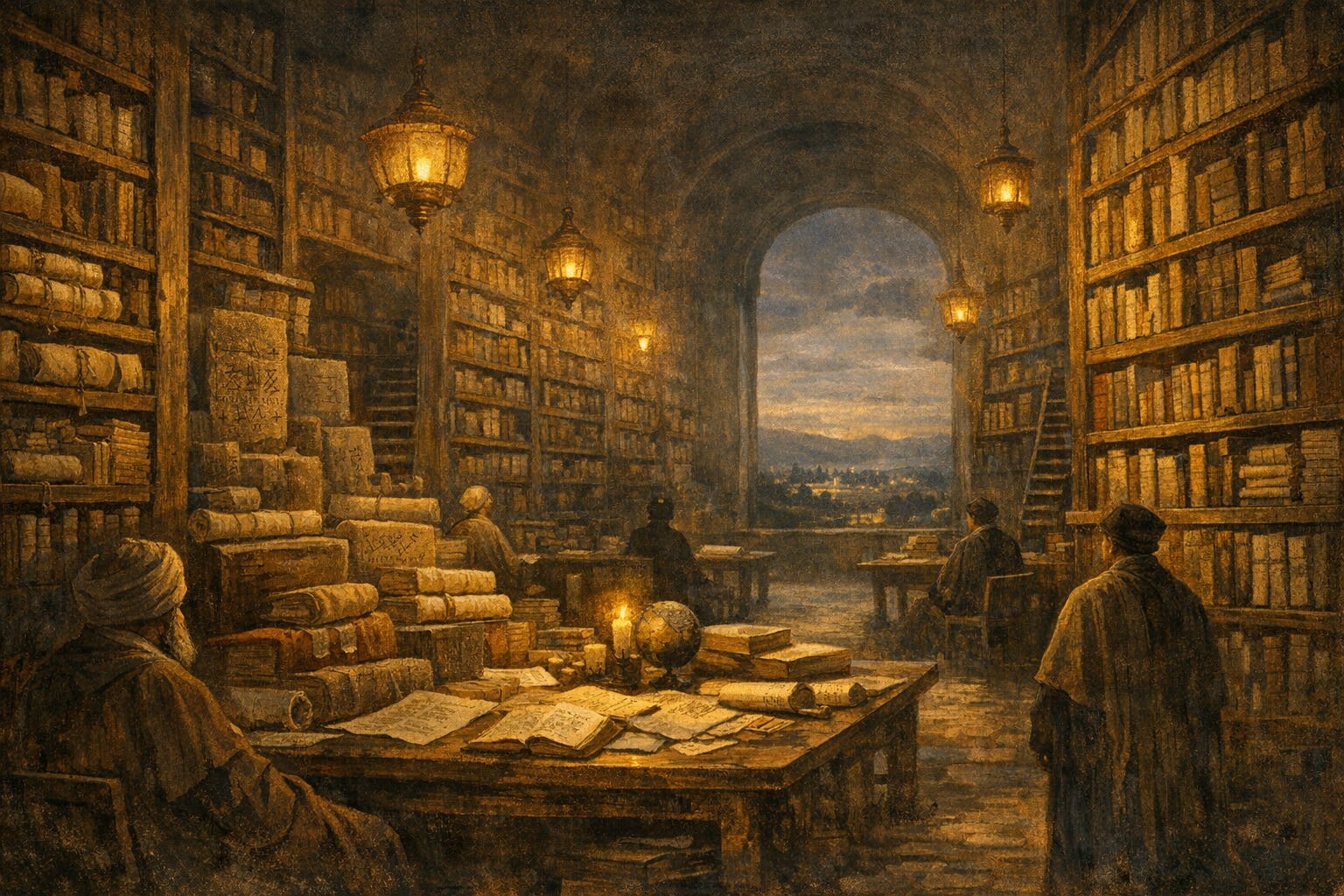
There’s a thought experiment I keep returning to. A meta-council convenes across eras — Thorstein Veblen, who spent his career being expelled from universities for explaining too precisely how institutions protect themselves, seated alongside Donella Meadows, whose modelling of planetary limits in the 1970s produced one of the most discussed and most thoroughly ignored documents of the twentieth century, alongside the unnamed architects of regenerative governance — all of them gathered in a “simulated foresight archive”.
They are here, ostensibly, to settle the question: can humanity shift from industrial economism to an ecority worldview – conscious, regenerative, and cooperative within an economy of sufficiency – before total systemic breakdown? What I ponder most is whether the convocation itself answers the question. Not the deliberations as such.
The archive holds the most sophisticated civilisational diagnostics ever produced — and not only from the tradition that gave us the industrial operating system but also, belatedly, its critics. Ibn Khaldun mapped the metabolic arc of civilisations in the fourteenth century, charting how the social cohesion that builds empires is precisely what their success destroys — a cyclical reading of systemic collapse that the Western reform tradition has largely chosen not to inherit. Kautilya’s Arthashastra understood the entanglement of ecological stewardship and political order as a governing premise rather than an afterthought. The Taoist insistence that systems governed through force and accumulation devour themselves — that wu wei, the yielding path, is not passivity but structural intelligence — anticipates by two millennia the systems dynamics that Meadows would render in computer models. Buddhist thought on impermanence and interdependence has been articulating the case against infinite-growth economics since before economics had a name. P.R. Sarkar’s social cycle theory, developed across the mid-twentieth century outside the Western academy, charts the recurring dominance and exhaustion of successive ruling classes – warriors, intellectuals, and acquisitors – and locates in that exhaustion not catastrophe but the structural precondition for transition. His PROUT framework, grounded in the principle of progressive utilisation and rational distribution, proposed an economics of sufficiency decades before sufficiency became the language of ecological necessity.
The archive holds all of this alongside Veblen’s dissection of how leisure-class predation becomes the invisible grammar of economic life, Schumacher’s insistence that small was not beautiful so much as structurally indispensable, and Meadows’ demonstration that a finite planet modelled honestly produces conclusions institutions cannot afford to accept. It holds Immanuel Wallerstein’s world-systems analysis – his argument that the capitalist world-system is not a permanent condition but a historical structure now entering terminal crisis, undone not by external assault but by the internal contradictions that its own success has made unmanageable. It holds the entire futures literacy project with its scenario methodologies, its three horizons and its causal layered analyses, and Richard Slaughter’s sustained critique from within that field — his insistence that futures studies, if it is to be more than a sophisticated instrument of present-power interests, requires an epistemological break the mainstream has consistently deferred: a refusal to treat the future as a resource to be colonised by current arrangements rather than a terrain to be genuinely opened. It holds the argument, developed across decades of work in the Asia-Pacific and beyond, that industrial economism is a planetary operating system — one that can only be replaced by something that holds simultaneously our obligations to each other, to future generations, and to the living systems on which both depend: what the concept of Ecority names as the trimunary, the three-fold covenant that syntrophic inquiry — the practice of building understanding through generative rather than extractive engagement — exists to serve.
It holds every compelling critique of industrial economism that the last two centuries have generated, from Bangkok to Berlin, from the fourteenth century to last week. The archive is not thin. The archive is not even exclusively Western, though it has largely been read as though it were. The archive is extraordinary. And the world it was meant to change is in the conditions you see around you.
The reformer-activists across eras would not, in that archive, discover common cause. They would discover something more distressing: they have been occupying the same room for two hundred years, producing increasingly refined maps of a topology that continues to deteriorate at an accelerating pace. The archive doesn’t represent accumulated capacity. It represents accumulated testimony — the record of people who saw clearly, were often heard politely, and then ignored.
The inquiry worth exploring is structural. The reformers were not naive. Veblen understood institutional capture with a precision that remains unmatched — and paid for it with his career. Meadows understood that systems resist change most fiercely at the nodes where change looks most available. Wallerstein understood that the sociology of knowledge is itself a product of the world-system — that the very categories through which reformers think are shaped by the order they’re attempting to challenge. Slaughter understood that the futures field had developed a comfortable institutional niche that insulated it from the more disruptive implications of its own methodology. The diagnosticians have known for a very long time that knowing is not the same as doing.
And yet the knowing keeps getting produced. More refined. More global in its reference points. More technically accomplished. The scenario methodologies grow more sophisticated. The civilisational critiques grow more granular. The language for describing what industrial economism has done to social trust, to ecological integrity, to the temporal horizon of governance — that language is now remarkably precise.
What the archive reveals, if you look at it without the consolation of progress narratives, is a pattern that repeats across generations of reform: the critique is absorbed, the critic is credentialed, and the system continues along the same trajectory. Not because the critique was wrong. Because the institutional forms available to the critic — the think tank, the summit, the university appointment, the commissioned futures report — are themselves products of the operating system the critique was meant to disrupt. The container shapes the content before the ink dries.
Clarity is important in this regard, as is the avoidance of despair. If you intend to disrupt a system, you can’t do it from inside the constricted apparatus the system provides for that purpose. The reformers in the archive were, most of them, housed, funded, published, and convened by the self-same order they were critiquing. The critique was real enough. The containment was also real. Both things were true simultaneously, and neither cancelled the other.
The futures literacy community has a particular version of this problem that deserves its own examination. Foresight is, by design, a capacity-building practice. Its premise is that if enough people can think in longer time horizons, with greater tolerance for complexity, across substantial interconnected systems — then the decisions that shape those systems will improve. This is not an unreasonable premise. It may even be correct.
What it has difficulty accounting for is the issue of which people. In practice, futures literacy has become extraordinarily adept at producing sophisticated thinkers within organisations that have already decided to commission futures work. Scenarios reach the boardroom. Causal layered analyses reach the policy forum. The Three Horizons analysis reaches the innovation unit. These are usually substantial. But they’re also not the systemic acupuncture points where the operating system is actually replicated.
Something deeper is concealed within this incapacity. The expanded now—the deliberate extension of temporal perception to hold past, present, and future in simultaneous relation rather than sequential anxiety—is the specific cognitive shift that genuine foresight requires. It’s not simply thinking further ahead. It is restructuring one’s experience of time itself so that the seventh generation is not an abstraction but a presence and the fourteenth-century Ibn Khaldun is not history but a living interlocutor. Institutions don’t want this capacity widely distributed. An expanded now is incompatible with a quarterly reporting cycle. It corrodes the legitimacy of decisions made for electoral convenience. It makes the long-term costs of short-term arrangements visible in ways that are professionally awkward. So the capacity gets commissioned in carefully bounded forms — a two-day scenario workshop, a horizon-scanning report, a futures team that reports to strategy — and the boundary between useful foresight and structurally threatening foresight is policed with great care, usually without anyone acknowledging that the policing is occurring.
The operating system is reproduced in the places where future literacy is rarely, if ever, commissioned. In the financial architectures that can’t price ecological cost without destroying themselves. In electoral cycles that make decade-scale thinking political suicide. In the incentive structures of the institutions that house the reformer-activists and fund their work. These are not amenable to a scenario workshop.
What they require is worth naming with some precision, because the foresight community has historically reached for “influence” as its answer and found the word both accurate and insufficient. Three distinct capacities are in play, and collapsing them produces the confusion that has been dogging reform movements for generations. Positional authority — the ability to make binding decisions, control resources, and set institutional agendas — is what reformers typically lack, and the system’s preferred channels for managing dissent ensure they continue to. Advising those in power is not the same as holding power oneself. Epistemic influence—the capacity to shift the unthinkable to the thinkable, to alter the conceptual vocabulary within which decisions are made—is where the archive has done its most substantial work and where the foresight community has genuine achievements to its name. The problem is that epistemic influence without positional authority produces exactly the pattern already described: critique becomes wallpaper in the system it was meant to disrupt. The third register, and the least inhabited, is prefigurative authority – the credibility that accrues from actually instantiating alternative arrangements rather than describing them. Buckminster Fuller understood this better than almost anyone in the archive: you don’t change things by fighting the existing reality but by building a working model that renders it inadequate. This is what Sarkar’s cooperatives and Schumacher’s intermediate technology gesture toward, and what Ecority as a practised covenant rather than a proposed framework would embody. Prefigurative authority can’t be granted by the existing order. It is earned by demonstrating, in living form, that the alternative is not just conceivable but preferable and already underway.
The meta-council in the archive would eventually, if it were honest, arrive at this — and at something harder still. The accumulated wisdom is real. Wisdom unaccompanied by any of these three capacities remains a library. And the question is not whether humanity is capable of species-wide reinvention — Wallerstein’s terminal crisis analysis and Sarkar’s social cycle both suggest that the structural conditions for transition are maturing regardless of what reformers do — but whether those who understand most clearly what transition requires are positioned to shape its direction when the existing order’s contradictions finally open space that epistemic influence alone could never create.
Time and time again I find myself returning to the temporal structure that underlies most civilisational reform thinking: crisis-and-response, insight racing against breakdown, and the question of whether clarity arrives in time. It’s a seductive frame. It positions the reformer as the protagonist, the archive as the repository, and the future as the terrain on which the argument will finally be won or lost.
What this frame conceals is that its own temporal structure is part of the problem. Crisis and response are contracted now – a present so compressed by urgency that it can only react, never reorientate. The expanded now is its antithesis: not the lengthening of a planning horizon but the qualitative transformation of how time is inhabited. When the present is genuinely expanded — held open to the deep past and the long future simultaneously — the crisis-and-response frame dissolves. There is no race, because the insight did not begin with the crisis. There is no arrival, because the understanding has been present in many languages and many centuries throughout. What the contracted now experiences as an emergency, the expanded now recognises as the latest iteration of a pattern old enough to be understood on its own terms. Wallerstein’s long cycles and Sarkar’s social arc are only decipherable from within an expanded now; compressed into crisis time, they become either invisible or simply alarming.
But the insight has already arrived. Many times. In many registers. The archive holds it — in Arabic and Sanskrit and classical Chinese as much as in English, centuries before the industrial operating system existed to be criticised.
What hasn’t yet arrived, in sufficient form, is the willingness to act from outside the system’s preferred channels for managing renewal — which is to say, from outside the channels that ensure reform remains advisory, incremental, and ultimately deniable when it conflicts with the reproduction of existing arrangements. The foresight community hasn’t failed to see clearly. Sometimes it has been seen with exceptional clarity. What it has been slower to do is accept that clear sight, communicated through sanctioned institutional forms, doesn’t threaten what it describes.
This is the reformer’s archive: generations of lucid diagnosis, housed in structures that the diagnosed system provided and controls. The question the meta-council should put to itself is not whether humanity can change. It’s whether the people who understand most clearly what change requires are prepared to inhabit all three registers — epistemic, positional, and prefigurative — and bear the cost of pursuing at least one of them outside the apparatus that currently employs them.
That’s a different question. It doesn’t have a comfortable answer. But it’s the question the archive, if it could speak clearly about its own condition, would finally ask.