Synopsis: COP31 has collapsed, and the case for a clean-energy race driven by national self-interest has never looked stronger. Yet a race run on the old logic of extraction finds new places to dig, and new people to displace.
The forest on Halmahera is being cleared so the world can stop burning oil. Thousands of hectares of rainforest on this island in Indonesia’s North Maluku have been stripped to reach the nickel beneath. The ore feeds Weda Bay, now the largest nickel mine on Earth, and the smelters that have grown up around it. The Hongana Manyawa have lived in those hills for generations, and a few hundred of them have never sought contact with the outside world. Their homeland has become the first link in a supply chain. The metal leaves by ship for cathode plants, then for battery factories, then for cars sold in Shenzhen, Stuttgart and Sydney as a small act of planetary repair.
I doubt Halmahera came up much in Antalya.
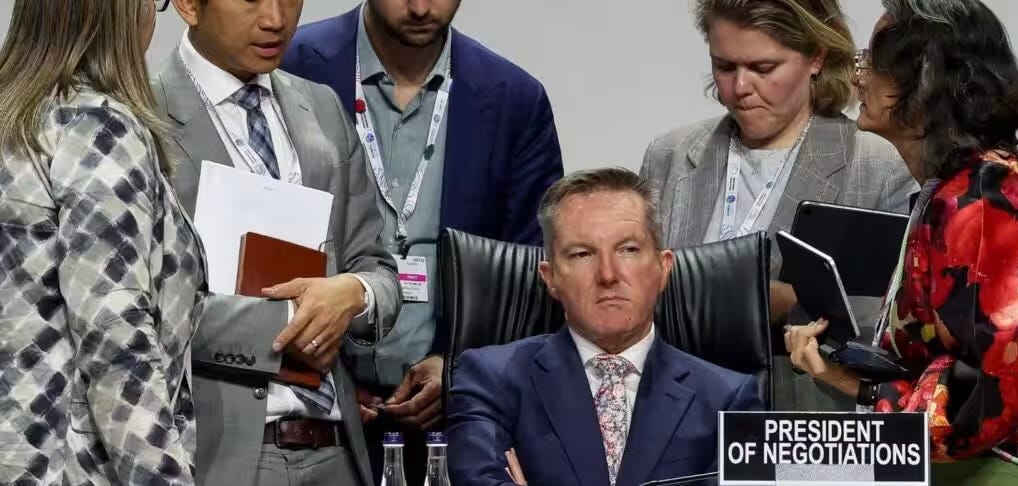
COP31 ended last Sunday, two days late, without agreeing its main political text. It’s the first time since Copenhagen in 2009 that a climate summit has failed to adopt an overarching decision. The draft Antalya Pact had been rewritten until it didn’t mention fossil fuels at all. A large bloc of countries, led by the European Union, wouldn’t sign a climate agreement that said nothing about the main cause of the climate crisis. The petrostates wouldn’t accept any wording that pointed at them. So the summit stalled between delegations who refused a text that mentioned oil and delegations who refused one that didn’t. Both were behaving rationally. That’s what makes the result so damning.
Saudi Arabia did more than most to secure that outcome. The House of Saud is intent on keeping the kingdom drilling indefinitely, whatever the costs imposed on everyone else, and Antalya was one of its greatest successes so far. Yet the kingdom sits at the centre of a system of petrodollar recycling that both heats the planet and feeds the Western arms industry. The weapons it bought, mainly from the United States and Britain, were used to commit war crimes in Yemen. A few Saudi princes, staunch allies of Washington and London, will be remembered by future generations for blocking any curb on fossil-fuel extraction. Their patrons, who sold the arms and banked the proceeds, are likely to be remembered less clearly. The arrangement depends on that.
My friend Paul Gilding has spent half a century on sustainability. He’s just written a candid farewell to the COP model. His case is that a process needing consensus, among parties some of whom are backed by the very industry it exists to retire, was never going to deliver. He goes further. Drawing on Kingsmill Bond’s analysis at Ember, he argues that clean energy no longer has to be sold as shared sacrifice. The technologies are cheaper and the advantages go to whoever moves first. National self-interest, not treaty, can drive the change. Watch China, he says, and build as fast as policy allows.
I agree with nearly all of it. That’s why it unsettles me.
The argument persuades because it speaks the language that got us here. Recasting the transition from burden to advantage changes the motive for acting. The structure underneath stays exactly where it was. A civilisation organised around competitive accumulation is invited to keep accumulating competitively, using different elements from the periodic table. The race goes on, on a newly surfaced track. Industrial economism has always been good at this. Every crisis becomes a market, and every market needs a frontier: somewhere cheap, somewhere far from the buyer, somewhere whose people can’t easily say no. For coal those places were Appalachia, the Ruhr and Jharkhand. For electrification they’re Halmahera and Sulawesi, the copper belt of Zambia and Katanga, and the salt flats where Chile, Argentina and Bolivia meet. The map is different. But the way it’s drawn is oh so familiar.
Carbon is one measure of a living world in distress, and only one. The trees on Halmahera held carbon, and they also held soils, rivers, fisheries and a people’s whole way of knowing their place. A decarbonised economy can still be an extractive one, and a faster one at that. Its accounts can be spotless on emissions while forests, aquifers and coral reefs disappear in sections that no climate negotiator is asked to audit. When the target is “who electrifies first”, whatever isn’t counted toward winning goes unnoticed.
Then there’s the language we use. Even those of us most committed to a habitable planet keep reaching for contest. We talk of a race, a battle, a campaign fought country by country. Paul closes his own piece with a guerrilla war. These metaphors are the worldview speaking through us, setting the limits of what we can imagine before we’ve even started imagining. I know this from the inside. When I began writing about business ecosystems, my point was that enterprises co-evolve, and that a firm which thrives at the expense of its surroundings is consuming its own future. Too often, boards heard “ecosystem” and turned it straight back into territory to be dominated. The idea came back to me dressed as a weapon.
China is the proof case. Its clean-technology build-out is real and staggering in scale, and much of the world benefits from the price collapse it has caused. It’s also pursued openly as a contest for industrial supremacy. That’s the advantage argument in its purest form. By its own standards it’s working. My doubt is whether those standards are adequate to the predicament in which we find ourselves. A country can win the market for solar panels and batteries, as a whole generation of exporters is now trying to do, and still belong to a species that’s losing the conditions it needs to survive.
Seen this way, the failure in Antalya runs deeper than the guest list. Paul is right that inviting the fossil-fuel states to set the pace was fatal. Pure folly. But the COP framework rested on a prior assumption that went largely unexamined: that the climate crisis is a pollution problem, to be bargained over by national economies each defending its growth. The competitive alternative drops the bargaining. It keeps the nation states, keeps the growth imperative, and swaps consensus for rivalry. Both versions treat the economy as the fixed point and the planet as the variable to be managed around it.
For years I’ve argued for the opposite orientation, which I call ecority: a civilisation organised around the conditions of life rather than the pursuit of advantage. It has no lobby. It publishes no quarterly figures. It promises no one a first-mover dividend. Next to a race that the fastest can plainly win, it looks naive, and I accept the charge. The people of Halmahera are being asked to subsidise the speed of others. They didn’t choose a race, and they won’t share in its prizes.
I’d still much rather the coming decade be won by sunlight than by oil. If the choice in front of us were only between those two, I’d take Paul’s side without hesitation and cheer every solar farm that undercuts a coal plant. What I can’t do is to pretend that particular choice is the whole of it.
I’m no longer convinced that a race is the shape survival takes. And I notice, with some discomfort, that the alternative I’ve spent years describing still offers nothing (or very little) the winners would recognise as a prize.